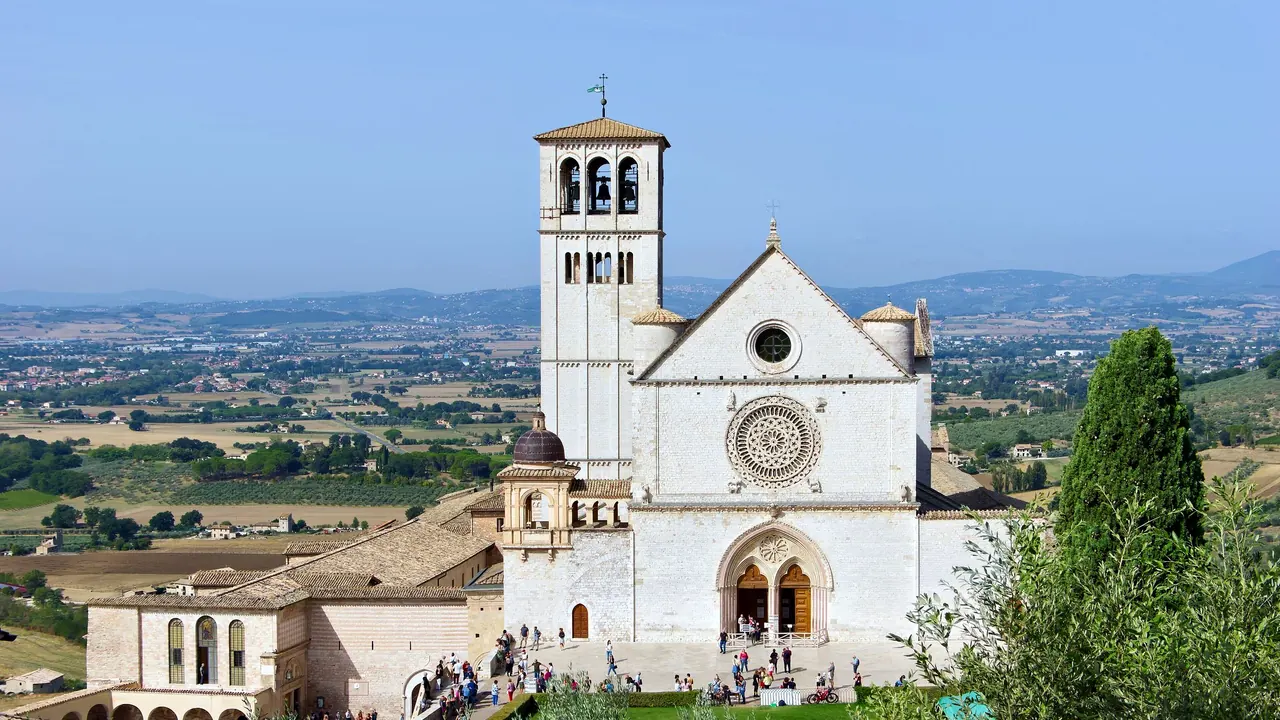
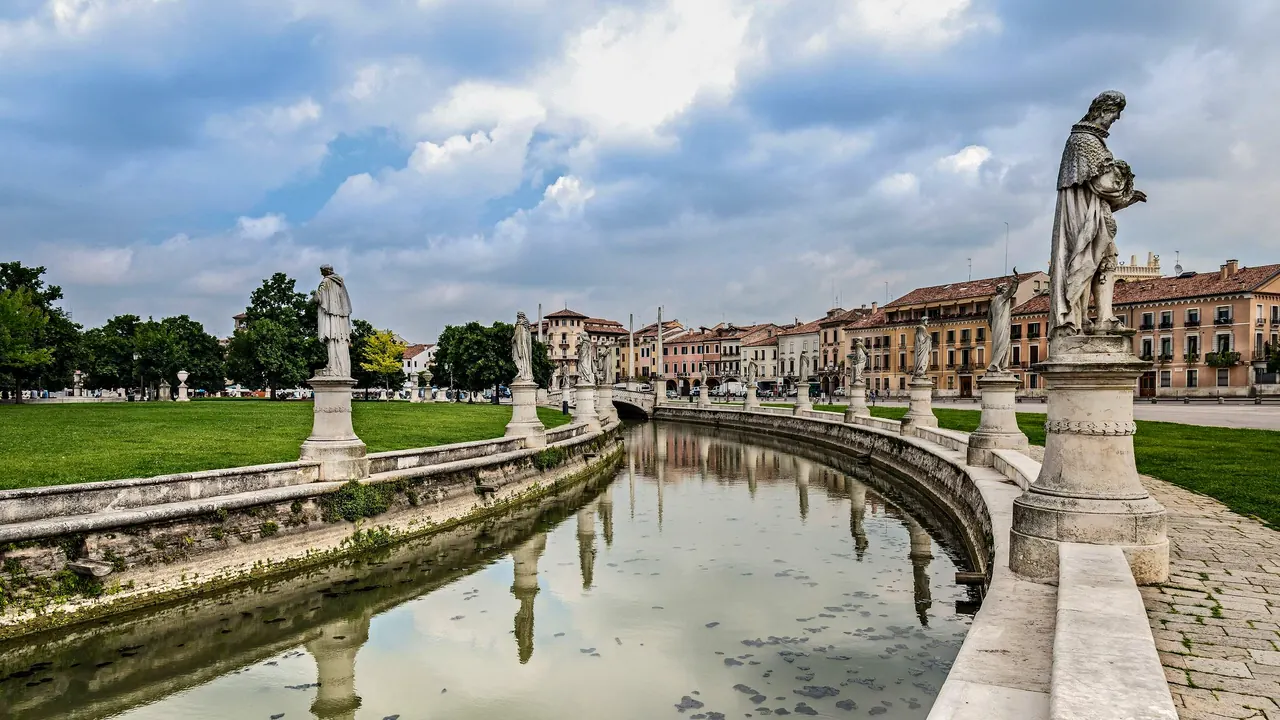
Photos: Assisi by Berthold Werner, CC BY-SA 4.0, cropped; Padua by Didier Descouens, CC BY-SA 4.0, cropped.
Assisi or Padua?
Our verdict in twelve categories, each scored against the same fixed benchmark cities, and the climate month by month, so you can choose for your trip.
Choose Assisi for
- nature and the outdoors
- prices
Assisi suits a slow, quiet trip built around the Basilica of San Francesco and the Umbrian countryside. It is the better pick if you want to walk up Monte Subasio in the morning, eat a long dinner in a side lane and go to bed in a silent stone town. It also suits pilgrims, and anyone with a car who wants to tour the hill towns. Don't choose it for evenings out, shopping or easy days with small children.
Choose Padua for
- nightlife
- wellness
- shopping
Padua is the more practical and more sociable base. Its centre is flat and walkable, its station puts Venice, Verona and Bologna within easy reach by train, and its squares fill with students and locals at the spritz hour. It suits travellers who want a university city with a daily life of its own, a busy morning market and the freedom to see the whole Veneto without a car.
Scoreboard
Twelve categories on one fixed scale from 0 to 100. The shaded stretch is the gap between the two.
Your match
Pick a travel style or drag the sliders, and both match scores follow your weighting.
Wins on nature and the outdoors and prices with your weighting.
Wins on nightlife and wellness with your weighting.
What matters to you?
Category by category
What the scores mean for a trip.
Beaches & swimming
Neither city is a place for a beach trip, but Padua makes a day at the sea easier. Sottomarina and the Lido of Venice are each about an hour away. Both have shallow, calm Adriatic water that is fine for paddling children, though the beaches are flat rows of umbrellas.
From Assisi the only realistic swimming is in Lake Trasimeno, at small lidos where the water is warm but murky. Otherwise, swimming here means a hotel pool.
Food & drink
Padua eats and drinks with more variety. The markets in Piazza delle Erbe and Piazza della Frutta, and the delicatessens beneath them, are at the centre of daily life. There is Venetian cooking such as bigoli with duck and baccalà, plus the evening spritz and the historic Caffè Pedrocchi.
Assisi has excellent ingredients, including black truffle, Subasio olive oil and Sagrantino from Montefalco. But it has no market hall, and the restaurants near the basilica often cook for tour groups. To eat well there, look for the side-lane trattorias and the agriturismi below the town.
Culture & sights
The two are about even here, and they share a link: Giotto, or the painters linked to him, left landmark fresco cycles in both. In Assisi the art is concentrated in one overwhelming monument. The two stacked churches of San Francesco sit within a small UNESCO town of pink stone, Roman remains and Franciscan shrines that you can see in two unhurried days.
Padua spreads its riches across more kinds of place. Besides the Scrovegni Chapel there are the Basilica of Saint Anthony with Donatello's bronzes, the oldest permanent anatomical theatre in the world, a sixteenth-century botanical garden and the great hall of the Palazzo della Ragione. Assisi offers more atmosphere, while Padua offers more variety.
Nightlife
Padua has a real evening life, though not a wild one. Students and locals crowd the squares for aperitivo, and wine bars and pubs fill the lanes of the old ghetto during term. Clubs are few, and the city empties in high summer.
Assisi has nothing comparable. Once the day visitors leave, the evening is dinner, one glass of wine and a walk through empty floodlit lanes. Anyone who wants more has to go to Perugia.
Nature & outdoors
Assisi has the outdoors on its doorstep. You can walk out of town straight onto Monte Subasio, past the Eremo delle Carceri to summit meadows at about 1,290m, and cycle the flat valley to Spello and Bevagna. The Valnerina and the Sibillini mountains are within driving range.
Padua sits on a flat plain, so nature means going a little way out. That could be the Euganean Hills about 15km south-west, the towpaths along the Brenta, or the pre-Alps around Monte Grappa, which take a longer drive.
Day trips
Both are fine bases, but Padua's position is hard to beat. Venice is under half an hour by train and easy to visit several times, and Vicenza, Verona and Bologna are also simple train trips. The Brenta villas and the walled towns around the Euganean Hills add closer options.
Assisi has the Umbrian hill towns around it: Spello, Perugia, Spoleto, Gubbio, Todi and Orvieto further out. The valley railway covers only some of them, so a car makes the rest much easier.
Good for families
Padua is the easier city with children. The centre is flat and largely pedestrianised, Prato della Valle gives them room to run, and Gardaland and the Adriatic beaches are each within about an hour or so.
Assisi is safe and welcoming, but its stepped lanes defeat pushchairs, and the main sights call for silence. Families usually stay at a valley agriturismo with a pool and visit the town in short bursts.
Getting around
Padua is the simpler place to get about. The centre is flat, much of it is under arcades and closed to traffic, and a tram links the station with the old squares. The station sits on main lines in every direction, so you can manage without a car.
Assisi is small but steep, with stairs between the basilica and Piazza del Comune. Its station is about 4km below in the valley, and beyond the single rail line most visitors end up hiring a car.
Shopping & style
In Assisi the shops lean heavily towards the pilgrimage, with rosaries, Tau crosses and Franciscan souvenirs. The worthwhile buys among them are the embroidered Umbrian linens, Deruta ceramics, olive oil and Sagrantino.
Padua offers a good deal more choice, though still not enough to plan a trip around. Its arcaded streets carry Italian fashion and shoe shops, independent boutiques and university bookshops. The daily food markets are good for cheese and Euganean wine to take home, and a large antiques market fills Prato della Valle one Sunday a month.
Affordability
Costs are similar, and both are moderate for Italy. In Assisi the savings come from free entry to the basilicas and churches, plus simple convent guesthouses and valley agriturismi. The catch is the restaurants nearest the basilicas.
In Padua the savings come from sleeping more cheaply than in Venice while seeing it by day, along with inexpensive standing spritzes and a walkable centre. The Scrovegni Chapel and the museums charge normal entry fees, and rooms cost more during trade fairs and graduation season.
Live music & performing arts
Padua has a modest programme that runs all year. There is prose theatre and some opera at the Teatro Verdi, a chamber orchestra that plays in the Sala dei Giganti and the Basilica of Saint Anthony, and student music venues. Venice's Fenice and the Verona Arena are close enough for an evening out.
Assisi's music is mostly sacred and seasonal: organ and choral concerts in its churches and the medieval pageantry of Calendimaggio in spring. For anything more, people go to Perugia.
Wellness & relaxation
Assisi's rest is spiritual rather than physical. Apart from a few spas in country hotels, there is little in the way of treatments. But the town is deeply still in the early morning and after the tour groups leave, and convent retreats and silent walks to the Eremo give it a calm that Padua's busier squares cannot match.
For actual soaking and treatments, Padua is far better placed. At the foot of the Euganean Hills, mineral water rises from the ground at up to 87°C, and the local mud has been used for cures since Roman times. Many spa hotels there let you in for the day, and the local bus or train gets you there easily, so you can combine a thermal afternoon with a morning of frescoes.
When should you go?
Pick your month. The climate figures are measured averages, not a forecast.
Assisi in July
Padua in July
Daytime high, °C
Rainfall in the month, mm
Where the figures come from
Assisi's temperatures are measured 51 km from the centre, at Frontone.
Assisi has no rain gauge within 25 km of the centre, so its rainfall comes from a gridded climate dataset read at the city rather than from a gauge further away.
Padua's temperatures are measured 35 km from the centre, at Treviso / Istrana.
Padua has no rain gauge within 25 km of the centre, so its rainfall comes from a gridded climate dataset read at the city rather than from a gauge further away.
Padua's sunshine is measured 36 km from the centre, at Treviso / S. Angelo.
Temperature and rainfall are climate normals, averaged over the years shown. Assisi: 1991-2020 normals, Frontone (50.5 km from centre). Padua: 1991-2020 normals, Treviso / Istrana (35.4 km from centre).
Both cities follow a similar pattern through the year, with Padua a degree or two warmer most of the time. In Assisi, May and September are the best months for walking. The air is warm without being heavy, Monte Subasio is green in spring, and autumn brings the best hiking light. July and August reach about 30°C in both cities, which is tiring on Assisi's steep lanes and sticky in Padua's humid air, so do your sightseeing early in either. Assisi is the drier of the two in high summer, while Padua's summers are noticeably wetter.
Assisi has no sea within reach. From Padua, the nearby Adriatic warms to about 25°C in July and August, the sunniest part of Padua's year, so a beach day works well then. From October the rain builds in both places, peaking in November at close to 95mm. Winters are cold, with daytime highs of about 8°C, and the plain around Padua often lies under fog. Winter is fine for frescoes and churches in either city, but not for spending long outdoors.
Which traveller are you?
For an outdoors trip, Assisi is the better pick. Monte Subasio rises straight behind the town, with a path through oak woods to the Eremo delle Carceri and open summit meadows. Padua's hills and mountains are a bus ride or a drive away.
On a food and nightlife trip, choose Padua. Its morning markets under the Palazzo della Ragione and its crowded spritz hour in the squares give it daily life Assisi lacks, since Assisi goes quiet after dinner and its best cooking is scattered among small trattorias.
For a relaxing and wellness trip, Padua has the edge thanks to Abano and Montegrotto, where thermal pools and mud treatments are a short ride from town. Assisi offers calm and convent retreats, but very little in the way of spas or treatments.
Before you go
| Measure | Assisi | Padua |
|---|---|---|
| Official language | Italian | Italian |
| Currency | Euro (EUR) | Euro (EUR) |
| Sockets | CFL230 V, 50 Hz | CFL230 V, 50 Hz |
| Driving side | Right | Right |
| Time zone | UTC+1, UTC+2 in summer | UTC+1, UTC+2 in summer |
| Emergency number | 112 | 112 |
| Elevation | 424 m | 12 m |
| Main airport | Perugia San Francesco d'Assisi – Umbria International Airport (PEG)9 km from centre17 non-stop destinations | Venice Marco Polo Airport (VCE)39 km from centre103 non-stop destinations |
| Public holidays this year | 13 days | 13 days |
By the numbers
| Measure | Assisi | Padua |
|---|---|---|
| City population | 27,605 | 206,496 |
| People per km² | 147 | 2,220 |
| Museums within 10 km | 14 | 29 |
| UNESCO World Heritage sites within 50 km | 2 | 5 |
| Swim season, months above 21 °C | - | 4 months |
Where else could you go?
Every comparison below shares a destination with this one, so you can follow Assisi or Padua somewhere new.
- Venicevs Padua
- Veronavs Padua
- San Marinovs Assisi
- Sienavs Assisi
- Bolognavs Padua
- Cortina d'Ampezzovs Padua