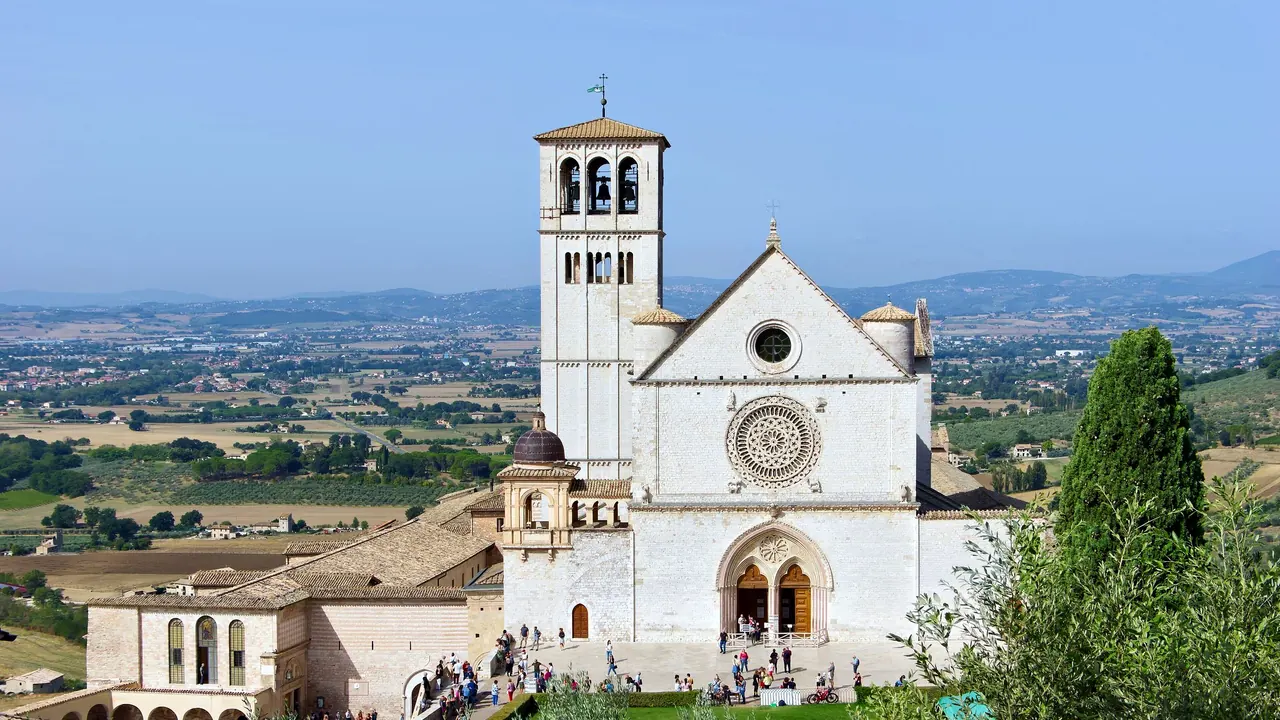
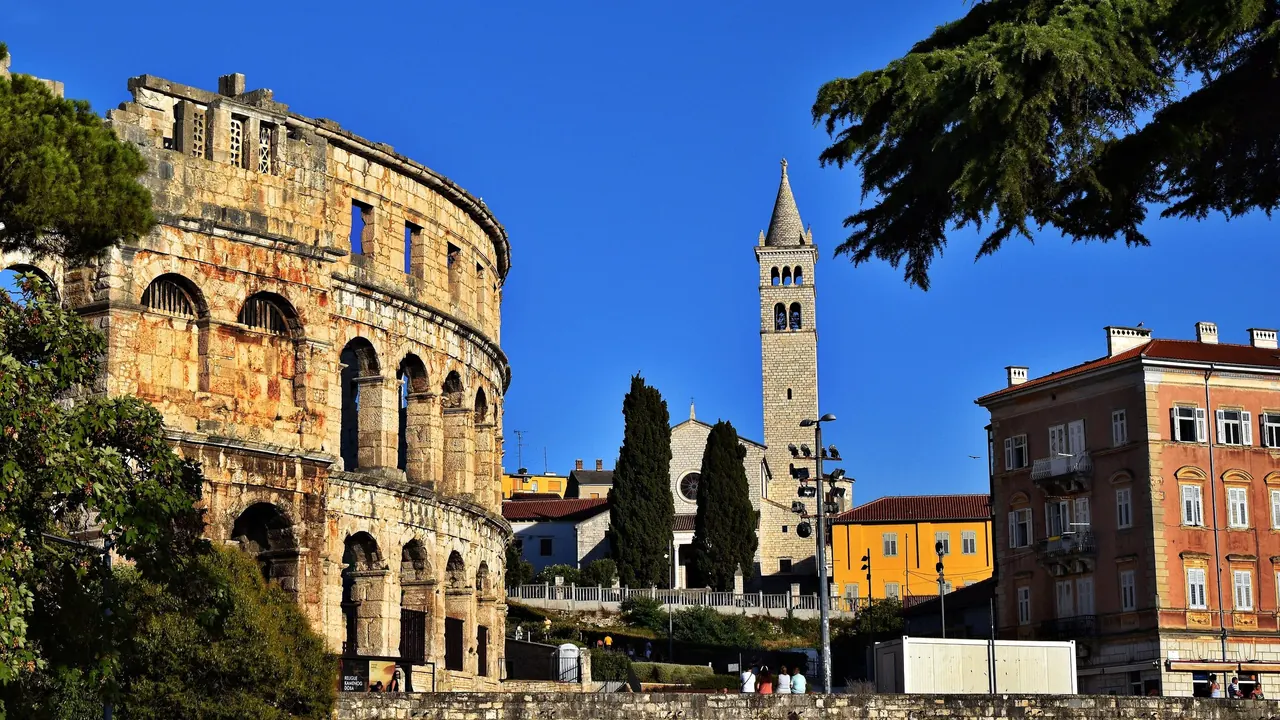
Photos: Assisi by Berthold Werner, CC BY-SA 4.0, cropped; Pula by Miroslav.vajdic, CC BY-SA 4.0, cropped.
Assisi or Pula?
Our verdict in twelve categories, each scored against the same fixed benchmark cities, and the climate month by month, so you can choose for your trip.
Choose Assisi for
- culture and sights
- wellness
- day trips
Assisi suits a slower inland trip built around art and quiet. The frescoed Basilica of San Francesco, stone lanes that empty in the evening, walks on Monte Subasio and a ring of Umbrian hill towns within an hour make it a good fit for couples and solo travellers. It is best for people who want calm evenings and good-value convent stays more than a swim or a late night.
Choose Pula for
- beaches
- nightlife
- families
Pick Pula if the sea matters. The clear coves at Kamenjak and the sheltered bays of Medulin give it a beach side that Assisi cannot offer, and the Roman Arena gives the city a real sight of its own, with concerts inside it in summer. Families, swimmers and anyone who wants a terrace drink after dark will be happier on the Istrian coast.
Scoreboard
Twelve categories on one fixed scale from 0 to 100. The shaded stretch is the gap between the two.
Your match
Pick a travel style or drag the sliders, and both match scores follow your weighting.
Wins on culture and sights and wellness with your weighting.
Wins on beaches and nightlife with your weighting.
What matters to you?
Category by category
What the scores mean for a trip.
Beaches & swimming
On beaches the two are about as far apart as they can be. Assisi sits in the hills of central Italy, and the nearest swimming is at the small lidos on Lake Trasimeno, where the water is shallow and slightly cloudy, so most visitors settle for a hotel pool.
Pula has no sand either, but its rock platforms and pebble coves on Verudela and Stoja, and the wild inlets of Cape Kamenjak, give very clear Adriatic water from June into September. Pack water shoes because of the sea urchins. Families with small children do best in the gently shelving bays at Medulin.
Food & drink
Both kitchens rely on truffles, olive oil and good local wine, so the difference is in range more than style. Pula adds the sea, with grilled squid, scampi buzara and fresh fish alongside Istrian fuži and Malvazija, plus a covered market hall that shows what is in season.
Assisi's Umbrian cooking of strangozzi, Castelluccio lentils, wild boar and Sagrantino is very good but narrower, with no market hall and plenty of set menus near the basilica. In both places the best meals are away from the big monuments, in side-lane trattorias or country taverns.
Culture & sights
Each town has one great monument, but Assisi's carries more weight. The two stacked churches of the Basilica of San Francesco, with frescoes by Cimabue, Simone Martini and the Giotto cycle, are among the high points of European art. Santa Chiara, the Temple of Minerva and the tiny Porziuncola fill out two calm days.
Pula answers with Roman engineering rather than painting: the Arena, the intact Temple of Augustus on the Forum and the Arch of the Sergii, plus a Venetian fortress and Habsburg naval forts. It makes a rewarding day or two, but without the depth of art found in Assisi's churches.
Nightlife
Neither is a place for a big night out, but only Assisi truly shuts down. Once the day-trippers leave, evenings mean dinner, a glass of Sagrantino and silent floodlit lanes, and anyone who wants bars goes to Perugia.
Pula at least has a summer scene, with drinks on the terraces around the Forum, beach and cocktail bars on Verudela and in Medulin, and a few small clubs on warm weekends. Out of season it goes quiet as well.
Nature & outdoors
Assisi and Pula are about level on the outdoors, but they give very different kinds of day. Around Assisi the walking is mostly uphill. The mountain behind the town makes a proper half-day climb past Francis's hermitage to open grassland with the whole Umbrian valley spread out below, and autumn is the kindest season for it. Lower down, the olive and vine country suits easy cycling between the wine villages, and the gorges of the Valnerina or the Sibillini make longer outings by car.\n\nPula has no real high ground nearby, so most of its outdoor days involve the water.
The car-free headland of Kamenjak is good for walking or cycling among cliffs and small islets, and kayaking, windsurfing and wreck diving are all easy to arrange. Keen hikers face a drive of about an hour and a half to Učka, so walkers will be happier in Umbria and people who like being active on the sea will prefer Istria.
Day trips
Both make good touring bases, with Assisi slightly the stronger. Spello is minutes away and Perugia half an hour, while Spoleto, Gubbio, Todi and Orvieto are all within easy reach, and several of them can be reached by regional train.
Pula's Istria makes a fine circuit too, with Rovinj, the mosaics of Poreč, the hill towns of Motovun and Hum, and the boat to Brijuni. Buses are thin, though, and nearly everything needs a car.
Good for families
Pula is clearly the easier choice with children. The shallow, sheltered bays at Medulin and Premantura, an aquarium inside an Austro-Hungarian fort, the Arena's underground passages and the animals on Brijuni give the days a shape, and a water park and a dinosaur park are both within an hour.
Assisi is safe and welcoming but built for silence: fresco-filled churches, steep stepped streets that defeat a pushchair, and hot afternoons. Older children enjoy the Rocca Maggiore, but most families stay at a valley agriturismo with a pool.
Getting around
Getting around is a similar mix in both towns, though the details differ. Assisi's centre is compact but steep, all stairs and slopes, and its station is 4km below in the valley. In return, a regional rail line runs to Perugia, Spello and Spoleto.
Pula's centre is flat and short, and city buses run out to Verudela. Its railway is of little use to visitors, however, so Kamenjak and the hill towns really need a car or a scooter.
Shopping & style
Neither is a shopping destination, and in both the best buys are things to eat and drink. Pula has the slight edge thanks to its market hall, its delicatessens and a pedestrian street of everyday chains, with Istrian oil, truffles, rakija and pršut to take home.
Assisi's streets are given over to rosaries and Tau crosses, though embroidered Umbrian linens, Deruta ceramics and Sagrantino are worth looking for.
Affordability
Assisi is the easier of the two on the wallet. The basilicas are free to enter, convent guesthouses offer simple rooms at low cost and the agriturismi in the valley are good value. Only Easter and the big feast days push prices up.
Pula is reasonable in spring and autumn, but in July and August rooms cost about as much as on the Western European coasts, and car hire and boat trips add up.
Live music & performing arts
Pula has the more memorable stage. In summer the Arena hosts touring pop and rock acts, classical galas and Pula Film Festival screenings under its Roman arches, and the Istrian National Theatre covers the rest of the year, mostly in Croatian.
Assisi's music is sacred and seasonal: organ and choral concerts in its churches, and the medieval song and processions of Calendimaggio in spring. For opera and jazz, people go to Perugia.
Wellness & relaxation
Assisi gives the deeper rest, and it is a contemplative kind: retreats in convent guesthouses, silent walks up to the Eremo delle Carceri, and mornings and evenings that go completely still once the tour groups have left. The few spas it has are in country hotels down in the valley.\n\nPula's version is more conventional, with pools, saunas and massages at the resort hotels on Verudela and in Medulin, and pine-shaded coastal paths for an evening stroll. Neither town has a bathing tradition of its own, and Pula's slower pace returns only outside high summer.
When should you go?
Pick your month. The climate figures are measured averages, not a forecast.
Assisi in July
Pula in July
Daytime high, °C
Rainfall in the month, mm
Where the figures come from
Assisi's temperatures are measured 51 km from the centre, at Frontone.
Assisi has no rain gauge within 25 km of the centre, so its rainfall comes from a gridded climate dataset read at the city rather than from a gauge further away.
Pula's temperatures are measured 87 km from the centre, at Trieste.
Pula has no rain gauge within 25 km of the centre, so its rainfall comes from a gridded climate dataset read at the city rather than from a gauge further away.
Temperature and rainfall are climate normals, averaged over the years shown. Assisi: 1991-2020 normals, Frontone (50.5 km from centre). Pula: 1991-2020 normals, Trieste (87 km from centre).
Pula's sea is warm enough for swimming from June to September and reaches 25°C in August, and July is its sunniest month. Assisi has no sea, and inland its summer feels heavier, around 30°C in July, which makes the steep lanes hard going at midday. For walking the streets and the hills, May and late September to early October suit both towns best.
Both get wetter in autumn, and November is the wettest month in each, with Pula's 107mm the heavier. Winter is mild on the Istrian coast, while Assisi is colder, with January highs near 7°C, so on a winter trip Pula is the more comfortable of the two for strolling.
Which traveller are you?
On a beach and sun trip, Pula wins easily. Clear water off the pine-shaded rocks of Verudela and the wild coves of Cape Kamenjak replace Assisi's distant lake lidos, and summer evenings end with a drink on a seaside terrace.
For a culture and arts trip, Assisi is the stronger pick. The Basilica of San Francesco holds frescoes by Cimabue and the Giotto cycle, and Perugia, Spoleto and Orvieto stretch the art trail over several days, while Pula's Roman sights take a day or two.
On a family trip with children, Pula is much easier. Shallow bays at Medulin, the aquarium inside an old fort and a water park within an hour keep children busy, whereas Assisi's silent churches and stepped lanes suit adults better.
Before you go
| Measure | Assisi | Pula |
|---|---|---|
| Official language | Italian | Croatian |
| Currency | Euro (EUR) | Euro (EUR) |
| Sockets | CFL230 V, 50 Hz | CF230 V, 50 Hz |
| Driving side | Right | Right |
| Time zone | UTC+1, UTC+2 in summer | UTC+1, UTC+2 in summer |
| Emergency number | 112 | 112 |
| Elevation | 424 m | 5 m |
| Main airport | Perugia San Francesco d'Assisi – Umbria International Airport (PEG)9 km from centre17 non-stop destinations | Pula Airport (PUY)7 km from centre34 non-stop destinations |
| Public holidays this year | 13 days | 14 days |
By the numbers
| Measure | Assisi | Pula |
|---|---|---|
| City population | 27,605 | 52,220 |
| People per km² | 147 | 971 |
| Museums within 10 km | 14 | 4 |
| UNESCO World Heritage sites within 50 km | 2 | 1 |
| Swim season, months above 21 °C | - | 4 months |
Where else could you go?
Every comparison below shares a destination with this one, so you can follow Assisi or Pula somewhere new.