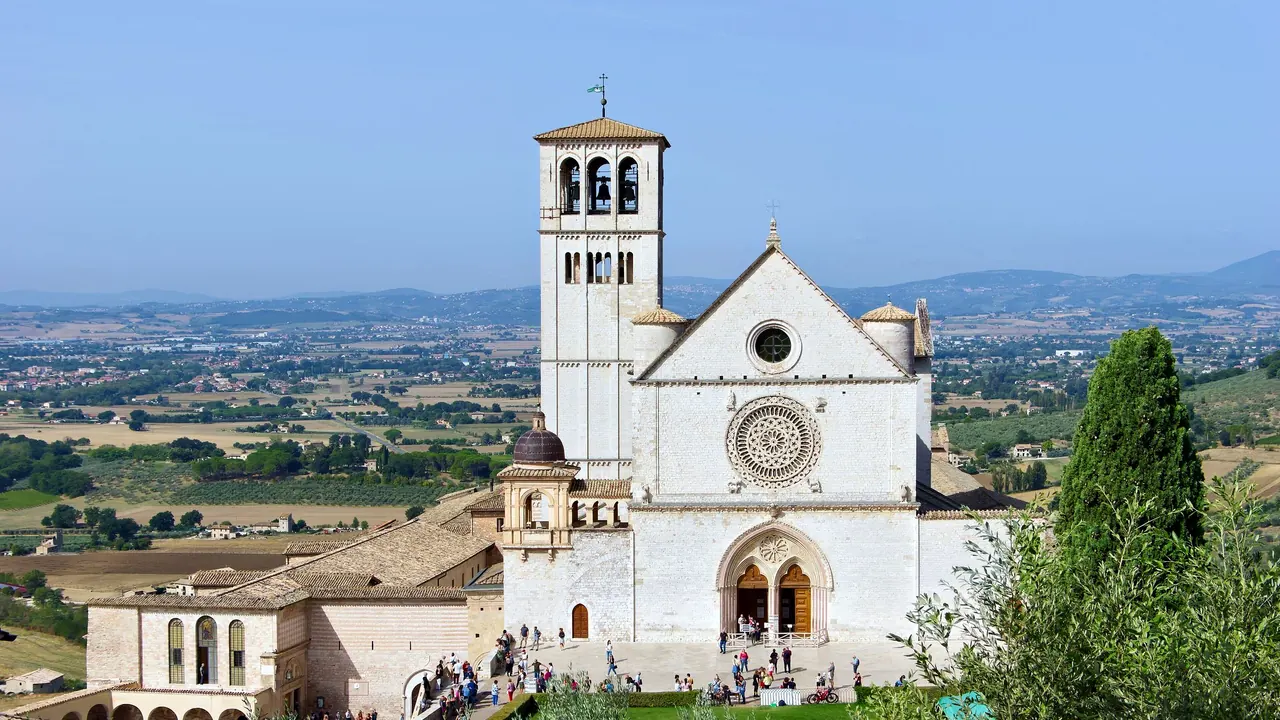
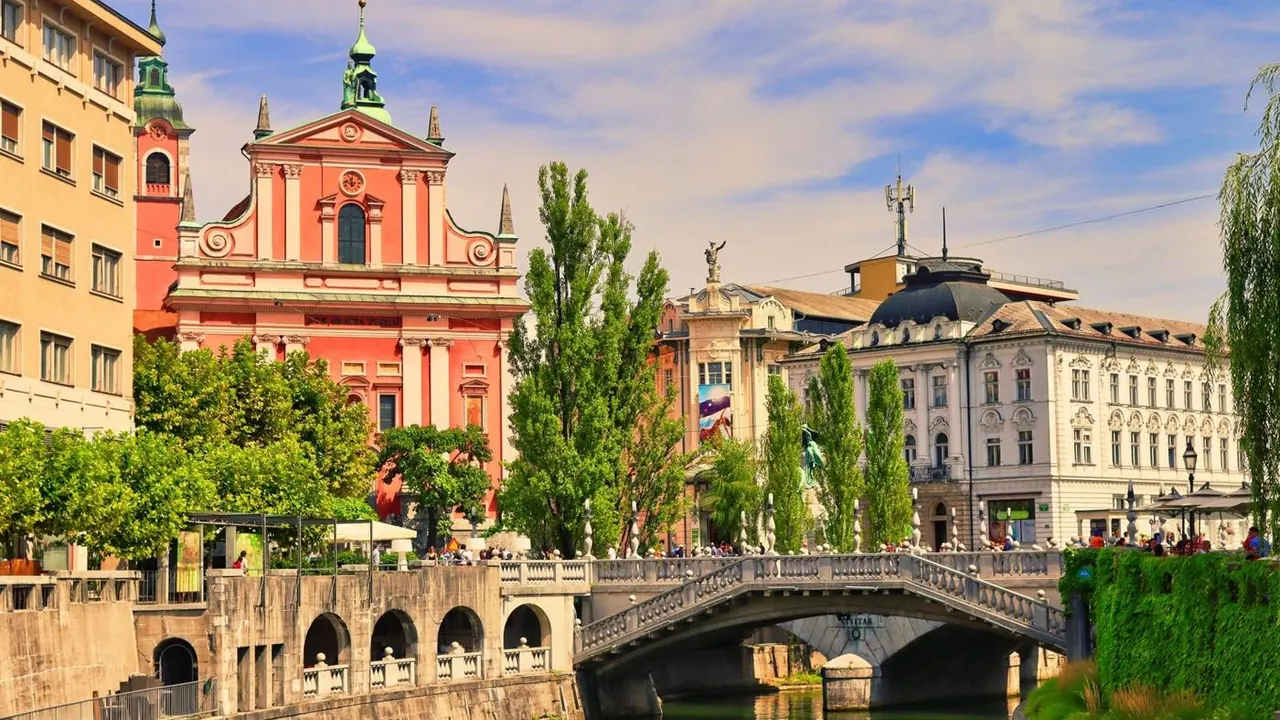
Photos: Assisi by Berthold Werner, CC BY-SA 4.0, cropped; Ljubljana by detait, Pexels License.
Assisi or Ljubljana?
Our verdict in twelve categories, each scored against the same fixed benchmark cities, and the climate month by month, so you can choose for your trip.
Choose Assisi for
- culture and sights
- day trips
- prices
Assisi suits travellers who want art, faith and the Umbrian countryside more than city life. The Basilica of San Francesco and its frescoes put it among the great sights of Europe. It also makes an excellent base for touring Spello, Perugia, Spoleto, Gubbio and Orvieto. Evenings are silent and children find little to do, so it works best for couples, pilgrims and slow travellers who like quiet nights.
Choose Ljubljana for
- nightlife
- live music and the arts
- families
Ljubljana is the better choice for an active, easy-going trip with more going on after dark. The Julian Alps, Triglav National Park and the karst caves are all close. The flat, car-free centre is simple to manage with children. There are riverside terraces, an opera house and a summer festival for the evenings. The sights are smaller in scale, and the city's appeal lies in its relaxed pace and the mountains around it.
Scoreboard
Twelve categories on one fixed scale from 0 to 100. The shaded stretch is the gap between the two.
Your match
Pick a travel style or drag the sliders, and both match scores follow your weighting.
Wins on culture and sights and day trips with your weighting.
Wins on nightlife and live music and the arts with your weighting.
What matters to you?
Category by category
What the scores mean for a trip.
Beaches & swimming
Neither city is a beach destination, but Ljubljana gives you a little more choice. Locals swim in the Sava on the city's edge, and Lake Bled is about an hour away for warm summer swims. The Adriatic at Piran makes a long day out, though the shore there is concrete platforms and pebbles rather than sand.
From Assisi, the only natural water nearby is Lake Trasimeno, about 45 minutes away. Its small lidos have shallow, slightly cloudy water. Most visitors simply book somewhere with a pool.
Food & drink
Ljubljana offers more variety and more ways to eat. You can graze at the open-air market under Plečnik's colonnades, eat štruklji and jota in a gostilna, or try one of the handful of modern Slovenian kitchens. The wines of Vipava, Brda and Styria, poured by the glass along the river, are the real draw.
Assisi's cooking is plainer but has excellent raw materials: truffled strangozzi, Castelluccio lentils, Subasio olive oil and Sagrantino from Montefalco. The catch is that many restaurants near the basilicas serve set menus to tour groups. Eating well usually means finding a trattoria on a side lane or an agriturismo in the valley.
Culture & sights
Assisi has the greater sights. The Basilica of San Francesco, with the dim Lower Church and the bright Upper Church above it, is a landmark of Western art. Santa Chiara, the Temple of Minerva and the Porziuncola chapel add depth to a small town made of pink stone.
Ljubljana's appeal lies in its townscape rather than in any one masterpiece. Plečnik's bridges, embankments and library give the centre its character, and the castle hill and Secession façades complete the picture. Its museums are pleasant but secondary. Both places can be seen in two or three days, but Assisi's art is the kind people travel across Europe to see.
Nightlife
Ljubljana has an actual nightlife, while Assisi has almost none. On warm evenings the bars on both banks of the Ljubljanica fill up, students keep things lively during term, and the scruffy clubs at Metelkova stay open late at weekends. It suits a drink by the water better than a big night out.
In Assisi, a night out means dinner, a glass of Sagrantino and a walk through floodlit lanes that are empty by eleven. Anyone wanting bars has to go to Perugia.
Nature & outdoors
Ljubljana is surrounded by bigger and more varied landscapes. You can climb Šmarna Gora on the edge of town and cycle across the marshes to the south. Within about an hour are the Kamnik-Savinja Alps, Triglav National Park and the Vintgar gorge, and further out there is rafting on the Soča and the caves at Postojna and Škocjan. In winter there are small ski resorts within reach.
Assisi has one fine mountain right behind the town. The path up Monte Subasio climbs through oak woods past the Eremo delle Carceri to open summit meadows, and the olive-covered valley below is good for gentle cycling. The Sibillini and the Valnerina offer wilder country, but they need a car and a full day.
Day trips
Assisi has the edge as a touring base, because it has so many first-rate towns close together. Spello is ten minutes away. Perugia and Spoleto are on the same railway line, and Gubbio, Todi and Orvieto's cathedral make full days out. Montepulciano and Cortona over the Tuscan border are also within reach.
From Ljubljana the trips cover more variety of scenery: Bled's island church, Predjama Castle built into its cliff, the Lipizzaner stud at Lipica and Venetian-looking Piran on the coast. Trieste or Zagreb can be visited from the city too. It offers mountains and sea, but not Umbria's run of art towns.
Good for families
Ljubljana is clearly easier with children. The centre is flat and mostly closed to cars, and younger children love the funicular, the Dragon Bridge and the puppet theatre, which needs no Slovene. Tivoli Park's playgrounds, a modest zoo and a hands-on science centre fill two or three days.
Assisi welcomes families but offers them little. Its steep, stepped streets are hard work with a pushchair, and its frescoed churches need silence. Older children enjoy the Rocca Maggiore and the walk up Subasio, and a valley agriturismo with a pool makes a better base.
Getting around
Ljubljana is the simpler city to move around. The old town, market, museums and Tivoli Park are all a short, level walk apart, and there are electric shuttles and a bike-share scheme too. Intercity buses reach most of the country.
Assisi is compact but steep, with stairs between the basilica and Piazza del Comune. The station is about 4km below in Santa Maria degli Angeli, reached by bus or taxi. The valley railway line covers the main towns, but most of Umbria really needs a hire car.
Shopping & style
Neither city is worth planning a trip around for shopping, but Ljubljana has a little more to browse. There is coastal salt, honey and pumpkin-seed oil at the market, Idrija lace, a Sunday flea market on the embankment and a few design boutiques on Trubarjeva street.
In Assisi, rosaries and Tau crosses fill most of the shop windows. The things worth taking home are the Assisi-embroidered linens, Deruta ceramics, truffles and Sagrantino.
Affordability
The two cost about the same overall, but you save money in different places. In Assisi the basilicas are free, convent guesthouses offer cheap, simple rooms and agriturismi are good value. Prices rise around Easter and on feast days, and the restaurants by the basilicas charge for the view.
In Ljubljana, the set lunches at inns and the cheap local wine keep food costs down, and walking everywhere costs nothing. Rooms are the expensive part, priced like Western Europe in July and August. Staying outside the old town or visiting out of season helps.
Live music & performing arts
Ljubljana has much more on stage. There is the Slovenian Philharmonic, an opera and ballet house, and a full programme at Cankarjev dom. In summer the Ljubljana Festival brings orchestras to Plečnik's open-air Križanke courtyard. Spoken theatre is in Slovene, but music needs no translation.
In Assisi, the performing arts are mostly organ and choral concerts in the churches, along with the medieval pageantry of Calendimaggio in spring. For opera or jazz you need to go to Perugia.
Wellness & relaxation
Both cities offer calm rather than real spa culture, but of different kinds. Assisi's quiet is spiritual: convent retreats, silent walks to the Eremo delle Carceri and lanes that empty at dusk.
Ljubljana's calm is that of a green, car-free capital with long café afternoons. It also has more practical options, with a sauna complex at its water park and Slovenia's thermal spa towns within about an hour's drive.
When should you go?
Pick your month. The climate figures are measured averages, not a forecast.
Assisi in July
Ljubljana in July
Daytime high, °C
Rainfall in the month, mm
Where the figures come from
Assisi's temperatures are measured 51 km from the centre, at Frontone.
Assisi has no rain gauge within 25 km of the centre, so its rainfall comes from a gridded climate dataset read at the city rather than from a gauge further away.
Temperature and rainfall are climate normals, averaged over the years shown. Assisi: 1991-2020 normals, Frontone (50.5 km from centre). Ljubljana: 1991-2020 (sunshine 1981-2010, rainfall 1981-2010) normals, Ljubljana / Bezigrad (1.9 km from centre).
Assisi is the drier of the two in every month of the year. May, June and September are the best months for walking its steep lanes, warm without being punishing. July and August are the driest stretch, but highs near 30°C make the climb up from the basilica tiring in the middle of the day, so walk early and save the afternoon for shade or a pool. Lake Trasimeno is only pleasant for a swim in those two summer months. Rain builds through autumn to a peak of about 94mm in November, and winters are chilly but milder than in Ljubljana.
Ljubljana is far wetter, and its summer rain often comes as heavy thundery downpours. July is the month to aim for: it is the sunniest of the year and, at about 80mm, much drier than June or August. That makes it the best time for swimming in the Alpine lakes and walking in the mountains. May is a good alternative, mild and fairly bright before the June rain. September may look like a gentle end to summer, but it is as wet as August, and October is the wettest month at around 176mm. Winters are colder and darker than in Umbria, with daytime highs near 4°C.
Which traveller are you?
For a culture and arts trip, choose Assisi. Its two-storey basilica holds frescoes by Cimabue, Simone Martini and the Giotto cycle, which outrank anything in Ljubljana's galleries. Orvieto, Spoleto and Perugia's National Gallery are all within a day's reach.
For a food and nightlife trip, choose Ljubljana. There is the Central Market, a weekly street-food gathering in summer and wine bars pouring orange wine by the river. Terraces stay busy on warm evenings, and Metelkova runs late at weekends. Assisi has fine produce, but it goes quiet after dinner.
On a family trip with children, Ljubljana is much easier. Its flat, car-free centre suits pushchairs. Children enjoy the castle funicular, the dragon statues, Tivoli's playgrounds and the puppet theatre. Assisi's stepped lanes and fresco-filled churches that need silence are hard going for young children.
Before you go
| Measure | Assisi | Ljubljana |
|---|---|---|
| Official language | Italian | Slovene |
| Currency | Euro (EUR) | Euro (EUR) |
| Sockets | CFL230 V, 50 Hz | CF230 V, 50 Hz |
| Driving side | Right | Right |
| Time zone | UTC+1, UTC+2 in summer | UTC+1, UTC+2 in summer |
| Emergency number | 112 | 112 |
| Elevation | 424 m | 309 m |
| Main airport | Perugia San Francesco d'Assisi – Umbria International Airport (PEG)9 km from centre17 non-stop destinations | Ljubljana Jože Pučnik Airport (LJU)20 km from centre32 non-stop destinations |
| Public holidays this year | 13 days | 21 days |
By the numbers
| Measure | Assisi | Ljubljana |
|---|---|---|
| City population | 27,605 | 284,293 |
| People per km² | 147 | 1,736 |
| Museums within 10 km | 14 | 14 |
| UNESCO World Heritage sites within 50 km | 2 | 3 |
Where else could you go?
Every comparison below shares a destination with this one, so you can follow Assisi or Ljubljana somewhere new.
- Bledvs Ljubljana
- Triestevs Ljubljana
- Piranvs Ljubljana
- San Marinovs Assisi
- Sienavs Assisi
- Zagrebvs Ljubljana