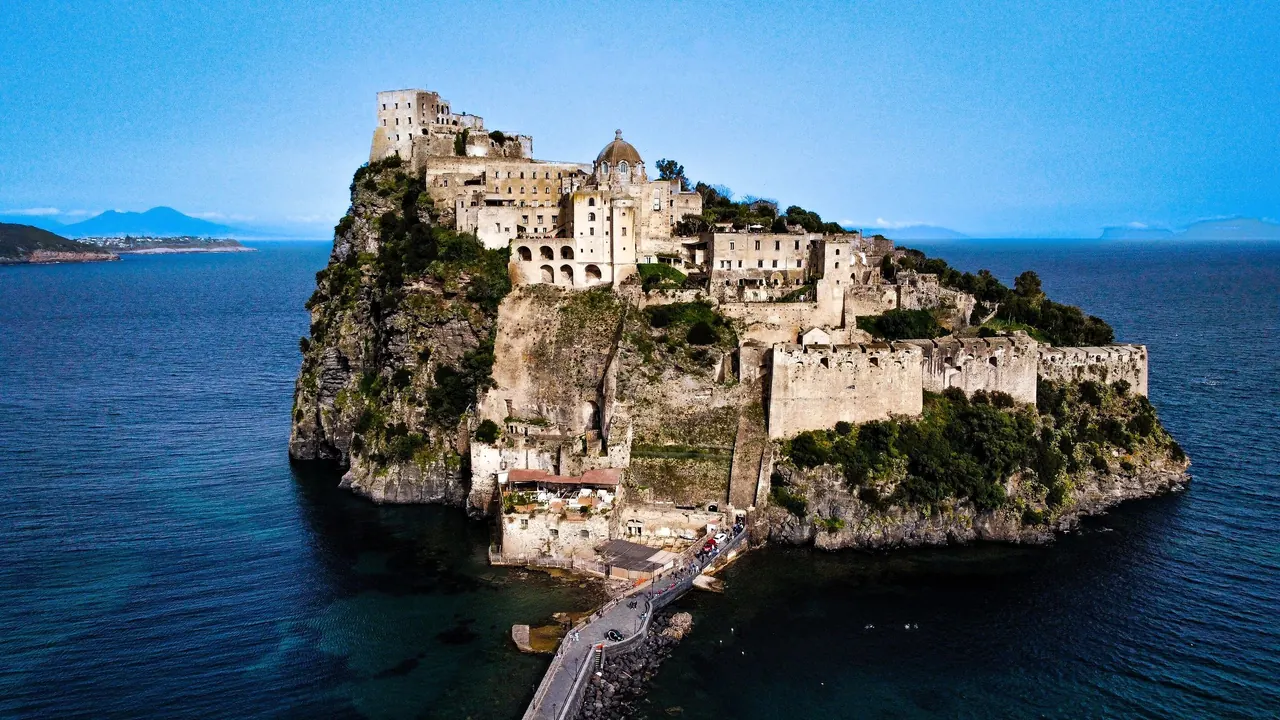
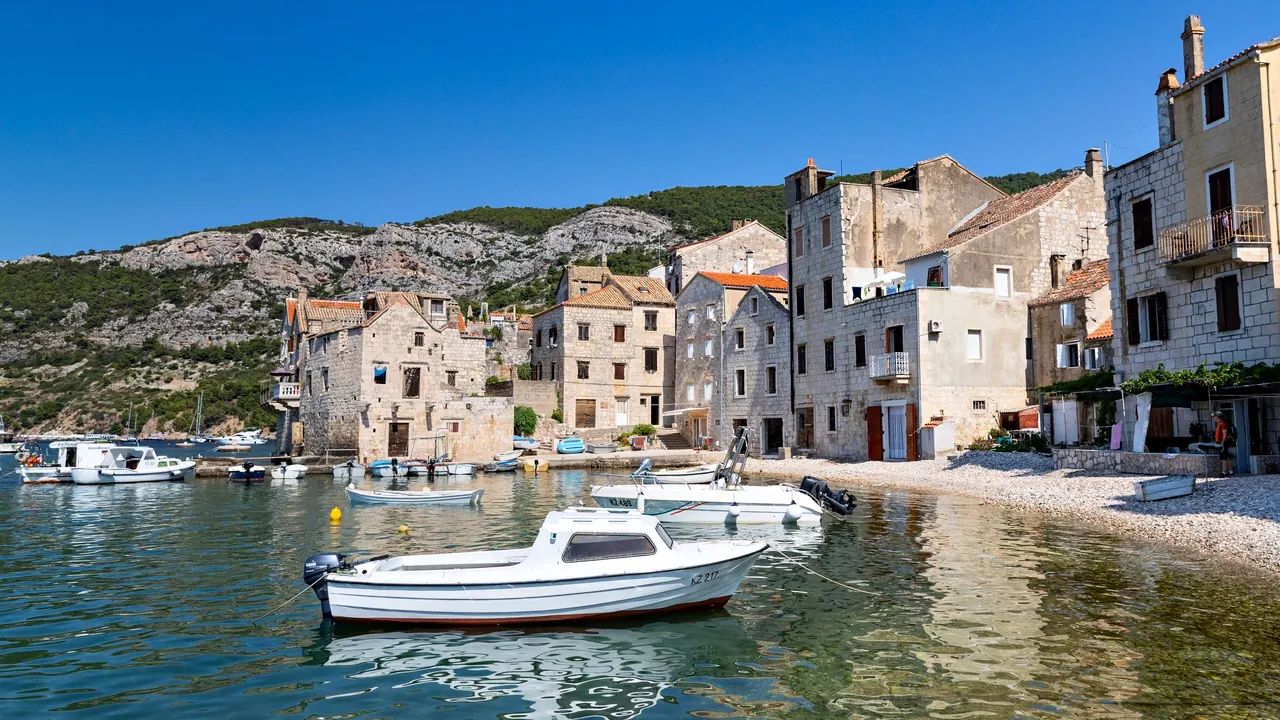
Photos: Ischia by Pipito93, CC BY-SA 4.0, cropped; Vis by dronepicr, CC BY 2.0, cropped.
Ischia or Vis?
Our verdict in twelve categories, each scored against the same fixed benchmark cities, and the climate month by month, so you can choose for your trip.
Choose Ischia for
- wellness
- day trips
- shopping
Ischia is the better choice if you want an island with more going on around the beach. Hot springs and terraced thermal parks are at the centre of a stay, and on dry land there are the Aragonese Castle and the Greek finds at Lacco Ameno. Ferries put Naples, Procida, Capri and the Phlegraean Fields within a day's reach. It suits couples and families who want a slow spa and swimming vacation on an island that is easy to reach and easy to leave for outings.
Choose Vis for
- nature and the outdoors
If you want to be properly far out at sea, go to Vis. It is quieter and more remote than Ischia, and nearly everything there revolves around the water: clear coves such as Stiniva, boat days to the Blue Cave and the outer islets, diving on wrecks and walls, and long dinners at harbour tables in Komiza. It takes more effort to reach and has less to do on land. That suits travellers who want to switch off away from towns, sights and crowds of day boats.
Scoreboard
Twelve categories on one fixed scale from 0 to 100. The shaded stretch is the gap between the two.
Your match
Pick a travel style or drag the sliders, and both match scores follow your weighting.
Wins on wellness and day trips with your weighting.
Wins on nature and the outdoors with your weighting.
What matters to you?
Category by category
What the scores mean for a trip.
Beaches & swimming
The swimming is equally good on both islands, but the beaches are different. Ischia has real sand by Bay of Naples standards: the long dark curve of Maronti, the calm, shallow bay of San Montano and Citara facing the sunset. You can walk onto most of them, but the popular bays fill with sunbeds and day boats in high summer.
Vis has coves rather than beaches, almost all pebble or rock, and the water is clearer. Stiniva, closed off between two cliffs, is the famous one. Many of the best are reached down a steep path or by taxi boat, and there is little shade, so bring your own.
Food & drink
Ischia has the broader table, though neither island has much range. It has its own rabbit dish braised in terracotta, seafood in the harbours at Sant'Angelo, Forio and Ischia Ponte, and Biancolella whites from terraced vineyards you can visit. The catch is that many visitors eat on half-board in their hotel and miss the better trattorias in the hill villages.
Vis keeps things simpler. Konobas serve fish and lobster off the boats, slow-cooked peka and the anchovy pie of Komiza, with Vugava and Plavac wines from the inland fields. Outside summer many of them close, so the choice shrinks quickly.
Culture & sights
Neither island takes long to see, but Ischia has the bigger set pieces. The Aragonese Castle on its rock off Ischia Ponte deserves half a day, and Villa Arbusta holds Nestor's Cup from the Greek settlement of Pithekoussai. The Mortella gardens and the lanes of Sant'Angelo fill out a couple of days.
What Vis has is smaller and stranger. There are the remains of Greek Issa, a bronze head in the Austrian fortress museum and British forts from the Napoleonic wars. The most memorable sights are Tito's wartime cave and the tunnels and submarine pens left from the decades the island was a closed military zone.
Nightlife
Evenings on both islands are mostly about dinner and a drink by the harbour. Ischia has a bit more beyond that: the waterfront and shopping streets of Ischia Porto have wine bars, cocktail terraces and a couple of discos that stay open late in July and August.
On Vis the late hours are a few bars in Vis town and Komiza and the occasional beach party on a summer weekend. Both islands are short of a real club night, but Vis is quiet earlier.
Nature & outdoors
The two islands are about level for the outdoors, but the ground under your feet is quite different. Ischia is a green volcano: paths climb through chestnut woods and vineyards to the eroded tuff summit of Monte Epomeo, and steam vents on the south coast show it is still active. Offshore, the marine protected area it shares with Procida is good for snorkelling, and dolphins are sometimes seen.
Vis is drier and more exposed, a high plateau of vineyards and abandoned terraces that ends in steep southern cliffs, with open sea all round from the top of Hum. Its geopark takes in the volcanic islets of Brusnik and Jabuka and sea caves along the coast, including the Green Cave on Ravnik, and the diving on wrecks and walls is excellent.
Day trips
Day trips are one of Ischia's clearest advantages. From the ferry quay you can reach the pastel houses of Procida, the historic centre and archaeological museum of Naples, and the Solfatara and sunken Baia in the Phlegraean Fields. In summer there are direct boats to Capri and Sorrento.
From Vis, outings mean boats to the islets around it: the Blue Cave on Bisevo, Ravnik, and on a calm day the distant Svetac or Jabuka. These are lovely sea days, but Split and the other islands are too far for a return trip, so any towns or heritage sites have to be fitted in before or after your stay.
Good for families
Ischia is easier with children. The sand at Maronti and the sheltered water of San Montano are gentle for small swimmers. The thermal parks near Forio and Lacco Ameno, with their pools at different temperatures, make simple days out when the beach gets old. The hill villages are all steps, though, and older children can get restless after a week.
Vis gives children freedom in its small, safe harbour towns, and Stoncica has shallow water. Elsewhere the steep paths, pebble beaches and lack of shade make beach days harder work, and once the sea is done there is very little else for children to do.
Getting around
Ischia is the easier island to manage without your own transport. One coastal road loops around it, and buses run both ways and branch up to every hill village. Microtaxis and water taxis cover the rest. The buses are slow and crowded in summer, but a car is more trouble than it is worth.
Vis asks more of you both getting there and getting around. The crossing from Split takes well over an hour, with only a few sailings a day. The bus between Vis town and Komiza does not reach the coves, so most visitors hire a scooter or car for the winding roads or take taxi boats to the southern bays.
Shopping & style
Ischia has at least one proper shopping stroll, the long walk along Via Roma and Corso Vittoria Colonna between Ischia Porto and Ischia Ponte. There you will find resort linen, sandals, jewellery, ceramics and cosmetics made with the island's thermal waters.
Vis has almost nothing beyond groceries, a few souvenir stalls and farm wine, olive oil and herbal brandies. Bring anything you need from the mainland.
Affordability
Ischia is the more forgiving of the two on cost. Its many family-run spa hotels sell half-board stays that include their own thermal pools, and buses, ferries and trattorias away from the harbour fronts are fairly priced. Sunbeds, thermal park entry and boat trips still add up over a week in high summer.
On Vis, a modest apartment is offset by everything else: lobster priced by weight, taxi boats, scooter hire, the ferry and shops that carry the cost of being far out at sea. On both islands June and September are noticeably cheaper than July and August.
Live music & performing arts
Neither island is somewhere to go for performances, but Ischia does have a small summer programme. There are chamber concerts in the Mortella gardens that William Walton created, and concerts and screenings at the Aragonese Castle during the film festival. Naples, with its opera house, is a ferry ride away.
On Vis, live music means klapa singers in the harbours, the odd open-air concert and the fishermen's feast days in Komiza. These are worth catching if you happen upon them, but they are all there is.
Wellness & relaxation
This is the biggest gap between the two islands. On Ischia, taking the waters is the point of the trip. Hotels pipe the hot springs into their own pools. The thermal parks at Citara, Lacco Ameno and Casamicciola step down towards the sea. At Sorgeto hot water bubbles into rock pools, and the Cavascura gorge has ancient steam caves.
Vis offers rest of a plainer kind, with no bathing tradition and only a few massage rooms. You relax there through long lunches, little traffic and evenings that end early, which suits people who want to switch off rather than be looked after.
When should you go?
Pick your month. The climate figures are measured averages, not a forecast.
Ischia in July
Vis in July
Daytime high, °C
Rainfall in the month, mm
Where the figures come from
Ischia's temperatures are measured 36 km from the centre, at Grazzanise.
Ischia has no rain gauge within 25 km of the centre, so its rainfall comes from a gridded climate dataset read at the destination rather than from a gauge further away.
Vis's temperatures are measured 55 km from the centre, at Split / Marjan.
Vis has no rain gauge within 25 km of the centre, so its rainfall comes from a gridded climate dataset read at the destination rather than from a gauge further away.
Vis's sunshine is measured 55 km from the centre, at Split / Marjan.
Temperature and rainfall are climate normals, averaged over the years shown. Ischia: 1991-2020 normals, Grazzanise (36 km from centre). Vis: 1991-2020 (sunshine 1971-2000) normals, Split / Marjan (54.8 km from centre).
The two islands share a summer. Swimming season runs from June to early October on both, and July and August reach about 31°C by day with very little rain. At that time of year the middle of the day is for the water, not for walking. May, late September and October are the best months for exploring on foot, warm without the summer glare. Ischia stays warm a little longer, still around 28°C in September when Vis has already cooled, and its sea is slightly warmer all season.
The difference shows from October. Around the main resort areas of Ischia the autumn turns properly wet, with about 148mm of rain in November. Vis stays drier at about 94mm and gets a little more sunshine through most of the year. Winter is cool on both islands, but Ischia still has a reason to go: its hot springs and thermal pools work in any month. Vis has little to offer once the sea cools and the summer places close.
Which traveller are you?
On a relaxing and wellness trip, choose Ischia. Hot springs are what the island is about. You can spend whole days in the thermal parks at Citara and Lacco Ameno, bathe in the warm sea pools at Sorgeto and book mud treatments. Vis offers quiet, but hardly any spa culture.
For a culture and arts trip, Ischia comes out clearly ahead. On the island itself there are the Aragonese Castle and Nestor's Cup, and Naples, Pompeii and the Phlegraean Fields are all within a day's reach. Vis has unusual Greek and military remains, but Split is too far away for a day out.
On an outdoors trip, both islands are good, but in different ways. Vis suits people whose outdoors is the sea: wreck and wall dives, sea caves and kayaking around a remote geopark. Ischia is better for walkers, with chestnut woods and vineyard paths up Monte Epomeo.
Before you go
| Measure | Ischia | Vis |
|---|---|---|
| Official language | Italian | Croatian |
| Currency | Euro (EUR) | Euro (EUR) |
| Sockets | CFL230 V, 50 Hz | CF230 V, 50 Hz |
| Driving side | Right | Right |
| Time zone | UTC+1, UTC+2 in summer | UTC+1, UTC+2 in summer |
| Emergency number | 112 | 112 |
| Main airport | Naples International Airport (NAP)131 non-stop destinations | Split Saint Jerome Airport (SPU)69 non-stop destinations |
| Public holidays this year | 13 days | 14 days |
By the numbers
| Measure | Ischia | Vis |
|---|---|---|
| Population | 62,027 | - |
| People per km² | 1,340 | - |
| Swim season, months above 21 °C | 5 months | 4 months |
Where else could you go?
Every comparison below shares a destination with this one, so you can follow Ischia or Vis somewhere new.