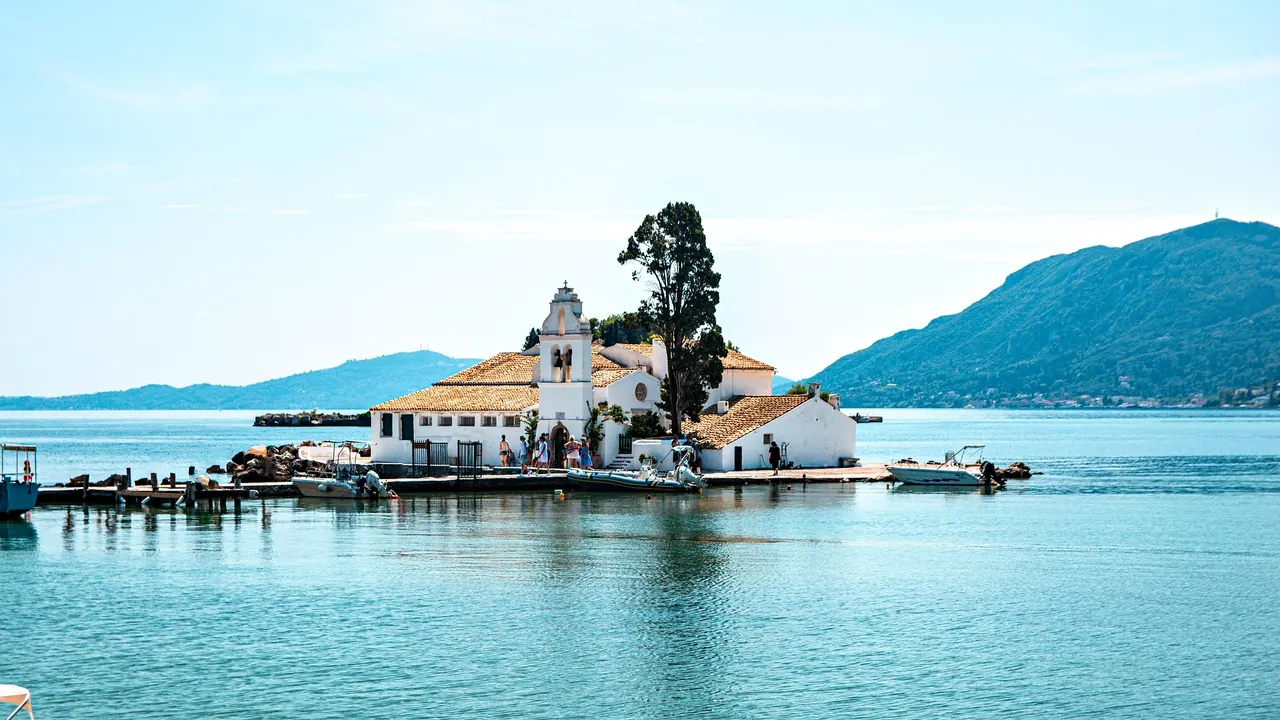
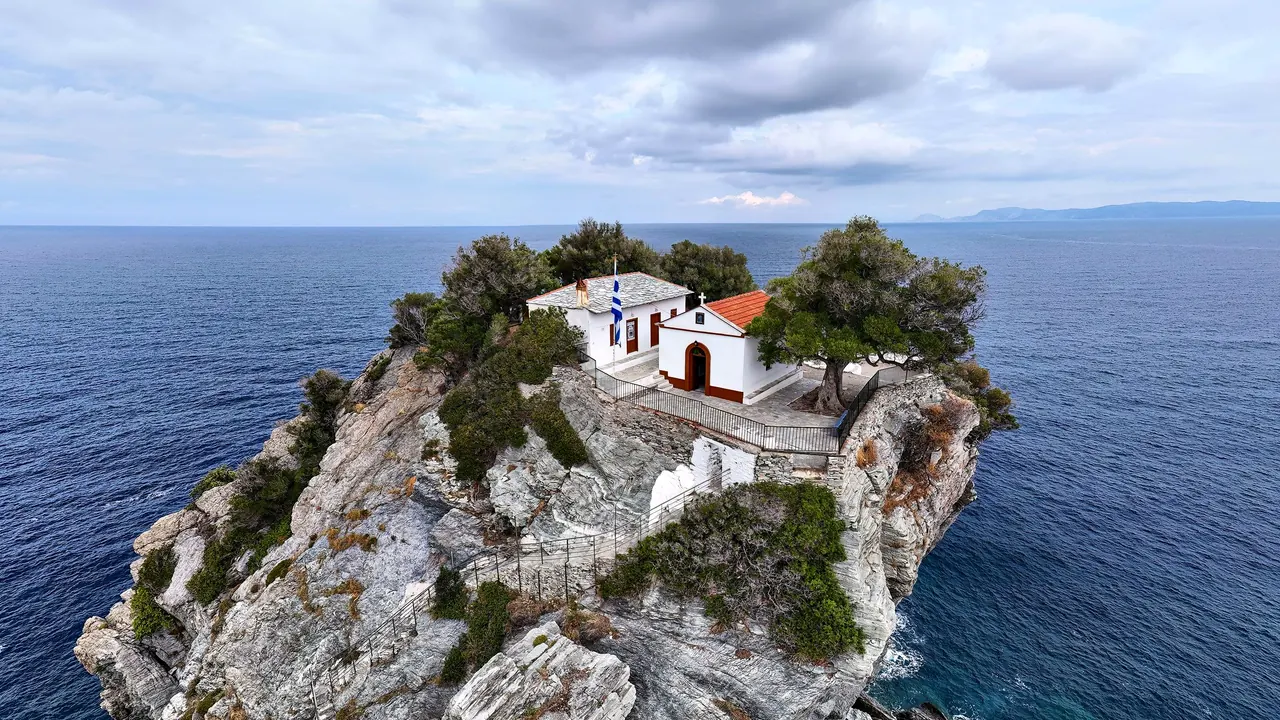
Photos: Corfu by Nico Hartnauer, Pexels License; Skopelos by Giles Laurent, CC BY-SA 4.0, cropped.
Corfu or Skopelos?
Our verdict in twelve categories, each scored against the same fixed benchmark cities, and the climate month by month, so you can choose for your trip.
Choose Corfu for
- nightlife
- culture and sights
- day trips
Corfu suits travellers who want an island with a real town attached. Corfu Town's Venetian lanes, fortresses and museums give you days away from the beach, the food has a character of its own, and evenings can be anything from cocktails under the Liston to all-night clubbing in Kavos. Families get gentle sandy beaches and more to do, and the airport makes it easy to reach. The price is resort strips that are crowded in high summer, so pick your base carefully.
Choose Skopelos for
- nature and the outdoors
Skopelos is for a smaller, slower trip of pine-backed coves, one stepped harbour town and quiet evenings. The beaches are nearly as good, the walking and the marine park with its monk seals match anything Corfu has outdoors, and summer is a little less fierce. You give up nightlife, a wide range of sights and easy access, because getting there takes a ferry. For couples who want to slow right down, that is a fair trade.
Scoreboard
Twelve categories on one fixed scale from 0 to 100. The shaded stretch is the gap between the two.
Your match
Pick a travel style or drag the sliders, and both match scores follow your weighting.
Wins on nightlife and culture and sights with your weighting.
Wins on nature and the outdoors with your weighting.
What matters to you?
Category by category
What the scores mean for a trip.
Beaches & swimming
The beaches are about as good on both islands, but they feel different. Corfu has long sand on the west coast at Glyfada, Issos and Halikounas, with surf on windy afternoons. Around Paleokastritsa there are small cliff-backed coves, the north has shallow sandy resort beaches, and boat trips run to Antipaxos. The busiest resort beaches fill up in high summer.
Skopelos is mostly fine pebble or mixed sand and pebble, a string of pine-fringed coves along the sheltered south and west such as Agnontas, Panormos and Limnonari, often with no more than a taverna and some sunbeds. Choose Corfu for wide sand and sunsets, and Skopelos for clear, quiet coves where you can try a different one each day.
Food & drink
Corfu gives you more to eat. Its Venetian past shows in pastitsada, veal sofrito and the fiery fish stew bourdeto, and there is also kumquat liqueur and the island's ginger beer. The back lanes of Corfu Town and the inland village tavernas reward a little searching, though the menus in the main resorts are generic.
Skopelos has a few specialities of its own, the fried coiled cheese pie, dishes made with its plums and the town's almond sweets. Beyond those you get well-made Greek taverna food, grilled octopus at Agnontas and goat in the hill villages, with little variety and many places closed outside summer.
Culture & sights
Corfu is much richer here. Corfu Town is a UNESCO-listed old town that looks Italian, with tall Venetian houses, the Liston arcades, the Old and New Fortresses, the shrine of Agios Spyridon and real museums. Outside town there is the Achilleion, built for Empress Elisabeth, and the cliff-top ruin of Angelokastro.
On Skopelos the town itself is the main sight, slate-roofed houses climbing to a Venetian castle ruin, with a small folk museum and the monasteries on Mount Palouki above. Add Glossa and the Mamma Mia chapel of Agios Ioannis, and a day or two covers it all.
Nightlife
Corfu has far more going on after dark, though where you stay decides what you get. Kavos is a party resort that runs until dawn, Ipsos and Dassia have beach bars and late venues, and Corfu Town offers cocktails under the Liston and clubs along the coast road.
Skopelos has nothing like that. An evening there means a long dinner and then a drink on the harbour front or in a small bar in the lanes, with Greek music playing late in July and August. It suits couples well but will disappoint anyone who wants to dance.
Nature & outdoors
Both islands are unusually green and offer about as much outdoors, but in different landscapes. Corfu is olive groves and cypresses, with the 900m bulk of Pantokrator, abandoned stone villages looking across to Albania, and the Corfu Trail running the length of the island. It adds birdwatching at the Korission lagoon and diving in the sea caves off Paleokastritsa.
Skopelos is pine forest almost everywhere, from the water's edge up to Mount Delfi, crossed by old mule tracks between chapels and bays. Its real advantage is the neighbouring marine park, where boat trips go looking for monk seals and dolphins, and the indented coast is good for sea kayaking.
Day trips
Corfu's day trips go further and vary more. Boats run to Paxos and Antipaxos, a short ferry crosses to Albania for the Roman and Venetian ruins of Butrint, and excursions reach Parga and Sivota on the Greek mainland.
From Skopelos the choice is mostly the neighbouring Sporades: livelier Skiathos one way, and Alonissos with its hilltop old village the other, often combined with swimming stops in the marine park. The mainland is hours away, so outings rarely go beyond the islands.
Good for families
Corfu is the easier family choice. Gently shelving sand at Roda, Acharavi and Issos, resorts built around pools and kids' clubs, a water park and pirate-style boat trips give children more to do. Flying straight to the island saves a ferry transfer, but stay away from Kavos and Ipsos.
Skopelos is good for a quiet beach stay in sheltered bays like Limnonari and Panormos, but there is nothing built for children. The town's stepped lanes are hard work with a pushchair, and the journey there usually involves a ferry.
Getting around
Neither island is easy without wheels, but Corfu is somewhat simpler. It has its own airport, Corfu Town is walkable, and green buses reach the main resorts, though they run too rarely for a varied stay. Most people hire a car for the western beaches, but expect twisting roads and heavy summer traffic near town.
Skopelos starts with a ferry or fast boat from Skiathos or the mainland. One main road runs from town to Glossa with summer buses, and for the smaller coves and the monasteries you need a car or scooter on narrow, sometimes unpaved roads.
Shopping & style
Corfu has more to offer, all of it in Corfu Town: olive-wood bowls, kumquat sweets, olive oil and soaps along Nikiforou Theotoki and the lanes behind the Liston, plus ordinary clothing chains in the newer streets. On Skopelos, the lanes behind the harbour fill an evening hour with ceramics, linen, honey and prunes, and there is nothing beyond that.
Affordability
Costs are much the same on both, and both are noticeably cheaper outside July and August. On Corfu the package resorts of the north and east keep rooms reasonable, while Kassiopi's villas and Corfu Town in summer cost more. Skopelos relies on family-run studios and modest tavernas, but has fewer budget options, and the ferry, car hire and boat trips add to the bill.
Live music & performing arts
Corfu has a living musical tradition that is rare in Greece. Its historic philharmonic bands play in the Spianada and village squares through the summer and lead the Easter processions, kantades serenades survive in tavernas, and there are classical evenings at the Old Fortress.
Skopelos has no theatre or concert hall. What you will hear is rebetiko and island songs in town tavernas on summer nights and dancing at the August saints' day festivals, which is lovely when you find it but limited.
Wellness & relaxation
Both islands relax you mainly through their pace, but Corfu also has proper treatments. Its larger resort hotels have spas and there are yoga retreats in the olive groves of the west and north. A hill village or the quiet northeast coast makes the most restful base.
Skopelos has only a few hotel spas and some seasonal massage. Its calm comes from late breakfasts, shaded tavernas and very little traffic, and you will not find a retreat programme there.
When should you go?
Pick your month. The climate figures are measured averages, not a forecast.
Corfu in July
Skopelos in July
Daytime high, °C
Rainfall in the month, mm
Where the figures come from
Skopelos's temperatures are measured 68 km from the centre, at Skyros Airport.
Skopelos has no rain gauge within 25 km of the centre, so its rainfall comes from a gridded climate dataset read at the destination rather than from a gauge further away.
Temperature and rainfall are climate normals, averaged over the years shown. Corfu: 1991-2020 normals, Kerkyra Airport (0.9 km from centre). Skopelos: 1998-2025, 11 years observed (rainfall 1991-2020) normals, Skyros Airport (67.7 km from centre).
Both islands are beach destinations from June to early October, and their seas warm at much the same rate, peaking at about 26°C in August. The difference is on land. Corfu gets hotter, reaching around 32°C in July and August, which is too hot for exploring Corfu Town at midday or for walking the hills. Skopelos tops out nearer 29°C, so high summer there is a little kinder for getting about. On both islands spring and autumn are the seasons for walking.
Corfu's best shoulder months are May and June, with long sunny days, little rain and comfortable warmth for combining the beach with sightseeing. Late September is when its weather starts to turn, and the rain builds through autumn until November, its wettest month, brings about 188mm. That is why the island is so green. Skopelos has a much drier autumn and winter, though by then most of its tavernas and boat services have stopped anyway.
Which traveller are you?
On a culture and arts trip, Corfu is the clear choice. Corfu Town's UNESCO-listed old town, its two fortresses, its museums of Asian art and archaeology, and the Achilleion give you several full days of sightseeing, while Skopelos has one handsome town and its monasteries.
For a food and nightlife trip, go to Corfu. Its Venetian-rooted dishes such as pastitsada and bourdeto are more distinctive than Skopelos's taverna menus, and its evenings range from bars in the old town lanes to the clubs of Kavos. Skopelos goes quiet after dinner.
On an outdoors trip, Skopelos edges it. Pine forest runs from the shore up to Mount Delfi, mule tracks link monasteries and quiet bays, and boats head into a marine park with monk seals and dolphins. Corfu's walking is on Pantokrator and the Corfu Trail.
Before you go
| Measure | Corfu | Skopelos |
|---|---|---|
| Official language | Greek | Greek |
| Currency | Euro (EUR) | Euro (EUR) |
| Sockets | CF230 V, 50 Hz | CF230 V, 50 Hz |
| Driving side | Right | Right |
| Time zone | UTC+2, UTC+3 in summer | UTC+2, UTC+3 in summer |
| Emergency number | 112 | 112 |
| Main airport | Corfu Ioannis Kapodistrias International Airport (CFU)88 non-stop destinations | Skiathos Island National Airport (JSI)37 non-stop destinations |
| Public holidays this year | 15 days | 15 days |
By the numbers
| Measure | Corfu | Skopelos |
|---|---|---|
| Population | 100,854 | - |
| People per km² | 161 | - |
| Swim season, months above 21 °C | 5 months | 5 months |
Where else could you go?
Every comparison below shares a destination with this one, so you can follow Corfu or Skopelos somewhere new.
- Skiathosvs Skopelos
- Paxosvs Corfu
- Halkidikivs Skopelos
- Lefkadavs Corfu
- Aeginavs Skopelos
- Kefaloniavs Corfu