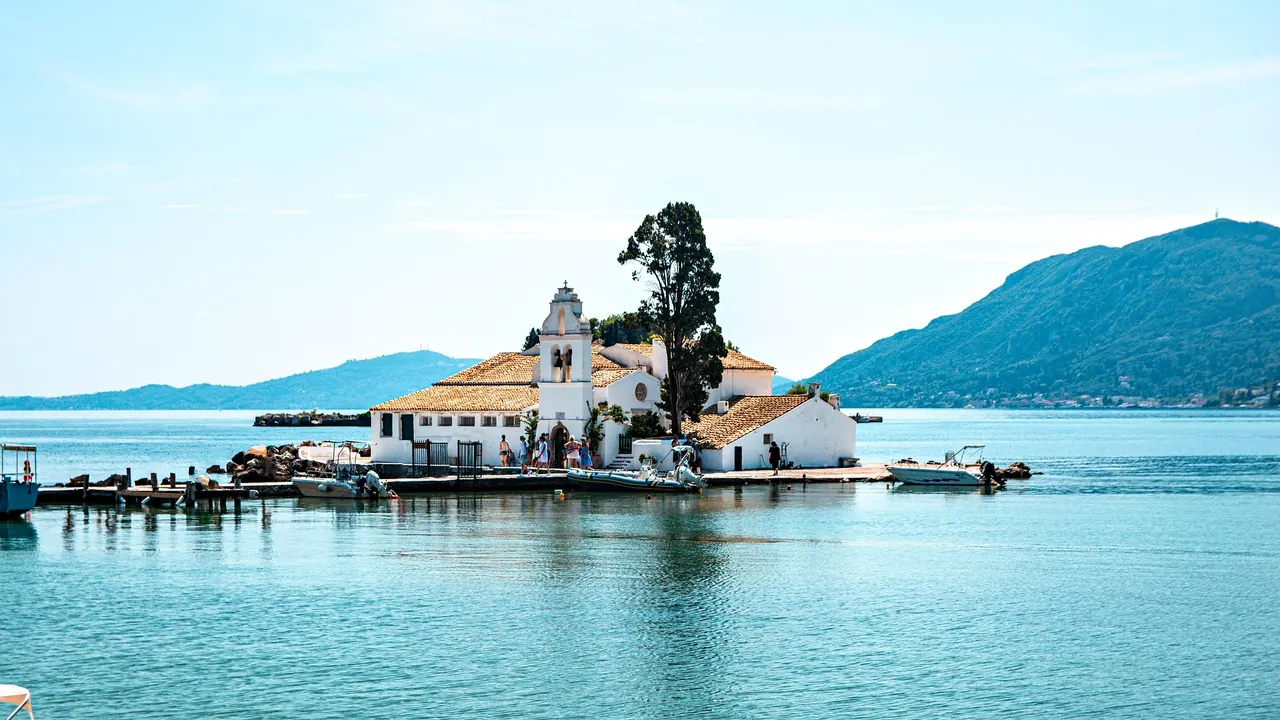
Photos: Corfu by Nico Hartnauer, Pexels License.
Corfu or Halkidiki?
Our verdict in twelve categories, each scored against the same fixed benchmark cities, and the climate month by month, so you can choose for your trip.
Choose Corfu for
- culture and sights
- shopping
- live music and the arts
Corfu suits travellers who want a beach stay with a real town attached. Corfu Town's Venetian lanes, fortresses and Liston arcades give the trip a second strand beyond swimming, and the island adds a cooking style of its own and evenings that run from cocktails in the old town to all-night Kavos. Choose it for a mixed trip of beaches, sightseeing and eating out.
Choose Halkidiki for
- wellness
- beaches
If the plan is to spend most of the day in the water, Halkidiki is the stronger pick. Its three peninsulas offer far more shore, pine forest running down to the sand and calm, shallow sea, with Sithonia's granite coves for quieter days. What you give up is a historic town to wander: Mount Athos is mostly seen from a boat, and anything urban means the drive to Thessaloniki.
Scoreboard
Twelve categories on one fixed scale from 0 to 100. The shaded stretch is the gap between the two.
Your match
Pick a travel style or drag the sliders, and both match scores follow your weighting.
Wins on culture and sights and shopping with your weighting.
Wins on wellness and beaches with your weighting.
What matters to you?
Category by category
What the scores mean for a trip.
Beaches & swimming
Both are first-rate beach destinations, and Halkidiki has slightly the deeper supply: hundreds of kilometres of shore across three peninsulas, pale sand and pine trees almost to the waterline. Kassandra has the organised beaches with sunbeds and bars, and Sithonia has the wilder granite coves, so you choose the style by choosing the peninsula.
Corfu's beaches vary more within one island. The west coast has long sands at Glyfada and Issos, sunsets and some surf, Paleokastritsa has small, very clear coves under green cliffs, and the northeast has calm pebble bays facing Albania. Boat trips to Antipaxos add some of the clearest water in the Ionian.
Food & drink
The eating is broadly level, but different in kind. Corfu has a cuisine of its own from its Venetian centuries, with pastitsada, sofrito and bourdeto, plus kumquat liqueur and ginger beer, so it rewards curious eaters who seek out the town's back lanes and inland villages.
Halkidiki is classic Greek seaside cooking done well: grilled fish and octopus, mussels and the region's big green olives in fishing villages such as Nikiti and Toroni, with thyme honey and Athos wines to take home. For anything more ambitious, people go to Thessaloniki for the day.
Culture & sights
Here Corfu is far ahead. Corfu Town alone fills several days, with its Venetian houses and kantounia, the Old and New Fortresses, Agios Spyridon, the Asian art museum and the Gorgon pediment in the Archaeological Museum, and the Achilleion and Angelokastro lie a short drive away.
Halkidiki's great monument, Mount Athos, is closed to women and open to men only by permit, so most visitors see the monasteries from a cruise boat out of Ouranoupoli. Olynthos, ancient Stagira and the Petralona cave make pleasant half-days rather than a reason to come.
Nightlife
Corfu has the wider range of evenings. Kavos is a full party resort running until dawn, Ipsos and Dassia have a mixed strip of late bars, and Corfu Town offers a grown-up night out under the Liston arcades and in the old lanes, which also keeps going in winter.
Halkidiki's scene is narrower and almost all on Kassandra: open-air clubs at Kallithea and bar strips in Pefkohori and Hanioti, livened up at weekends by young Greeks from Thessaloniki. It shuts down after early September, and Sithonia's evenings are for the waterfront taverna.
Nature & outdoors
The two are roughly even outdoors, but Corfu is the walker's island and Halkidiki the place for the water. Corfu is lush with olive groves and cypresses, and Mount Pantokrator, its abandoned stone villages and the island-long Corfu Trail give real hiking, with the Korission lagoon for birdwatchers.
Halkidiki's best scenery is Sithonia's granite headlands and pine slopes, explored most easily by sea kayak or on boat trips to Diaporos and its lagoon. Its one serious hike, the mule paths of Athos, is open only to men with a permit.
Day trips
Both offer a good spread of outings, and the difference is the means of travel. From Corfu almost everything goes by boat: Paxos and Antipaxos, Parga and Sivota on the mainland, and the ferry to Saranda for the ruins of Butrint in Albania, though most of these run only in season.
From Halkidiki you drive, and the big prize is Thessaloniki, a real city with Byzantine churches and serious food about an hour or so away. Vergina and Pella make a long day of Macedonian history, and Kavala and Amphipolis lie beyond the Athos side.
Good for families
Corfu has the edge for families because children have more to do once they tire of swimming. An inland water park and the fortresses of Corfu Town are a real break from the beach, and on an island this size neither is far away. The base matters more here, though, because the party resorts are on the same island as the family ones.\n\nAt the water's edge Halkidiki is just as good. The sand around Kassandra stays shallow a long way out, like Corfu's north coast and Issos, and its sea is usually calmer. The difference is the rest of the day: with almost nothing built for children, a week there is spent in the sea. Getting between the peninsulas means long drives in the summer heat.
Getting around
Corfu's roads are the tighter drive, narrow and twisting through the north and west, with heavy summer traffic around the town and airport. Still, the island is only about 60km long, so no western beach or hill village is far off. Corfu Town is best seen on foot, and a beach stay in a single resort works without a car if boat trips fill in the gaps.\n\nHalkidiki's main roads are better, but its geography works against you. Each peninsula is a long finger, so crossing from Kassandra to Athos means driving back up to the base and down the next one. Southern Sithonia is close to two hours from the airport, and in both places the buses run too rarely to build a stay around.
Shopping & style
Corfu gives you more to browse. The old town lanes around Nikiforou Theotoki and the Liston have olive-wood bowls, kumquat sweets, soaps and handmade jewellery, and there is a proper town for everyday needs.
Halkidiki has only resort strips of beachwear and souvenirs, with honey, olives, wine and the icons and incense of Ouranoupoli as the things worth carrying home. Anyone serious about shopping heads to Thessaloniki.
Affordability
Costs are much the same, and in both June and September are noticeably cheaper than high summer. In Corfu the expensive corners are the villa coast around Kassiopi and Corfu Town in July and August, and car hire adds up because you need it to explore.
Halkidiki's large domestic trade of Greek and Balkan families keeps plenty of simple rooms and village tavernas, while the big Kassandra resorts and paid sunbeds at organised beaches push the bill up.
Live music & performing arts
Corfu has a far stronger musical life, rooted in its Venetian past. Its historic philharmonic bands play on the Spianada and in village squares through the summer, Easter brings them out for the processions in Corfu Town, and kantades are still sung in tavernas.
Halkidiki has two summer festivals, the Kassandra Festival at Siviri's open-air amphitheatre and the jazz and classical evenings at Sani, and little else outside July and August.
Wellness & relaxation
Neither is a spa destination, though Halkidiki has the edge because of the thermal springs at Agia Paraskevi, warm mineral pools above the sea on Kassandra's southern tip, along with serious resort spas. Its calm lies in Sithonia and towards Ouranoupoli.
Corfu offers yoga retreats in the olive groves of the west and north, and its most restful bases are the hill villages and the quiet northeast coast, well away from the resort strips.
When should you go?
Pick your month. The climate figures are measured averages, not a forecast.
Corfu in July
Halkidiki in July
Daytime high, °C
Rainfall in the month, mm
Where the figures come from
Halkidiki's temperatures are measured 64 km from the centre, at Thessaloniki Airport.
Halkidiki has no rain gauge within 25 km of the centre, so its rainfall comes from a gridded climate dataset read at the destination rather than from a gauge further away.
Temperature and rainfall are climate normals, averaged over the years shown. Corfu: 1991-2020 normals, Kerkyra Airport (0.9 km from centre). Halkidiki: 1991-2020 normals, Thessaloniki Airport (63.7 km from centre).
Both are summer destinations with a swimming season from June to early October, and both reach about 32°C in July and August, too hot for much walking around in the middle of the day. Halkidiki's sea warms a little sooner and is already about 26°C in July, while Corfu's gets there in August. Spring and early autumn are the comfortable months for walking in both, with warm days in May and late September.
They split in the cooler half of the year. Corfu turns wet from September, and November and December are very rainy, with about 188mm in November, which is why the island is so green. Halkidiki stays much drier through autumn and winter but gets colder, down to about 10°C in January, so it has no real off-season appeal. Corfu's milder, wetter winter suits a quiet town stay better than Halkidiki's does.
Which traveller are you?
On a culture and arts trip, Corfu is the clear choice. Its UNESCO-listed old town, two fortresses, the Achilleion and Angelokastro sit alongside a living tradition of philharmonic bands and kantades, while Halkidiki offers little beyond the Athos boat cruise and two summer festivals.
For a food and nightlife trip, Corfu again comes out ahead. Venetian-rooted dishes such as pastitsada and bourdeto give its tavernas a character of their own, and evenings range from the Liston arcades to Kavos. Halkidiki's going out is mostly Kassandra's summer clubs and beach bars.
On a relaxing and wellness trip, Halkidiki has the edge. The thermal pools at Agia Paraskevi give it real bathing, the big resorts have serious spas, and Sithonia's pine-shaded coves are calm, whereas Corfu relies on hotel spas and the slow pace of a hill village.
Before you go
| Measure | Corfu | Halkidiki |
|---|---|---|
| Official language | Greek | Greek |
| Currency | Euro (EUR) | Euro (EUR) |
| Sockets | CF230 V, 50 Hz | CF230 V, 50 Hz |
| Driving side | Right | Right |
| Time zone | UTC+2, UTC+3 in summer | UTC+2, UTC+3 in summer |
| Emergency number | 112 | 112 |
| Main airport | Corfu Ioannis Kapodistrias International Airport (CFU)88 non-stop destinations | Thessaloniki Macedonia International Airport (SKG)93 non-stop destinations |
| Public holidays this year | 15 days | 15 days |
By the numbers
| Measure | Corfu | Halkidiki |
|---|---|---|
| Population | 100,854 | 110,587 |
| People per km² | 161 | 38 |
| Swim season, months above 21 °C | 5 months | 5 months |
Where else could you go?
Every comparison below shares a destination with this one, so you can follow Corfu or Halkidiki somewhere new.
- Lefkadavs Corfu
- Kefaloniavs Corfu
- Zakynthosvs Corfu
- Pugliavs Corfu
- Lefkadavs Halkidiki
- Peloponnesevs Halkidiki