Halkidiki or Peloponnese?
Our verdict in twelve categories, each scored against the same fixed benchmark cities, and the climate month by month, so you can choose for your trip.
Choose Halkidiki for
- nightlife
- families
- beaches
Halkidiki is the better pick for a straightforward beach vacation in northern Greece. Pine forest runs down to pale sand and calm, shallow water, family resorts on Kassandra are built for children, and the summer bars around Kallithea give younger travellers somewhere to go after dinner. Choose it if you want one base, a sunbed and little else on the agenda.
Choose Peloponnese for
- culture and sights
- nature and the outdoors
- day trips
The Peloponnese is the trip for people who want more from their days than the sea. Olympia, Mycenae, Epidaurus, Mystras and Monemvasia are all in one region, with mountain gorges, Nemea wine and Mani villages between them, and the Messinian coast still gives you some excellent swimming. Expect to drive a lot and to change bases. In return you get far more history and countryside, and it costs a little less.
Scoreboard
Twelve categories on one fixed scale from 0 to 100. The shaded stretch is the gap between the two.
Your match
Pick a travel style or drag the sliders, and both match scores follow your weighting.
Wins on nightlife and families with your weighting.
Wins on culture and sights and nature and the outdoors with your weighting.
What matters to you?
Category by category
What the scores mean for a trip.
Beaches & swimming
Halkidiki has the edge, simply because beaches are the whole point of the region. Its three peninsulas give you a choice: organised sand with sunbeds on Kassandra, or granite coves and pine-backed bays on Sithonia, all with calm turquoise water.
The Peloponnese runs it close and has more variety. There is the Voidokilia horseshoe and Navarino Bay in Messinia, the tropical-looking sand of Elafonisos and pebble coves in the Mani. Its beaches are spread across a much bigger area, though, and they empty out more noticeably outside high summer.
Food & drink
The Peloponnese eats better. It has Kalamata olives and oil, Mani cured pork, the Agiorgitiko reds of Nemea and Moschofilero whites from the Arcadian plateau, and Kalamata and Nafplio both have a decent range of places to eat.
Halkidiki's best meals are grilled fish in Nikiti, Toroni or Ouranoupoli. Its local finds are Athos wine and pine honey. The Kassandra resorts mostly serve repetitive menus, and serious eaters end up driving into Thessaloniki.
Culture & sights
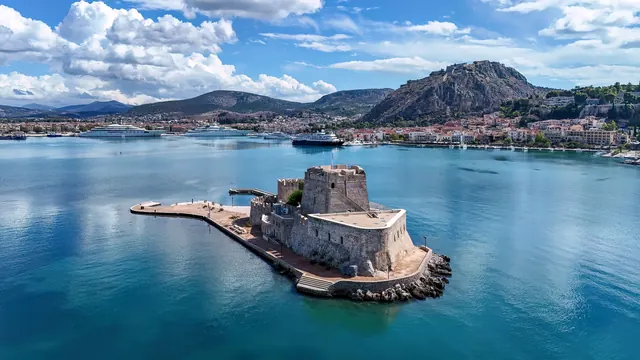
This is where the two differ most. The Peloponnese is one of Greece's great heritage regions. It has Mycenae's Lion Gate, the theatre at Epidaurus, Olympia and Messene from the ancient world, then Mystras, Monemvasia and the Venetian castles of Methoni and Koroni from the medieval centuries.
Halkidiki has one great heritage site, the monasteries of Mount Athos, and most visitors can only see them from a boat. Beyond that it offers half-days at Olynthos, Stagira, the Petralona cave and the stone village of Afytos.
Nightlife
Halkidiki goes out later, but only in summer and only on Kassandra. Kallithea has open-air clubs, and Pefkohori and Hanioti have bar strips that fill with young Greeks from Thessaloniki at weekends.
In the Peloponnese, evenings are mostly harbour-front drinks in Nafplio or Kalamata. Its only real club scene is in the university city of Patras, which is out of the way for most visitors.
Nature & outdoors
Halkidiki's nature is a coastal one: pine forest meeting clear water, at its finest around Sithonia's headlands and Mount Itamos, and best enjoyed from a kayak or a boat to Diaporos.
The Peloponnese has much more for anyone who walks. Taygetos rises to about 2,400m, the Lousios and Vouraikos gorges link monasteries and stone villages, and the bare Mani runs down to Cape Tainaron. There is also birdlife at the Gialova lagoon and skiing on Chelmos in winter.
Day trips
For Halkidiki, the obvious day trip is Thessaloniki, with Vergina and Pella beyond it, plus Ammouliani or Kavala from the Athos side.
The Peloponnese gives you more and better choices. From Nafplio you can take a ferry to car-free Hydra and Spetses or drive to Nemea's wineries. Further south are Monemvasia, Elafonisos and the Mani villages, and Athens is a two-hour drive. You will need a car for nearly all of them.
Good for families
Halkidiki is the easier choice with small children. The sand on Kassandra and around Gerakini shelves very gently, the sea is usually calm, and many large resorts are designed around families, so most days need no planning.
The Peloponnese has good family beaches too, at Tolo, in Messinia and on Elafonisos, and Mycenae or Olympia will interest older children if you go early in the day. Expect long drives and little shade at the sites.
Getting around
You need a car in both. In Halkidiki the peninsula shape is the problem: to go from one to the next you drive back to the base and down again, and Kassandra's single road gets slow on summer weekends.
The Peloponnese is a little easier, because motorways link the Corinth Canal with Kalamata and Olympia. Once you leave them, the Mani and mountain roads are slow and winding, and buses are no use for reaching sites.
Shopping & style
Neither is a shopping destination, but the Peloponnese has a bit more. Nafplio's old lanes sell jewellery, worry beads and ceramics, and there are lively weekly markets in Kalamata and Tripoli. In Halkidiki the best things to buy are olive oil, honey, and the icons and incense sold in Ouranoupoli. Otherwise it is resort beachwear.
Affordability
The Peloponnese works out somewhat cheaper. Family-run rooms in Mani and Arcadian villages and inexpensive taverna meals help, although a hire car and site entry fees add to the bill. Halkidiki is moderately priced thanks to its many simple apartments, but beachfront rooms and sunbeds on Kassandra get expensive in high summer. In both regions, June and September give you the same sea for less.
Live music & performing arts
The Peloponnese has the one performance worth planning a trip around: ancient drama at night in the theatre of Epidaurus, plus Kalamata's summer dance festival. Halkidiki's summer stages are the open-air Kassandra Festival at Siviri and the Sani Festival's jazz and classical evenings. These are pleasant if you are already there, but for anything more you go to Thessaloniki.
Wellness & relaxation
The two are about equal, and both are mostly about slowing down. Halkidiki has the more striking thermal bathing, at Agia Paraskevi above the sea, and its quietest stretches are on Sithonia and towards Ouranoupoli.
In the Peloponnese the peace is in stone villages and empty out-of-season coves. Its bathing is in the old spa towns of Loutraki and Methana and at the sulphur lake at Kaiafas.
When should you go?
Pick your month. The climate figures are measured averages, not a forecast.
Halkidiki in July
Peloponnese in July
Daytime high, °C
Rainfall in the month, mm
Where the figures come from
Halkidiki's temperatures are measured 64 km from the centre, at Thessaloniki Airport.
Halkidiki has no rain gauge within 25 km of the centre, so its rainfall comes from a gridded climate dataset read at the destination rather than from a gauge further away.
Peloponnese's temperatures are measured 89 km from the centre, at Kalamata Airport.
Peloponnese has no rain gauge within 25 km of the centre, so its rainfall comes from a gridded climate dataset read at the destination rather than from a gauge further away.
Temperature and rainfall are climate normals, averaged over the years shown. Halkidiki: 1991-2020 normals, Thessaloniki Airport (63.7 km from centre). Peloponnese: 1991-2020 normals, Kalamata Airport (89 km from centre).
Both regions are at their best for the beach from June to September. July and August are equally hot, around 32°C, and in both the sea reaches about 26°C, too hot for long sightseeing walks but ideal for swimming. The Peloponnese stays warm for longer. Its sea is still pleasant in October, its days are sunnier through the year, and its winters are milder, about 15°C against Halkidiki's 10°C in January.
The rain also comes at different times. In Halkidiki it is spread fairly evenly from October to May. The Peloponnese is very dry in summer but turns wet in November and December, at about 95mm a month. For walking ancient sites and mountain trails in comfort, April, May and October suit the Peloponnese best. In Halkidiki the spring and autumn shoulder months are cooler and better for coast walks than for swimming.
Which traveller are you?
On a culture and arts trip, choose the Peloponnese without hesitation. Mycenae, Epidaurus, Olympia, Messene and Byzantine Mystras are all within its borders, and you can see a summer drama at Epidaurus. Halkidiki has Olynthos, Stagira and a boat trip past Mount Athos.
For an outdoors trip, the Peloponnese also wins. It has Taygetos, the Lousios gorge, the long Menalon Trail and the stark Mani coast for walking. Halkidiki's outdoor life is mostly kayaking and snorkelling along Sithonia, and its one real hike is on Athos, open only to men with a permit.
On a family trip with young children, Halkidiki makes life easier. Kassandra, Gerakini and Psakoudia have long stretches of shallow sandy water, and there are plenty of resorts with pools and kids' clubs. The Peloponnese also has good family beaches, but they are further apart and you spend more time in the car.
Before you go
| Measure | Halkidiki | Peloponnese |
|---|---|---|
| Official language | Greek | Greek |
| Currency | Euro (EUR) | Euro (EUR) |
| Sockets | CF230 V, 50 Hz | CF230 V, 50 Hz |
| Driving side | Right | Right |
| Time zone | UTC+2, UTC+3 in summer | UTC+2, UTC+3 in summer |
| Emergency number | 112 | 112 |
| Main airport | Thessaloniki Macedonia International Airport (SKG)93 non-stop destinations | Athens Eleftherios Venizelos International Airport (ATH)176 non-stop destinations |
| Public holidays this year | 15 days | 15 days |
By the numbers
| Measure | Halkidiki | Peloponnese |
|---|---|---|
| Population | 110,587 | - |
| People per km² | 38 | - |
| Swim season, months above 21 °C | 5 months | 5 months |
Where else could you go?
Every comparison below shares a destination with this one, so you can follow Halkidiki or Peloponnese somewhere new.
- Zakynthosvs Peloponnese
- Milosvs Peloponnese
- Kefaloniavs Peloponnese
- Parosvs Peloponnese
- Mykonosvs Peloponnese
- Lefkadavs Peloponnese