Mykonos or Peloponnese?
Our verdict in twelve categories, each scored against the same fixed benchmark cities, and the climate month by month, so you can choose for your trip.
Choose Mykonos for
- nightlife
- shopping
- beaches
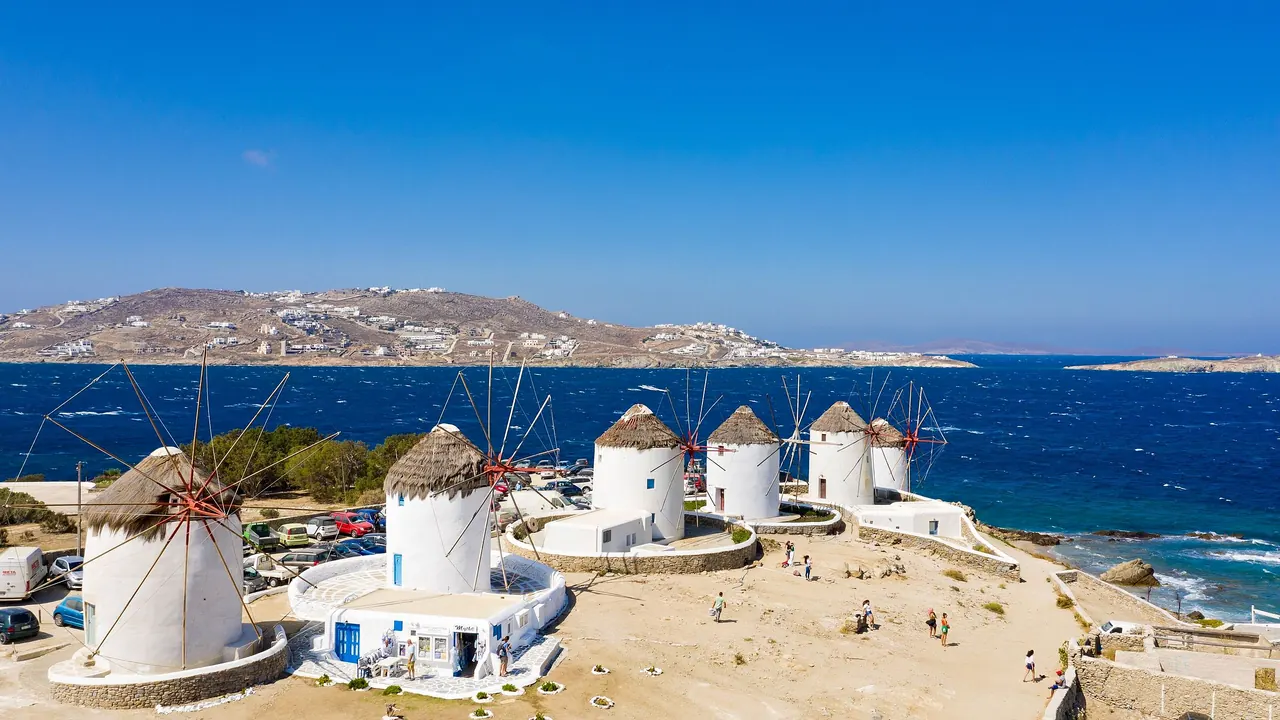
Mykonos suits a trip built around the sea by day and long nights after dark: beach clubs on the south coast, sunset in Little Venice, then Chora's bars and clubs running until sunrise in high summer. The island is compact, so your days go on sand rather than in a car. The price is high, though, and beyond Delos and the lanes of Chora there is little sightseeing to fill a week.
Choose Peloponnese for
- prices
- nature and the outdoors
- live music and the arts
Choose the Peloponnese for a road trip through Greek history and landscape. Mycenae, Epidaurus, Olympia, Mystras and Monemvasia lie within reach, with mountain gorges in Arcadia and quiet beaches in Messinia and on Elafonisos in between. It costs far less, eats better and is easier with children. In return you need a hire car and patience for long drives, and your evenings will end at a harbour taverna, not on a dance floor.
Scoreboard
Twelve categories on one fixed scale from 0 to 100. The shaded stretch is the gap between the two.
Your match
Pick a travel style or drag the sliders, and both match scores follow your weighting.
Wins on nightlife and shopping with your weighting.
Wins on prices and nature and the outdoors with your weighting.
What matters to you?
Category by category
What the scores mean for a trip.
Beaches & swimming
Both are strong beach destinations, with Mykonos slightly ahead. The real difference is in character. Mykonos packs its sandy bays along one south coast, from sheltered Ornos and Agios Ioannis to the sunbed rows of Psarou and the party beaches of Paradise and Super Paradise. Sea taxis link them, so you can try a different beach each day.
The Peloponnese spreads its beaches along a far longer coastline: the horseshoe of Voidokilia and Navarino Bay in Messinia, the pale sand of Elafonisos, and pebble coves under the Mani villages. These beaches are quieter and less organised, but far apart, so you pick one stretch of coast rather than sampling them all.
Food & drink
The Peloponnese eats better and more honestly. It has Kalamata olives and oil, slow-cooked goat and wild greens in village tavernas, and wine straight from the Agiorgitiko vineyards of Nemea and the Moschofilero country around Tripoli. Mykonos offers fine settings, with grilled octopus over the water in Little Venice and its own kopanisti cheese and louza pork. Much of its dining, though, is high-end and built for being seen, and everyday Greek food is a smaller part of it.
Culture & sights
Mykonos has one great sight, the sacred island of Delos, a short boat ride from the old harbour. Add the windmills, Little Venice and the Paraportiani church in Chora, and most visitors have seen it all in two or three days.
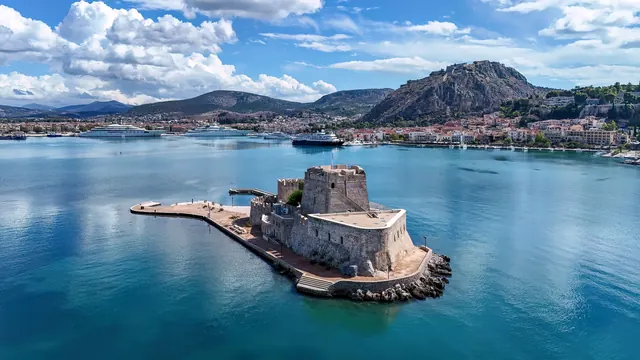
The Peloponnese is in another league. Olympia, Mycenae, Epidaurus, Messene and Bassae cover the ancient world, and Mystras, Monemvasia and the Venetian castles at Methoni and Koroni cover the medieval one. It could fill a fortnight, though seeing it all means moving between bases such as Nafplio and the Messinian coast.
Nightlife
Mykonos is far ahead here. Summer nights start with afternoon beach-club sessions at Paradise and move on to cocktail and dance bars in Chora's lanes, shaped by a long-established gay scene. Large clubs then carry on until sunrise.
In the Peloponnese, an evening means a long dinner and a drink on the waterfront in Nafplio or Kalamata. Only Patras, a university city on the north coast, has real clubs, and it is away from the beaches and sites where most visitors stay.
Nature & outdoors
The Peloponnese wins outright. Taygetos rises to about 2,400m above the Mani, the Lousios gorge links cliffside monasteries in Arcadia, and the Menalon Trail and the Vouraikos rack railway lead into the mountains. On the coast, the Gialova lagoon draws migrating birds.
Mykonos is low, rocky and brown, beautiful for its light and sea rather than its land. Its outdoor strengths are on the water: kitesurfing and windsurfing in the meltemi at Korfos and Kalafatis, and diving around reefs and wrecks.
Day trips
Every outing from Mykonos is by boat: first Delos, then Tinos, Syros, Paros and Naxos. All are Cycladic islands, and the meltemi can cancel crossings. The Peloponnese offers more range. There are the car-free islands of Hydra and Spetses off the Argolid, the wine villages of Nemea, the mountain villages of Arcadia and Monemvasia, with Athens about two hours away, though almost every trip needs a car.
Good for families
The Peloponnese is the easier family choice. It has shallow sandy bays at Tolo, along the Messinian coast and on Elafonisos, resort hotels with kids' clubs, and sites such as Mycenae and Olympia for older children. The cost is long hours in the car.
Mykonos can work at quiet south-coast bays such as Agios Stefanos or Ornos, and there is a water park near Elia. But the island is built around adult nights out, and Chora gets loud and crowded late in high summer.
Getting around
Neither is simple without your own transport, and the problems differ. On Mykonos, nowhere is far, Chora is walkable, and buses and sea taxis reach the main south-coast beaches. The trouble is too few taxis and congested roads in July and August. The Peloponnese is a large region that needs a car throughout. Fast motorways link the towns, but mountain roads are slow and buses rarely reach sites or beaches.
Shopping & style
Mykonos is the better place to shop, though only in one narrow way. Matoyianni Street and the lanes around it are full of resort wear, swimwear, Greek jewellery and galleries, open late into the evening. The Peloponnese has little beyond the small boutiques of Nafplio. Its best finds are things to eat and drink: Kalamata olive oil, mountain honey, wine bought at the wineries of Nemea, and the weekly markets in Kalamata and Tripoli.
Affordability
The gap is wide. In summer, Mykonos is one of the most expensive places in Europe, with hotels, beach-club sunbeds and cocktails priced for a luxury crowd. Inland rooms and gyros only soften the bill.
The Peloponnese costs far less. Family-run rooms in the Mani and Arcadian villages, taverna meals and local wine are all good value. The main extra costs are a hire car, fuel and entry fees at the sites.
Live music & performing arts
Neither is a destination for the stage, but the Peloponnese has one event worth planning a trip around. Ancient drama is performed on summer weekend nights in the theatre of Epidaurus, with concerts at the Little Theatre nearby and a dance festival in Kalamata in July. Mykonos has club DJs and the odd village festival or open-air concert, but nothing worth booking a trip for.
Wellness & relaxation
The Peloponnese is the better place for rest. It offers slow village afternoons, empty coves outside high season, old spa towns at Loutraki and Methana, and the warm springs that feed the lake at Kaiafas. On Mykonos, wellness means hotel spas and yoga terraces. Its late-night summer rhythm works against calm unless you stay near Agios Sostis, Ftelia or beyond Kalafatis, or come in early June or late September.
When should you go?
Pick your month. The climate figures are measured averages, not a forecast.
Mykonos in July
Peloponnese in July
Daytime high, °C
Rainfall in the month, mm
Where the figures come from
Mykonos has no weather station within reach, so its figures come from a gridded climate model rather than a measured record, and read a broad area rather than one spot.
Peloponnese's temperatures are measured 89 km from the centre, at Kalamata Airport.
Peloponnese has no rain gauge within 25 km of the centre, so its rainfall comes from a gridded climate dataset read at the destination rather than from a gauge further away.
Temperature and rainfall are climate normals, averaged over the years shown. Mykonos: 2001-2020 normals, NASA POWER reanalysis grid, no weather station within 90 km. Peloponnese: 1991-2020 normals, Kalamata Airport (89 km from centre).
Mykonos stays mild through summer. Highs peak at about 25°C in July and August, warm enough for the beach but rarely too hot for Chora's lanes in the middle of the day. The sea is warm enough to swim from June to early October, and May to September is almost dry. Rain returns in October, and winter is cool and wet, with the wettest months close to 100mm. April, May and late October are pleasant for walking but too cool for the beach.
The Peloponnese runs much hotter. Highs reach 32°C in July and August, which is fine for the beach but too hot for ruins or hiking in the middle of the day. The sea also gets a little warmer, reaching 26°C. June, September and October bring long sunny days that suit both swimming and the ancient sites. May is sunny and warm enough for sightseeing, but the sea is still too cool for most swimmers. November and December are the wettest months.
Which traveller are you?
For a food and nightlife trip, Mykonos wins on going out, but plan for July or August, as its scene thins sharply either side. The Peloponnese suits slower, dinner-led evenings: ouzeri plates and Nemea wine, then a late drink on Nafplio's waterfront.
On a tight budget, the Peloponnese is the realistic choice. Stay in a village rather than Nafplio or a Messinian resort, travel in May, June or September, and set money aside for a car, the one cost you cannot avoid. Mykonos stretches any budget in summer.
For an outdoors trip, the Peloponnese lets you spend whole days on foot or on the water: a village-to-village walk in Arcadia, a climb above the Mani, kayaking or sailing along the coast. Plan for spring or autumn. Mykonos suits only those who come for wind and water sports.
Before you go
| Measure | Mykonos | Peloponnese |
|---|---|---|
| Official language | Greek | Greek |
| Currency | Euro (EUR) | Euro (EUR) |
| Sockets | CF230 V, 50 Hz | CF230 V, 50 Hz |
| Driving side | Right | Right |
| Time zone | UTC+2, UTC+3 in summer | UTC+2, UTC+3 in summer |
| Emergency number | 112 | 112 |
| Main airport | Mykonos Island National Airport (JMK)44 non-stop destinations | Athens Eleftherios Venizelos International Airport (ATH)176 non-stop destinations |
| Public holidays this year | 15 days | 15 days |
By the numbers
| Measure | Mykonos | Peloponnese |
|---|---|---|
| Population | 10,134 | - |
| People per km² | 96 | - |
| Swim season, months above 21 °C | 5 months | 5 months |
Where else could you go?
Every comparison below shares a destination with this one, so you can follow Mykonos or Peloponnese somewhere new.
- Naxosvs Mykonos
- Parosvs Mykonos
- Iosvs Mykonos
- Milosvs Mykonos
- Santorinivs Mykonos
- Zakynthosvs Peloponnese