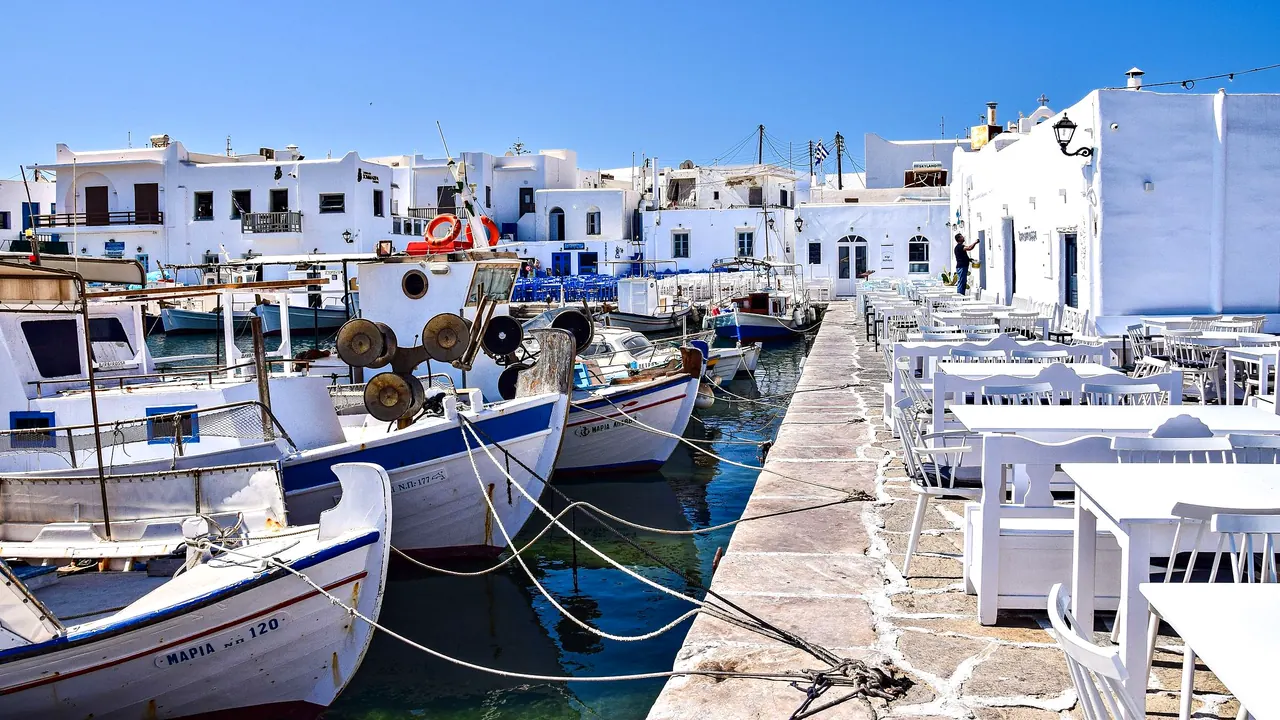
Photos: Paros by AXP Photography, Pexels License.
Paros or Peloponnese?
Our verdict in twelve categories, each scored against the same fixed benchmark cities, and the climate month by month, so you can choose for your trip.
Choose Paros for
- nightlife
- getting around
- shopping
Paros is the easier pick for a compact beach vacation on one island. The sandy bays are a short bus or boat ride apart, Naoussa's harbour keeps going past midnight in summer, and ferries to Antiparos and Naxos make good outings without a car. It suits travellers who want to unpack once, swim every day and go out in the evening, as long as they accept island prices in high summer and only a short list of sights.
Choose Peloponnese for
- culture and sights
- nature and the outdoors
- prices
Choose the Peloponnese for a road trip through Greek history and landscape. Mycenae, Epidaurus, Olympia, Mystras and Monemvasia are all in the one region, along with the Taygetos range, the gorges of Arcadia and the long beaches of Messinia. It costs less than the famous islands and suits people happy to drive and to change base once or twice. In return, evenings are quieter and almost everything depends on a hire car.
Scoreboard
Twelve categories on one fixed scale from 0 to 100. The shaded stretch is the gap between the two.
Your match
Pick a travel style or drag the sliders, and both match scores follow your weighting.
Wins on nightlife and getting around with your weighting.
Wins on culture and sights and nature and the outdoors with your weighting.
What matters to you?
Category by category
What the scores mean for a trip.
Beaches & swimming
Both are excellent for swimming, and the difference lies in how the beaches are spread. Paros packs its sandy bays around one small island: Kolymbithres with its smooth granite boulders, the longer sands of Santa Maria and the wide, gently shelving Golden Beach, all within a short ride. When the meltemi blows, you simply cross to the sheltered south or west coast.
The Peloponnese has far more coast and more variety. There is the horseshoe of Voidokilia and Navarino Bay in Messinia, the white sand of Elafonisos, and pebble coves and rock swimming in the Mani. The sea is slightly warmer, and outside July and August many beaches are close to empty, but reaching them takes longer drives.
Food & drink
Paros eats well along Naoussa's harbour, with drying octopus, chickpeas slow-baked in clay pots, island cheeses and souma. Naoussa also has a few more polished kitchens, though many places close once summer ends.
The Peloponnese has the edge for a trip built around food, mainly because it has more produce and more wine. Kalamata olives and oil, the Mani's cured pork and mountain goat come from close by, Nemea's Agiorgitiko reds and the Moschofilero whites of the Tripoli plateau can be tasted at the source, and Kalamata's covered market gives a morning of local life.
Culture & sights
On Paros the highlight is the Ekatontapiliani in Parikia, with the small archaeological museum, the Frankish castle and the ancient marble quarries at Marathi as pleasant extras. It is enough for a few half-days between swims.
The Peloponnese is in another league and can carry a whole trip. You have the Lion Gate at Mycenae, the theatre at Epidaurus, Olympia, Messene and the lone temple at Bassae, followed by Byzantine Mystras, the fortified rock of Monemvasia and the Venetian castles of Methoni and Koroni. Nafplio makes an elegant base for the Argolid sites, though the west and south need separate bases.
Nightlife
Paros is the better place to go out. In July and August Naoussa's harbour and lanes fill with a well-dressed cocktail crowd until late, Parikia's seafront and a few clubs draw a younger one, and beach bars hold parties, though it never becomes a party island.
Evenings in the Peloponnese mostly mean a long dinner and a stroll along a harbour front in Nafplio or Kalamata. Patras has the only real club scene, but it is a university city on the north coast, far from most beach and heritage bases.
Nature & outdoors
Paros is low Cycladic country of dry terraced hills, with one fine walk on the marble Byzantine path from Lefkes to Prodromos and coastal trails on the Agios Ioannis Detis headland. Its outdoor appeal is mostly on the water, with the wind and sailing trips around Antiparos.
The Peloponnese offers far more for hikers. You can climb Taygetos to about 2,400m, follow the Lousios gorge past cliffside monasteries, walk the long Menalon Trail or take the rack railway up the Vouraikos gorge. There is also stark walking down the Mani to Cape Tainaron and birdlife on the Gialova lagoon.
Day trips
From Paros, day trips mean island-hopping. Antiparos and its cave are close, Naxos Chora takes under an hour by fast boat, and in summer ferries reach Mykonos, Ios and Sifnos. Outside the season the boats thin out, and a strong meltemi can stop the smaller ones.
The Peloponnese offers more outings and runs them by road for most of the year. From Nafplio you can reach the car-free islands of Hydra and Spetses, the Nemea wine villages and even Athens. From the south and west you can visit Monemvasia, Elafonisos, the Mani tower villages and the old harbours of Pylos and Methoni.
Good for families
Both suit a simple beach stay with children about equally. Each has shallow sandy bays and tavernas that welcome children late in the evening, and neither has a zoo or theme park. Paros has the advantage of short distances, with Livadia and the east-coast beaches near Logaras and Piso Livadi a short hop from a calm village base.
The Peloponnese makes up for long hours in the car in other ways. Resort hotels in Messinia have kids' clubs and pools, and older children can explore Mycenae and Olympia if you go early, before the heat.
Getting around
Paros is much simpler to get around. You can cross the island in under half an hour, summer buses from Parikia's port reach Naoussa, Lefkes and the main beaches, and small boats cross the bay to Kolymbithres. A hired scooter or car helps only for the remoter coves.
In the Peloponnese a car is close to essential. Motorways make the main towns quick to reach, but mountain and Mani roads are slow, and buses barely reach the sites, beaches or villages.
Shopping & style
Neither is a shopping destination, but Paros is the better place to browse for clothes and gifts. Naoussa's whitewashed lanes and Parikia's market street have linen, resort wear, Greek designer jewellery and ceramics, though prices are high and the shops close when the season ends.
In the Peloponnese, Nafplio's old lanes are pleasant for jewellery and worry beads. The best things to bring home are olive oil, mountain honey and wine bought straight from the Nemea wineries, along with the local weekly markets in Kalamata and Tripoli, which Paros does not have.
Affordability
The Peloponnese is clearly cheaper. Family-run rooms in the Mani and Arcadian villages, village tavernas and local wine cost little, and only Nafplio and the luxury resorts of Messinia charge island-style prices. The main costs are a hire car, fuel and entry fees at the big sites.
Paros charges resort prices in July and August, especially in Naoussa and at the well-known beaches. You can save by staying in Parikia or the inland villages and by coming in June or September.
Live music & performing arts
The Peloponnese has one of the great experiences of a Greek summer: ancient drama at Epidaurus on weekend nights in July and August, in a theatre where the actors need no amplification. Kalamata adds an international dance festival in July.
On Paros, live culture means village feast days with violin and lute, the great mid-August feast of the Virgin at the Ekatontapiliani and Naoussa's pirate-raid festival with fireworks. These are lovely if your dates match, but there is little else to see.
Wellness & relaxation
The Peloponnese offers a little more for rest. It has real thermal springs at Loutraki and on the Methana peninsula, the warm sulphur lake at Kaiafas, and full spas at the Messinian resorts, as well as stone villages and coves that are empty outside high season.
Paros relies on hotel spas, a few yoga retreats and its pace of life. To unwind there, stay in Lefkes, Marpissa or Prodromos, or cross to Antiparos, rather than staying in Naoussa in August.
When should you go?
Pick your month. The climate figures are measured averages, not a forecast.
Paros in July
Peloponnese in July
Daytime high, °C
Rainfall in the month, mm
Where the figures come from
Paros's temperatures are measured 82 km from the centre, at Santorini Island / Monólithos.
Paros has no rain gauge within 25 km of the centre, so its rainfall comes from a gridded climate dataset read at the destination rather than from a gauge further away.
Peloponnese's temperatures are measured 89 km from the centre, at Kalamata Airport.
Peloponnese has no rain gauge within 25 km of the centre, so its rainfall comes from a gridded climate dataset read at the destination rather than from a gauge further away.
Temperature and rainfall are climate normals, averaged over the years shown. Paros: 2000-2025, 12 years observed (rainfall 1991-2020) normals, Santorini Island / Monólithos (81.8 km from centre). Peloponnese: 1991-2020 normals, Kalamata Airport (89 km from centre).
Winters are much alike, mild and fairly wet in both. On Paros the rain all but stops from May to September, and the sea is warm enough to swim from June into early October, reaching 24°C in August, while daytime highs sit around 30°C. The meltemi wind makes high summer feel fresher than the thermometer suggests. The rain returns in November, and from then until February the island is grey and mostly closed.
The Peloponnese runs hotter, at 32°C in July and August, with long sunny days and a sea that reaches 26°C, so the beach season is a little warmer and lasts well into October. That heat makes midsummer hard going for the open ancient sites and for walking below the mountains. April, May and late September to October are the best months for sightseeing and hiking. Late autumn is wetter than on Paros, with about 95mm of rain in November.
Which traveller are you?
On a culture and arts trip, the Peloponnese wins easily. Paros offers the Ekatontapiliani and a few pleasant half-days, while the mainland has Mycenae, Olympia, Messene, Mystras and Monemvasia, plus ancient drama on summer nights in the theatre at Epidaurus.
For a trip on a tight budget, the Peloponnese goes further. Paros eases off in June and September, especially in Parikia, but family-run rooms and village tavernas in the Mani and Arcadia cost less, even with a hire car.
On a beach and sun trip, Paros is easier. Its sandy bays lie a short bus or boat ride apart, with a sheltered shore close by when the wind rises. The Peloponnese has more coast, but nearly every beach means a drive.
Before you go
| Measure | Paros | Peloponnese |
|---|---|---|
| Official language | Greek | Greek |
| Currency | Euro (EUR) | Euro (EUR) |
| Sockets | CF230 V, 50 Hz | CF230 V, 50 Hz |
| Driving side | Right | Right |
| Time zone | UTC+2, UTC+3 in summer | UTC+2, UTC+3 in summer |
| Emergency number | 112 | 112 |
| Main airport | Paros National Airport (PAS)5 non-stop destinations | Athens Eleftherios Venizelos International Airport (ATH)176 non-stop destinations |
| Public holidays this year | 15 days | 15 days |
By the numbers
| Measure | Paros | Peloponnese |
|---|---|---|
| Population | 13,715 | - |
| People per km² | 71 | - |
| Swim season, months above 21 °C | 5 months | 5 months |
Where else could you go?
Every comparison below shares a destination with this one, so you can follow Paros or Peloponnese somewhere new.