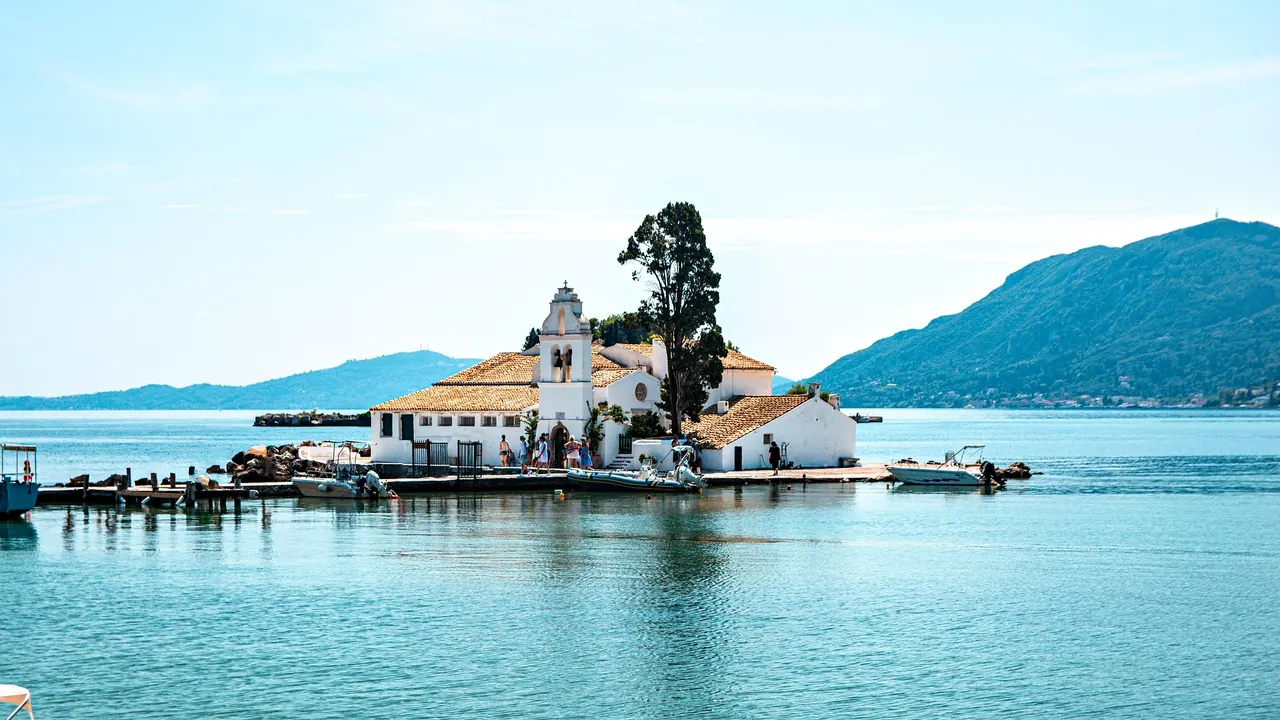
Photos: Corfu by Nico Hartnauer, Pexels License.
Corfu or Kos?
Our verdict in twelve categories, each scored against the same fixed benchmark cities, and the climate month by month, so you can choose for your trip.
Choose Corfu for
- live music and the arts
- culture and sights
- food and drink
Corfu is the island for travellers who want more than the beach. Its Venetian old town, the Achilleion and Angelokastro give it real sightseeing, its cooking has a character of its own, and its green hills and long trail reward walkers. It suits a varied trip with a hire car, where days at the beach alternate with villages, fortresses and long lunches.
Choose Kos for
- getting around
- wellness
Kos makes more sense for an easy, uncomplicated sun-and-sand week. It is compact and flat, with buses along the main road and cycle lanes from Kos Town, so getting to the beach takes little planning. The ruins of Kos Town and the Asklepieion fill a couple of days, and the rest is sandy beaches, resort pools and boat trips to Nisyros or Bodrum.
Scoreboard
Twelve categories on one fixed scale from 0 to 100. The shaded stretch is the gap between the two.
Your match
Pick a travel style or drag the sliders, and both match scores follow your weighting.
Wins on live music and the arts and culture and sights with your weighting.
Wins on getting around and wellness with your weighting.
What matters to you?
Category by category
What the scores mean for a trip.
Beaches & swimming
These are equally strong beach islands, and the difference lies in the kind of coast. Corfu offers more variety: long sandy beaches and sunsets on the west coast, clear coves under cliffs at Paleokastritsa, calm pebble bays in the northeast, and boat trips to the turquoise water of Antipaxos.
Kos is more consistently sandy, with long, open strands on the north coast from Tigaki to Mastichari. The catch is the summer meltemi, which can make the sea there choppy. For calm, clear water, head to the south coast and the Kefalos bays, such as Paradise Beach and Agios Stefanos.
Food & drink
Corfu gives you more to seek out at the table. Its Venetian past shows in pastitsada, sofrito and bourdeto, which you won't find elsewhere in Greece, along with kumquat liqueur and the island's own ginger beer.
Kos offers pleasant, standard island cooking: grilled octopus, meze, chickpea fritters and wine-matured cheese, best eaten in Zia, Pyli or the fishing harbours. On both islands the resort menus are weak, but on Corfu the reward for avoiding them is greater.
Culture & sights
Corfu Town is the reason Corfu pulls clearly ahead: a whole Italianate old town of kantounia lanes, the Liston arcades and two fortresses, plus the Achilleion and clifftop Angelokastro further out. Sightseeing here can easily fill several days.
Kos has a different kind of history, mostly ancient. Roman and Hellenistic ruins sit among the streets of Kos Town, the Knights' castle guards the harbour, and the terraced Asklepieion is the highlight. It is rewarding, but two or three days cover it.
Nightlife
There is little to choose between them for going out, and both split the same way: one dedicated party resort, Kavos on Corfu and Kardamena on Kos, and otherwise quiet evenings. The difference is in the main towns.
Corfu Town offers the more grown-up evening, with cocktails under the Liston and bars in the old lanes. In Kos Town's old quarter, the bars are louder and stay busy into the small hours. Corfu Town also stays open through winter, while Kos almost entirely closes down out of season.
Nature & outdoors
Corfu is much the greener and more varied island, with old olive groves, cypresses and spring wildflowers, the long Corfu Trail, and Pantokrator looking across to Albania. Sea caves at Paleokastritsa and the Korission lagoon add snorkelling, diving and birdwatching.
Kos is mostly low and dry, though the pine-covered Dikeos hills above Zia make a good sunset walk. Its outdoor strengths are activities rather than scenery: flamingos on the salt lake by Tigaki, flat cycling, and windsurfing and kitesurfing in the meltemi.
Day trips
On both islands day trips go by boat and are broadly as good, but each has a foreign neighbour across the water. From Corfu, a short ferry reaches Albania and the layered ruins of Butrint, and there are trips to Paxos and Antipaxos and to Parga on the mainland.
From Kos, the obvious trip is Bodrum in Turkey, with its crusader castle and bazaar. The more unusual outing is Nisyros, where you can walk to the rim of a volcanic crater, and Kalymnos and Pserimos are also close.
Good for families
Both islands suit families with young children, with gently shelving sandy beaches, resorts built around pools and kids' clubs, a water park and relaxed tavernas. Corfu's fortresses give older children a bit more to explore.
Kos has the practical edge on a small scale: the coastal land is flat and the distances short, so families can cycle together around Kos Town. On both islands, avoid the party resorts, Kavos and Ipsos on Corfu and Kardamena on Kos.
Getting around
Kos is clearly the easier island to get around. It is long and narrow, its roads are good, buses run the main road between the town, the airport and the resorts, and cycle lanes link Kos Town to its nearby beaches. A car is only needed for a day or two, to reach the hill villages and the far south-west.
Corfu is harder going. Its buses run too rarely to rely on, and the roads in the north and west are narrow and twisting. Summer traffic around the town is heavy, so most visitors who want to see the island end up hiring a car for the whole stay.
Shopping & style
Neither island is a shopping destination, but Corfu Town gives you more to browse. Its old lanes around Nikiforou Theotoki sell olive-wood bowls, kumquat sweets, soaps and handmade jewellery, and the newer town has ordinary clothing chains.
Kos Town's old quarter is mostly souvenirs, sponges and sandals. Its best stop is the Italian-era market hall for herbs, spices and local produce.
Affordability
Both islands cost about the same, in the middle range for the Mediterranean. Where the money goes differs. On Corfu, the villa-lined northeast coast and Corfu Town in midsummer are expensive, and the car hire most visitors need adds up.
Kos is built for package travel, so mid-range rooms are plentiful in Kardamena, Tigaki and Marmari. Buses and bikes cover much of the island, which keeps transport cheap, though harbour-front restaurants and sunbeds add up.
Live music & performing arts
Corfu has a musical life that is unusual for a Greek island. Its historic philharmonic bands play in the Spianada and village squares all summer, lead the Easter processions, and kantades serenades still turn up in tavernas.
Kos has much less: the summer Hippokrateia festival, staged in the Odeon, the Asklepieion and the castle, plus music at village saints' days and resort Greek nights. Out of season there is essentially nothing.
Wellness & relaxation
The two are evenly matched for unwinding, and on both islands the pace matters more than the spas. Kos has one thing Corfu lacks: the hot sulphur spring at Therma, where you bathe in rock pools where the hot water mixes with the sea.
Corfu's version of relaxing is a yoga retreat in the olive groves, or a stay in a hill village or on the quiet northeast coast. On either island, choosing a base away from the busy resorts is what makes the stay restful.
When should you go?
Pick your month. The climate figures are measured averages, not a forecast.
Corfu in July
Kos in July
Daytime high, °C
Rainfall in the month, mm
Where the figures come from
Kos has no rain gauge within 25 km of the centre, so its rainfall comes from a gridded climate dataset read at the destination rather than from a gauge further away.
Temperature and rainfall are climate normals, averaged over the years shown. Corfu: 1991-2020 normals, Kerkyra Airport (0.9 km from centre). Kos: 1993-2020 (rainfall 1991-2020) normals, Kos Airport (23.2 km from centre).
Both islands are beach destinations from June to September, with the sea warm enough to swim into early October and reaching about 26°C off Corfu in August. Midsummer is hot on both, around 32°C on Corfu, which makes July and August a time for the beach rather than for walking. May and late September are the better months for sightseeing and hiking on either island, with warm days and calmer heat.
The real difference is the rain. Kos is almost completely dry from June to August and stays fairly dry well into October, so autumn there is reliable. Corfu's wetter climate, the reason it is so green, returns in September, and by November it gets about 188mm of rain, twice as much as Kos. Corfu does have long sunny days in high summer, but for a late-season trip Kos is the safer choice. In winter both are mild but quiet, and the sea stays a little warmer around Kos.
Which traveller are you?
On a culture and arts trip, Corfu is the clear choice. Its UNESCO-listed old town, two fortresses, the Asian art museum and the Achilleion go much further than Kos's ruins, and its philharmonic bands and Easter processions give it a musical life Kos lacks.
For an outdoors trip, Corfu also wins. The Corfu Trail runs the length of a green island of olive groves, Mount Pantokrator has walks through abandoned villages, and the cliffs at Paleokastritsa suit snorkelling and diving. Kos has fine windsurfing but much less landscape.
For a beach and sun trip, Kos is the easier pick. Its beaches are mostly sand, its summers are reliably dry, and buses and cycle paths reach much of the coast. On Corfu, the best western beaches really need a car on winding roads.
Before you go
| Measure | Corfu | Kos |
|---|---|---|
| Official language | Greek | Greek |
| Currency | Euro (EUR) | Euro (EUR) |
| Sockets | CF230 V, 50 Hz | CF230 V, 50 Hz |
| Driving side | Right | Right |
| Time zone | UTC+2, UTC+3 in summer | UTC+2, UTC+3 in summer |
| Emergency number | 112 | 112 |
| Main airport | Corfu Ioannis Kapodistrias International Airport (CFU)88 non-stop destinations | Kos International Airport "Ippokratis" (KGS)75 non-stop destinations |
| Public holidays this year | 15 days | 15 days |
By the numbers
| Measure | Corfu | Kos |
|---|---|---|
| Population | 100,854 | 33,387 |
| People per km² | 161 | 115 |
| Swim season, months above 21 °C | 5 months | 5 months |
Where else could you go?
Every comparison below shares a destination with this one, so you can follow Corfu or Kos somewhere new.