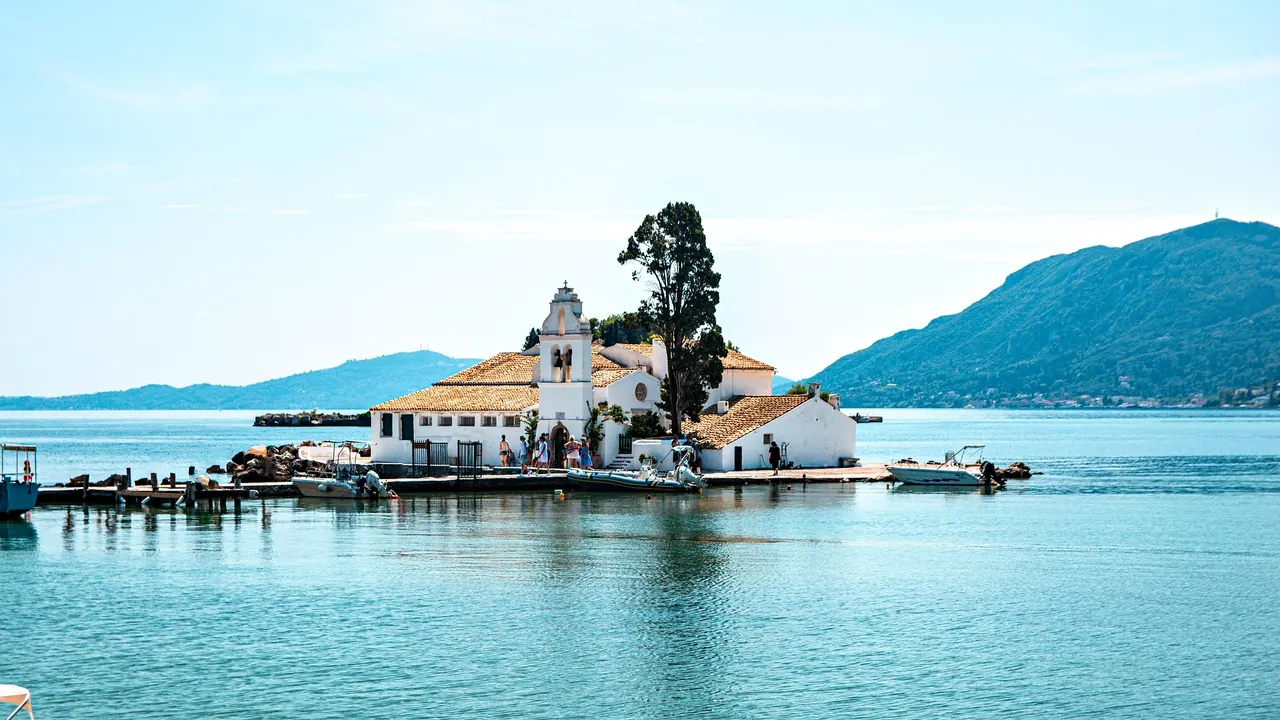
Photos: Corfu by Nico Hartnauer, Pexels License.
Corfu or Peloponnese?
Our verdict in twelve categories, each scored against the same fixed benchmark cities, and the climate month by month, so you can choose for your trip.
Choose Corfu for
- nightlife
- families
- shopping
Corfu suits a beach vacation with one base and an easy rhythm. Families can settle on the shallow north coast, and boat trips do the travelling. Venetian Corfu Town is good for an evening stroll, and there is more going on after dark, from cocktails under the Liston arcades to the all-night strip at Kavos. It is the simpler choice for children and for anyone who would rather not spend the week behind a wheel.
Choose Peloponnese for
- nature and the outdoors
- culture and sights
- day trips
Travellers who want to move around and see things will get more from the Peloponnese. Mycenae, Epidaurus, Olympia, Mystras and Monemvasia give it a depth of history that Corfu cannot match, and the mountains of Taygetos and Arcadia offer serious walking. The price is a hire car, long winding drives and quiet nights. In return, meals and village rooms cost a little less.
Scoreboard
Twelve categories on one fixed scale from 0 to 100. The shaded stretch is the gap between the two.
Your match
Pick a travel style or drag the sliders, and both match scores follow your weighting.
Too close to call, 2 points apart
Wins on nightlife and families with your weighting.
Wins on nature and the outdoors and culture and sights with your weighting.
What matters to you?
Category by category
What the scores mean for a trip.
Beaches & swimming
Both make an excellent base for a beach stay, and the difference is in the type of beach. Corfu gives you variety on one compact island: long sands and some surf on the west coast at Glyfada and Issos, small clear coves under the cliffs at Paleokastritsa, and calm pebble bays facing Albania around Kassiopi. It also has the boat trip to Antipaxos. The beaches near the big resorts get crowded in high summer, though.
The Peloponnese's best beaches are spread further apart. The Messinian coast has the horseshoe of Voidokilia and the sweep of Navarino Bay, Elafonisos has white sand in the far south, and the Mani has rocky swimming below stone villages. Outside July and August many of these beaches are close to empty, which is rare on Corfu.
Food & drink
Corfu has the more unusual cooking, with Venetian-influenced pastitsada, sofrito and bourdeto, kumquat liqueur and ginger beer. But the resorts fall back on menus aimed at package visitors, so the good meals have to be found in Corfu Town's back lanes and inland villages.
The Peloponnese eats more reliably well. Kalamata olives and oil, cured pork from the Mani, slow-cooked goat and wine from Nemea and the Tripoli plateau are part of ordinary country cooking, and Kalamata's covered market is worth a morning. Neither is a destination for fine dining.
Culture & sights
Corfu's culture is centred on one place, the UNESCO-listed old town with its two fortresses, the Liston and the Church of Agios Spyridon. The Achilleion palace and the cliff-top ruin of Angelokastro make good half-day outings. It is charming, and you can see most of it in a few days.
The Peloponnese works on a completely different scale. It has Bronze Age Mycenae and Tiryns, the theatre at Epidaurus, Olympia, Messene and the lone temple at Bassae, and then a medieval layer at Mystras, Monemvasia and the Venetian castles of Methoni and Koroni. Seeing it properly means more than one base and plenty of driving, but nowhere on Corfu comes close.
Nightlife
Corfu has far more going on after dark. Kavos runs until dawn for a young crowd, Ipsos and Dassia have beach bars and late venues, and Corfu Town offers a more grown-up evening in the old town lanes and under the Liston arcades.
In the Peloponnese, evenings mostly mean dinner and a drink on a harbour front in Nafplio or along Kalamata's seafront. Its only real club scene is in Patras, a university city on the northern coast that is off the route of most visitors.
Nature & outdoors
Corfu is lush rather than wild. It has olive groves and cypresses, walks on Mount Pantokrator at about 900m, the Corfu Trail, and sea caves at Paleokastritsa that are good for snorkelling and diving.
The Peloponnese offers much bigger landscapes. Taygetos rises far higher, the gorges of Lousios and Vouraikos cut through Arcadia and the north, Chelmos even has winter skiing, and the Mani peninsula is bare, rocky walking country. Both have a wetland for birdwatchers, Korission on Corfu and Gialova near Pylos, and on both the hiking season is spring and autumn.
Day trips
From Corfu, day trips go by boat: to Paxos and Antipaxos, to Parga and Sivota on the mainland, and across the strait to Albania for the ruins of Butrint. That last one is a genuine extra that the Peloponnese has nothing like. Most of these trips run only in the main season.
The Peloponnese offers more choice, provided you drive. From Nafplio you can reach car-free Hydra and Spetses, the Nemea wine villages and even Athens. Further south, Monemvasia, Elafonisos and the Mani villages each fill a good day.
Good for families
Corfu is the easier family choice. Gently shelving sands at Roda, Acharavi and Issos, resorts with pools and kids' clubs, a water park, and pirate-style boat trips keep children busy without long journeys. Parents just need to avoid Kavos and Ipsos.
The Peloponnese also has shallow bays, at Tolo, in Messinia and on Elafonisos, but it has no theme parks or aquariums. Its ancient sites have little shade, and there is a lot of time in the car, so it suits older children better than toddlers.
Getting around
Both are places where a car helps, but the scale is very different. Corfu is only about 60km long, so a car or scooter is enough to reach every beach, and staying in one resort with a few boat trips works fine without one.
The Peloponnese is much larger. Fast motorways link Corinth, Kalamata and Olympia, but mountain and Mani roads are slow, buses rarely reach the sites, and a car is close to essential. In both, the old towns of Corfu Town and Nafplio are best explored on foot.
Shopping & style
Neither is worth visiting for the shopping, but Corfu Town's lanes around Nikiforou Theotoki give a slightly better browse. Look for olive-wood bowls, kumquat sweets, soaps and handmade jewellery.
The Peloponnese's best buys are edible: olives and oil from Kalamata, mountain honey, and wine bought at the cellar door in Nemea. Nafplio's lanes are the place for ceramics and worry beads.
Affordability
The Peloponnese works out a little cheaper, especially if you sleep in family-run rooms in Mani or Arcadian villages and eat at village tavernas. Against that, you have to budget for a hire car and fuel, plus entry fees at the major sites.
Corfu is middling for a Mediterranean island. The package resorts on the north and east coasts are reasonable, while Kassiopi and Corfu Town in high summer are expensive. One saving is that a beach stay on Corfu can do without a car. On both, spring and autumn cost less than July and August.
Live music & performing arts
Neither has much of a year-round programme, but what each offers is different. Corfu's tradition is musical and local: historic philharmonic bands playing in the Spianada and in village squares, Easter processions led by brass bands, and kantades serenades in tavernas.
The Peloponnese has one major event: ancient drama on summer weekend nights in the theatre of Epidaurus, with its famous acoustics. Kalamata adds an international dance festival in July.
Wellness & relaxation
Hot springs are what separate these two. Corfu has no bathing tradition, so wellness there means the spas of the bigger resort hotels and a few yoga retreats in the olive groves of the west and north. Its calm depends on where you stay: a hill village or the quiet northeast coast is restful, while a resort strip in high summer is not.
The Peloponnese has real thermal water, at the old spa towns of Loutraki and Methana and in the sulphur-warmed lake at Kaiafas on the west coast. The Messinian resort hotels have the region's most complete spas. With empty coves outside high season and slow afternoons in stone villages as well, it is the better choice for a restful trip.
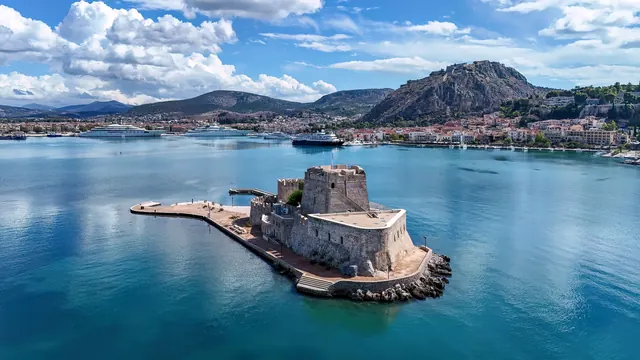
When should you go?
Pick your month. The climate figures are measured averages, not a forecast.
Corfu in July
Peloponnese in July
Daytime high, °C
Rainfall in the month, mm
Where the figures come from
Peloponnese's temperatures are measured 89 km from the centre, at Kalamata Airport.
Peloponnese has no rain gauge within 25 km of the centre, so its rainfall comes from a gridded climate dataset read at the destination rather than from a gauge further away.
Temperature and rainfall are climate normals, averaged over the years shown. Corfu: 1991-2020 normals, Kerkyra Airport (0.9 km from centre). Peloponnese: 1991-2020 normals, Kalamata Airport (89 km from centre).
For swimming, both are at their best from June to September. July and August reach about 32°C by day in both places, and the sea is around 26°C in August. That heat is fine for the beach but means walking old towns or ancient sites is best done early in the morning, so May and late September are the more comfortable months for sightseeing.
The real difference is rain. Corfu is green because its autumns and winters are wet. The rain returns in September, and November brings around 188mm, nearly twice what falls in that month on the Peloponnese coast where most visitors stay. The Peloponnese stays drier and a little sunnier well into October, so it is the safer choice for an autumn trip. Corfu is best kept to May through mid-September.
Which traveller are you?
On a culture and arts trip, the Peloponnese is the clear choice. Mycenae, Epidaurus, Olympia, Messene and Byzantine Mystras all lie in one region, and a summer night of ancient drama at Epidaurus outdoes anything Corfu offers beyond its Venetian old town.
On a family trip with young children, Corfu is easier. Its north coast and southern sands shelve gently, many resorts have pools and kids' clubs, and there is a water park inland. Boat trips also spare children the long car journeys the Peloponnese demands.
For an outdoors trip, choose the Peloponnese. Taygetos rises to about 2,400m, the Lousios gorge and the Menalon Trail link monasteries and stone villages, and the Mani has stark coastal walking. That is a bigger range than Corfu's Pantokrator and the Corfu Trail.
Before you go
| Measure | Corfu | Peloponnese |
|---|---|---|
| Official language | Greek | Greek |
| Currency | Euro (EUR) | Euro (EUR) |
| Sockets | CF230 V, 50 Hz | CF230 V, 50 Hz |
| Driving side | Right | Right |
| Time zone | UTC+2, UTC+3 in summer | UTC+2, UTC+3 in summer |
| Emergency number | 112 | 112 |
| Main airport | Corfu Ioannis Kapodistrias International Airport (CFU)88 non-stop destinations | Athens Eleftherios Venizelos International Airport (ATH)176 non-stop destinations |
| Public holidays this year | 15 days | 15 days |
By the numbers
| Measure | Corfu | Peloponnese |
|---|---|---|
| Population | 100,854 | - |
| People per km² | 161 | - |
| Swim season, months above 21 °C | 5 months | 5 months |
Where else could you go?
Every comparison below shares a destination with this one, so you can follow Corfu or Peloponnese somewhere new.
- Lefkadavs Corfu
- Kefaloniavs Corfu
- Zakynthosvs Peloponnese
- Milosvs Peloponnese
- Kefaloniavs Peloponnese
- Parosvs Peloponnese