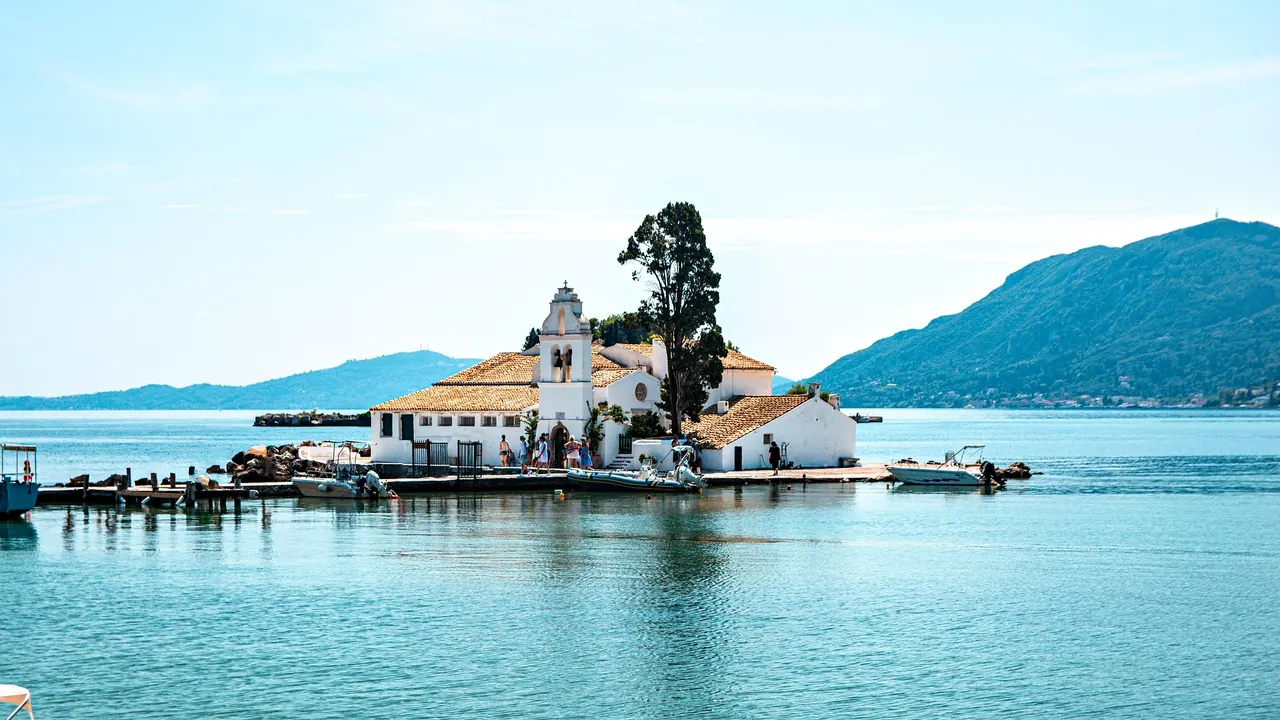
Photos: Corfu by Nico Hartnauer, Pexels License.
Brač or Corfu?
Our verdict in twelve categories, each scored against the same fixed benchmark cities, and the climate month by month, so you can choose for your trip.
Choose Brač for
Brač does not lead in any category we score.
Brač suits a slower, simpler sea vacation: a swim off pebbles in the morning, a long konoba dinner on a stone harbour, and perhaps an afternoon of windsurfing off Bol or a hike up Vidova Gora. It is quieter than Corfu, with fewer sights and less going on after dark. Its best outing is Split, a short ferry ride away, which supplies the city culture the island lacks.
Choose Corfu for
- culture and sights
- nightlife
- live music and the arts
Pick Corfu if you want more from an island than the beach. Corfu Town's Venetian old town, a more distinctive kitchen, a real choice of evenings and sandy, gently shelving beaches make it the fuller and more family-friendly vacation. It is also the cheaper of the two, apart from the smart northeast corner. Choose your base with care, though, because the party strips and the hill villages feel like different islands.
Scoreboard
Twelve categories on one fixed scale from 0 to 100. The shaded stretch is the gap between the two.
Your match
Pick a travel style or drag the sliders, and both match scores follow your weighting.
Has no clear advantage with the weighting you have chosen.
Wins on culture and sights and nightlife with your weighting.
What matters to you?
Category by category
What the scores mean for a trip.
Beaches & swimming
Both islands are true beach destinations, so the difference is in what lies underfoot. Brač is almost all pebble and rock. Its star is Zlatni Rat at Bol, a curving pebble spit with pine shade and very clear water, and the north coast villages have quieter bays, with sandy Lovrečina a rare exception.
Corfu has far more sand. There are long, dune-backed beaches on the west and south coasts, shallow sandy shores in the north, and small cliff-ringed coves around Paleokastritsa. Boat trips also run out to the turquoise bays of Antipaxos, so Corfu gives you more variety.
Food & drink
Corfu eats better and more distinctively. Its Venetian past shows in pastitsada, sofrito and fiery bourdeto, with kumquat liqueur and the island's own ginger beer on the side. The back lanes of Corfu Town add a city's choice of tables to the village tavernas.
Brač's kitchen is honest but narrow: grilled fish, octopus cooked under an iron lid, spit-roasted vitalac and good olive oil. The best meals are in inland villages such as Dol, and many places close outside summer.
Culture & sights
Corfu has far more to see. Corfu Town alone, with its UNESCO-listed Venetian lanes, the Liston and Spianada, two fortresses and several real museums, outweighs anything on Brač. Beyond the town there are the Achilleion and the clifftop ruins of Angelokastro.
Brač's heritage is quieter and lies in its white stone. The cliffside Blaca hermitage, the old walls and tower at Škrip, the stonemasons' harbour of Pučišća and a Tintoretto in Bol's Dominican monastery make for pleasant days of exploring rather than serious sightseeing.
Nightlife
After dark, Corfu has much more on offer, and in several styles. Kavos at the southern tip runs a full party strip until dawn, Ipsos and Dassia are livelier but more mixed, and Corfu Town has cocktails under the Liston arcades and bars in the old lanes.
On Brač the night is mostly dinner and a drink by the harbour. Bol's beach bars and a few open-air venues stay busy in July and August, but anyone after a real party usually takes the catamaran to Hvar.
Nature & outdoors
Both islands have good walking and water sports, but the landscapes could hardly be more different. Brač is dry, stony karst with dry-stone walls and pine, rising to Vidova Gora with its drop down to Zlatni Rat. The channel off Bol is a real windsurfing and kitesurfing spot.
Corfu is green and wooded, with old olive groves, cypresses and spring flowers. You can walk over Mount Pantokrator or follow the long Corfu Trail, explore the sea caves around Paleokastritsa, and watch birds at the Korission lagoon.
Day trips
The outings are about equally good, but they head in different directions. From Brač a car ferry takes you to Split and Diocletian's Palace, and walled Trogir and Omiš are close by on the mainland. A summer catamaran also reaches Hvar.
From Corfu every outing is by boat. You can visit the olive-grove island of Paxos and the bays of Antipaxos, cross to Albania for the ruins of Butrint, or sail to Parga on the Greek mainland. On both islands most of these connections run thin outside the main season.
Good for families
Corfu is the easier island with children. Its sandy northern and southern beaches shelve gently, and many resorts are built around pools and kids' clubs. There is a large water park inland, and the old fortresses keep older children busy.
Brač's sheltered north coast villages, such as Supetar and Postira, suit a calm stay in an apartment, but there is little made for children. The beaches are pebbly, and Zlatni Rat gets deep quite quickly.
Getting around
Arriving is where the two part ways. Most people reach Brač by car ferry from Split to Supetar or by catamaran to Bol and Milna, and its small airport takes mainly summer charters. That makes the crossing the bottleneck, with long queues on summer weekends. On the island a car or scooter is the sensible choice, though the road over the plateau to Bol is slow and winding.
Corfu's much larger airport has a far wider range of flights, so you land on the island itself. It is also a bigger island, about 60km long, with narrow, twisting roads in the north and west and heavy summer traffic around the town. Buses on both run too rarely to plan around, but on Corfu you can manage without a car by staying in one resort and adding boat trips.
Shopping & style
Neither island is a shopping trip, but Corfu Town at least gives you streets to browse. Its old lanes sell olive-wood bowls, kumquat sweets, soaps and jewellery, and there are ordinary clothing chains in the newer part of town. On Brač you mostly buy what the island makes: carved stone from Pučišća, olive oil, honey and wine. For anything else you go to Split.
Affordability
Corfu goes easier on the budget. Its tavernas, local wine and buses are fairly priced, and the package resorts on the north and east coasts offer reasonable rooms. Only the villa coast around Kassiopi and Corfu Town in midsummer are markedly dearer.
Brač in July and August costs about what Western Europe does, and car ferry fares add up. Private rooms in the north coast villages help. On both islands the shoulder months are noticeably cheaper.
Live music & performing arts
Corfu has a living musical tradition that Brač lacks. Its historic philharmonic bands play on the Spianada and in village squares, Easter processions march to their music, and kantades serenades survive in tavernas. There are also summer concerts in the Old Fortress.
Brač has no theatre or regular live-music venue. You may catch klapa singing or an open-air concert in Bol or Supetar, but for opera or theatre you cross to Split's summer festival.
Wellness & relaxation
On Brač, quiet comes from small stone harbours such as Milna, Povlja and Sumartin and from the villages inland, with hotel spas in Bol and Supetar when you want a massage or a sauna. Corfu adds yoga retreats in the olive groves of the west and north, and its most restful bases are the hill villages and the calm northeast coast, well away from the busy resort strips.
When should you go?
Pick your month. The climate figures are measured averages, not a forecast.
Brač in July
Corfu in July
Daytime high, °C
Rainfall in the month, mm
Where the figures come from
Brač's temperatures are measured 34 km from the centre, at Split / Marjan.
Brač has no rain gauge within 25 km of the centre, so its rainfall comes from a gridded climate dataset read at the destination rather than from a gauge further away.
Brač's sunshine is measured 34 km from the centre, at Split / Marjan.
Temperature and rainfall are climate normals, averaged over the years shown. Brač: 1991-2020 (sunshine 1971-2000) normals, Split / Marjan (33.5 km from centre). Corfu: 1991-2020 normals, Kerkyra Airport (0.9 km from centre).
The two islands follow almost the same summer pattern. The sea is warm enough to swim from June to early October and is at its warmest in August, about 25°C off Brač and 26°C off Corfu. July and August bring highs above 30°C on both, with long, very sunny days. That is too hot for hiking the bare Brač plateau or the Corfu Trail, and hard work in the streets of Corfu Town at midday. June and September are the best months for mixing beach days with walking and sightseeing, and May and early October suit walkers who can do without a warm sea.
They differ most in the wet half of the year. Both turn rainy from September, but Corfu's winters are much wetter, with November rainfall around 190mm against about 125mm on Brač. That rain is what keeps Corfu so green. Corfu is also a few degrees milder in winter, though neither island is a winter beach destination.
Which traveller are you?
On a culture and arts trip, Corfu wins. Brač gives you a few quiet mornings in stone villages, and any serious sightseeing means a day's ferry crossing to Split. On Corfu you can stay in a historic town and spend several days seeing it on foot, with music in the evenings.
On a family trip with young children, Corfu is less work for parents. Brač suits a quiet stay in one harbour village, but finding something for restless children means taking a ferry to the mainland. Corfu has its children's attractions on the island itself, as long as you avoid the party resorts.
For windsurfers and kitesurfers, Brač has the edge. The channel off Bol gets a reliable westerly on summer afternoons, and you ride it within sight of Zlatni Rat. Corfu's west coast gets some surf on windy afternoons, but the island is not known for a steady wind like Bol's.
Before you go
| Measure | Brač | Corfu |
|---|---|---|
| Official language | Croatian | Greek |
| Currency | Euro (EUR) | Euro (EUR) |
| Sockets | CF230 V, 50 Hz | CF230 V, 50 Hz |
| Driving side | Right | Right |
| Time zone | UTC+1, UTC+2 in summer | UTC+2, UTC+3 in summer |
| Emergency number | 112 | 112 |
| Main airport | Split Saint Jerome Airport (SPU)69 non-stop destinations | Corfu Ioannis Kapodistrias International Airport (CFU)88 non-stop destinations |
| Public holidays this year | 14 days | 15 days |
By the numbers
| Measure | Brač | Corfu |
|---|---|---|
| Population | 14,434 | 100,854 |
| People per km² | 36 | 161 |
| Swim season, months above 21 °C | 4 months | 5 months |
Where else could you go?
Every comparison below shares a destination with this one, so you can follow Brač or Corfu somewhere new.