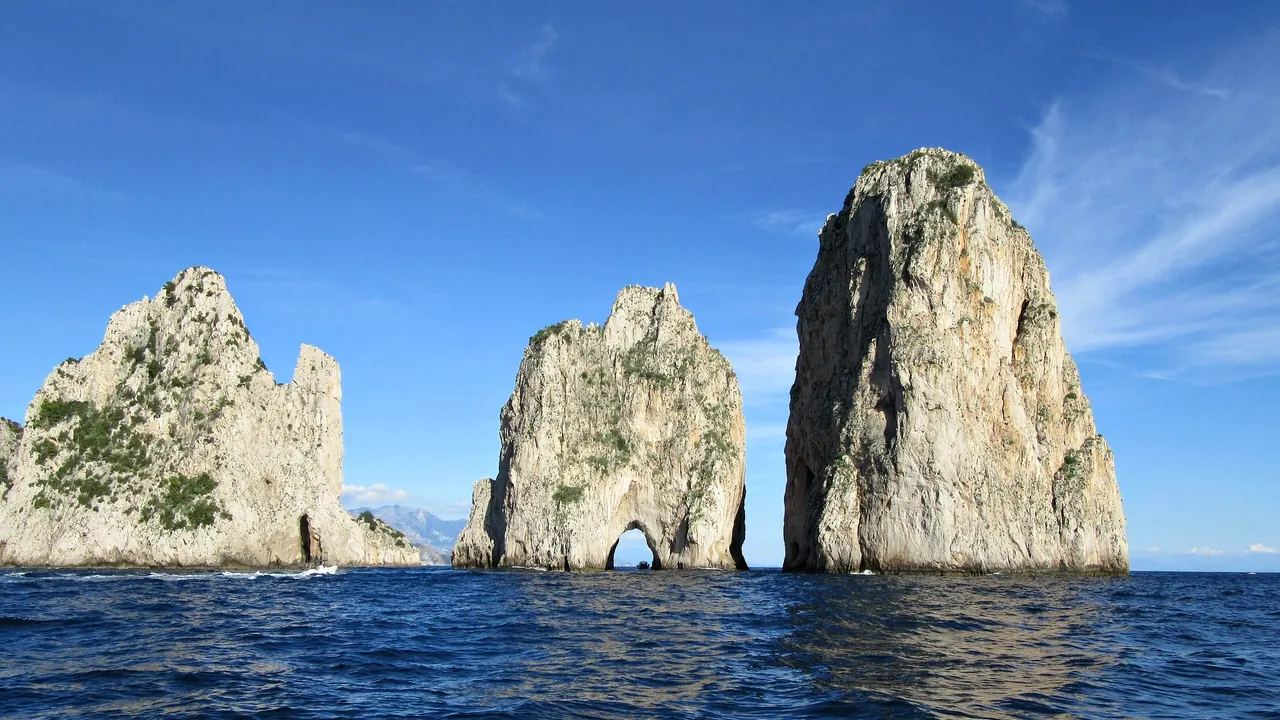
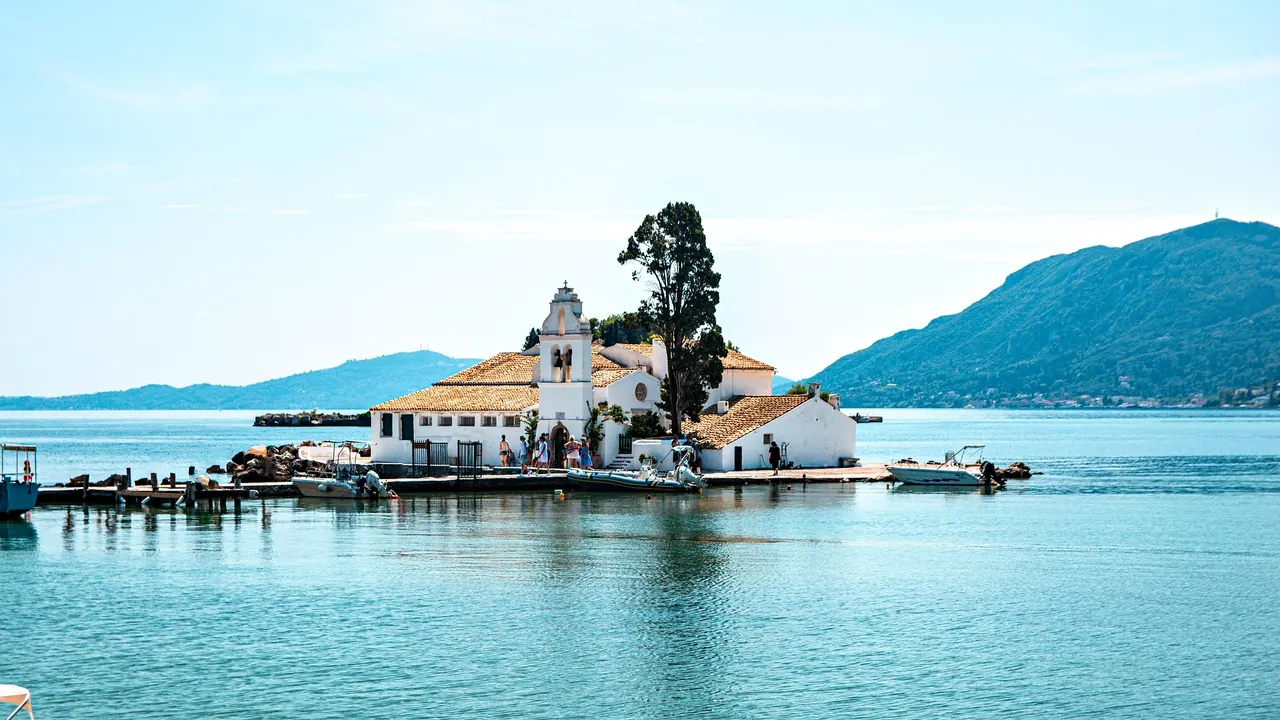
Photos: Capri by Sheeba Samuel, CC BY-SA 4.0, cropped; Corfu by Nico Hartnauer, Pexels License.
Capri or Corfu?
Our verdict in twelve categories, each scored against the same fixed benchmark cities, and the climate month by month, so you can choose for your trip.
Choose Capri for
- shopping
- getting around
- day trips
Capri suits a short, well-funded stay where scenery is the point: cliffs and sea stacks, steep paths between viewpoints, a boat round the grottoes and evenings dressed up on the Piazzetta. It is compact enough to manage without a car, and the whole Bay of Naples, from Pompeii to the Amalfi Coast, is a boat ride away. It is also very expensive, rocky rather than sandy, and hard work with small children.
Choose Corfu for
- prices
- families
- live music and the arts
Corfu is the better choice for a longer beach vacation, and especially for families or anyone watching costs. Its sandy west and north coasts, Venetian old town, distinctive cooking and wide range of evenings, from taverna dinners to all-night Kavos, give you far more to fill a week or two. The trade-off is size: you will want a car, and you need to choose your base with care.
Scoreboard
Twelve categories on one fixed scale from 0 to 100. The shaded stretch is the gap between the two.
Your match
Pick a travel style or drag the sliders, and both match scores follow your weighting.
Wins on shopping and getting around with your weighting.
Wins on prices and families with your weighting.
What matters to you?
Category by category
What the scores mean for a trip.
Beaches & swimming
Corfu is the island for beaches. The west coast has long sand at Glyfada, Agios Gordios and the dunes of Issos, the north coast is shallow and sandy, and the northeast has calm pebble bays near Kassiopi. Add boat trips to the turquoise water of Antipaxos and you can try a different kind of shore every day.
Capri is a place to swim rather than to lie on sand. You go in from small pebble coves at Marina Piccola, from rock platforms with ladders, or from the rocks below the lighthouse at Punta Carena. The water is superb, but space is tight and nobody comes for long walks along a beach.
Food & drink
Corfu has more to explore at the table. Its Venetian past gives it dishes found nowhere else in Greece, such as pastitsada, sofrito and the fiery fish stew bourdeto, along with kumquat liqueur and the island's own ginger beer. The village tavernas and the back lanes of Corfu Town reward a little searching.
Capri's own list is short but famous: insalata caprese, ravioli capresi and the almond torta caprese. Around the Piazzetta and the marinas you mostly pay for the view, so the better meals are in Anacapri's family trattorias under lemon pergolas.
Culture & sights
Corfu Town alone outweighs Capri here. It is a UNESCO-listed Venetian old town with two fortresses, the Liston arcades, a museum of Asian art and the Gorgon pediment in the Archaeological Museum. Beyond it are the Achilleion palace and the cliff-top ruins of Angelokastro.
Capri has a few fine sites rather than a historic town: Tiberius's Villa Jovis on its headland, Villa San Michele and the Certosa monastery. Two days covers it.
Nightlife
Corfu gives far more choice after dark, and it depends on where you stay. Kavos is a club strip that runs until dawn, Ipsos and Dassia have beach bars, and Corfu Town offers cocktails under the Liston and bars in the old lanes.
Capri has one main scene: the Piazzetta at aperitivo, followed by piano taverns where Neapolitan songs carry on late. It is glamorous rather than wild, and with no real clubs, a night or two exhausts it.
Nature & outdoors
Capri packs more drama into a small space. The Faraglioni stacks, the Arco Naturale and cliffs dropping hundreds of metres into very clear water are all within a short walk or boat ride of each other. The Sentiero dei Fortini, the chairlift up Monte Solaro and a trip round the sea caves fill a few memorable days.
Corfu's nature is gentler and greener, with olive groves, cypresses and spring wildflowers. It also has more room to roam: Mount Pantokrator, the island-long Corfu Trail and the Korission lagoon for birdwatchers suit walkers who come in spring or autumn.
Day trips
Capri's position in the Bay of Naples is hard to beat. Sorrento, Naples, Positano and Amalfi are all reachable by boat, and Pompeii and Herculaneum make a long but possible day. Ischia is close by too.
Corfu's outings are good but fewer: Paxos and Antipaxos, Butrint across the strait in Albania, and Parga on the mainland. On both islands everything depends on boats that run mainly in season and stop in rough weather.
Good for families
Corfu is far better with children. Sandy beaches in the north and south shelve gently into calm water, resorts are built around pools and kids' clubs, and there is a water park inland. Keeping away from Kavos and Ipsos keeps things calm.
Capri has nothing made for children. It has steps everywhere, deep water off rocks, and buses and a funicular that are packed in summer. Older children who swim well will enjoy the Blue Grotto and Monte Solaro, but small ones are easier on the mainland.
Getting around
Capri is small enough that you never need a car. The funicular, little orange buses and open taxis link the marinas, Capri town and Anacapri, though the walking is steep and summer queues can be long.
Corfu is about 60km long and its buses run too rarely to rely on, so most visitors hire a car or scooter for narrow, twisting roads. The alternative is to stay put in one resort and add boat trips.
Shopping & style
Capri punches far above its size. Via Camerelle and the lanes off the Piazzetta are lined with luxury boutiques, and the island's own sandals, linen, ceramics and perfumes give it real character, though nothing is cheap.
Corfu's shopping is simpler: olive-wood bowls, kumquat sweets, olive oil and jewellery in the old town lanes around Nikiforou Theotoki. The resorts have little beyond beachwear.
Affordability
This is where the two islands are furthest apart. Corfu is fairly priced for the Mediterranean, with reasonable taverna meals and package resorts on the north and east coasts. Only the villa coast around Kassiopi and Corfu Town in high summer push costs up, along with car hire.
Capri is among the most expensive places to stay in Italy, from hotel rooms to sunbeds to Piazzetta cocktails. The walks, buses and Anacapri bakeries help, but it is a place for a splurge rather than a budget.
Live music & performing arts
Corfu has a musical life unusual for a Greek island. Its historic philharmonic bands play in the Spianada and village squares through the summer, Easter processions move to their music, and kantades serenades survive in tavernas.
Capri offers little beyond occasional summer concerts at the Certosa or Villa San Michele and Neapolitan songs in the piano taverns. For opera, take the boat to Naples.
Wellness & relaxation
Neither island has a bathing tradition, so on both, relaxing means hotel spas and finding the right pace. On Capri, quiet comes with the time of day: the island is serene in the early mornings and evenings once the day-trippers leave, and Ischia's thermal baths are across the bay.
On Corfu, quiet comes with the place you stay. A hill village, a yoga retreat in the olive groves or the northeast coast is deeply restful, while the resort strips are not.
When should you go?
Pick your month. The climate figures are measured averages, not a forecast.
Capri in July
Corfu in July
Daytime high, °C
Rainfall in the month, mm
Where the figures come from
Capri has no rain gauge within 25 km of the centre, so its rainfall comes from a gridded climate dataset read at the destination rather than from a gauge further away.
Capri's sunshine is measured 58 km from the centre, at Grazzanise.
Temperature and rainfall are climate normals, averaged over the years shown. Capri: 2005-2025 (sunshine 1991-2020, rainfall 1991-2020) normals, Capri (3.6 km from centre). Corfu: 1991-2020 normals, Kerkyra Airport (0.9 km from centre).
On Capri the sea is warm enough to swim from June to early October, reaching about 26°C in August. Summer days peak around 30°C, which is warm but still manageable on the steep lanes and cliff paths. Corfu's sea warms and cools on almost the same pattern. Its summer is hotter, though, at close to 32°C in July and August, which makes walking and sightseeing in the middle of the day hard work. Both islands are at their driest and sunniest from June to August, and Corfu is slightly the sunnier of the two.
For walking, May is the best month on both islands, with warm, mostly dry days. September is still warm enough for the beach, but the rain comes back to both islands that month, slightly more on Corfu, and October is wetter again, so expect showers on either. The real difference is in winter. Capri's wettest month is November, while Corfu's rain is heavier and lasts longer, close to 190mm in November and nearly as much in December. That rain is what keeps Corfu so green. Neither island is a beach destination from November to March.
Which traveller are you?
On a family trip with children, Corfu is the clear choice. Its north and south coasts shelve gently into calm water, resorts have pools and kids' clubs, and tavernas welcome children. Capri's steps, ladders into deep water and crowded buses make it hard going with small children.
For a trip on a tight budget, Corfu again. Its taverna meals, buses and package resorts on the north and east coasts are fairly priced. Capri is among Italy's most expensive places to stay, and saving money there usually means missing its evenings.
On a shopping trip, Capri comes out ahead. The lanes off the Piazzetta pack in Italian luxury boutiques, and you can have sandals made to measure while you wait or buy perfume made on the island. Corfu offers olive-wood crafts, kumquat liqueur and ordinary Greek chains.
Before you go
| Measure | Capri | Corfu |
|---|---|---|
| Official language | Italian | Greek |
| Currency | Euro (EUR) | Euro (EUR) |
| Sockets | CFL230 V, 50 Hz | CF230 V, 50 Hz |
| Driving side | Right | Right |
| Time zone | UTC+1, UTC+2 in summer | UTC+2, UTC+3 in summer |
| Emergency number | 112 | 112 |
| Main airport | Naples International Airport (NAP)131 non-stop destinations | Corfu Ioannis Kapodistrias International Airport (CFU)88 non-stop destinations |
| Public holidays this year | 13 days | 15 days |
By the numbers
| Measure | Capri | Corfu |
|---|---|---|
| Population | 12,903 | 100,854 |
| People per km² | 1,241 | 161 |
| Swim season, months above 21 °C | 5 months | 5 months |
Where else could you go?
Every comparison below shares a destination with this one, so you can follow Capri or Corfu somewhere new.