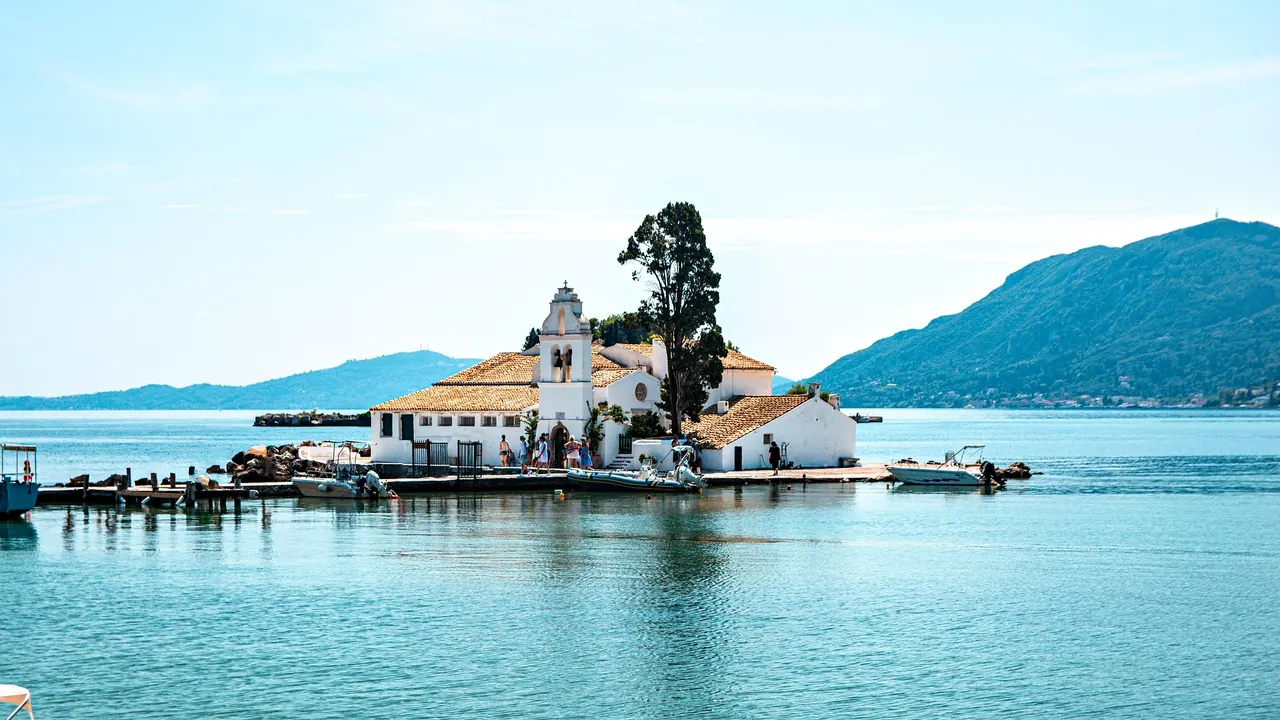
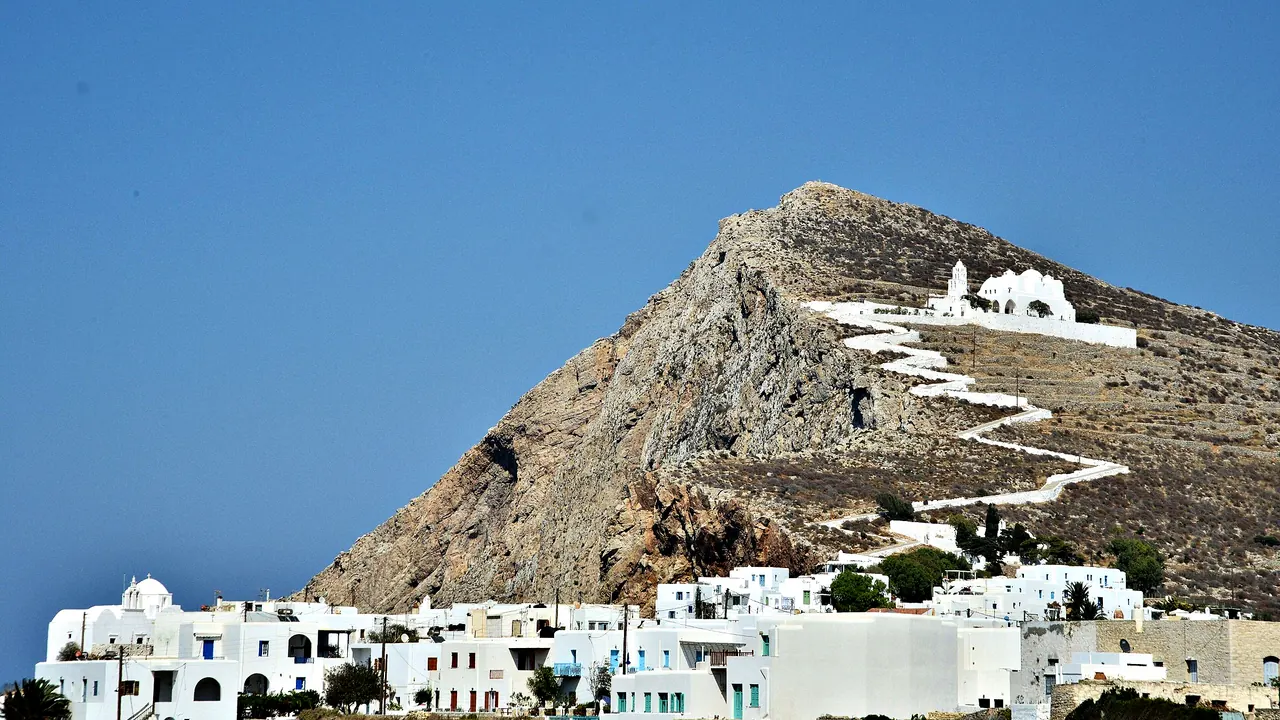
Photos: Corfu by Nico Hartnauer, Pexels License; Folegandros by Chris Kar, CC BY-SA 4.0, cropped.
Corfu or Folegandros?
Our verdict in twelve categories, each scored against the same fixed benchmark cities, and the climate month by month, so you can choose for your trip.
Choose Corfu for
- nightlife
- families
- culture and sights
Corfu is the island for a full, varied vacation. It has long sandy beaches on the west coast and shallow water in the north for children, a Venetian old town in Corfu Town with real sights, and a kitchen of its own. Evenings range from the Liston arcades to the clubs of Kavos, and boats run to Paxos, Albania and the mainland. It suits families, first-timers to Greece and anyone who wants each day to be different, provided they hire a car and pick their resort with care.
Choose Folegandros for
- getting around
Folegandros is for travellers who want very little to happen, and want it done beautifully. It has one cliff-top village, a car-free Chora with shaded squares for long dinners, footpaths over bare rock to clear shingle coves, and no resorts or clubs at all. Couples and walkers who like a slow week on one small island will love it. Anyone who needs sights, shopping, easy beaches for toddlers or nights out will run out of things to do quickly.
Scoreboard
Twelve categories on one fixed scale from 0 to 100. The shaded stretch is the gap between the two.
Your match
Pick a travel style or drag the sliders, and both match scores follow your weighting.
Wins on nightlife and families with your weighting.
Wins on getting around with your weighting.
What matters to you?
Category by category
What the scores mean for a trip.
Beaches & swimming
Corfu gives far more choice. It has wide sand with sunsets and some surf at Glyfada, Issos and Halikounas, clear coves under the cliffs at Paleokastritsa, shallow sandy water in the north and calm pebble bays near Kassiopi. Boats run to the turquoise bays of Antipaxos, but the beaches near the big resorts get crowded in summer.
Folegandros has small coves of shingle and sand with exceptionally clear water. Only Agali and the bays near the port are easy to reach. For the rest, such as Katergo or Livadaki, you take a boat or a rough path, often with no shade at all, and the north wind decides which side of the island is swimmable that day.
Food & drink
Corfu has the more distinctive and wider kitchen. Its Venetian legacy shows in pastitsada, sofrito and the fiery bourdeto fish stew, and it adds kumquat liqueur and ginger beer. The best meals are in Corfu Town's back lanes and inland villages rather than the package resorts.
Folegandros cooks simply but well for its size, with matsata pasta with rooster, soft souroto cheese and watermelon pie. Almost all of it happens in a handful of tavernas around Chora's squares, and the range is narrow.
Culture & sights
The gap here is wide. Corfu Town is a UNESCO-listed old town with two fortresses, the Liston and Spianada, the Church of Agios Spyridon, a museum of Asian art and the Gorgon pediment in the Archaeological Museum. Out on the island there are the Achilleion and the cliff-top ruin of Angelokastro, enough for several days.
On Folegandros, the sight is Chora's medieval Kastro, its houses forming the outer wall, plus the climb to the Panagia church and a folk museum in Ano Meria. It is lovely, but an afternoon covers it.
Nightlife
Corfu has real nightlife, though it depends on where you stay. Kavos is a full party strip that runs until dawn, Ipsos and Dassia are livelier but mixed, and Corfu Town offers bars in the old lanes and a few clubs on the coast road.
Folegandros has no clubs. Nights mean lingering in Chora's squares after dinner and a drink at a small cliff-edge bar, and many visitors come precisely for that.
Nature & outdoors
The two are about equal outdoors, but the landscapes could hardly be more different. Corfu is green with olive groves, cypresses and spring flowers. It has Mount Pantokrator at about 900m, the island-long Corfu Trail, diving off Paleokastritsa, birdwatching at the Korission lagoon and kayaking in the sheltered east channel.
Folegandros is a bare, almost treeless ridge with stone terraces, chapels and some of the highest sea cliffs in the Cyclades. Walking the waymarked paths is the main activity there, and boats run along the coast to sea caves such as Chrysospilia.
Day trips
From Corfu, regular excursion boats reach Paxos and Antipaxos, Parga and Sivota on the mainland, and the Diapontia islets. A short ferry to Saranda opens up Butrint, a UNESCO ruin in Albania, which is something few Greek islands can offer.
Folegandros is a place to stay put. Ferries reach Sikinos, Milos or Santorini, but not every day, and the wind can cancel crossings, so moving on usually makes more sense than coming back the same day.
Good for families
Corfu is much the easier family island. The north coast resorts and the southern sands of Issos and Agios Georgios slope gently into calm water. Many hotels have pools and kids' clubs, and there is a water park and pirate-style boat trips. The obvious places to avoid are Kavos and Ipsos.
Folegandros suits older children who like to swim and walk. Toddlers are limited to Livadi, Agali and the beaches near the port, the other coves are steep and shadeless, and the cliffs and strong summer wind need watching.
Getting around
Neither island is easy without wheels, but the problems differ. Corfu is about 60km long and its buses are sparse, so most visitors hire a car for the west coast and the hill villages and then face narrow, twisting roads and heavy summer traffic near town.
Folegandros is tiny, with a bus that covers the island's few roads and a Chora you can cross in minutes. Its beaches need hiking or a seasonal caique, though, and without an airport, getting there means a ferry that the wind can delay. Corfu has its own airport.
Shopping & style
Corfu has a modest but real run of shops in Corfu Town's old lanes, around Nikiforou Theotoki and behind the Liston. They sell olive-wood bowls, kumquat sweets, olive oil and soaps, with ordinary Greek chains in the newer streets. On Folegandros, shopping is an after-dinner browse through a few small shops in Chora selling jewellery, linen, ceramics, capers and honey.
Affordability
Corfu is the easier island on a budget. Its big package resorts on the north and east coasts keep rooms reasonable, and taverna meals and buses are fair. Costs rise around Kassiopi, in Corfu Town in midsummer and with car hire.
Folegandros leans towards boutique cliff-view hotels in Chora that fill early in July and August. Meals and buses are fair, and simpler rooms near Karavostasis or in Ano Meria, or a June or September visit, help bring the cost down.
Live music & performing arts
Corfu has a living musical tradition, where Folegandros has no stage at all. Corfu's Venetian past left it a band culture rare in Greece. Historic philharmonic bands, the oldest dating from the nineteenth century, play in the Spianada and in village squares through the summer, and at Easter they accompany the processions through Corfu Town. Kantades, serenades sung with guitar and mandolin, still turn up in tavernas, and summer classical evenings in the Old Fortress add a small formal programme.
Folegandros has no theatre or concert venue. Its music belongs to the summer panigyria held on saints' days, when island violin and lute play late into the night, and to the Easter procession of the Panagia icon. Otherwise you get a guitar in a Chora bar.
Wellness & relaxation
Neither island has a bathing tradition, and spas on both are limited to hotels, with Corfu adding a few yoga retreats in its olive groves. What both really offer is a slow pace. On Corfu you have to choose a hill village or the northeast coast to find it. On Folegandros, the car-free village and the absence of resorts make the whole island restful, especially in June and September.
When should you go?
Pick your month. The climate figures are measured averages, not a forecast.
Corfu in July
Folegandros in July
Daytime high, °C
Rainfall in the month, mm
Where the figures come from
Folegandros has no weather station within reach, so its figures come from a gridded climate model rather than a measured record, and read a broad area rather than one spot.
Temperature and rainfall are climate normals, averaged over the years shown. Corfu: 1991-2020 normals, Kerkyra Airport (0.9 km from centre). Folegandros: 2001-2020 normals, NASA POWER reanalysis grid, no weather station within 90 km.
Both islands can be swum from June into early October, but their summers feel quite different. Corfu gets properly hot, with highs around 32°C in July and August, so walking Corfu Town's lanes or the Corfu Trail is best left to spring and autumn. Long sunny days run from May to September, and in August its sea peaks at about 26°C. The rain returns hard in autumn, with November the wettest month at around 188mm. That rain keeps the island green, but it makes late autumn and winter a gamble.
Folegandros has a milder summer, with highs around 27°C in August and almost no rain from June to August. Its sea keeps pace with Corfu's through most of the year, even a touch warmer in late winter and spring, and only peaks a little lower in August. The north wind takes the edge off the heat in July and August but roughens the water and can disrupt ferries, which makes June and September the gentler months. It also dries out sooner in spring than Corfu, so April and May suit walking on both islands.
Which traveller are you?
On a family trip with children, Corfu is the clear choice. The north coast and Issos shelve gently into calm water, resorts have pools and kids' clubs, and there is a water park. On Folegandros, many coves need a steep walk and have no shade.
For a food and nightlife trip, Corfu wins. Its Venetian dishes, such as pastitsada and sofrito, give dinner real character, and evenings run from cocktails on the Liston to the late clubs of Kavos. Folegandros offers good dinners in Chora's squares, a few quiet bars and nothing more.
On a relaxing and wellness trip, Folegandros is the easier pick. The whole island is calm, with no big resorts and a car-free village, so you cannot pick the wrong base. On Corfu the same peace exists in hill villages and on the northeast coast, but you have to look for it.
Before you go
| Measure | Corfu | Folegandros |
|---|---|---|
| Official language | Greek | Greek |
| Currency | Euro (EUR) | Euro (EUR) |
| Sockets | CF230 V, 50 Hz | CF230 V, 50 Hz |
| Driving side | Right | Right |
| Time zone | UTC+2, UTC+3 in summer | UTC+2, UTC+3 in summer |
| Emergency number | 112 | 112 |
| Main airport | Corfu Ioannis Kapodistrias International Airport (CFU)88 non-stop destinations | Santorini International Airport (JTR)60 non-stop destinations |
| Public holidays this year | 15 days | 15 days |
By the numbers
| Measure | Corfu | Folegandros |
|---|---|---|
| Population | 100,854 | - |
| People per km² | 161 | - |
| Swim season, months above 21 °C | 5 months | 5 months |
Where else could you go?
Every comparison below shares a destination with this one, so you can follow Corfu or Folegandros somewhere new.
- Iosvs Folegandros
- Milosvs Folegandros
- Sifnosvs Folegandros
- Santorinivs Folegandros
- Paxosvs Corfu
- Parosvs Folegandros