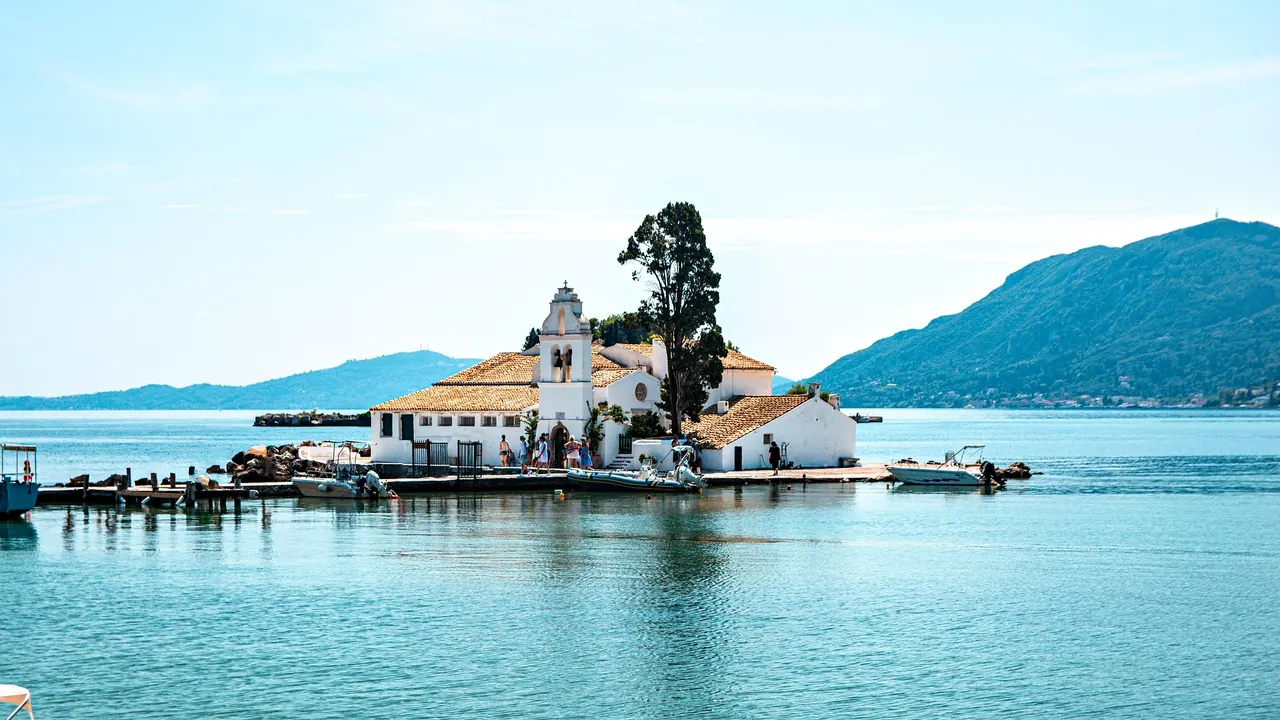
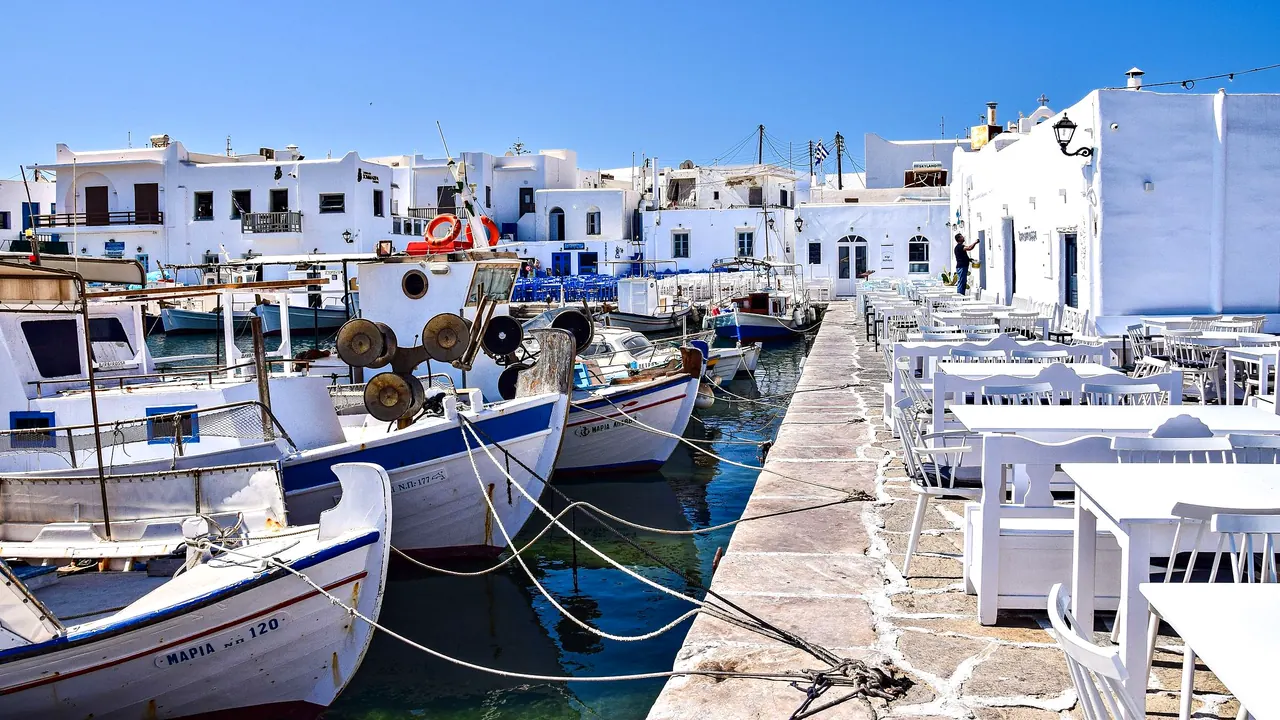
Photos: Corfu by Nico Hartnauer, Pexels License; Paros by AXP Photography, Pexels License.
Corfu or Paros?
Our verdict in twelve categories, each scored against the same fixed benchmark cities, and the climate month by month, so you can choose for your trip.
Choose Corfu for
- live music and the arts
- prices
- culture and sights
Corfu suits travellers who want more than the beach from their island. It has a UNESCO-listed old town with Venetian lanes, two fortresses and real museums, a green interior of olive groves and mountain walks, and families get gentle sandy shores in the north and south. It is also the gentler island on the wallet. The price is distance: it is a big island, and to see much of it you need a hire car on twisting roads.
Choose Paros for
- getting around
- food and drink
- day trips
Paros is the better pick for a compact, sun-and-sea Cycladic stay. The island is small enough to cross in under half an hour, the summer buses reach the main beaches, and the evenings centre on Naoussa's harbour. Fast ferries put Naxos, Antiparos and other islands within easy reach. Expect to pay more in high summer, and don't expect much culture or green countryside.
Scoreboard
Twelve categories on one fixed scale from 0 to 100. The shaded stretch is the gap between the two.
Your match
Pick a travel style or drag the sliders, and both match scores follow your weighting.
Wins on live music and the arts and prices with your weighting.
Wins on getting around and food and drink with your weighting.
What matters to you?
Category by category
What the scores mean for a trip.
Beaches & swimming
Both islands are true beach destinations, and the difference is in the kind of shore. Corfu offers more variety: long, sunset-facing sands with occasional surf on the west coast at Glyfada and Issos, clear coves under green cliffs at Paleokastritsa, and calm pebble bays facing Albania around Kassiopi. Its sea runs a couple of degrees warmer in late summer.
On Paros, the sand is set among granite boulders at Kolymbithres and stretches into wide, gently shelving bays around Golden Beach and Drios. The meltemi is what decides where you swim, since on windy days the south and west coasts stay calmer.
Food & drink
The two islands eat equally well, but they cook very differently. Corfu's table carries its Venetian history: pastitsada, sofrito and fiery bourdeto, with kumquat liqueur and ginger beer as local oddities. It is best found in Corfu Town's back lanes and inland villages rather than in the package resorts.
Paros is plainer and closer to the sea: octopus drying at Naoussa's harbour, clay-baked chickpeas, island cheeses and souma, along with local wines you can taste at the wineries. Naoussa also has more polished modern Greek cooking, but the choice thins out sharply once the season ends.
Culture & sights
Corfu has far more to see. Corfu Town alone, with its Italianate lanes, the Liston arcades, the Old and New Fortresses, Agios Spyridon and the Archaeological Museum with its Gorgon pediment, makes a full sightseeing programme. Beyond the town there are the Achilleion and the cliff-top ruin of Angelokastro.
Paros has one outstanding monument in the Ekatontapiliani, one of Greece's oldest churches. The rest is village texture: the windmills of Lefkes, the small Venetian fort at Naoussa and the ancient marble quarries at Marathi, which make good outings of half a day each.
Nightlife
Corfu has a true party resort and Paros does not. At Kavos, on Corfu's southern tip, a strip of bars and clubs aimed at young visitors runs until dawn from late spring to early autumn, while Ipsos and Dassia on the east coast have a smaller, more mixed run of beach bars. Corfu Town is the grown-up alternative, with cocktails under the Liston arcades and bars in the old lanes. In winter it is about the only place on the island with much still open.
Paros goes out in a dressier, more contained way. On summer nights, Naoussa's harbour and the lanes behind it fill with cocktail bars and a well-dressed crowd until past midnight, and Parikia's seafront is looser, with a few late clubs for a younger crowd. You can have a sociable night out and still be on the beach the next morning, and the scene has largely faded by late October.
Nature & outdoors
Corfu is the island for landscape. Olive groves and cypresses cover the island, Mount Pantokrator rises to about 900m above abandoned stone villages, the Corfu Trail runs its full length, and the Korission lagoon draws birdwatchers. Paleokastritsa's sea caves add snorkelling and diving.
Paros is dry, low Cycladic country with no forests or mountains. Its walks are short, such as the Byzantine path from Lefkes, and its outdoor strength is the wind, which drives the windsurfing and kitesurfing on the south-east coast.
Day trips
Both islands are good bases for trips by sea, and the destinations are what differ. From Corfu you can pair Paxos with the turquoise bays of Antipaxos, cross to Albania for the ruins of Butrint, or sail to Parga on the mainland.
Paros sits in the middle of the Cyclades. Antiparos and its cave are a short hop, Naxos's Chora is under an hour away, and summer ferries reach Mykonos, Ios and Sifnos. On both islands, boats are thin outside the season, and on Paros a strong meltemi can cancel the smaller ones.
Good for families
Corfu is the easier family island. Its north coast around Roda and Acharavi and the southern sands of Issos shelve into calm water, many resorts are built around pools and kids' clubs, and there is a large water park inland and pirate-style boat trips. Families simply need to steer clear of Kavos and Ipsos.
Paros has good shallow bays at Livadia, Golden Beach and Logaras, but beyond the sea there is very little built for children. The wind also means choosing a sheltered beach on blowy days.
Getting around
Paros is much easier to get around. It is small enough to cross in under half an hour, summer buses from Parikia reach Naoussa, Lefkes and the main beaches, and little boats cross the bay to Kolymbithres.
Corfu is about 60km long, with infrequent buses and narrow, winding roads in the north and west, so most visitors end up hiring a car or scooter. Without one, it works best to stay in a single resort and add boat trips.
Shopping & style
Neither island is a shopping destination, and each does small-scale browsing in its own style. On Corfu, it centres on Corfu Town's old lanes around Nikiforou Theotoki, with olive-wood bowls, kumquat sweets and soaps, and the town's ordinary clothing chains are useful for everyday needs.
Paros leans more towards style: linen, resort wear and Greek designer jewellery in Naoussa's whitewashed lanes, at higher prices, plus craft workshops in Lefkes. Most of these shops shut when the season ends.
Affordability
Corfu is clearly the cheaper island. The large package resorts on the north and east coasts keep rooms reasonable, and taverna meals and buses are fairly priced. Only the villa coast around Kassiopi and Corfu Town in high summer push costs up, along with car hire.
Paros is expensive in July and August, especially in Naoussa, where both rooms and harbour bars charge resort prices, and sunbeds and ferry hops add up. Staying in Parikia or the inland villages, or coming in June or September, makes it much more manageable.
Live music & performing arts
Corfu has a real musical life, which Paros lacks. Its philharmonic bands, a Venetian legacy dating back to the nineteenth century, play in the Spianada and village squares all summer and lead the Easter processions. You can also hear kantades serenades in tavernas and find classical evenings at the Old Fortress.
Live music on Paros comes almost entirely from village feast days, with island violin and lute, the great mid-August feast at the Ekatontapiliani and Naoussa's pirate-raid festival. Outside summer there is nothing to attend.
Wellness & relaxation
Neither island has a spa tradition. On both, wellness means hotel spas and a few yoga retreats, and rest comes from choosing a quiet base. On Corfu that means a hill village among the olive groves or the calm northeast coast, away from the resort strips.
On Paros, the restful choices are Lefkes, Marpissa or Prodromos, or crossing to Antiparos, rather than Naoussa in August.
When should you go?
Pick your month. The climate figures are measured averages, not a forecast.
Corfu in July
Paros in July
Daytime high, °C
Rainfall in the month, mm
Where the figures come from
Paros's temperatures are measured 82 km from the centre, at Santorini Island / Monólithos.
Paros has no rain gauge within 25 km of the centre, so its rainfall comes from a gridded climate dataset read at the destination rather than from a gauge further away.
Temperature and rainfall are climate normals, averaged over the years shown. Corfu: 1991-2020 normals, Kerkyra Airport (0.9 km from centre). Paros: 2000-2025, 12 years observed (rainfall 1991-2020) normals, Santorini Island / Monólithos (81.8 km from centre).
Both islands are beach weather from June to early October, but they behave differently at either end. Corfu gets hotter in high summer, around 32°C in July and August against Paros's 30°C, and its sea is a little warmer too, about 26°C in August. Paros is drier: from May to September it barely rains at all, while on Corfu the rain comes back in September and builds through autumn to a wet November of about 188mm.
That makes late September and early October more reliable on Paros, while Corfu shows its best side in May and June, when the days are long and sunny, the countryside is still green and the heat is not yet heavy for walking. Winter is mild on both, but Corfu's is noticeably wetter and greyer.
Which traveller are you?
On a culture and arts trip, Corfu is the clear choice. Corfu Town's Venetian old town, its two fortresses, the Asian art museum and the Achilleion fill several days, and philharmonic bands play in the squares. Paros has one great church and a handful of pleasant village half-days.
For a trip on a tight budget, Corfu again comes out ahead. Package resorts on the north and east coasts and fairly priced tavernas keep costs down, whereas on Paros, Naoussa, beach sunbeds and ferry hops push a summer week up noticeably.
Windsurfers and kitesurfers should head to Paros. The summer meltemi makes Golden Beach, New Golden Beach and Pounta some of the best spots in the Aegean, with schools and equipment hire at each. Corfu offers a little surf on the west coast but nothing on that scale.
Before you go
| Measure | Corfu | Paros |
|---|---|---|
| Official language | Greek | Greek |
| Currency | Euro (EUR) | Euro (EUR) |
| Sockets | CF230 V, 50 Hz | CF230 V, 50 Hz |
| Driving side | Right | Right |
| Time zone | UTC+2, UTC+3 in summer | UTC+2, UTC+3 in summer |
| Emergency number | 112 | 112 |
| Main airport | Corfu Ioannis Kapodistrias International Airport (CFU)88 non-stop destinations | Paros National Airport (PAS)5 non-stop destinations |
| Public holidays this year | 15 days | 15 days |
By the numbers
| Measure | Corfu | Paros |
|---|---|---|
| Population | 100,854 | 13,715 |
| People per km² | 161 | 71 |
| Swim season, months above 21 °C | 5 months | 5 months |
Where else could you go?
Every comparison below shares a destination with this one, so you can follow Corfu or Paros somewhere new.