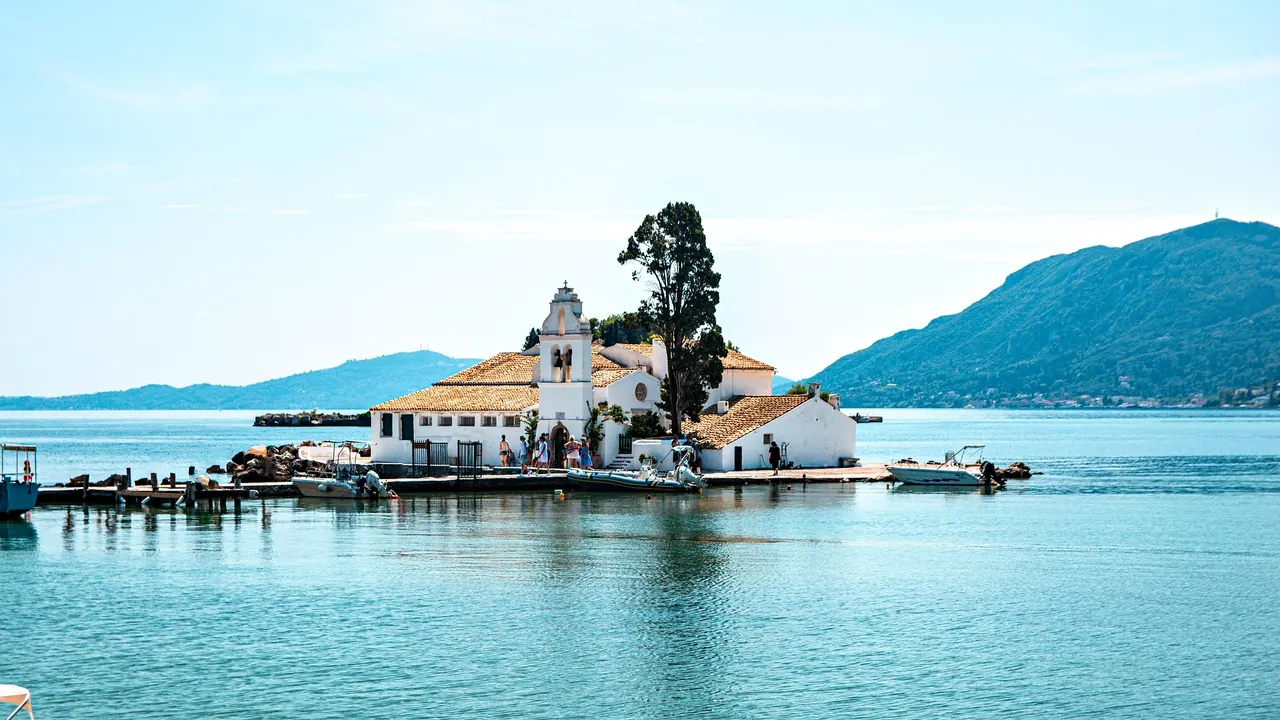
Photos: Corfu by Nico Hartnauer, Pexels License.
Corfu or Hvar?
Our verdict in twelve categories, each scored against the same fixed benchmark cities, and the climate month by month, so you can choose for your trip.
Choose Corfu for
- families
- culture and sights
- prices
Corfu is the stronger all-rounder, particularly for families, first-time visitors to the Ionian and anyone who wants more than the beach. It has sandy west-coast strands and shallow northern bays for children, and Corfu Town, a UNESCO-listed Venetian old town with real museums and fortresses. Costs are gentler too, as long as you stay away from the villa coast around Kassiopi.
Choose Hvar for
- nightlife
- getting around
Hvar is a smaller and more polished island, built around clear water, pebble coves and the Pakleni Islands just offshore. It suits couples and groups of friends who want long swimming days and serious local wine, and in midsummer one of the Adriatic's best-known party harbours. Expect to pay for it in Hvar Town, or base yourself in quieter Jelsa or Stari Grad and visit the harbour only for the evening.
Scoreboard
Twelve categories on one fixed scale from 0 to 100. The shaded stretch is the gap between the two.
Your match
Pick a travel style or drag the sliders, and both match scores follow your weighting.
Wins on families and culture and sights with your weighting.
Wins on nightlife and getting around with your weighting.
What matters to you?
Category by category
What the scores mean for a trip.
Beaches & swimming
For swimming, the two are evenly matched, but the shore underfoot is different. Corfu has sand: long west-coast beaches such as Glyfada and the dune-backed Issos, shallow sandy water along the north, and pebble coves only in the northeast and around Paleokastritsa.
Hvar is pebble and rock almost everywhere, so you swim from coves and stone ledges, often reached by taxi boat to the pine-fringed Pakleni Islands. If you want to lie on sand, go to Corfu. If you want clear water off a rock, Hvar delivers it.
Food & drink
The two eat equally well, and both reward leaving the harbour menus behind. Corfu's cooking is the more unusual, with Venetian-influenced dishes such as pastitsada and sofrito, kumquat liqueur and ginger beer. Hvar is straight Dalmatian, with peka-cooked lamb and gregada, and it scores on wine: Plavac Mali from the southern slopes, poured at family cellars.
On both islands the best tables are inland, in Corfu's village tavernas and in Hvar's konobas in Pitve or Velo Grablje.
Culture & sights
Corfu has clearly more to see. Corfu Town is a whole UNESCO-listed Venetian old town with two fortresses, the Liston arcades, a museum of Asian art and the Gorgon pediment. Outside town are the Achilleion and the clifftop ruins of Angelokastro.
Hvar's highlights are fine but compact: the white-stone square and cathedral of Hvar Town, the 1612 theatre above the Arsenal, and the ancient Greek field pattern of the Stari Grad Plain. A couple of unhurried days covers them.
Nightlife
Hvar is the livelier summer night out. Its harbour bars, stepped lanes and offshore beach clubs draw yacht crews and young travellers into one stylish, crowded and costly scene centred on Hvar Town.
Corfu's nightlife is spread out and comes in separate kinds: all-night clubbing at Kavos at the southern tip, a looser mix in Ipsos and Dassia, and grown-up cocktails under the Liston. It has more variety, but nowhere matches Hvar Town's peak-season energy.
Nature & outdoors
Corfu has a slight edge outdoors, mainly because it is greener and larger. Its olive groves and spring wildflowers, the 900m Mount Pantokrator with views into Albania, and the island-long Corfu Trail give walkers more to work with, and the Korission lagoon adds birdlife.
Hvar is drier and gentler: limestone terraces, lavender around Velo Grablje in early summer, and a short climb to Sveti Nikola. Its best outdoor asset is kayaking and snorkelling around the Pakleni Islands.
Day trips
Both islands depend on boats for outings, and the range is similar, but the destinations differ. From Corfu you can cross to another country: Saranda and the Roman and Venetian ruins of Butrint in Albania, as well as Paxos, Antipaxos and mainland Parga.
Hvar's catamarans reach Split and Diocletian's Palace in about an hour, along with walled Korčula and quiet Vis. Its own towns, Stari Grad, Jelsa and Vrboska, also make easy outings from one another.
Good for families
Corfu is much the better family island. Gently shelving sandy beaches at Roda, Acharavi and Issos, resorts built around pools and kids' clubs, and a large water park give children more to do. You just need to avoid Kavos and Ipsos.
Hvar can work for a simple seaside week from Jelsa or Stari Grad, but it has no attractions for children, the shore is mostly pebbles and Hvar Town's steps and party nights are hard going with small children.
Getting around
Getting around is about equally awkward on both islands, for different reasons. Corfu is the bigger island, about 60km long, with sparse buses and twisting roads, so most visitors hire a car or scooter. It has its own airport, though, so arriving is easy.
On Hvar the towns are small and walkable, but reaching the island at all means a ferry or catamaran from Split. Taxi boats then do much of the local work, and a car is mainly useful for the south coast.
Shopping & style
Neither island is a shopping destination, but Corfu Town has more to browse. Its lanes around Nikiforou Theotoki sell olive-wood bowls, kumquat products and jewellery, and ordinary clothing chains are close by. Hvar's shopping is a handful of island products, such as lavender, cellar wine and nuns' lace, plus some resort boutiques in Hvar Town.
Affordability
Corfu is noticeably easier on the budget. Package resorts on the north and east coasts offer reasonable rooms, and tavernas and buses are fairly priced. Only the Kassiopi villa coast and Corfu Town in midsummer push costs up.
Hvar Town in high summer is priced for the yacht crowd, from rooms to loungers to taxi boats. Even staying in Jelsa or Vrboska, July and August stay expensive, so June or September makes the biggest saving there.
Live music & performing arts
Corfu has the richer musical life. Its historic philharmonic bands play in the Spianada and village squares through the summer, Easter processions fill the town with music, and kantades serenades survive in tavernas.
Hvar's remarkable 1612 theatre has no regular season. What it offers is summer chamber concerts in churches and the Franciscan cloister, and klapa singing at village feasts.
Wellness & relaxation
The two are level on rest: neither has a spa tradition, and both rely on resort hotels plus seasonal yoga. The calm comes from choosing the right base. On Corfu that means a hill village or the quiet northeast coast. On Hvar it means Vrboska or Stari Grad, ideally in June or September, well away from Hvar Town's summer noise.
When should you go?
Pick your month. The climate figures are measured averages, not a forecast.
Corfu in July
Hvar in July
Daytime high, °C
Rainfall in the month, mm
Where the figures come from
Hvar's temperatures are measured 38 km from the centre, at Split / Marjan.
Hvar has no rain gauge within 25 km of the centre, so its rainfall comes from a gridded climate dataset read at the destination rather than from a gauge further away.
Hvar's sunshine is measured 38 km from the centre, at Split / Marjan.
Temperature and rainfall are climate normals, averaged over the years shown. Corfu: 1991-2020 normals, Kerkyra Airport (0.9 km from centre). Hvar: 1991-2020 (sunshine 1971-2000) normals, Split / Marjan (38.2 km from centre).
The two islands follow almost the same summer, and both are at their best for swimming from June to September. Corfu's sea is a touch warmer, at about 26°C in August against Hvar's 25°C. Both get properly hot in July and August, around 31-32°C, so on both islands that is a beach-and-shade rhythm rather than walking weather. May and late September to early October are the comfortable months for exploring towns and trails.
The real difference is the wet season. Corfu's green comes at a price: rain returns noticeably in September and peaks in November at around 188mm, well above Hvar's figure for the same month. Hvar's winters are cooler but drier and a little sunnier, which makes it slightly more dependable for a spring or autumn visit. Corfu's lush April and May landscapes are the reward for its wetter winters.
Which traveller are you?
On a family trip with young children, Corfu is the easier choice. Its north coast and the southern sands at Issos shelve gently, many resorts have pools and kids' clubs, and there is a water park. Hvar offers calm bays but nothing built for children.
For a culture and arts trip, choose Corfu. Corfu Town's Venetian old town, its museums and the Achilleion fill several days, and philharmonic bands play in the squares all summer. Hvar's sights are lovely but can be seen in two or three days.
For a food and nightlife trip, Hvar has the edge. Harbour sundowners turn into cocktail bars and beach-club parties on the Pakleni Islands, and family cellars pour Plavac Mali by day. Corfu's nights are either Kavos-style partying or quiet Liston cocktails.
Before you go
| Measure | Corfu | Hvar |
|---|---|---|
| Official language | Greek | Croatian |
| Currency | Euro (EUR) | Euro (EUR) |
| Sockets | CF230 V, 50 Hz | CF230 V, 50 Hz |
| Driving side | Right | Right |
| Time zone | UTC+2, UTC+3 in summer | UTC+1, UTC+2 in summer |
| Emergency number | 112 | 112 |
| Main airport | Corfu Ioannis Kapodistrias International Airport (CFU)88 non-stop destinations | Split Saint Jerome Airport (SPU)69 non-stop destinations |
| Public holidays this year | 15 days | 14 days |
By the numbers
| Measure | Corfu | Hvar |
|---|---|---|
| Population | 100,854 | - |
| People per km² | 161 | - |
| Swim season, months above 21 °C | 5 months | 4 months |
Where else could you go?
Every comparison below shares a destination with this one, so you can follow Corfu or Hvar somewhere new.