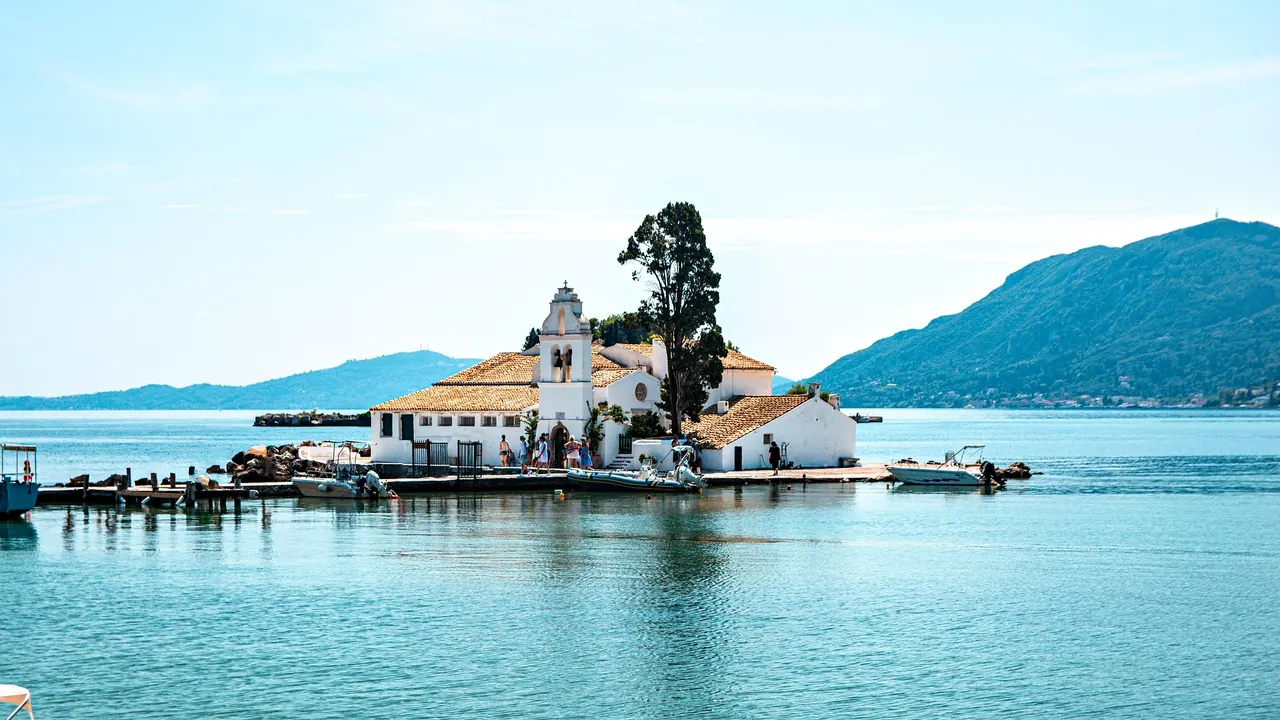
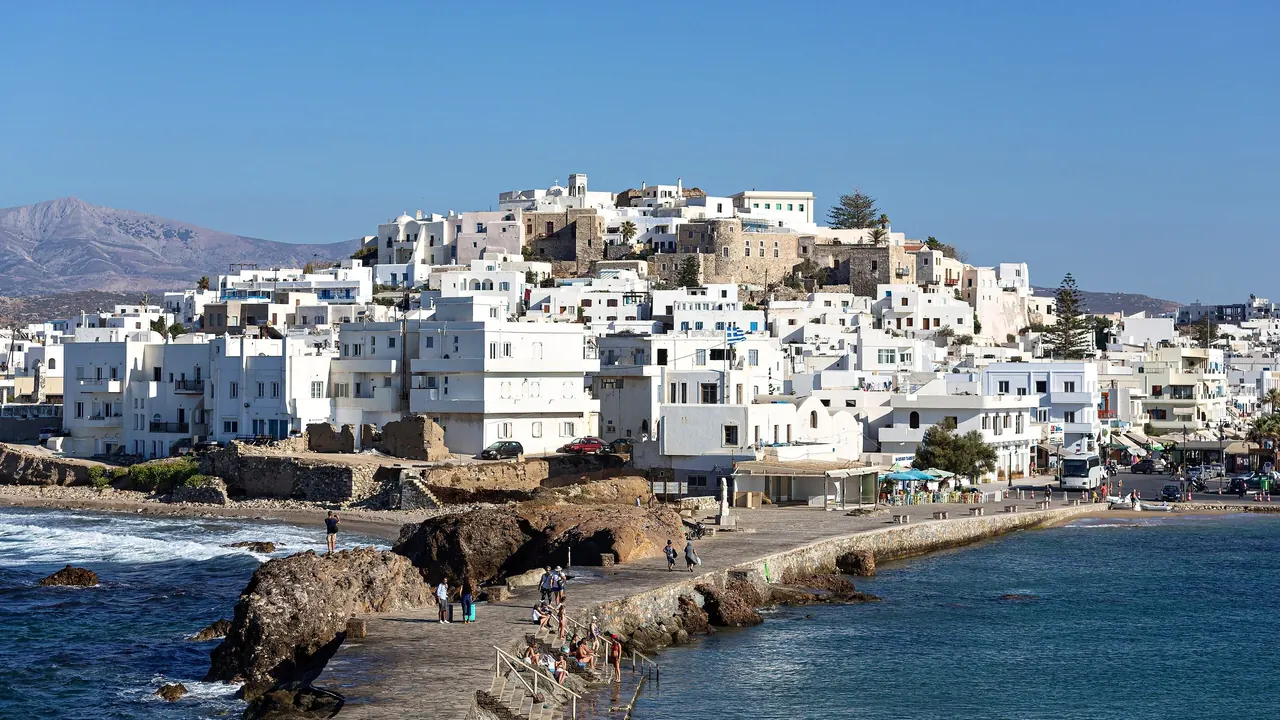
Photos: Corfu by Nico Hartnauer, Pexels License; Naxos by Manfred Werner (Tsui), CC BY-SA 4.0, cropped.
Corfu or Naxos?
Our verdict in twelve categories, each scored against the same fixed benchmark cities, and the climate month by month, so you can choose for your trip.
Choose Corfu for
- nightlife
- live music and the arts
- culture and sights
Corfu suits travellers who want an island with plenty to do besides swimming. Corfu Town gives you a Venetian old town, two fortresses and proper evenings out. The beaches range from sandy western strands to cliff-ringed coves, and families get resorts built around pools and children. You give up two things: dry weather outside high summer, and easy travel without a car.
Choose Naxos for
- getting around
- beaches
Naxos is the better pick if sand comes first and you want things simple. Its west coast is one near-continuous run of fine, shallow beaches, and summer buses reach them from Chora. Evenings are quiet, the mountain villages feed you well, and ferries to the rest of the Cyclades leave from the harbour. The summer wind that makes some beach days rough also brings in kitesurfers.
Scoreboard
Twelve categories on one fixed scale from 0 to 100. The shaded stretch is the gap between the two.
Your match
Pick a travel style or drag the sliders, and both match scores follow your weighting.
Wins on nightlife and live music and the arts with your weighting.
Wins on getting around and beaches with your weighting.
What matters to you?
Category by category
What the scores mean for a trip.
Beaches & swimming
The two are close on beaches, but they offer different things. Corfu's strength is variety. There are long sandy beaches facing the sunset on the west coast, clear rocky coves under the cliffs at Paleokastritsa and calm pebble bays in the northeast, and the sea gets a little warmer there in late summer.
Naxos has one kind of beach and plenty of it: a chain of fine, pale sand running south from Chora through Agios Prokopios and Plaka to Alyko, shallow far out and roomy even in high season. The trade-off is the meltemi wind, which can make the open stretches choppy for days at a time.
Food & drink
The two islands eat about equally well, but from different traditions. Corfu's cooking carries its Venetian past in pastitsada, sofrito and the peppery fish stew bourdeto, with kumquat liqueur and ginger beer to drink.
Naxos is a farming island. It is known for its potatoes, its graviera and arseniko cheeses and the citron liqueur kitron distilled in Halki, and it is best eaten in mountain villages such as Filoti and Apiranthos. On both islands the resort strips serve the weakest food, so it pays to go elsewhere.
Culture & sights
Corfu has more sightseeing packed into one place. Corfu Town's UNESCO-listed old town, its two fortresses, the Liston and its museums, including one of Asian art, make a full sightseeing day on foot. The Achilleion and the cliff-top castle of Angelokastro add more beyond the town.
Naxos goes further back in time but is more scattered. You get the Portara doorway over the harbour, the Venetian kastro, unfinished kouroi lying in their quarries and frescoed chapels in the Tragaea valley. These are rewarding sights, but you need a car and a few days to see them, and they feel intimate rather than grand.
Nightlife
Corfu has far more going on after dark, and you can choose the kind of night you want. Kavos is a full party resort that runs until dawn, Ipsos and Dassia mix beach bars with late venues, and Corfu Town offers a more grown-up evening.
Naxos has a short summer run of harbourfront bars, sunset sessions at the Agios Prokopios and Plaka beach bars and a couple of late clubs. Anyone who wants to dance all night usually takes a ferry to another island.
Nature & outdoors
Wetter winters keep Corfu green and wooded, with old olive groves, cypresses and Mount Pantokrator, where paths pass abandoned stone villages with Albania across the water. The Corfu Trail crosses the island from end to end. There are sea caves to snorkel and dive below Paleokastritsa, and the sheltered channel off the east coast suits sailing and kayaking.
Naxos is higher and barer, the most mountainous island in the Cyclades. The classic walk climbs Mount Zas to a summit cave with views over the whole archipelago, and old mule paths connect the marble villages of the Tragaea valley. The north and east coasts are rocky and empty. On both islands, July and August walks need early starts.
Day trips
Both islands do their day trips by boat, and the destinations decide it. From Corfu you can cross to Albania for the ruins of Butrint, sail to Paxos and the bays of Antipaxos, or visit Parga on the mainland.
Naxos sits at the centre of the Cyclades, so Paros, the quiet Small Cyclades, and Delos by way of Mykonos are all within easy reach, and Santorini makes a long day. It also has a good drive inland through its mountain villages. Strong wind can cancel sailings from Naxos.
Good for families
Corfu is the easier family choice. Many of its resorts are built around pools and kids' clubs, there is a large water park inland, and pirate-style boats and the town fortresses keep older children busy. The north-coast sands at Roda and Acharavi are shallow and calm. Avoid Kavos and Ipsos.
Naxos has lovely toddler-friendly sand and lots of space, but almost nothing made for children. Days are beach, boat and ice cream, and on some days the wind makes the open beaches too rough for small swimmers.
Getting around
Naxos is easier without a car. In summer, buses run from Chora's harbour along the beach coast to Plaka and up to the main villages, so a stay in Chora or Agios Prokopios works fine on foot and by bus.
Corfu is about 60km long and its buses are too infrequent to see much of it, so most visitors hire a car or scooter for the western beaches and hill villages. That means narrow, twisting roads and heavy summer traffic around Corfu Town and the airport.
Shopping & style
Neither island is worth a trip for shopping, but Corfu has a little more. The lanes around Nikiforou Theotoki sell olive-wood boards, kumquat sweets and handmade jewellery, and the newer part of town has ordinary clothing chains.
On Naxos, the old market below the kastro and the weaving and marble work in Apiranthos and Halki are pleasant to browse. The best things to take home are cheese, kitron and honey.
Affordability
The two islands cost much the same, with Corfu a little cheaper overall. Its big package resorts on the north and east coasts keep rooms reasonable, and taverna meals and local wine are fairly priced. Costs go up on the villa coast around Kassiopi and in Corfu Town in July and August, and car hire adds up if you want to see the island.
Naxos is moderately priced too. Its family-run studios and village rooms stay affordable even in summer, while the boutique hotels around Chora and Plaka are at the upper end. August is the expensive month there, when beachfront rooms book up and car hire costs more. On both islands spring and autumn cost less, and on Naxos June and September still have a warm sea.
Live music & performing arts
Corfu has a real musical tradition, unusual for a Greek island. Its historic philharmonic bands play on the Spianada and in village squares all summer and lead the Easter processions, kantades serenades still turn up in tavernas, and there are classical evenings at the Old Fortress.
Naxos has a small summer festival in a Venetian tower and some recitals in the kastro. Its best music comes from the village saints' day festivals, where violin and lute play late into the night.
Wellness & relaxation
Corfu gives you more ways to slow down. Its larger resort hotels have spas, there are yoga retreats in the olive groves of the west and north, and a stay in a hill village or on the quiet northeast coast is very restful.
Naxos has a handful of hotel spas and a few small retreats on the southwest coast. Its calm comes from the place itself: the hamlets around Halki and the emptier southern beaches, best outside August.
When should you go?
Pick your month. The climate figures are measured averages, not a forecast.
Corfu in July
Naxos in July
Daytime high, °C
Rainfall in the month, mm
Where the figures come from
Naxos's temperatures are measured 79 km from the centre, at Santorini Island / Monólithos.
Naxos has no rain gauge within 25 km of the centre, so its rainfall comes from a gridded climate dataset read at the destination rather than from a gauge further away.
Temperature and rainfall are climate normals, averaged over the years shown. Corfu: 1991-2020 normals, Kerkyra Airport (0.9 km from centre). Naxos: 2000-2025, 12 years observed (rainfall 1991-2020) normals, Santorini Island / Monólithos (78.8 km from centre).
Both islands are warm enough for the beach from June to September, but their weather differs a lot either side of that. Corfu gets hotter in July and August, with highs around 32°C, which makes midday walks around Corfu Town hard work, and its sunniest stretch runs through those months. The sea is at its warmest then too, reaching 26°C. The rain comes back hard in September, and November is the wettest month at about 188mm. That rain is what keeps the island green, but it makes late autumn and winter a gamble.
Naxos stays a little milder in midsummer, at about 30°C, and from June to September it gets almost no rain at all. Its sea is cooler, peaking near 24°C. Its winters are much drier than Corfu's, so May and October are dependable months for hiking and village visits there. On Corfu, late spring is the safer shoulder season.
Which traveller are you?
On a food and nightlife trip, Corfu suits you better. You can choose your night, from a party resort to a quiet cocktail in an old town, and dinner can be a Venetian-style stew in Corfu Town's back lanes. Naxos evenings end early.
For a culture and arts trip, choose Corfu. Its capital is a complete old town of fortresses, museums and arcades that you can see on foot, with brass bands in the squares in summer. On Naxos the ancient sites and chapels are spread across the interior.
On a beach and sun trip where sand matters most, Naxos is the simpler choice. Fine, shallow beaches run from Agios Prokopios to Alyko, summer buses reach them from Chora, and June to September is almost dry. Corfu's beaches are more varied but usually need a car.
Before you go
| Measure | Corfu | Naxos |
|---|---|---|
| Official language | Greek | Greek |
| Currency | Euro (EUR) | Euro (EUR) |
| Sockets | CF230 V, 50 Hz | CF230 V, 50 Hz |
| Driving side | Right | Right |
| Time zone | UTC+2, UTC+3 in summer | UTC+2, UTC+3 in summer |
| Emergency number | 112 | 112 |
| Main airport | Corfu Ioannis Kapodistrias International Airport (CFU)88 non-stop destinations | Naxos Island National Airport (JNX)3 non-stop destinations |
| Public holidays this year | 15 days | 15 days |
By the numbers
| Measure | Corfu | Naxos |
|---|---|---|
| Population | 100,854 | 17,930 |
| People per km² | 161 | 42 |
| Swim season, months above 21 °C | 5 months | 5 months |
Where else could you go?
Every comparison below shares a destination with this one, so you can follow Corfu or Naxos somewhere new.