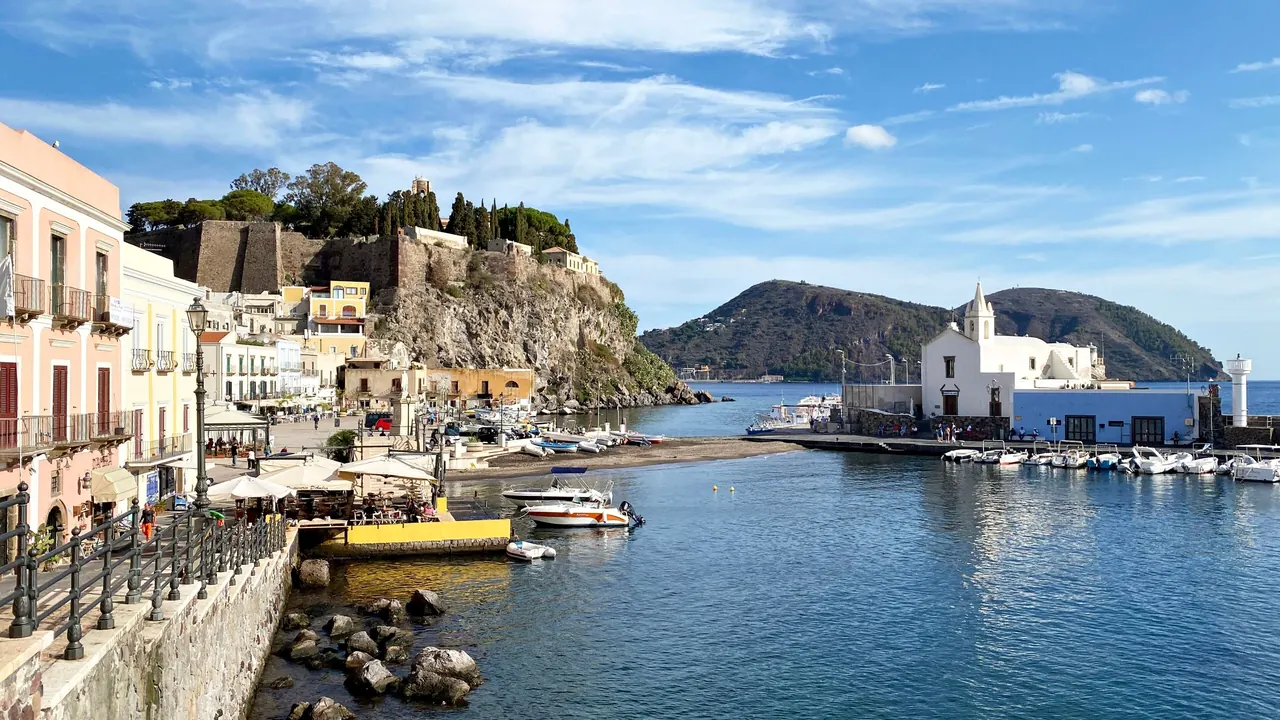
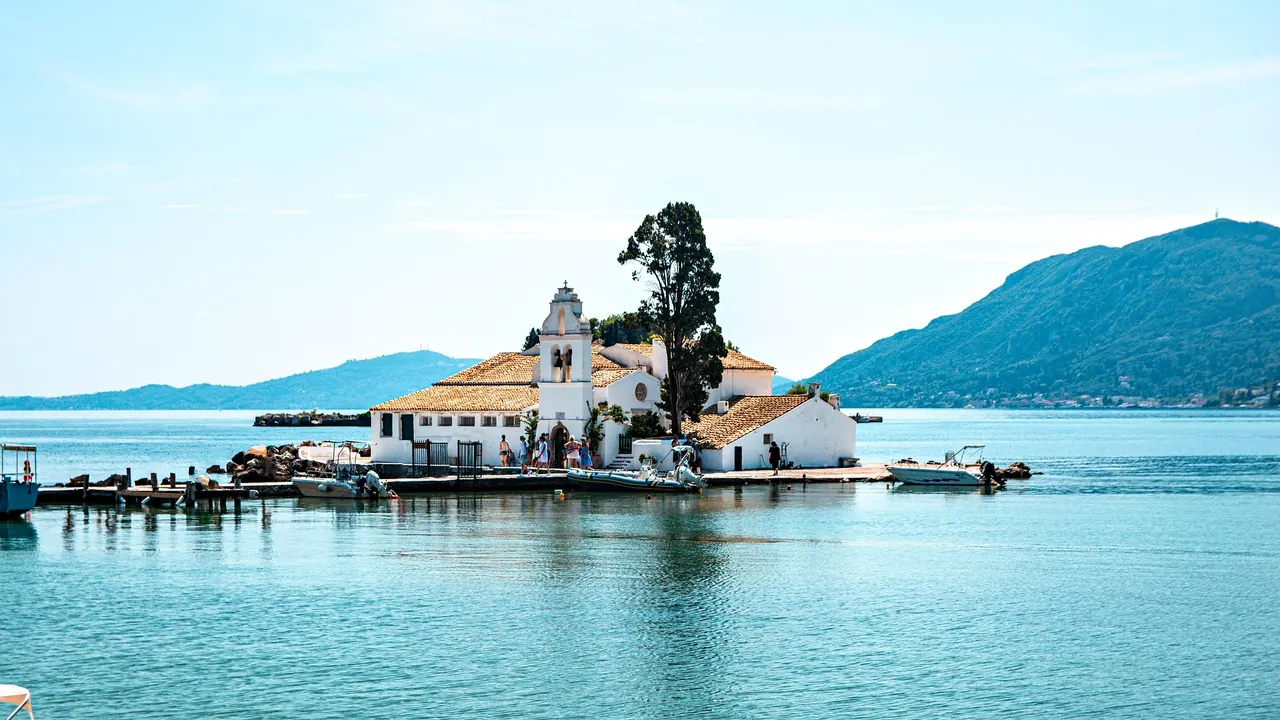
Photos: Aeolian Islands by Bernard Gagnon, CC BY 4.0, cropped; Corfu by Nico Hartnauer, Pexels License.
Aeolian Islands or Corfu?
Our verdict in twelve categories, each scored against the same fixed benchmark cities, and the climate month by month, so you can choose for your trip.
Choose Aeolian Islands for
- nature and the outdoors
- wellness
- food and drink
The Aeolian Islands are for travellers who want the landscape to be the event. Stromboli throwing lava into the night, the steaming crater on Vulcano and green Salina give a trip built on volcanoes, boats and clear deep water, with slow evenings on the quieter islands. You pay for it in money and convenience, and children and city sightseers find less to do.
Choose Corfu for
- live music and the arts
- families
- culture and sights
Corfu is the easier, broader choice. It has long sandy beaches with gentle shallows for families, a Venetian old town worth days of wandering, a real choice of nightlife and boat trips to Paxos and Albania. Prices are kinder too. It is a greener, more familiar island than the volcanic archipelago, and much less dramatic.
Scoreboard
Twelve categories on one fixed scale from 0 to 100. The shaded stretch is the gap between the two.
Your match
Pick a travel style or drag the sliders, and both match scores follow your weighting.
Wins on nature and the outdoors and wellness with your weighting.
Wins on live music and the arts and families with your weighting.
What matters to you?
Category by category
What the scores mean for a trip.
Beaches & swimming
Corfu has the better beaches for most people because it has sand. The west coast runs from Glyfada to the dune-backed stretches of Issos and Halikounas, and the north offers shallow sandy water as well as calm pebble bays in the northeast. On the Aeolian Islands the shore is dark pebble, black sand or rock ledges, and even Vulcano's black-sand bay gets too hot to walk on at midday.
Where the islands match Corfu is in the water itself. Coves under the cliffs of Salina and Panarea are deep and very clear, and a day of hopping between them in a hired boat is the high point. Corfu's equivalent is the boat trip to the turquoise bays of Antipaxos.
Food & drink
Both eat well, and the difference is in character. On the Aeolian Islands the cooking is sparse Sicilian island fare: capers from Salina, morning fish, pane cunzato at lunch, granita with brioche at breakfast and sweet Malvasia from the terraces. Corfu's table is Venetian-tinged, with pastitsada, sofrito and fiery bourdeto, plus kumquat liqueur and ginger beer.
In both places you have to choose where to eat with care. On Corfu that means avoiding the resort menus in favour of Corfu Town's back lanes and inland tavernas. On the islands it means knowing that Salina has the serious kitchens and that much closes once summer ends.
Culture & sights
Corfu has far more to see. Its UNESCO-listed old town of Venetian houses and kantounia lanes, the two fortresses, the Liston arcades, Agios Spyridon and several museums could fill days, and the Achilleion and cliff-top Angelokastro lie beyond.
The Aeolian Islands concentrate their heritage on Lipari's citadel. The archaeological museum there, with its obsidian, Greek pottery and theatrical masks, rewards anyone keen on prehistory, but beyond it you get Bronze Age hut villages and quiet churches rather than a town to explore.
Nightlife
Corfu offers more ways to go out. There is Kavos for all-night clubbing, the beach bars of Ipsos and Dassia, and cocktails under the Liston for a more grown-up evening in Corfu Town.
On the Aeolian Islands going out mostly means Panarea in July and August, a small, glamorous and costly scene of yachts and terrace dancing. Lipari's marina bars cover the rest. On the other islands the evening ends with dinner, which is exactly why many people go there.
Nature & outdoors
This is where the Aeolian Islands are far ahead. They are an active volcanic archipelago: Stromboli erupts every few minutes above the Sciara del Fuoco, Vulcano's Gran Cratere steams, and around them are Salina's fern-covered peak, the pumice slopes of Lipari and the empty mule tracks of Alicudi. The sea adds kayaking and diving over volcanic rock.
Corfu's nature is gentler and greener. Old olive groves, the slopes of Mount Pantokrator facing Albania, the long Corfu Trail and the Korission lagoon make for pleasant walking and birdwatching, but nothing as striking as a live volcano.
Day trips
A day out from Corfu can take you to a second country. A short ferry crosses to Saranda in Albania for the ruins of Butrint, and other boats run to Paxos and Antipaxos and to Parga and Sivota on the Greek mainland, so the outings mix islands, history and coast.
From the Aeolian Islands, day trips mostly mean hopping to the other islands, each with its own feel, from Salina's caper terraces to Alicudi's stepped paths. On the mainland side there are only Milazzo's castle and the Greek theatre at Tindari, because the big Sicilian sites are too far for a day.
Good for families
Corfu is clearly the better family choice. Gently shelving sandy beaches in the north and south, resort pools, kids' clubs, a water park and pirate-style boat trips make an easy beach-and-pool vacation, as long as you avoid Kavos and Ipsos.
The Aeolian Islands suit older children who like snorkelling, boats and volcanoes, and a night-time boat trip below Stromboli is a real treat. Rocky entries, steep lanes, choppy hydrofoils and a lack of anything built for children make them hard going with toddlers.
Getting around
Neither is effortless, but the problems differ. On the Aeolian Islands everything depends on hydrofoils and ferries that rough seas can cancel, and on land it is scooters on Lipari and Salina and walking or electric carts on car-free Stromboli and Panarea.
Corfu is a single island about 60km long with twisting roads and infrequent buses, so most visitors hire a car or scooter to reach the western beaches and hill villages, with Corfu Town itself best on foot.
Shopping & style
On the Aeolian Islands most of what you buy is food or drink: Salina's capers and Malvasia and the delis on Lipari, with Panarea's costly resort-wear boutiques as the exception. Corfu Town's old lanes around Nikiforou Theotoki give you more to browse, with olive-wood bowls, kumquat sweets, soaps and jewellery, and ordinary clothing chains nearby.
Affordability
Corfu is the more affordable island. Taverna meals, local wine, buses and the package resorts of the north and east coasts are fairly priced, and only Kassiopi's villas and summer rooms in Corfu Town push costs up.
The Aeolian Islands are an expensive corner of southern Italy in season. Rooms are scarce, food carries the cost of shipping, and the boats and volcano guides add up. Lipari or Vulcano is the sensible base for a moderate budget, and Panarea is best avoided if money matters.
Live music & performing arts
Corfu has a genuine musical life where the Aeolian Islands have almost none. Its historic philharmonic bands play in the Spianada and village squares all summer, Easter processions move to band music, and kantades serenades live on in tavernas.
On the islands, music means the odd summer concert in a church or square and band music at religious feasts. The evening show there is Stromboli.
Wellness & relaxation
The Aeolian Islands have the edge for rest. Vulcano's sulphurous mud pool and the warm gas vents bubbling offshore are a real bathing tradition, though gas levels sometimes close the pool, and Salina, Filicudi and Alicudi have almost no traffic.
Corfu has no such tradition. Wellness there means resort spas and a few yoga retreats in the olive groves, and real calm depends on choosing a hill village or the quiet northeast coast over the busy resort strips.
When should you go?
Pick your month. The climate figures are measured averages, not a forecast.
Aeolian Islands in July
Corfu in July
Daytime high, °C
Rainfall in the month, mm
Where the figures come from
Aeolian Islands's temperatures are measured 60 km from the centre, at Messina.
Aeolian Islands has no rain gauge within 25 km of the centre, so its rainfall comes from a gridded climate dataset read at the destination rather than from a gauge further away.
Temperature and rainfall are climate normals, averaged over the years shown. Aeolian Islands: 1991-2020 normals, Messina (59.7 km from centre). Corfu: 1991-2020 normals, Kerkyra Airport (0.9 km from centre).
Both islands follow the same summer rhythm. June to August is hot and almost rainless, with highs around 31°C to 32°C. The sea is warm enough to swim from June into early October, and around the Aeolian Islands it reaches about 27°C in August, a degree warmer than Corfu. In July and August the midday heat makes walking hard in both places, so the volcano climbs and Corfu's hill trails are better in May or October. September is when the rain returns to both, ending the long dry spell while the sea is still warm.
The bigger difference comes in the wetter months. Corfu's winters are far rainier, with close to 190mm in November, which is why it is so green. The Aeolian Islands get well under half that, though rough seas outside summer can cancel their ferries. In spring the volcanic islands are the drier of the two, while Corfu's walking season is greener but less dependable.
Which traveller are you?
For an outdoors trip, choose the Aeolian Islands. Night walks to watch Stromboli erupt, the rim of Vulcano's crater, Salina's wooded peak and kayaking under sea stacks beat Corfu's olive-grove trails and lagoon birdwatching for sheer spectacle.
On a family trip with young children, Corfu is much the easier choice. Sandy beaches at Roda, Acharavi and Issos shelve gently, resorts have pools and kids' clubs, and there is a water park. The islands have rocky entries, hot black sand and steep lanes.
On a tight budget, Corfu stretches money further. Taverna meals, buses and package-resort rooms are fairly priced. The Aeolian Islands carry the cost of shipping everything in, and the hydrofoils, boat hire and guided volcano walks quickly add up.
Before you go
| Measure | Aeolian Islands | Corfu |
|---|---|---|
| Official language | Italian | Greek |
| Currency | Euro (EUR) | Euro (EUR) |
| Sockets | CFL230 V, 50 Hz | CF230 V, 50 Hz |
| Driving side | Right | Right |
| Time zone | UTC+1, UTC+2 in summer | UTC+2, UTC+3 in summer |
| Emergency number | 112 | 112 |
| Main airport | Catania-Fontanarossa Airport (CTA)96 non-stop destinations | Corfu Ioannis Kapodistrias International Airport (CFU)88 non-stop destinations |
| Public holidays this year | 13 days | 15 days |
By the numbers
| Measure | Aeolian Islands | Corfu |
|---|---|---|
| Population | 15,419 | 100,854 |
| People per km² | 134 | 161 |
| Swim season, months above 21 °C | 5 months | 5 months |
Where else could you go?
Every comparison below shares a destination with this one, so you can follow Aeolian Islands or Corfu somewhere new.
- Paxosvs Corfu
- Lefkadavs Corfu
- Sicilyvs Aeolian Islands
- Kefaloniavs Corfu
- Zakynthosvs Corfu
- Caprivs Aeolian Islands