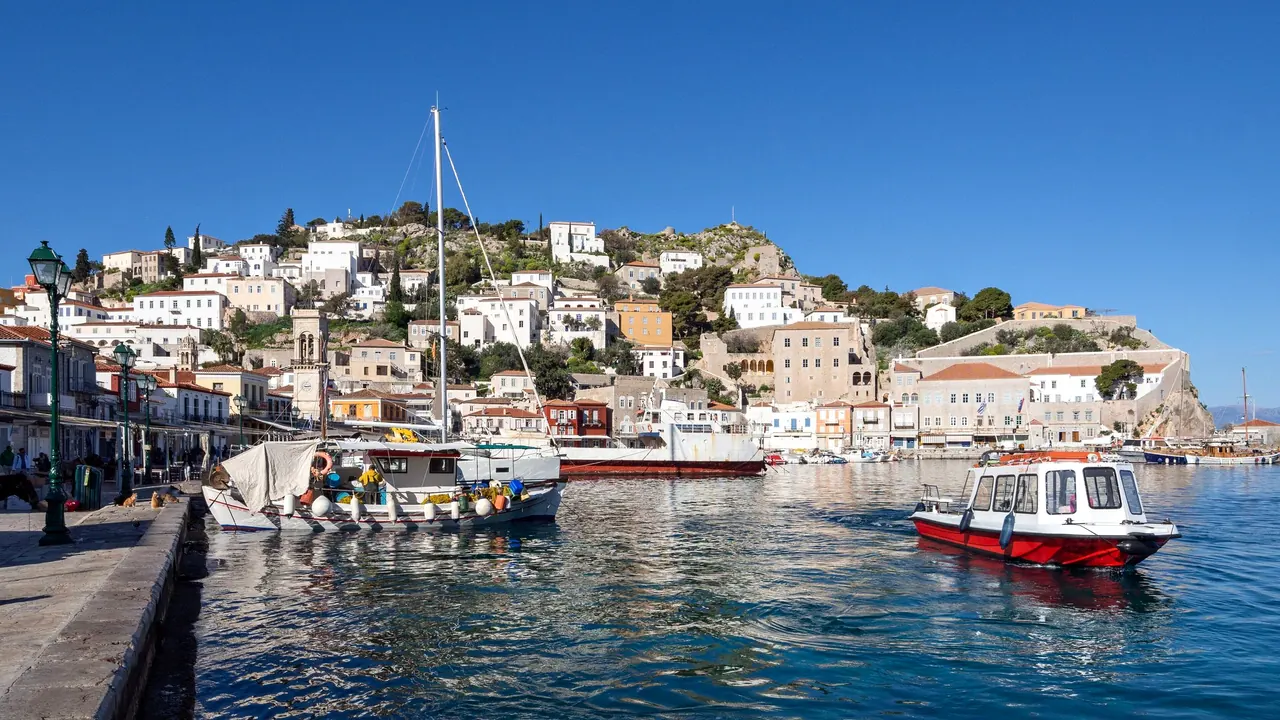
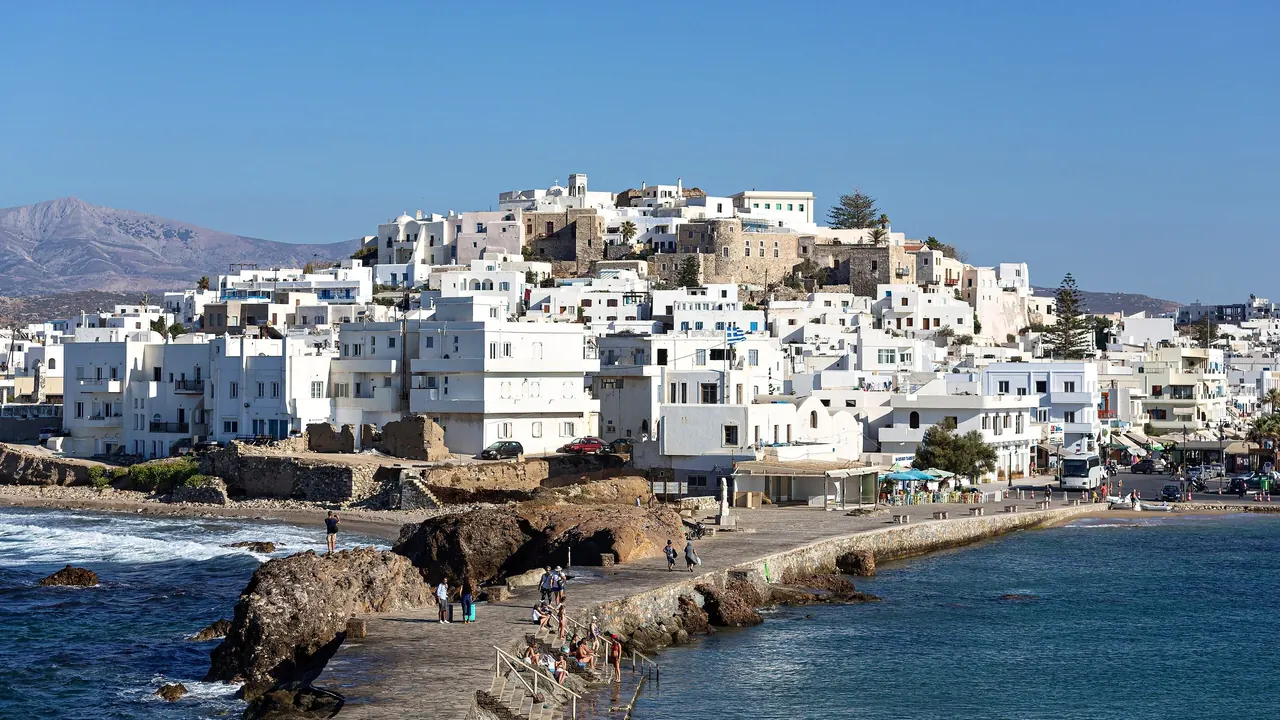
Photos: Hydra by C messier, CC BY-SA 4.0, cropped; Naxos by Manfred Werner (Tsui), CC BY-SA 4.0, cropped.
Hydra or Naxos?
Our verdict in twelve categories, each scored against the same fixed benchmark cities, and the climate month by month, so you can choose for your trip.
Choose Hydra for
- wellness
- nightlife
Hydra suits travellers who want a small, handsome place with no traffic and are happy to give up sandy beaches for it. The car-free stone town, the mule paths over the ridge and the swimming off rocks into deep, clear water make for a slow few days. It is also close enough to Piraeus to pair easily with Athens.
Choose Naxos for
- families
- beaches
- food and drink
For a longer vacation with more to do, Naxos is the stronger island. Its west coast of pale sand and shallow water is much better for families and beach lovers. The mountain villages give it better food and more to explore, and its place in the middle of the Cyclades opens up ferry outings to Paros, the Small Cyclades and Delos. It is also the cheaper of the two to stay on.
Scoreboard
Twelve categories on one fixed scale from 0 to 100. The shaded stretch is the gap between the two.
Your match
Pick a travel style or drag the sliders, and both match scores follow your weighting.
Wins on wellness and nightlife with your weighting.
Wins on families and beaches with your weighting.
What matters to you?
Category by category
What the scores mean for a trip.
Beaches & swimming
Hydra is an island for swimmers rather than sunbathers. You climb down ladders from the rocks west of the harbour into deep, very clear water, or walk to the small pebble coves at Kamini and Vlychos. The prettier pine-backed bays such as Bisti need a boat. Anyone planning whole days on soft sand should look elsewhere.
Naxos is by far the better beach island. South of Chora its west coast is an almost unbroken run of fine pale sand, from Agios Prokopios and Agia Anna to the dune-backed strands of Plaka and Alyko, with shallow water far out and space even in high summer. The catch is the meltemi, which can make that open coast choppy for days.
Food & drink
Hydra serves good taverna cooking within a narrow range: grilled fish and octopus, mezedes, and the rosewater almond sweets from its bakeries. The better meals are in the back lanes and at the coves of Kamini and Vlychos, not on the expensive harbour front.
Naxos has more to offer because it grows its own food. Its potatoes, graviera and arseniko cheeses, local meat and the kitron liqueur of Halki come together in the tavernas of mountain villages such as Filoti, Apiranthos and Koronos, which are worth the drive inland. Neither island has much beyond Greek cooking, but Naxos keeps meals interesting for longer on an extended stay.
Culture & sights
On Hydra the sight is the town itself: a whole harbour of shipowners' stone mansions, protected and free of cars. The Monastery of the Dormition, the naval archives and a few mansions you can visit tell the story of the fleet that fought in the War of Independence. Two days covers it all.
Naxos has more layers of history and more ground to cover. The Portara frames Chora's harbour, and the Venetian kastro holds a small museum of Cycladic figurines. Inland there are unfinished kouroi lying in their quarries, the Temple of Demeter near Sangri and Byzantine chapels across the Tragaea valley. Seeing it all takes a car and several days.
Nightlife
Neither island is for clubbing, and on both a summer night means a drink by the water. Hydra's version is more polished: cocktail terraces along the harbour, full of well-dressed Athenians and yachting visitors, at their liveliest on weekends.
Naxos is more relaxed and more spread out. There are music bars below the kastro in Chora, a couple of clubs that stay open late and sunset beach bars at Agios Prokopios and Plaka. Both islands go quiet once the season ends.
Nature & outdoors
Hydra's outdoors is a bare limestone ridge crossed by car-free mule paths. They climb to the hilltop monasteries and to Mount Eros at nearly 600m, and the cliffs below are good for snorkelling and kayaking. It is a fine island for half-day walks, though there is little shade.
Naxos has bigger and greener country. Mount Zas rises to about 1,000m above Filoti, olive groves fill the Tragaea valley, and the north and east coasts are wild and empty. The windy west coast at Mikri Vigla is also one of the best spots in the Aegean for kitesurfing and windsurfing, which Hydra cannot match.
Day trips
From Hydra the easy outings are other Saronic islands. Spetses and Poros are each a short hop and Aegina takes longer. Reaching the Peloponnese, with Epidaurus and Nafplio, means a boat to Metochi and then a car, so most visitors simply stay on the island.
Naxos sits in the middle of the Cyclades and makes a better base. Paros is under an hour away, the quiet Small Cyclades make easy days out, and Mykonos is the way to Delos. The island's own hill villages and Apollonas fill another day by car. On both islands, strong wind can cancel the boats.
Good for families
Hydra is hard work with small children. The traffic-free lanes, donkeys and water taxis delight them, but the town is all steep stone steps where a pushchair is useless, and swimming is mostly off rocks into deep water. It suits older children who swim well.
Naxos is far easier. The west-coast sand shelves so gently that toddlers can paddle a long way out, Agios Georgios is a walk from Chora and sheltered from the wind, and the family-run studios are welcoming. Neither island has attractions built for children, so on both the days are beach, boat and ice cream.
Getting around
Both islands can be managed without a car, but in very different ways. Hydra has no cars at all. You walk, often up and down stone steps, send your luggage by donkey and take water taxis to the distant coves, and getting there means a ferry of at least an hour and a half from Piraeus.
Naxos becomes a driving island once you leave Chora. Summer buses cover the west-coast beaches and the main mountain villages, but the inland chapels and the empty north and east need a hired car or scooter on narrow, winding roads.
Shopping & style
What you take home is what sets the two apart. On Hydra it is something made by hand: jewellery from the workshops in the lanes behind the harbour, a canvas from a gallery showing the island's resident artists, or linen and ceramics, all of a better standard than most island ports manage.\n\nOn Naxos the best buys are things to eat and drink, such as graviera cheese, kitron liqueur from Halki and thyme honey from the village co-operatives, with local weaving and marble work in Apiranthos. On either island shopping fits into an evening stroll, and anyone after fashion should save it for Athens.
Affordability
Hydra is the dearer island, mainly because of its rooms. There are only a few boutique guesthouses and converted mansions, and they fill early for high summer, while harbour-front drinks and water taxis add to the cost. The back-lane tavernas are fair value, and swimming off the rocks costs nothing.
Naxos gives more for the money. Family-run studios and village rooms stay affordable in summer, and food, wine and buses are reasonable, though August pushes up beachfront rooms and car hire. On both islands, June and September are the better-value months.
Live music & performing arts
Neither island has a theatre or concert season, so this is no reason to choose one over the other. Hydra's highlight is the Miaoulia festival in June, when a fireship is burned in the harbour, along with the odd open-air recital. Naxos has a summer festival in a Venetian tower and, more memorably, its village panigyria, where violin and lute play late into the night and everyone dances.
Wellness & relaxation
Hydra is the better island for switching off, and the reason is that it has no engines. Without traffic the town stays hushed from morning to night, and even the midday crush, when excursion boats tie up at the harbour, has drained away by evening. Rooms in the upper town or out at Kamini are the most peaceful, though treatments go no further than a few hotel rooms, massage and the odd yoga retreat.
Naxos has no spa culture either, and how calm it feels depends on where and when you stay. The hamlets in the hills around Halki and the emptier southern beaches are properly unhurried outside August. In that peak month, though, the west-coast beach strips and roads fill up and lose the stillness that car-free Hydra keeps.
When should you go?
Pick your month. The climate figures are measured averages, not a forecast.
Hydra in July
Naxos in July
Daytime high, °C
Rainfall in the month, mm
Where the figures come from
Hydra's temperatures are measured 66 km from the centre, at Athinai Airport.
Hydra has no rain gauge within 25 km of the centre, so its rainfall comes from a gridded climate dataset read at the destination rather than from a gauge further away.
Naxos's temperatures are measured 79 km from the centre, at Santorini Island / Monólithos.
Naxos has no rain gauge within 25 km of the centre, so its rainfall comes from a gridded climate dataset read at the destination rather than from a gauge further away.
Temperature and rainfall are climate normals, averaged over the years shown. Hydra: 1991-2020 normals, Athinai Airport (65.5 km from centre). Naxos: 2000-2025, 12 years observed (rainfall 1991-2020) normals, Santorini Island / Monólithos (78.8 km from centre).
Both islands are at their best from late May to early October, and both summers are almost rainless. Hydra is hotter in high summer, around 33°C in July and August against 30°C on Naxos, so on Hydra the steps and hill paths are for early mornings and evenings in those months. The sea is warm enough to swim on both from June to October, and Hydra's water is slightly warmer in August at about 26°C. September also stays drier on Naxos.
Spring and autumn are the walking seasons on either island, with mild days in April and October. On Hydra the rain arrives sooner and turns November and December wet, at close to 90mm a month, with short sunshine hours through the winter. Naxos gets its heaviest rain in midwinter instead. Outside the summer half of the year, neither is a beach destination.
Which traveller are you?
On a beach and sun trip, Naxos is the clear choice. Its west coast is a chain of fine sandy beaches from Agios Georgios to Alyko, with shallow water and plenty of space, while Hydra offers rock ladders and small pebble coves.
On a family trip with young children, Naxos is much easier. The gently shelving sand lets toddlers paddle safely, buses link Chora with the beaches and rooms cost less. On Hydra, the steep steps defeat pushchairs and most swimming is into deep water.
For a relaxing and wellness trip, Hydra has the edge. With no cars or motorbikes, all you hear is bells, donkeys and the sea, and days settle into a swim, a long lunch and a siesta. Naxos is calm too, but busier and noisier in August.
Before you go
| Measure | Hydra | Naxos |
|---|---|---|
| Official language | Greek | Greek |
| Currency | Euro (EUR) | Euro (EUR) |
| Sockets | CF230 V, 50 Hz | CF230 V, 50 Hz |
| Driving side | Right | Right |
| Time zone | UTC+2, UTC+3 in summer | UTC+2, UTC+3 in summer |
| Emergency number | 112 | 112 |
| Main airport | Athens Eleftherios Venizelos International Airport (ATH)176 non-stop destinations | Naxos Island National Airport (JNX)3 non-stop destinations |
| Public holidays this year | 15 days | 15 days |
By the numbers
| Measure | Hydra | Naxos |
|---|---|---|
| Population | 1,966 | 17,930 |
| People per km² | 40 | 42 |
| Swim season, months above 21 °C | 5 months | 5 months |
Where else could you go?
Every comparison below shares a destination with this one, so you can follow Hydra or Naxos somewhere new.