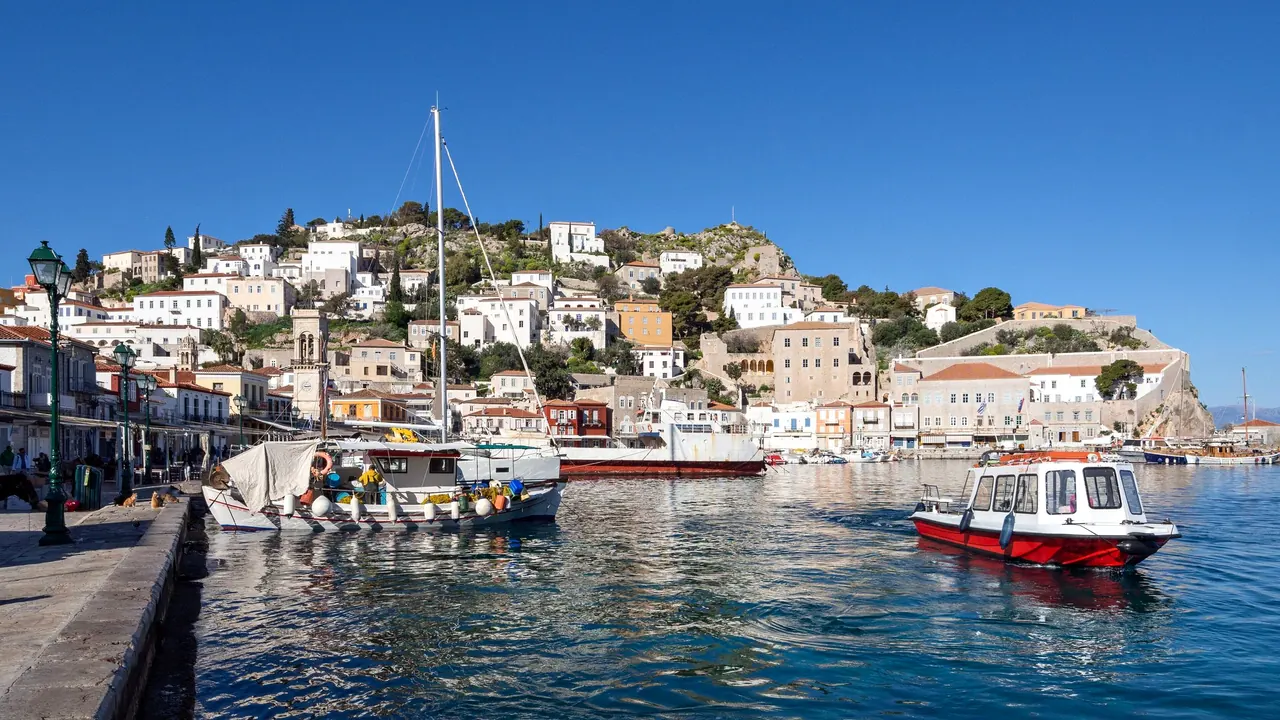
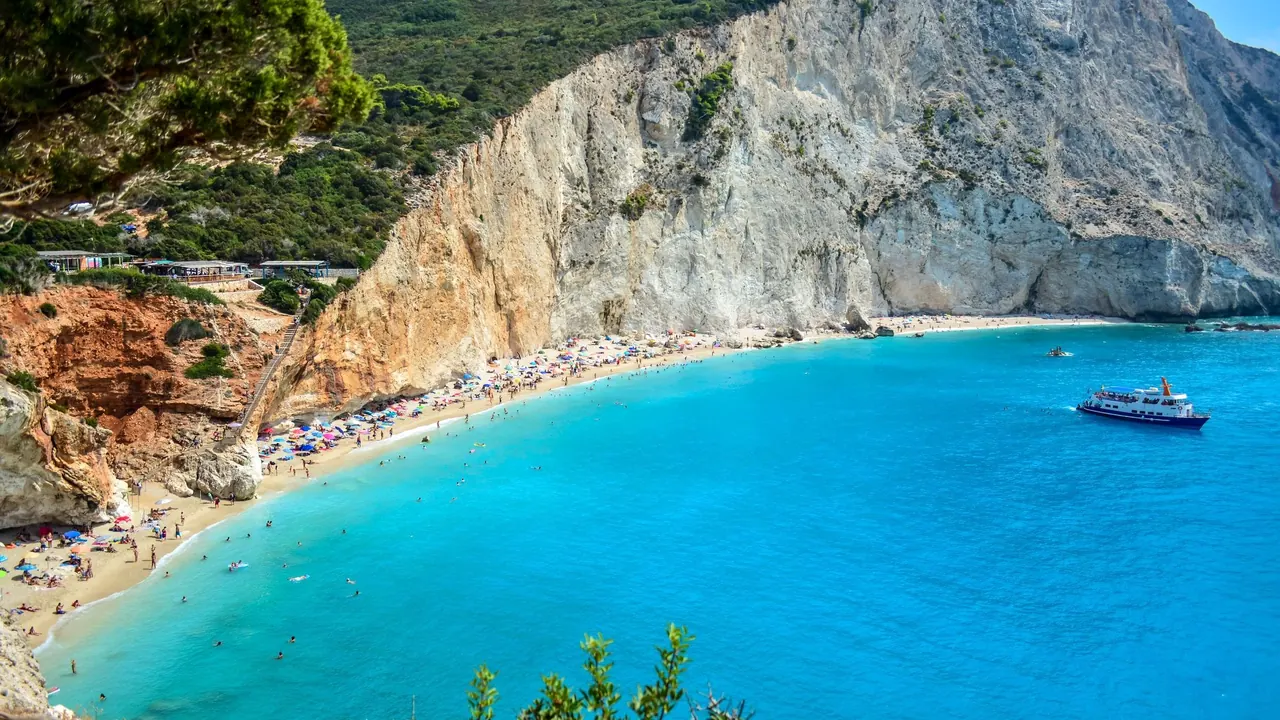
Photos: Hydra by C messier, CC BY-SA 4.0, cropped; Lefkada by Antone Adi, Pexels License.
Hydra or Lefkada?
Our verdict in twelve categories, each scored against the same fixed benchmark cities, and the climate month by month, so you can choose for your trip.
Choose Hydra for
- culture and sights
- wellness
- getting around
Hydra suits a slower, more polished trip: a car-free harbour town of stone mansions, swims from the rocks into deep clear water, long lunches and evenings over a drink facing the boats. It is the better pick for couples, for anyone who cares more about an intact historic town and quiet than about sand, and for those who want an island within reach of Athens by ferry. You pay more for rooms and run out of things to do after a few days.
Choose Lefkada for
- beaches
- families
- day trips
If the beach is the point of the trip, Lefkada is the better choice. Its west coast of long strands under white cliffs is on another level from Hydra's coves, and the calm bays on the east coast suit small children. Vasiliki's winds and the sheltered channels draw windsurfers and sailors. It costs less and gives a week of exploring by car and boat. In return you need a hired car, and the scenery matters more than the town.
Scoreboard
Twelve categories on one fixed scale from 0 to 100. The shaded stretch is the gap between the two.
Your match
Pick a travel style or drag the sliders, and both match scores follow your weighting.
Wins on culture and sights and wellness with your weighting.
Wins on beaches and families with your weighting.
What matters to you?
Category by category
What the scores mean for a trip.
Beaches & swimming
Hydra is an island for swimming rather than for beaches. You climb down ladders from the rocks west of the port into very clear, deep water, or take a water taxi to pine-backed coves such as Bisti and Agios Nikolaos. The coves are small and pebbly, and none of them is a place to spread out for a whole day.
Lefkada is on another scale. The west coast runs past Porto Katsiki, Egremni and Kathisma, long strands under white cliffs with famously turquoise water, though the shore shelves steeply, catches afternoon waves and fills up in midsummer. When the west is rough, the bays at Nikiana and Ligia in the east and at Vasiliki in the south have calm water. Hydra has no second side like that.
Food & drink
Both islands serve Greek taverna food, and neither is a place to travel for its food. Lefkada has the edge because it grows its own produce and has a countryside to find it in. There are the small lentils from the Eglouvi plateau, a local cured salami, and older home cooking in the mountain villages around Karya, a contrast with the tourist menus of the coast.
Hydra's range is narrower. It means grilled fish and mezedes, with the best meals in the back lanes or at the water's edge in Kamini and Vlychos, and almond amygdalota from the town bakeries. There are a few smarter modern Greek kitchens, but on a longer stay the menus start to repeat.
Culture & sights
Hydra's sight is the whole town. Its stone mansions rise in tiers above the harbour, built by the shipowners whose fleet fought in the War of Independence, and no cars or modern blocks break the picture. Add the Monastery of the Dormition, the Historical Archives Museum and the Koundouriotis mansion, and two days give you a full picture of one place and its history.
Lefkada's sights are smaller and more spread out. There is the fortress of Santa Maura by the causeway, a small archaeological museum, painted Ionian churches among the town's timber-framed earthquake houses, and the Faneromeni monastery above the lagoon. They fill an afternoon away from the beach rather than shaping a trip.
Nightlife
Neither island is for clubbing. On both, nights mean summer drinks by the water, and the bars fade once the season ends. What differs is the crowd. Hydra's harbour bars draw well-dressed Athenians and people off the yachts for a long, smart cocktail facing the boats.
Lefkada spreads its evenings across several places: young Greeks in the lanes of Lefkada town, resort guests and sailing crews on Nidri's harbour strip, and windsurfers in Vasiliki's easy-going bars. Lefkada gives you more choice of setting, and Hydra a single, more stylish one.
Nature & outdoors
On Hydra, the outdoors means walking and snorkelling. Old mule paths, free of traffic, climb the bare limestone ridge to Profitis Ilias and Mount Eros at nearly 600m, with little shade and wide views over the gulf. The clear water along the cliffs suits a mask or a kayak.
Lefkada offers more on land and far more on the water. Its interior is greener and rises above 1,100m, with the Dimosari waterfall and paths between hill villages. The steady afternoon winds at Vasiliki bring windsurfers, there is kitesurfing at Agios Ioannis, and the sheltered channels make Lefkada a classic place to start a week of sailing.
Day trips
From Hydra the easy outings are the other Saronic islands. Spetses and Poros are each well under an hour away by hydrofoil, and Aegina with the Temple of Aphaia is further off. Epidaurus and Nafplio on the Peloponnese are within reach, but you need a boat and then a car or a tour, so most visitors stay on the island.
Lefkada fills a week of outings more easily, because you can combine a car with the boats. Excursion boats from Nidri tour Meganisi, Kalamos and Kastos, and ferries from Vasiliki reach Fiskardo on Kefalonia and Ithaca. On the mainland there are the ruins of Roman Nikopolis, Parga under its castle and the oracle site at the Acheron.
Good for families
Children enjoy Hydra's car-free lanes and luggage donkeys, but every day involves steep steps, and most swimming is off ladders into deep water. It works best for older children who swim confidently and like walking, staying near Mandraki or Kamini.
Lefkada is the simpler beach vacation for younger children. Agiofili and the shore at Vasiliki have water calm enough for paddling, as do the bays at Nikiana and Ligia, and boat trips to the islets make easy days out. Save the dramatic west-coast beaches, with their surf and cliff staircases, for an occasional outing.
Getting around
The two islands work in opposite ways. Hydra has no cars at all. You walk, often up stone steps, with donkeys or porters for your luggage and water taxis to the far coves. You arrive by a ferry from Piraeus of an hour and a half or two, and strong winds can cancel it.
Lefkada is reached over a causeway, with Aktion airport about half an hour away. Once there you need a car or scooter, since the buses are infrequent and the west-coast and mountain roads wind slowly and clog in high summer. Hydra is easier once you are there, and Lefkada is easier to reach.
Shopping & style
Neither island is a shopping destination, and on each the shops fill an evening stroll at most. Hydra's lanes behind the harbour have the finer pieces: jewellery workshops and galleries selling work by the artists who live there. Lefkada's are more down to earth, with olive oil, honey and lentils along the pedestrian main street of the town and hand embroidery in the village of Karya.
Affordability
Lefkada is the easier island on the wallet. Studios and family-run apartments are plentiful, and the extra costs are mainly car hire and boat trips. Hydra has few rooms, mostly boutique guesthouses and converted mansions that fill early for high summer, and waterfront drinks, water taxis and donkeys for luggage add up.
On both islands, a taverna meal in the back lanes or the villages is fair value, and rooms are noticeably easier on the budget in June and September than at the peak.
Live music & performing arts
Each island has one big summer occasion. Hydra's is the Miaoulia in June, a naval festival with music that ends with a fireship burning in the harbour. Lefkada's is its international folklore festival in August, held for decades, with dance groups from many countries on open-air stages, along with village festivals of Greek music and dancing.
Outside those dates there is little to see on either island, and no theatre or concert season. Plan around the festival if you want one, or keep evenings of music and theatre for Athens.
Wellness & relaxation
Hydra is the more restful island, and the reason is the island itself rather than any spa. With no traffic anywhere, even the town is quiet. A room in the upper lanes or at Kamini is as peaceful as a remote village would be elsewhere, and a slow day of swimming, eating and sleeping through the heat needs no planning or transport. The day-boat crowds on the harbour front in summer are gone before dinner. Treatments are limited to a few hotel rooms and the occasional yoga retreat.
On Lefkada you have to look for the calm. It lies in the hill villages and the small harbours of the east coast, away from the resort strips, and getting there usually means driving the same roads everyone else uses. Spa options are just as limited, mostly the better hotels and a few retreats in the hills. In August the busiest resorts are far from restful, so June and September are the months for a slow stay on either island.
When should you go?
Pick your month. The climate figures are measured averages, not a forecast.
Hydra in July
Lefkada in July
Daytime high, °C
Rainfall in the month, mm
Where the figures come from
Hydra's temperatures are measured 66 km from the centre, at Athinai Airport.
Hydra has no rain gauge within 25 km of the centre, so its rainfall comes from a gridded climate dataset read at the destination rather than from a gauge further away.
Lefkada has no rain gauge within 25 km of the centre, so its rainfall comes from a gridded climate dataset read at the destination rather than from a gauge further away.
Temperature and rainfall are climate normals, averaged over the years shown. Hydra: 1991-2020 normals, Athinai Airport (65.5 km from centre). Lefkada: 1998-2020 (rainfall 1991-2020) normals, Aktion Airport (24.3 km from centre).
Both islands share the same sea, warm enough to swim from June to October and at its warmest, around 26°C, in August. On land they differ. Hydra is the hotter and drier of the two: July and August reach 33°C with almost no rain and long, cloudless days. That is perfect for swimming, but the stepped lanes and bare mule paths become hard work after mid-morning. Lefkada peaks a little cooler, around 31°C, and its greener slopes are easier going in high summer.
The bigger difference comes in autumn. Hydra stays dry well into October, so late September and October are good for walking and still fine for a swim. On Lefkada the rain returns sooner and harder: September is already noticeably wetter, and by November the island gets about 150mm, far more than Hydra. On both, June and September give warm water without the peak heat. May is pleasant for walking, but the sea is still cool, and winter is cool and damp.
Which traveller are you?
On a beach and sun trip, Lefkada is the clear choice. Porto Katsiki, Egremni and Kathisma are long strands of turquoise water under white cliffs, with calm bays on the other coast too, while Hydra offers rock platforms and small pebble coves.
For a culture and arts trip, Hydra is the better choice. Its entire harbour town of shipowners' mansions is protected and free of cars, with a naval archive museum, mansions you can visit and summer art exhibitions. Lefkada's fortress and small museum are breaks from the beach.
On a family trip with young children, Lefkada is far easier. Its shallow, calm east-coast bays are good for paddling and you can drive to them. Hydra means steep stone steps, lanes where a pushchair is useless and swimming off ladders into deep water.
Before you go
| Measure | Hydra | Lefkada |
|---|---|---|
| Official language | Greek | Greek |
| Currency | Euro (EUR) | Euro (EUR) |
| Sockets | CF230 V, 50 Hz | CF230 V, 50 Hz |
| Driving side | Right | Right |
| Time zone | UTC+2, UTC+3 in summer | UTC+2, UTC+3 in summer |
| Emergency number | 112 | 112 |
| Main airport | Athens Eleftherios Venizelos International Airport (ATH)176 non-stop destinations | Aktion National Airport (PVK)47 non-stop destinations |
| Public holidays this year | 15 days | 15 days |
By the numbers
| Measure | Hydra | Lefkada |
|---|---|---|
| Population | 1,966 | 22,652 |
| People per km² | 40 | 64 |
| Swim season, months above 21 °C | 5 months | 5 months |
Where else could you go?
Every comparison below shares a destination with this one, so you can follow Hydra or Lefkada somewhere new.