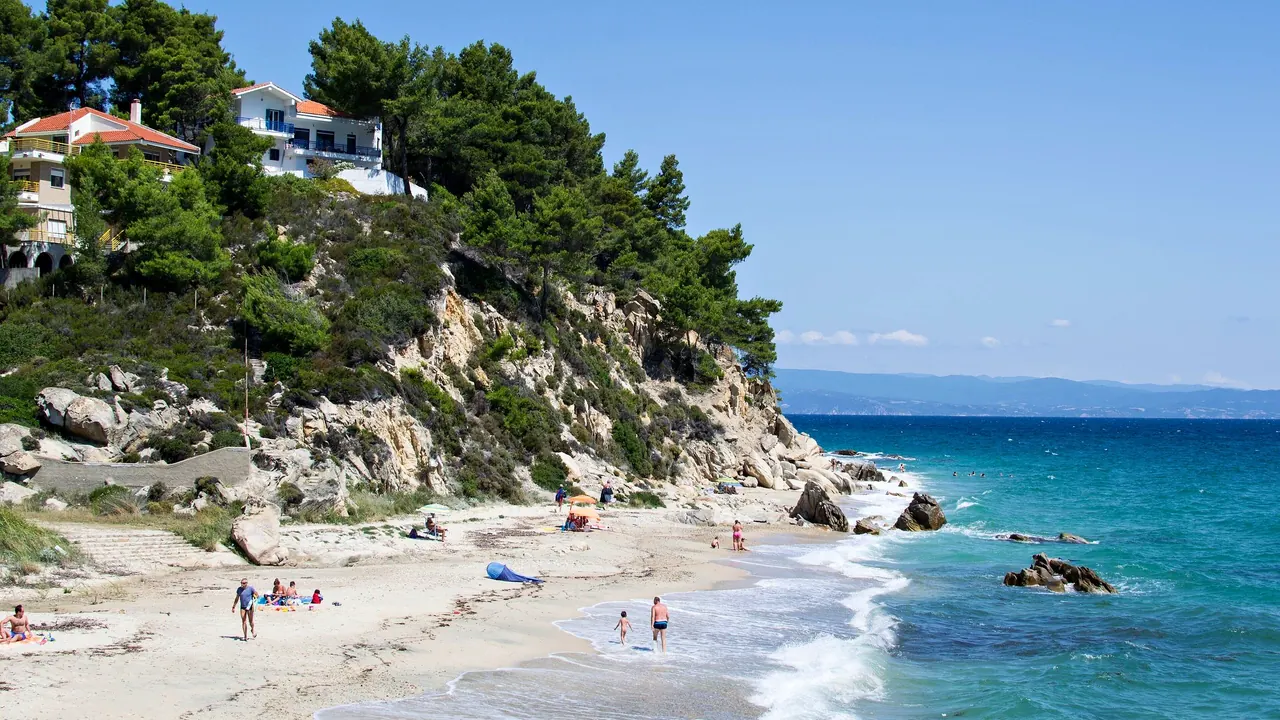
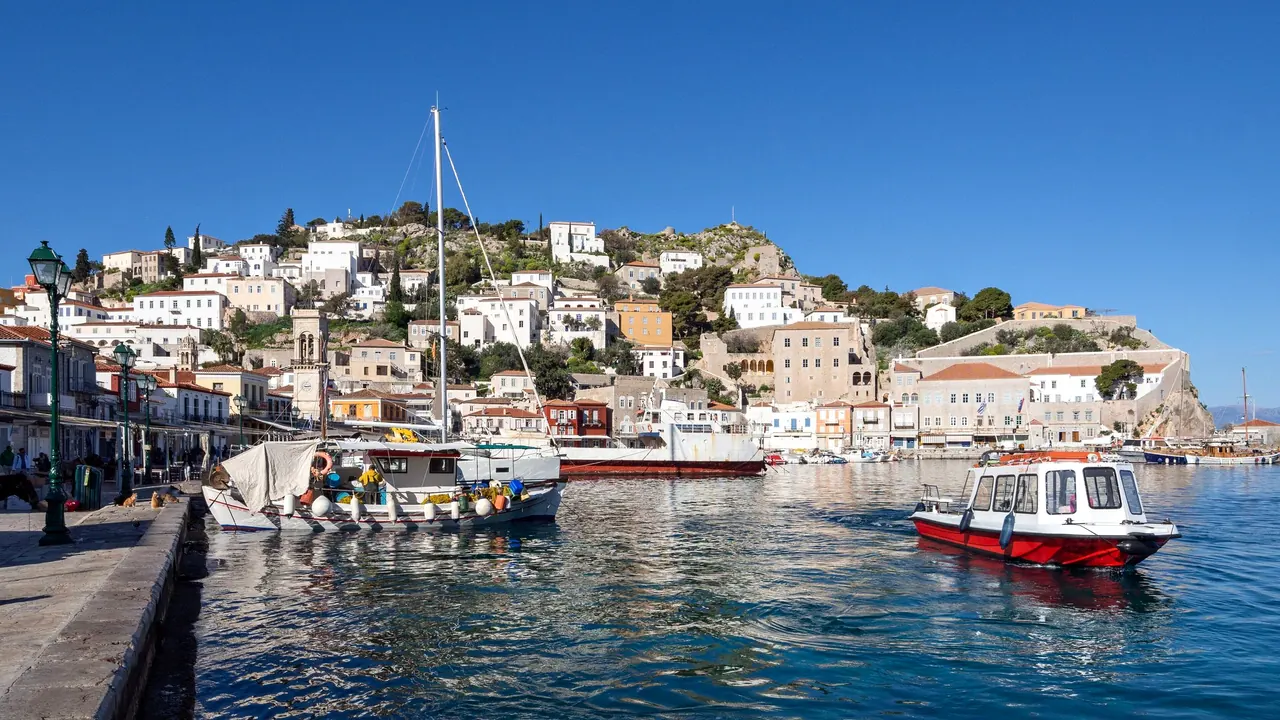
Photos: Halkidiki by Sprint28, CC BY-SA 3.0, cropped; Hydra by C messier, CC BY-SA 4.0, cropped.
Halkidiki or Hydra?
Our verdict in twelve categories, each scored against the same fixed benchmark cities, and the climate month by month, so you can choose for your trip.
Choose Halkidiki for
- families
- beaches
- prices
Halkidiki is the better choice for a proper beach vacation. Its three peninsulas give you long stretches of pale sand and shallow, calm water, with organised beaches and late bars on Kassandra and wilder granite coves on Sithonia. Families, groups who want to go out at night and anyone watching the budget get more from it, as long as they are happy to hire a car and drive between bases.
Choose Hydra for
- shopping
- culture and sights
- getting around
Hydra suits a slower, more polished stay in one beautiful harbour town. There are no cars, the stone mansions around the port are protected as a whole, and the days pass between swimming off the rocks, walking the mule paths and eating at dusk in Kamini. It works best for couples and walkers who can do without sandy beaches and pay more for a room.
Scoreboard
Twelve categories on one fixed scale from 0 to 100. The shaded stretch is the gap between the two.
Your match
Pick a travel style or drag the sliders, and both match scores follow your weighting.
Wins on families and beaches with your weighting.
Wins on shopping and culture and sights with your weighting.
What matters to you?
Category by category
What the scores mean for a trip.
Beaches & swimming
Halkidiki has the far bigger and gentler shore. Its three peninsulas give you hundreds of kilometres of pale sand and fine pebble sloping slowly into turquoise water. You can choose the organised beaches and beach bars of Kassandra, or the granite coves and long southern beaches of Sithonia at Karydi, Kalamitsi and Toroni.
Hydra gives up that space for deeper, clearer water. Where Halkidiki lets you wade in, here you climb down a ladder from the rocks west of the port. Its pebble coves at Kamini, Vlychos and Mandraki are a fraction of the size, and the prettier ones, Bisti and Agios Nikolaos, mean a water taxi, so a beach day takes more planning.
Food & drink
Halkidiki gives you more to eat and more places to eat it. Fishing villages such as Nikiti and Ouranoupoli and the inland hill villages have family tavernas cooking for Greek visitors, and there are local products to seek out: big green olives, pine and thyme honey, Athos wines. For a serious food day, Thessaloniki is close.
Hydra cooks the same kind of taverna food, but the choice is narrower. The harbour tables charge for their view, so the better meals are in the back lanes or by the water at Kamini. Its one real speciality is amygdalota, the rosewater almond sweets.
Culture & sights
Hydra comes out ahead because its heritage is right where you stay. The horseshoe harbour of grey and white shipowners' mansions, built when its fleet led the War of Independence, survives whole and free of cars. Add the Monastery of the Dormition, the Koundouriotis mansion and the cannons on the old batteries, and you have two good days.
Halkidiki's great monument, Mount Athos, is open only to men with a permit, so most visitors see the monasteries from a cruise boat out of Ouranoupoli. The rest, Olynthos, ancient Stagira and the Petralona cave, are spread out and make modest half-days.
Nightlife
Halkidiki is the one for a late night, though only on Kassandra and only in summer. Kallithea has open-air clubs, while Pefkohori and Hanioti have bar strips that fill after midnight with young Greeks who drive in from Thessaloniki.
Hydra's evenings are smarter and shorter. You drink cocktails on the waterfront with Athenians and yachting visitors, and a few bars keep the music and some dancing going into the small hours. But there are no big clubs and nothing like a party-island scene.
Nature & outdoors
Halkidiki has the wider range outdoors. Sithonia's granite headlands, islets and the wooded slopes of Mount Itamos make good coast drives and walks, and the sea gives you kayaking, sailing out to the Diaporos lagoon and snorkelling over rocky seabeds.
Hydra's outdoors comes down to one thing done well: walking. Car-free mule paths climb a bare limestone ridge to the hilltop monasteries and Mount Eros, close to 600m, with views over the Saronic Gulf. But there is little shade, so in summer it is a job for early mornings.
Day trips
From Halkidiki the outings are bigger and easier to reach by car. Thessaloniki is roughly an hour away for Byzantine churches and the White Tower, and the royal tombs at Vergina and Pella make a full day. Kavala and Amphipolis are within reach from the Athos side.
Hydra's day trips are by boat to the other Saronic islands: Spetses and Poros are each under an hour, and Aegina is further. Epidaurus and Nafplio on the Peloponnese mean a crossing to Metochi and then a car, so most visitors don't bother.
Good for families
Halkidiki is far easier with children. The sea is calm and stays shallow a long way out on Kassandra and around Psakoudia, and the big resorts are built around families. The main effort is the midsummer heat and the drives, since there are no theme parks or aquariums.
Hydra charms children with its donkeys, water taxis and lanes free of traffic, but the town is all steep stone steps, which rules out pushchairs. Most swimming is off ladders into deep water, so it suits older children who swim well.
Getting around
Hydra is simpler once you have arrived. Everything in town is a short walk, though often up steps. A coastal path leads to Kamini, Vlychos and Mandraki, and water taxis cover the rest. The catch is the ferry from Piraeus, which strong winds can cancel.
In Halkidiki you will need a car. Each peninsula is a long finger, so getting from Kassandra to the Athos side means driving back up to the base and down again, and Kassandra's road crawls at summer weekends. Buses are too sparse to rely on.
Shopping & style
Neither is a place to go shopping, but Hydra's lanes behind the harbour are better for browsing. You'll find jewellery workshops, galleries selling work by resident artists, linen and ceramics, of better quality than most island ports.
Halkidiki has mainly beachwear and souvenir strips in the Kassandra villages and Neos Marmaras. The things worth taking home are local olive oil, honey and wine, plus the icons and incense sold in Ouranoupoli.
Affordability
Halkidiki is noticeably cheaper. Most of its visitors are Greek and Balkan families who drive in, which keeps plenty of simple apartments and village tavernas in business. Costs rise mainly at the big Kassandra resorts and on organised beaches in high summer.
On Hydra the room is what costs the most. Beds are few, mostly boutique guesthouses and converted mansions that book up early for July and August, and water taxis and porters add to the bill. Back-lane tavernas and swimming from the rocks are fair value or free.
Live music & performing arts
Both are thin, but Halkidiki at least has a summer programme. The Kassandra Festival puts on concerts and theatre in the open-air amphitheatre at Siviri, and the Sani Festival adds jazz and classical evenings.
Hydra has occasional recitals, late taverna music and the Miaoulia in June, when a fireship is burned in the harbour to mark its naval past.
Wellness & relaxation
The two are about level, but they relax you in different ways. Halkidiki has the facilities: warm thermal pools above the sea at Agia Paraskevi and full spas in the big resorts, with the calmest stays on Sithonia.
Hydra has no spa culture. What it offers is quiet, with no engines, only bells, donkeys and the sea, and the upper town and Kamini are calm once the day boats leave.
When should you go?
Pick your month. The climate figures are measured averages, not a forecast.
Halkidiki in July
Hydra in July
Daytime high, °C
Rainfall in the month, mm
Where the figures come from
Halkidiki's temperatures are measured 64 km from the centre, at Thessaloniki Airport.
Halkidiki has no rain gauge within 25 km of the centre, so its rainfall comes from a gridded climate dataset read at the destination rather than from a gauge further away.
Hydra's temperatures are measured 66 km from the centre, at Athinai Airport.
Hydra has no rain gauge within 25 km of the centre, so its rainfall comes from a gridded climate dataset read at the destination rather than from a gauge further away.
Temperature and rainfall are climate normals, averaged over the years shown. Halkidiki: 1991-2020 normals, Thessaloniki Airport (63.7 km from centre). Hydra: 1991-2020 normals, Athinai Airport (65.5 km from centre).
Both are summer destinations with almost the same peak. Around the Halkidiki resorts, highs reach 32°C in July and August. Hydra runs a degree warmer, with almost no rain from June to August and more sunshine all year. The sea is warm enough to swim in on both from June, and on Hydra it stays warm a little longer, still about 23°C in October. From June to August it is too hot for long walks or drives in either place, so walkers do better in April and May, or from late September into October.
The two part ways in winter. Halkidiki turns properly cool, with highs near 10°C in January and steady rain from October to December. Hydra stays milder, but November and December bring heavy rain, around 89mm a month.
Which traveller are you?
On a family trip with young children, Halkidiki is the clear pick. Kassandra and the coast around Gerakini and Psakoudia have sand and water that stays shallow, and the resorts have pools and children's clubs. Hydra means steep steps and deep water.
For a beach and sun trip, Halkidiki wins easily. Hundreds of kilometres of shore give you whole days on soft sand with pine forest behind, while Hydra's swimming is from rocks, ladders and small pebble coves you reach by water taxi.
On a culture and arts trip, Hydra has more to offer. The whole car-free town of shipowners' mansions is the sight, with the naval archives, a harbour monastery and summer art exhibitions. Halkidiki's Mount Athos is mostly something you see from a boat.
Before you go
| Measure | Halkidiki | Hydra |
|---|---|---|
| Official language | Greek | Greek |
| Currency | Euro (EUR) | Euro (EUR) |
| Sockets | CF230 V, 50 Hz | CF230 V, 50 Hz |
| Driving side | Right | Right |
| Time zone | UTC+2, UTC+3 in summer | UTC+2, UTC+3 in summer |
| Emergency number | 112 | 112 |
| Main airport | Thessaloniki Macedonia International Airport (SKG)93 non-stop destinations | Athens Eleftherios Venizelos International Airport (ATH)176 non-stop destinations |
| Public holidays this year | 15 days | 15 days |
By the numbers
| Measure | Halkidiki | Hydra |
|---|---|---|
| Population | 110,587 | 1,966 |
| People per km² | 38 | 40 |
| Swim season, months above 21 °C | 5 months | 5 months |
Where else could you go?
Every comparison below shares a destination with this one, so you can follow Halkidiki or Hydra somewhere new.
- Aeginavs Hydra
- Peloponnesevs Hydra
- Skiathosvs Halkidiki
- Skopelosvs Halkidiki
- Milosvs Hydra
- Sifnosvs Hydra