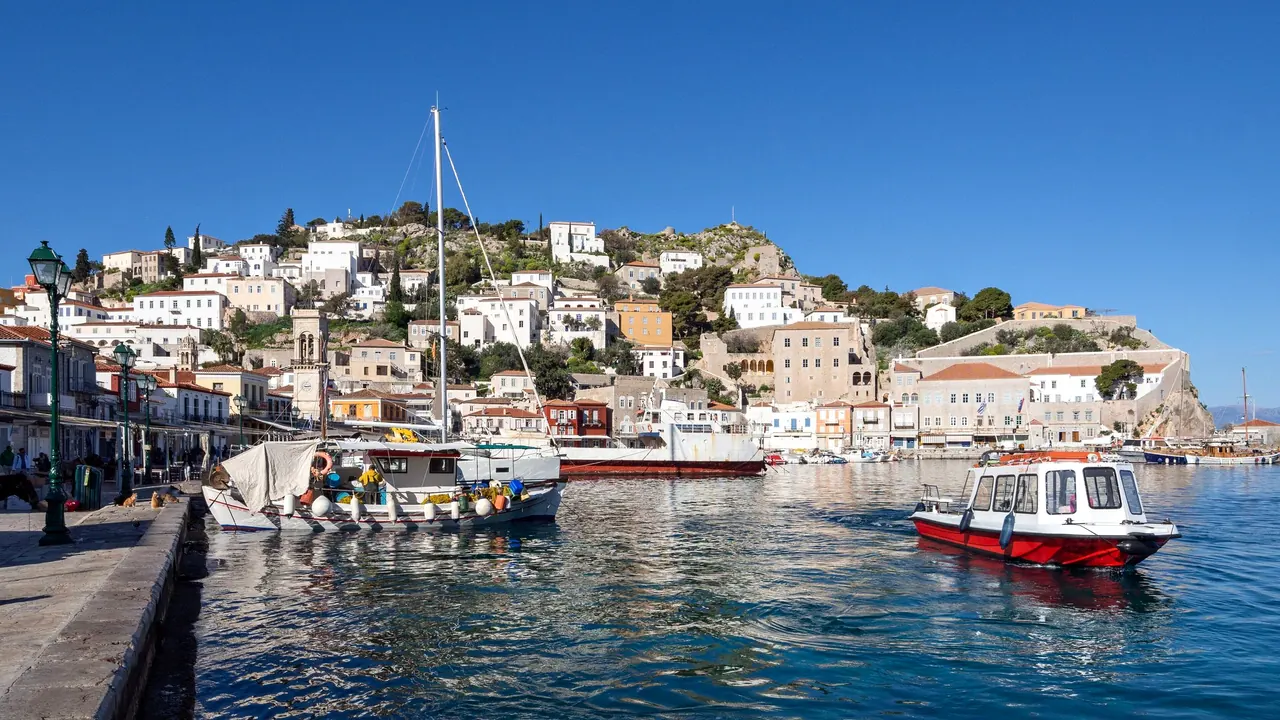
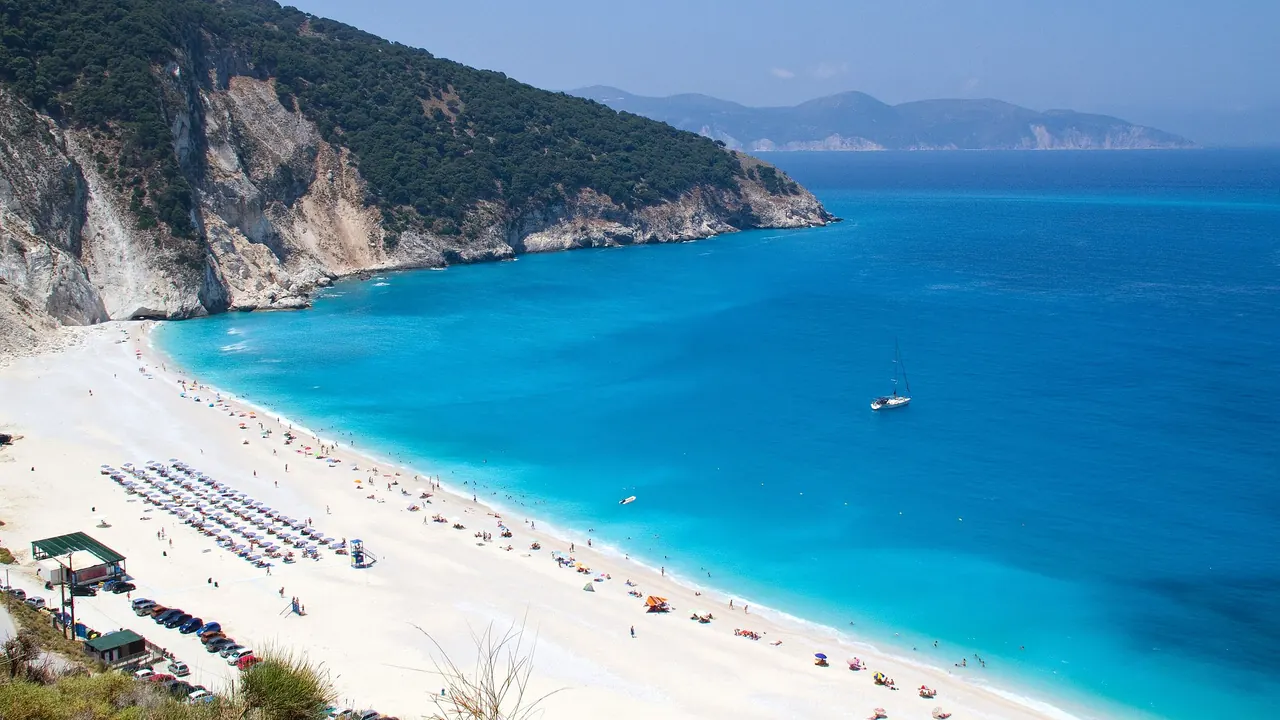
Photos: Hydra by C messier, CC BY-SA 4.0, cropped; Kefalonia by Tony Hisgett from Birmingham, UK, CC BY 2.0, cropped.
Hydra or Kefalonia?
Our verdict in twelve categories, each scored against the same fixed benchmark cities, and the climate month by month, so you can choose for your trip.
Choose Hydra for
- culture and sights
- nightlife
- getting around
Hydra suits travellers who want one beautiful harbour town and the quiet that comes with having no cars. Its stone mansions, waterfront evenings and old mule paths reward a few slow days of swimming off rocks, walking and long drinks beside the boats. It is close enough to Athens by ferry to add on to a city stay. In return you give up proper beaches, variety at the table and almost anything for children.
Choose Kefalonia for
- beaches
- families
- nature and the outdoors
For a beach vacation built around a hire car, Kefalonia is the better choice. The coves at Myrtos, Petani and Antisamos and the sand in the south are far better than anything on Hydra. Mount Ainos and the Melissani cave give you real outdoor days, and the local cooking and Robola wine last better over a week or two. Families with small children will find it much easier. What you give up is character in the towns, since most were rebuilt plainly after the earthquake, and you spend long stretches driving between coasts.
Scoreboard
Twelve categories on one fixed scale from 0 to 100. The shaded stretch is the gap between the two.
Your match
Pick a travel style or drag the sliders, and both match scores follow your weighting.
Wins on culture and sights and nightlife with your weighting.
Wins on beaches and families with your weighting.
What matters to you?
Category by category
What the scores mean for a trip.
Beaches & swimming
Kefalonia is a beach island and Hydra is a swimming island. On Hydra you get in off the rocks and concrete platforms west of the port, or at the small pebble coves of Kamini, Vlychos and Mandraki, with Bisti and Agios Nikolaos a water-taxi ride away. The water is superb, but there is little room to spread out for a whole day.
Kefalonia has much more range: the white pebble sweep of Myrtos under its cliffs, quieter Petani on Paliki, reddish sand at Xi and long stretches of sand and shingle at Skala and Lourdas. The catch is that the best of them lie on different coasts, so you pick a base and drive to the rest.
Food & drink
Both islands eat in tavernas, but Kefalonia has more local cooking of its own. There is meat pie, bourbourelia bean soup, aliada with salt cod, thyme honey and red mandoles. A Robola tasting in the Omala valley makes a good afternoon out, and Argostoli has a fish market and the widest choice.
Hydra's eating is narrower. You get good grilled fish and mezedes, best in the back lanes or at the coves of Kamini and Vlychos, rosewater almond sweets from the bakeries and a handful of smarter kitchens. On a longer stay the menus start to repeat sooner.
Culture & sights
On Hydra the town itself is the sight: grey and white shipowners' mansions rising around the harbour, protected as a whole and free of cars. The naval past is easy to see in the Historical Archives Museum, the Koundouriotis house and the cannons at the harbour mouth. Summer exhibitions keep up the island's links with painters and writers.
Kefalonia lost most of its old buildings in the 1953 earthquake, so its sights are separate outings: Venetian Fiskardo, the fortress at Assos, the Castle of Agios Georgios, the tomb at Tzanata and the abandoned ruins of Old Vlachata. Each is worth the drive, but none of them matches Hydra's whole town.
Nightlife
Neither island is for partying, but Hydra's harbour makes for the livelier evening. Cocktail bars along the waterfront and up the first lanes fill after dinner with Athenians and yacht crews. A few keep the music going into the small hours, especially on summer weekends.
On Kefalonia the evenings are more spread out and end earlier: the main square and the Lithostroto in Argostoli, the bar strip at Lassi, and harbour bars at Skala and Fiskardo. Outside July and August most of it winds down before midnight.
Nature & outdoors
Kefalonia has the bigger, greener landscape. Mount Ainos rises to about 1,628m and is protected as a national park, with fir forest and semi-wild horses. The west coast drops in white cliffs above Myrtos and Assos, and underground lie the Melissani lake cave and Drogarati. Turtles in Argostoli harbour, sea kayaking and sailing to Ithaca add to it.
Hydra is a bare limestone ridge, smaller in scale but excellent for walking. With no cars, the island is crossed by mule paths up to the hilltop monasteries and Mount Eros, and you can walk them alone for hours. The water is ideal for snorkelling, though there is little shade on land.
Day trips
There is little between them here, and on both islands the outings mostly start with a boat. From Hydra, Spetses and Poros are well under an hour away and Aegina, with its Temple of Aphaia, takes longer. Across the strait, the Peloponnese leads to Epidaurus and Nafplio if you arrange transport.
Kefalonia's best day out is Ithaca from Sami, for Vathy, Kioni and Frikes, and summer boats also reach Zakynthos and Lefkada. Its own far corners, Fiskardo, Assos and Paliki, make full days out from a base in the south, which Hydra is too small to offer.
Good for families
Kefalonia is far easier with children. The sandy, shallow beaches at Skala, Lourdas and Xi suit small swimmers, and the boat through Melissani and the turtles in Argostoli harbour make good outings. Long, hot drives and the lack of attractions built for children are its limits.
Children love Hydra's car-free lanes and donkeys, but the steep stone steps rule out pushchairs and most swimming is into deep water from ladders. It works for older children who swim well, staying near Mandraki or Kamini.
Getting around
Hydra is simpler once you are there. Everything in town is a short walk, if a steep one, a coastal path links Kamini, Vlychos and Mandraki, and water taxis cover the far coves, so nobody needs a car. Its weak point is the ferry from Piraeus, which strong winds can cancel.
Kefalonia almost demands a hire car. The island is large and mountainous, and the beaches and caves sit on different coasts. Argostoli to Fiskardo takes about an hour and a half on winding roads, buses run too rarely to rely on, and summer parking at Myrtos and Assos is tight.
Shopping & style
Neither island is a place to shop, but Hydra's few lanes behind the harbour are better for browsing. They have jewellery workshops, galleries selling work by resident artists, and linen and ceramics of higher quality than most island ports. Kefalonia offers everyday clothes and gifts on Argostoli's Lithostroto and craft stalls in Fiskardo, and its best buys are things to eat and drink: Robola, thyme honey, olive oil and mandoles.
Affordability
Kefalonia is the cheaper island. Apartments and small hotels around Skala, Lourdas, Lassi and the southern villages are fair value, and taverna meals are reasonable. Only Fiskardo and Assos cost noticeably more, though car hire adds to almost every visitor's budget.
On Hydra the room is the big expense, because the few boutique guesthouses and converted mansions fill early for high summer. Back-lane tavernas and free swimming from the rocks soften the cost, and May, June and late September give you a better room for the money.
Live music & performing arts
Both are quiet for live performance, with no theatre or regular season. They differ in what there is. Hydra's big event is the Miaoulia in June, when a fireship is burned in the harbour, along with occasional summer recitals. Kefalonia has its own living tradition of kantades serenades and Argostoli's philharmonic band, which you hear at village festivals and open-air concerts in the squares.
Wellness & relaxation
For pure quiet, Hydra has a slight edge. Without traffic you lose most of the noise a Greek island usually makes, and the town is small enough that you rarely need to leave it, so the days slip into early swims and long afternoon rests. The exception is the harbour at midday in summer, when the excursion boats unload. The upper town and Kamini stay calmer.
Kefalonia lets you unwind through space rather than silence. You can retreat to the Paliki peninsula or the north-east coast and spend hours over lunch in a hill village. If you want treatments, the larger resort hotels at Lassi, Skala and Fiskardo have proper spas, which offer more than Hydra's few treatment rooms in boutique hotels.
When should you go?
Pick your month. The climate figures are measured averages, not a forecast.
Hydra in July
Kefalonia in July
Daytime high, °C
Rainfall in the month, mm
Where the figures come from
Hydra's temperatures are measured 66 km from the centre, at Athinai Airport.
Hydra has no rain gauge within 25 km of the centre, so its rainfall comes from a gridded climate dataset read at the destination rather than from a gauge further away.
Kefalonia's temperatures are measured 59 km from the centre, at Zakinthos / Agrilia.
Kefalonia has no rain gauge within 25 km of the centre, so its rainfall comes from a gridded climate dataset read at the destination rather than from a gauge further away.
Temperature and rainfall are climate normals, averaged over the years shown. Hydra: 1991-2020 normals, Athinai Airport (65.5 km from centre). Kefalonia: 1991-2020 normals, Zakinthos / Agrilia (58.6 km from centre).
In summer the two islands have almost the same weather. Highs pass 25°C in May and reach 33°C in July and August, and the sea is warm enough to swim from June to October, peaking at 26°C in August. High summer is too hot for walking in either place, so keep Hydra's mule paths and the trails on Mount Ainos for early mornings, or go in May or late September.
They differ in the wet season. Hydra, on the Saronic Gulf, stays fairly dry well into autumn. Kefalonia, out in the Ionian, turns wet from October, with about 100mm that month and 159mm in November. That makes Hydra the safer bet for an October trip, while Kefalonia is at its best from late May to the end of September. In winter both are cool and rainy and closed for beach purposes.
Which traveller are you?
For a beach and sun trip, Kefalonia wins. Hydra suits strong swimmers happy to get in off rocks, while Kefalonia lets you spend whole days on sand or pebbles, choosing between cliff-backed coves and calm, shallow bays in the south.
On a culture and arts trip, pick Hydra. The whole town is a protected piece of maritime history, and summer exhibitions keep up its link with painters. Kefalonia's past survives in scattered fragments, each worth a drive but none a reason to travel.
On a family trip with young children, choose Kefalonia. Hydra's steep steps and deep-water swimming suit only older children who swim well. Kefalonia's south has sandy, gently shelving beaches at Skala and Lourdas, and a base with a pool covers the rest.
Before you go
| Measure | Hydra | Kefalonia |
|---|---|---|
| Official language | Greek | Greek |
| Currency | Euro (EUR) | Euro (EUR) |
| Sockets | CF230 V, 50 Hz | CF230 V, 50 Hz |
| Driving side | Right | Right |
| Time zone | UTC+2, UTC+3 in summer | UTC+2, UTC+3 in summer |
| Emergency number | 112 | 112 |
| Main airport | Athens Eleftherios Venizelos International Airport (ATH)176 non-stop destinations | Kefalonia International Airport "Anna Pollatou" (EFL)41 non-stop destinations |
| Public holidays this year | 15 days | 15 days |
By the numbers
| Measure | Hydra | Kefalonia |
|---|---|---|
| Population | 1,966 | 36,064 |
| People per km² | 40 | 49 |
| Swim season, months above 21 °C | 5 months | 5 months |
Where else could you go?
Every comparison below shares a destination with this one, so you can follow Hydra or Kefalonia somewhere new.
- Aeginavs Hydra
- Zakynthosvs Kefalonia
- Peloponnesevs Hydra
- Lefkadavs Kefalonia
- Milosvs Hydra
- Sifnosvs Hydra