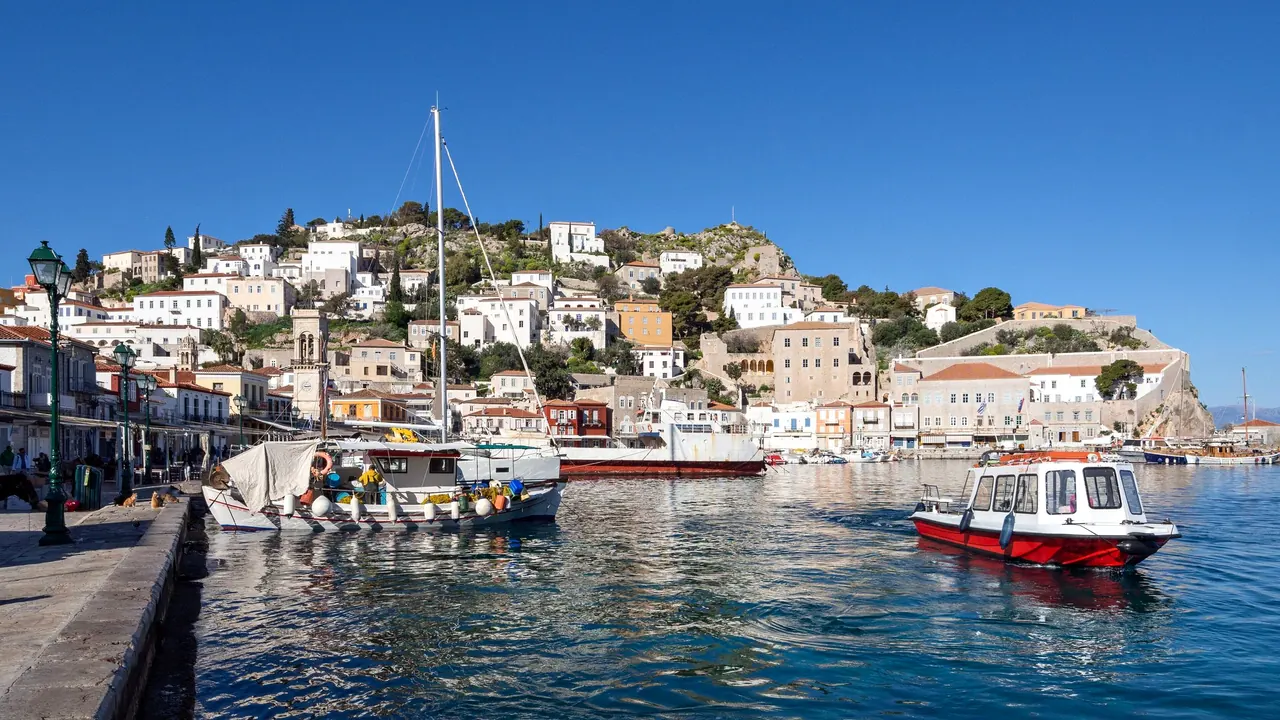
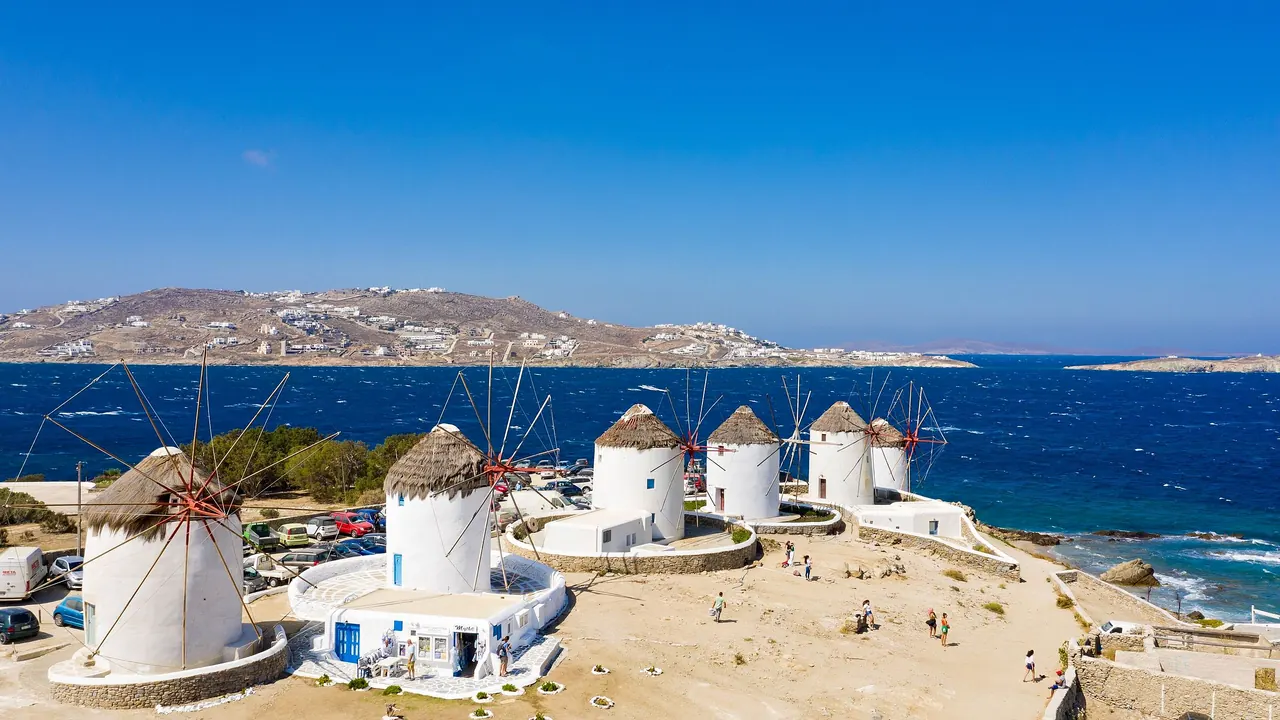
Photos: Hydra by C messier, CC BY-SA 4.0, cropped; Mykonos by dronepicr, CC BY 2.0, cropped.
Hydra or Mykonos?
Our verdict in twelve categories, each scored against the same fixed benchmark cities, and the climate month by month, so you can choose for your trip.
Choose Hydra for
- prices
- wellness
- nature and the outdoors
Hydra is the choice for a slow, quiet island stay. There are no cars, the stone mansion town around the horseshoe harbour is protected as a whole, and old mule paths lead up to hilltop monasteries. Days run to a morning swim off the rocks, a long lunch and an evening drink by the boats. It suits couples and walkers who are happy to give up sandy beaches and late nights for peace, and it costs less than its neighbour, though it is still not cheap.
Choose Mykonos for
- nightlife
- beaches
- shopping
Mykonos suits a livelier, more social trip. The sandy bays along its south coast, beach clubs that run from afternoon until sunrise, and the ruins of Delos a short boat ride away are the reasons to go, and Tinos, Syros, Paros and Naxos are easy to add by ferry. Expect to pay some of the highest prices in Europe and to share it all with big summer crowds.
Scoreboard
Twelve categories on one fixed scale from 0 to 100. The shaded stretch is the gap between the two.
Your match
Pick a travel style or drag the sliders, and both match scores follow your weighting.
Wins on prices and wellness with your weighting.
Wins on nightlife and beaches with your weighting.
What matters to you?
Category by category
What the scores mean for a trip.
Beaches & swimming
Hydra is for swimming, not sunbathing. You climb down ladders from the rocks west of the port into deep, very clear water, use the small pebble coves at Kamini and Vlychos, or take a water taxi to pine-backed Bisti and Agios Nikolaos. Nobody goes there for long days on soft sand.
Mykonos is built around its sand. The south coast offers sheltered Ornos and Agios Ioannis, polished Psarou and Platis Gialos, the party beaches at Paradise and Super Paradise, and longer, roomier stretches at Elia and Kalafatis. On windy days, swimmers leave the wilder north coast at Ftelia and Agios Sostis and move to the south side.
Food & drink
Hydra keeps to taverna cooking: grilled fish, octopus, slow-cooked meat and mezedes, at their best in the back lanes or beside the water at Kamini and Vlychos. Apart from the rosewater almond sweets, there is little variety to keep a longer stay interesting.
Mykonos offers more choice. There are fish tables in Little Venice, more local tavernas around the square at Ano Mera, island specialities such as kopanisti cheese and louza, and a large high-end scene of sushi and fusion. That polished end can be more about being seen than eating well, but you will not run out of options.
Culture & sights
Hydra's sight is its whole town. The shipowners' stone mansions above the harbour recall the fleet that fought in the War of Independence, and you can see the Monastery of the Dormition, the Historical Archives Museum and the Koundouriotis house in a couple of unhurried days.
Mykonos has more to offer because of Delos. The sacred island of Apollo, with the Terrace of the Lions and its mosaic-floored houses, is one of the great ancient sites of Greece. Chora's windmills, Little Venice and Paraportiani church, plus the carved iconostasis at Panagia Tourliani, fill the rest of a visit.
Nightlife
On Hydra the night means a long drink on the waterfront among Athenians and yachting visitors. A few bars play music until the small hours, but there are no clubs.
Mykonos is one of the great party islands of the Mediterranean. Afternoon sessions at Paradise and Super Paradise lead into the dance bars of Chora, with a long-established gay scene, and then to big clubs where international DJs play until sunrise in July and August. Both islands go quiet in winter.
Nature & outdoors
Hydra is the better island for being outdoors. A car-free network of stone mule paths climbs through pine and scrub to Profitis Ilias, Agia Efpraxia and Mount Eros at nearly 600m, with the Peloponnese spread out below. You can also snorkel or kayak along the cliffs. Shade is scarce, so spring and autumn suit walking best.
Mykonos is low, bare and brown, crossed by dry-stone walls. Walking there means country lanes and the coast near the Armenistis lighthouse. Its real outdoor draw is the wind, which brings kitesurfers and windsurfers to Korfos Bay and Kalafatis, along with diving on its reefs and wrecks.
Day trips
Hydra's outings are mostly other Saronic islands: Spetses and Poros are each well under an hour by boat, and Aegina with the Temple of Aphaia is a bit further. Reaching Epidaurus or Nafplio means crossing to Metochi and arranging a car or a tour, so most visitors don't bother.
Mykonos is better placed for day trips. Delos is on the doorstep, and Tinos with its pilgrimage church, Syros with neoclassical Ermoupoli, and Paros and Naxos are all an hour or less away. All of these trips are island-hopping within the Cyclades, though, and the wind can disrupt the crossings.
Good for families
Neither island is made for children, but Mykonos copes better. Agios Stefanos, Ornos and Platis Gialos have shallow, gentle water with tavernas on the sand, there is a water park near Elia, and Delos can hold an older child's interest.
Hydra's traffic-free lanes and luggage-carrying donkeys charm children. The steep steps defeat pushchairs, though, and swimming off ladders into deep water suits only strong swimmers. Families do best at Mandraki or Kamini, ideally with older children.
Getting around
Both islands are easy to get around in their own way. On Hydra you walk, ride a mule or take a water taxi, and nearly every route away from the harbour means stone steps.
Mykonos has buses from Chora to the south-coast beaches and Ano Mera, plus sea taxis between the bays. Taxis are scarce and the roads crowded in high summer, so the quieter north and east need a hired car or scooter. Ferries to either island can be cancelled in strong wind.
Shopping & style
Hydra has a few lanes of jewellery workshops, galleries showing resident artists, linen and ceramics. The quality is good, but there is little beyond an evening's browse.
Mykonos has more to buy, centred on Matoyianni Street, where shops stay open late with designer resort wear, swimwear, sandals, fine Greek jewellery and design pieces. It is still a narrow, seasonal range, best for a beach wardrobe.
Affordability
Neither island is cheap in summer, but Hydra is easier on the budget. Its boutique guesthouses are costly and book up early, yet back-lane taverna meals are fair value and swimming off the rocks is free.
Mykonos is among the most expensive places to vacation in Europe. Its hotels, beach-club sunbeds, cocktails and taxis are all priced for a luxury crowd. Staying around Ano Mera, eating gyros and using the buses help, and on both islands June and late September cost less.
Live music & performing arts
There is little to attend on either island, and an evening of theatre or concerts means going to Athens. The difference is in the occasions. Hydra has occasional summer recitals and the Miaoulia festival in June, when a fireship is burned in the harbour, while on Mykonos the music comes from club DJs, with now and then a village festival of traditional dance.
Wellness & relaxation
Hydra is the more restful island. There are no spas to speak of, but with no engines the days take on a slow rhythm of swimming, lunch and a nap through the heat, and the harbour empties once the excursion boats have left.
Mykonos has the better hotel spas, with massages and yoga on sea-facing terraces, but its summer of beach clubs and late nights works against rest. Visitors looking for calm head for Agios Sostis, Ftelia or the bays beyond Kalafatis.
When should you go?
Pick your month. The climate figures are measured averages, not a forecast.
Hydra in July
Mykonos in July
Daytime high, °C
Rainfall in the month, mm
Where the figures come from
Hydra's temperatures are measured 66 km from the centre, at Athinai Airport.
Hydra has no rain gauge within 25 km of the centre, so its rainfall comes from a gridded climate dataset read at the destination rather than from a gauge further away.
Mykonos has no weather station within reach, so its figures come from a gridded climate model rather than a measured record, and read a broad area rather than one spot.
Temperature and rainfall are climate normals, averaged over the years shown. Hydra: 1991-2020 normals, Athinai Airport (65.5 km from centre). Mykonos: 2001-2020 normals, NASA POWER reanalysis grid, no weather station within 90 km.
Summer is far hotter on Hydra. Daytime highs reach 33°C in July and August, so walking the stepped lanes and hill paths is best left to early morning, and May, late September and October are more comfortable for exploring. Mykonos stays milder, peaking around 25°C, so Chora's lanes can be walked through the middle of a summer day. Both islands are almost rainless from June to August, and Hydra's long sunny days run from May to September.
The sea is warm enough on both from June into October. Hydra's water gets a little warmer, about 26°C in August against 24°C off Mykonos. The rain returns from November, and winter is wet on both. Mykonos is at its wettest in January at about 100mm, while Hydra's heaviest months are November and December. Neither is a beach destination from November to April.
Which traveller are you?
On a beach and sun trip, Mykonos is the clear pick. Its south coast is a row of sandy bays with sunbeds, sea taxis between them and room to spread out at Elia or Kalafatis, while Hydra offers rock ladders and small pebble coves.
For a food and nightlife trip, choose Mykonos. Evenings move from sunset drinks in Little Venice to dance bars and clubs that close at sunrise, with a wider choice of food than Hydra, whose nights end over a quiet harbour cocktail.
On a relaxing and wellness trip, Hydra suits far better. With no cars or motorbikes, the only sounds are donkeys, bells and the sea, the upper town and Kamini stay calm, and the island has none of the late-night noise that fills Mykonos in summer.
Before you go
| Measure | Hydra | Mykonos |
|---|---|---|
| Official language | Greek | Greek |
| Currency | Euro (EUR) | Euro (EUR) |
| Sockets | CF230 V, 50 Hz | CF230 V, 50 Hz |
| Driving side | Right | Right |
| Time zone | UTC+2, UTC+3 in summer | UTC+2, UTC+3 in summer |
| Emergency number | 112 | 112 |
| Main airport | Athens Eleftherios Venizelos International Airport (ATH)176 non-stop destinations | Mykonos Island National Airport (JMK)44 non-stop destinations |
| Public holidays this year | 15 days | 15 days |
By the numbers
| Measure | Hydra | Mykonos |
|---|---|---|
| Population | 1,966 | 10,134 |
| People per km² | 40 | 96 |
| Swim season, months above 21 °C | 5 months | 5 months |
Where else could you go?
Every comparison below shares a destination with this one, so you can follow Hydra or Mykonos somewhere new.