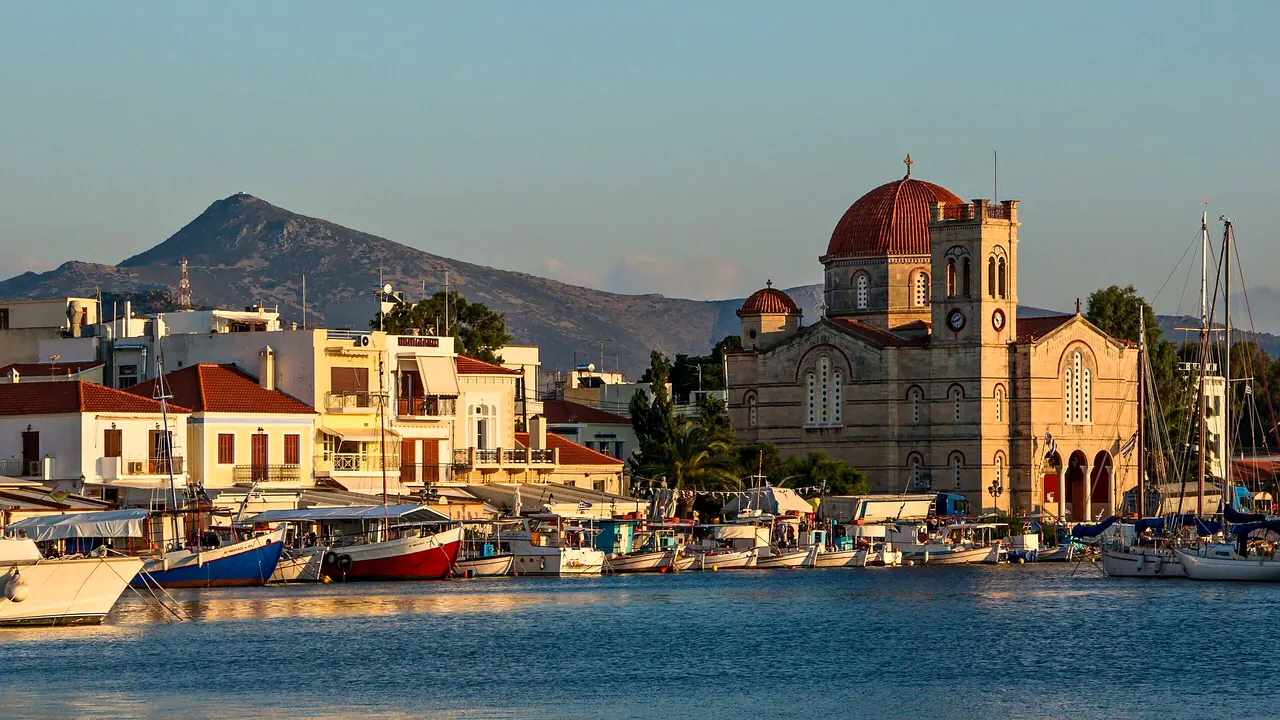
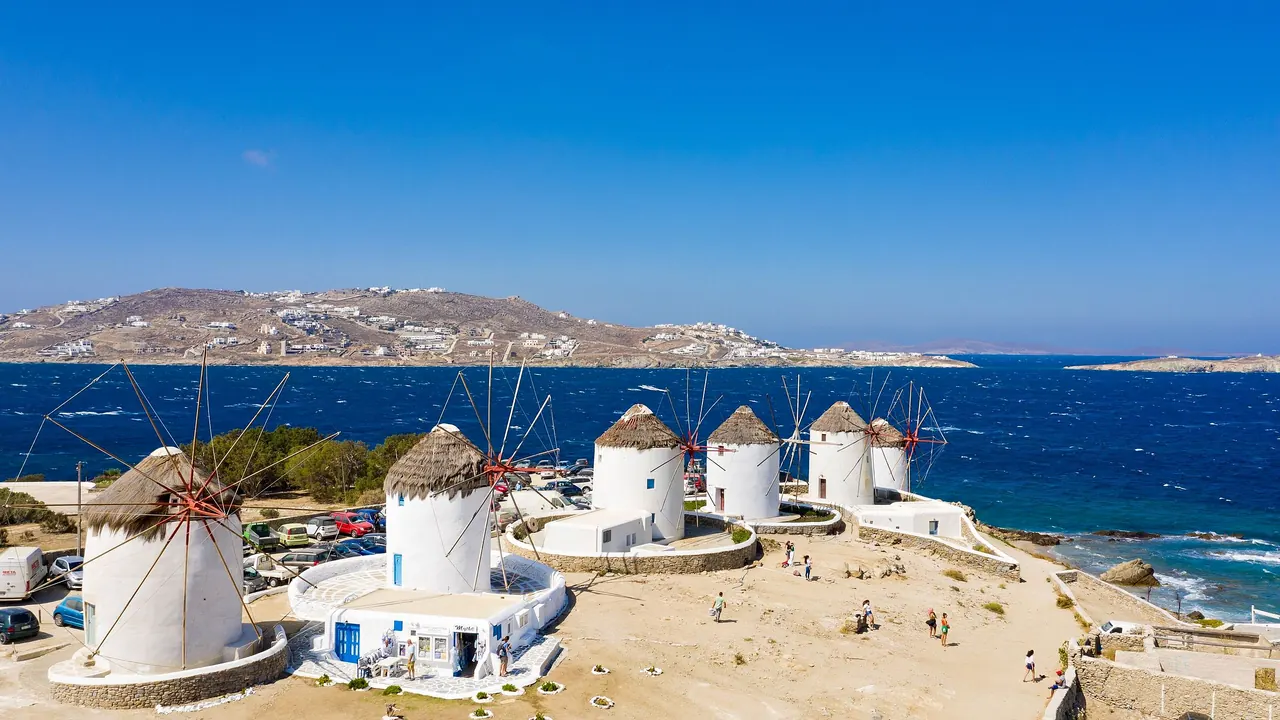
Photos: Aegina by Jebulon, CC0; Mykonos by dronepicr, CC BY 2.0, cropped.
Aegina or Mykonos?
Our verdict in twelve categories, each scored against the same fixed benchmark cities, and the climate month by month, so you can choose for your trip.
Choose Aegina for
- prices
- nature and the outdoors
- families
Aegina is for travellers who want a calm, unpolished Greek island within easy reach of Athens. It suits couples and families with young children, walkers, and anyone keeping an eye on the budget. Its pleasures are low-key: the Temple of Aphaia on its pine-covered hilltop, the pistachio orchards and the climb up Mount Oros, and fish suppers on the quay at Perdika. The Acropolis is an easy day out by fast boat.
Choose Mykonos for
- nightlife
- shopping
- beaches
Mykonos makes sense when the beach and the night out are the point of the trip and cost matters less. Its south coast is lined with sandy bays, Chora's whitewashed lanes and Little Venice give the evenings a setting, and the party season from June to September is among the liveliest in the Mediterranean. Delos, a short boat ride away, adds a major ancient site. You pay heavily for all of it, and the island has little of Aegina's quiet.
Scoreboard
Twelve categories on one fixed scale from 0 to 100. The shaded stretch is the gap between the two.
Your match
Pick a travel style or drag the sliders, and both match scores follow your weighting.
Wins on prices and nature and the outdoors with your weighting.
Wins on nightlife and shopping with your weighting.
What matters to you?
Category by category
What the scores mean for a trip.
Beaches & swimming
Mykonos is the beach island of the two. Its south coast runs from sheltered Ornos and Agios Ioannis, through the polished sands of Psarou and Platis Gialos and the party beaches of Paradise, to the longer, roomier bays at Elia and Kalafatis. The water is very clear. The price of this is that much of the shore is given over to sunbeds and beach clubs, and the north coast is often too rough when the meltemi blows.
Aegina's swimming is smaller and more local: coves at Marathonas and Aiginitissa, rocks to dive off near Perdika, and one proper resort strand at Agia Marina. The finest water is off the pine-fringed islet of Moni. It is pleasant for a summer stay, but you will not find the long sandy bays of Mykonos.
Food & drink
Mykonos has the broader table. Grilled fish and octopus are served at the water's edge in Little Venice, and the island has foods of its own to look for: the peppery kopanisti cheese, cured louza and the almond sweets of Chora's bakeries. On top of that comes a large high-end scene of sushi and fusion cooking, although much of it is more about being seen than about eating well.
Aegina keeps to Greek and seafood cooking and does it honestly, in the ouzeries behind the old fish market and the fish tavernas along Perdika's quay, with the local pistachio in almost everything. So many of the diners are weekending Athenians that few of its tables feel touristy.
Culture & sights
Delos gives Mykonos the edge. It was one of the great sanctuaries of the ancient Greek world, and its Terrace of the Lions, mosaic floors and theatres fill a whole morning. Back on Mykonos, the windmills of Kato Mili, the Paraportiani church and the maze of Chora's lanes make a sight in themselves.
Aegina's list is shorter. The Temple of Aphaia is one of the most complete Doric temples in Greece. The island also has the frescoed chapels scattered over ruined Paleochora, the lone column at Kolona, and the neoclassical houses left from its brief time as the first capital of modern Greece.
Nightlife
These two islands are opposites after dark. From June to September, Mykonos runs from afternoon sessions at the Paradise and Super Paradise beach clubs, to cocktail bars and dance bars in Chora shaped by a long-established gay scene, to large clubs where international DJs play until sunrise.
Aegina's evenings are long dinners and drinks along the harbour, which stays lively past midnight on summer weekends. Agia Marina adds a few beach bars. On Aegina, a real night out means taking the ferry back to Athens.
Nature & outdoors
Aegina is the better island for getting out on foot or by bike. The path up the cone of Mount Oros passes an ancient sanctuary of Zeus on the way to views over the whole Saronic Gulf, and quiet roads wind through pistachio orchards and pine woods.
Mykonos is low, bare and brown, and walking there is limited to lanes and coastal paths such as the one to the Armenistis lighthouse. Its strengths are wind and water instead. The meltemi brings kitesurfers and windsurfers to Korfos Bay and Kalafatis, and divers explore the reefs and wrecks.
Day trips
Both islands are good bases for outings, and both tie you to ferry timetables. The difference is where the boats go. From Aegina, a fast boat reaches Athens in about forty minutes, so the Acropolis and the big city museums are an easy day, with car-free Hydra, Poros, little Agistri and the theatre at Epidaurus as other options.
From Mykonos, every outing means island-hopping: Delos first, then pilgrimage Tinos, neoclassical Ermoupoli on Syros, and Paros and Naxos. The meltemi can cancel crossings.
Good for families
Aegina is the easier island with children. The crossing is short, Agia Marina and Marathonas have gently shelving sandy water, tavernas welcome children late into the evening, and the peacocks and deer on Moni make a half-day outing. Its quiet days suit young children more than teenagers.
Mykonos can work if you pick a calm bay such as Agios Stefanos or Ornos. Older children will enjoy the water park near Elia and the trip to Delos. The island is built around adult nights out, though, so Chora is loud late in high summer, and the north coast can be dangerous for small swimmers when the wind is up.
Getting around
Both islands are small enough to drive across in about half an hour, and both work best with a scooter or car. On Aegina, boats from Piraeus run throughout the day, the flat harbour town is easy to walk, and buses run out to Perdika and to Agia Marina via Aphaia, though not often.
Mykonos has a car-free Chora, buses from Fabrika and the old port, and sea taxis that hop between the south-coast beaches. Its weak points are the shortage of taxis and the summer traffic and parking around town.
Shopping & style
Mykonos has real shopping, at least for a beach wardrobe. The boutiques along Matoyianni Street and the surrounding alleys sell designer resort wear, linen, sandals and fine Greek jewellery, with galleries mixed in, and they stay open late into the night. Much of it closes outside the season.
Aegina has pistachio shops, a few ceramics stores and everyday Greek shops around the harbour. A bag of nuts is what most people take home.
Affordability
Aegina costs far less. Its visitors are mostly Greeks, so guesthouses, tavernas and harbour cafés charge mainland prices, and the ferry, buses and scooter hire cost little. Rooms are the one cost that climbs, on summer weekends and in August.
Mykonos in season is among the most expensive places in Europe, with hotels, beach clubs, sunbeds, cocktails and car hire all priced for a luxury crowd. Gyros counters, rooms at Ano Mera, public buses and a June or late September visit soften the bill, but they do not make the island cheap.
Live music & performing arts
Neither island has theatre, opera or a concert season. Aegina's summer offers open-air cinema and live Greek music in some tavernas, and the ancient-theatre festivals of Athens and Epidaurus are within reach. On Mykonos the music comes from club and beach-bar DJs, with the occasional village festival of traditional dance.
Wellness & relaxation
Neither island has a spa or bathing tradition, so rest has to come from somewhere else. On Mykonos, the upmarket hotels offer massages, treatments and yoga on terraces facing the sea, but the summer rhythm of beach clubs and late nights works against rest, unless you stay out near Agios Sostis or Ftelia.
Aegina has only a few small hotel spas, but the island itself is slow. You can spend long lunches in Perdika and quiet hours among the chapels of Paleochora, especially on weekdays.
When should you go?
Pick your month. The climate figures are measured averages, not a forecast.
Aegina in July
Mykonos in July
Daytime high, °C
Rainfall in the month, mm
Where the figures come from
Aegina's temperatures are measured 32 km from the centre, at Athinai Airport.
Aegina has no rain gauge within 25 km of the centre, so its rainfall comes from a gridded climate dataset read at the destination rather than from a gauge further away.
Mykonos has no weather station within reach, so its figures come from a gridded climate model rather than a measured record, and read a broad area rather than one spot.
Temperature and rainfall are climate normals, averaged over the years shown. Aegina: 1991-2020 normals, Athinai Airport (31.8 km from centre). Mykonos: 2001-2020 normals, NASA POWER reanalysis grid, no weather station within 90 km.
Both islands are close to rainless from June to August, and on both the sea is warm enough to swim from June into October. Summer feels very different on each, though. Around Aegina town the afternoons climb to 33°C in July and August, under long, cloudless days, so the walk to Aphaia or up Mount Oros is hard work in the middle of the day. Aegina's sea is also slightly the warmer of the two, reaching about 26°C in August. On Mykonos the meltemi keeps summer highs nearer 25°C, but it also churns up the north coast.
On Aegina, May is good for walking, though the sea is still cool at around 19°C. Late September and October give you both at once: the heat has eased and the water is still warm. Mykonos is mild for walking through spring and autumn, and its sea stays swimmable into early October. Winter brings the rain to both islands, and Mykonos gets more of it, with around 100mm in January.
Which traveller are you?
For a food and nightlife trip, Mykonos is the clear choice. Its days start at the beach clubs, its evenings move on to sunset drinks in Little Venice and its clubs run until sunrise. It also has the wider choice of restaurants, while Aegina's evenings end early over meze.
On a trip on a tight budget, Aegina is far kinder. Its guesthouses and tavernas charge ordinary mainland prices, and ferries and scooter hire cost little. Mykonos ranks among Europe's most expensive places in season, from the hotel rooms to the sunbeds.
On a beach and sun trip, Mykonos offers much more. The south coast has a long line of sandy bays in very clear water, from sheltered Ornos to the roomy Elia and Kalafatis. Aegina has small coves, rocks to swim off and one resort beach.
Before you go
| Measure | Aegina | Mykonos |
|---|---|---|
| Official language | Greek | Greek |
| Currency | Euro (EUR) | Euro (EUR) |
| Sockets | CF230 V, 50 Hz | CF230 V, 50 Hz |
| Driving side | Right | Right |
| Time zone | UTC+2, UTC+3 in summer | UTC+2, UTC+3 in summer |
| Emergency number | 112 | 112 |
| Main airport | Athens Eleftherios Venizelos International Airport (ATH)176 non-stop destinations | Mykonos Island National Airport (JMK)44 non-stop destinations |
| Public holidays this year | 15 days | 15 days |
By the numbers
| Measure | Aegina | Mykonos |
|---|---|---|
| Population | 13,056 | 10,134 |
| People per km² | 149 | 96 |
| Swim season, months above 21 °C | 5 months | 5 months |
Where else could you go?
Every comparison below shares a destination with this one, so you can follow Aegina or Mykonos somewhere new.