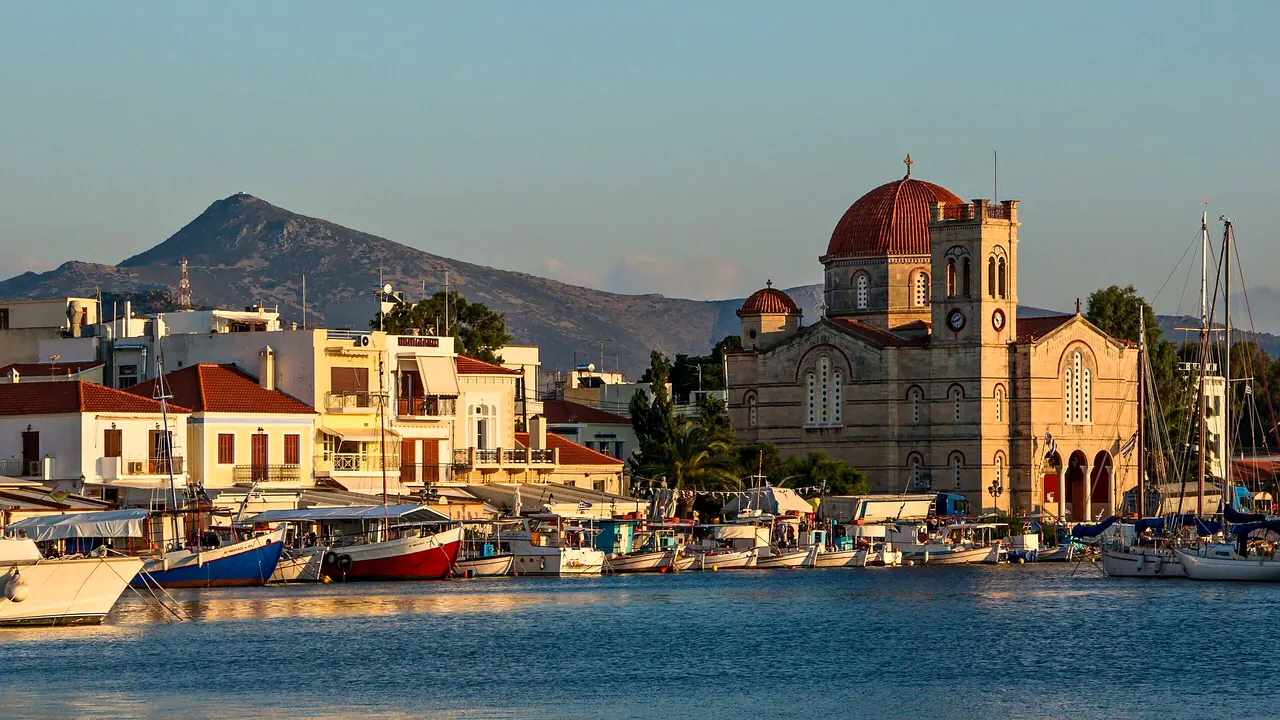
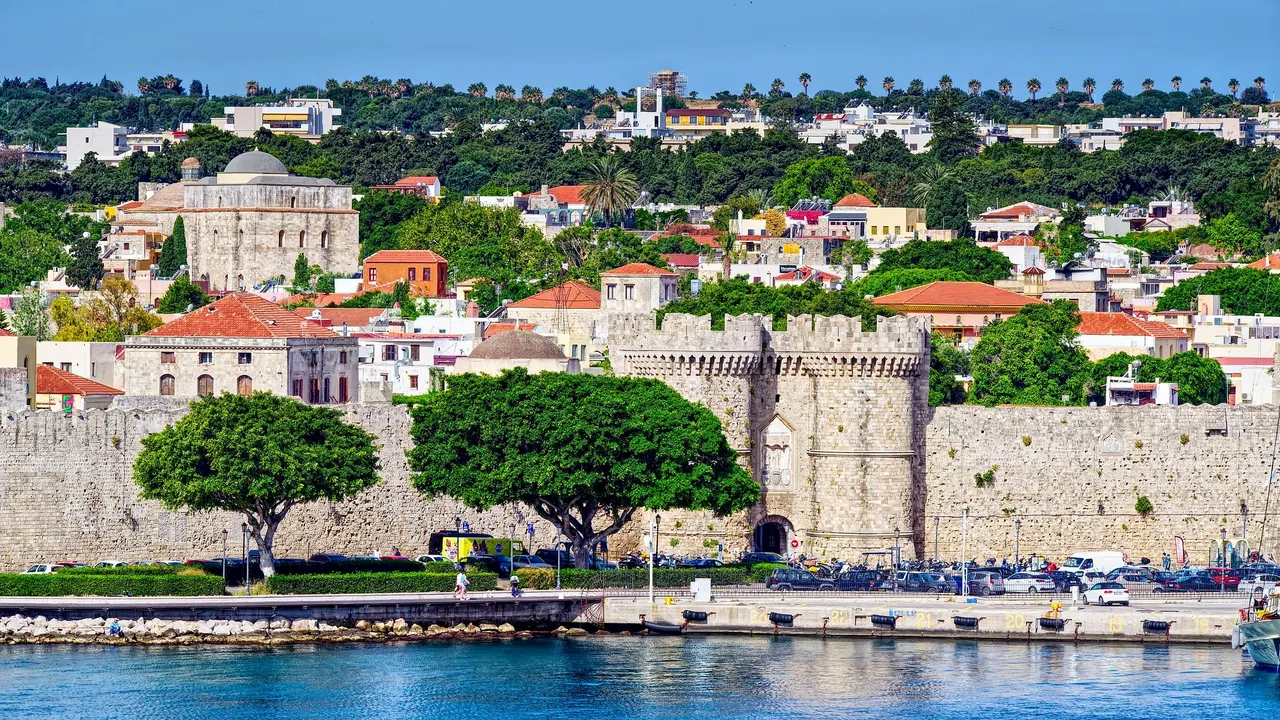
Photos: Aegina by Jebulon, CC0; Rhodes by Mark Thomas, Pexels License.
Aegina or Rhodes?
Our verdict in twelve categories, each scored against the same fixed benchmark cities, and the climate month by month, so you can choose for your trip.
Choose Aegina for
- prices
- day trips
Aegina suits a few unhurried days of Greek island life within easy reach of Athens. It works as an add-on to a city trip or as a quiet escape: one great temple at Aphaia, fish suppers on the quay at Perdika, pistachios everywhere and swimming off rocks and small coves. What you give up is long sandy beaches, a real night out and anything built for children. The island makes up for it with calm and a short crossing.
Choose Rhodes for
- culture and sights
- nightlife
- families
Rhodes is the better choice for a full week or more by the sea. The east coast between Faliraki and Lindos has far better beaches, the medieval Old Town and the acropolis of Lindos give it real depth in history, and resort hotels make family stays easy. It is a bigger island to get around, often busy in high summer, and a long way from Athens. In return you get much more to fill each day.
Scoreboard
Twelve categories on one fixed scale from 0 to 100. The shaded stretch is the gap between the two.
Your match
Pick a travel style or drag the sliders, and both match scores follow your weighting.
Wins on prices and day trips with your weighting.
Wins on culture and sights and nightlife with your weighting.
What matters to you?
Category by category
What the scores mean for a trip.
Beaches & swimming
Rhodes is the stronger beach island by some distance. Its east coast is one sheltered bay after another, from Faliraki through Kolymbia and Tsambika's long sweep of soft sand to St Paul's Bay below Lindos, with snorkelling inlets at Anthony Quinn Bay and kitesurfing water at Prasonisi. The busiest stretches fill with rows of sunbeds in summer, but you have plenty of choice.
Aegina offers a smaller, more local kind of swimming. There are coves around Marathonas and Aiginitissa, people diving off the rocks near Perdika, the pine-fringed pebble cove on Moni, and Agia Marina as the one real resort beach. It is a pleasant place to swim, but it has nothing like Rhodes's length of coast.
Food & drink
Rhodes has the wider table. Village tavernas inland serve pitaroudia, matsi pasta and slow-cooked goat, with souma and wine from Embonas, and there is a small upmarket tier in Lindos and Rhodes Town. The catch is the resort belt and the Old Town's main lanes, where buffets and tourist menus dominate, so you have to choose where to eat.
Aegina is narrower but more consistent. Its ouzeries behind the old fish market and the fish tavernas on Perdika's quay feed Athenian weekenders who expect good food, and the island's pistachios turn up in everything from pastries to liqueur. Outside Greek cooking and seafood there is little else on offer.
Culture & sights
The gap here is wide. Rhodes has one of Europe's most complete fortified medieval towns: the Street of the Knights, the Palace of the Grand Master, the Archaeological Museum in the Knights' Hospital, and mosques and a synagogue within the walls. Beyond it lie the clifftop acropolis of Lindos, ancient Kamiros and the stadium on Monte Smith, enough for several days of sightseeing.
Aegina has a short list. The Doric Temple of Aphaia is among the best-preserved in Greece and worth the trip on its own, and the ruined town of Paleochora, the lone column at Kolona and the neoclassical houses from the island's brief time as Greece's first capital add to it. Most visitors see it all in a day or two.
Nightlife
Rhodes has an actual party scene. Faliraki's strip of bars and clubs runs until dawn in July and August, the Old Town has a lane of late bars, and Lindos draws an older crowd to rooftop and courtyard bars. You can choose the kind of night you want.
On Aegina an evening means dinner and then a drink on Aegina town's harbour, which only stays lively past midnight on summer weekends. Agia Marina's beach bars are about the limit. For clubbing, islanders take the boat to Athens.
Nature & outdoors
Rhodes has more room for the outdoors. Mount Attavyros rises to 1,216m above the wine villages, and the shaded Valley of the Butterflies and wooded Seven Springs give some relief from the heat. Prasonisi, where a sandbar separates two seas, is one of the Mediterranean's well-known windsurfing and kitesurfing spots, and you can dive off the east coast.
Aegina's landscape is gentler and smaller in scale. The climb up Mount Oros, about 530m, passes an ancient sanctuary of Zeus and looks over the whole Saronic Gulf. Otherwise you have cycling through pistachio orchards, a walk on Moni and easy sailing in sheltered water.
Day trips
Both islands are equally good for outings, but they lead to very different places. From Aegina, the fast boat puts the Acropolis and the Athens museums within easy reach, and Agistri, Poros and car-free Hydra are a ferry ride away, with Epidaurus reachable by car from the mainland.
From Rhodes, the big day out is the pastel harbour of Symi with the monastery of Panormitis, or a crossing to Marmaris for a taste of Turkey. Quieter Halki and inland villages and castles such as Embonas and Monolithos round out the list. On both islands you plan around ferry timetables.
Good for families
Rhodes is much better set up for children. Resort hotels along the east coast are built around pools and kids' clubs, the bays at Tsambika, Afandou and Kolymbia shelve gently, and the water park above Faliraki and the aquarium in Rhodes Town give you days off the beach. The midsummer heat and the steps of Lindos are the drawbacks.
Aegina keeps things simple. The crossing is short, distances are tiny, the sandy shallows at Agia Marina and Marathonas suit little ones, and the peacocks and deer on Moni make a good half-day. With nothing built for children, it suits toddlers better than teenagers.
Getting around
Aegina is small enough that no drive takes much over half an hour, while Rhodes needs a car for much of what lies beyond its east coast. On Aegina you step off the boat from Piraeus into a harbour town that is flat and easy to walk. A rented scooter or bicycle covers the rest of the island, because the buses to Agia Marina and Perdika run too rarely to rely on.
Rhodes is a much larger island. Buses run well along the east coast to Faliraki and Lindos, about an hour from town, but services thin out towards the south and the inland villages, and Prasonisi is about an hour and a half away by car. Parking near Lindos and the Old Town walls is tight in summer, but once you are inside the walls the car-free Old Town is a pleasure to walk.
Shopping & style
Neither island is a shopping destination, but Rhodes gives you more to browse. Sokratous Street in the Old Town is lined with jewellery, leather and sponges, Lindian-style ceramics come from Archangelos, and the villages sell lace and honey. On Aegina, shopping mostly means a bag of the island's pistachios from the harbour shops and a few ceramics.
Affordability
The two cost much the same, but for different reasons. Aegina's visitors are mostly Greeks, so tavernas and family guesthouses charge mainland prices, and the ferry and scooter rental are cheap. Rooms get scarce on summer weekends and in August, so weekdays and June or September cost noticeably less.
On Rhodes, the large supply of package and all-inclusive hotels keeps the north and east coasts moderate. Lindos and the Old Town's boutique hotels are where costs climb, so on Rhodes what you spend depends mainly on where you stay.
Live music & performing arts
Both islands have very little performance. Rhodes has a long-established folk dance company in a small Old Town theatre, and its summer concerts in the medieval moat or the ancient stadium come with a striking setting. Aegina has open-air cinema, festival evenings and taverna music. Its real advantage is being close to Athens and Epidaurus, so you can reach the ancient-theatre festivals easily.
Wellness & relaxation
Neither island has a bathing culture, and the Kallithea rotunda on Rhodes is only a sight. Rhodes has a slight edge because its big east-coast and Lindos resorts have proper spas with good treatment rooms, and its southern villages such as Lahania and Asklipio offer quiet evenings far from the resort strip.
Aegina has only a few small hotel spas. Its calm comes from its pace: long lunches in Perdika, the stillness of Paleochora's chapels and an old town that empties on weekday evenings.
When should you go?
Pick your month. The climate figures are measured averages, not a forecast.
Aegina in July
Rhodes in July
Daytime high, °C
Rainfall in the month, mm
Where the figures come from
Aegina's temperatures are measured 32 km from the centre, at Athinai Airport.
Aegina has no rain gauge within 25 km of the centre, so its rainfall comes from a gridded climate dataset read at the destination rather than from a gauge further away.
Rhodes has no rain gauge within 25 km of the centre, so its rainfall comes from a gridded climate dataset read at the destination rather than from a gauge further away.
Temperature and rainfall are climate normals, averaged over the years shown. Aegina: 1991-2020 normals, Athinai Airport (31.8 km from centre). Rhodes: 1991-2020 normals, Rhodes Airport (12.6 km from centre).
Both islands have the dry Greek summer, but Aegina runs hotter. Daytime highs there reach about 33°C in July and August, against about 30°C on Rhodes, so the climb to Aphaia or up Mount Oros is best done early in the day in high summer. On both islands the sea is comfortable for swimming from June to October. Rhodes starts a little earlier, in late May, and its water is slightly warmer at its peak, about 27°C in August.
The winters differ more. Rhodes is milder but far wetter, with rain peaking at about 171mm in January. Aegina is cooler, gets less than half that rain at its wettest, about 77mm in December, and sees short, dull winter days. For walking and sightseeing in comfortable warmth, May and late September into October suit both islands best. Rhodes holds its warmth a little longer into November.
Which traveller are you?
For a beach and sun trip, Rhodes wins clearly. Its east coast is a long chain of sheltered bays and soft sand from Faliraki to Lindos, and the sea warms early. Aegina's coves and swimming rocks are pleasant but small, and they stay low-key.
On a culture and arts trip, choose Rhodes. The walled Old Town of the Knights, the acropolis of Lindos, Kamiros and Monte Smith fill several days. Aegina has the superb Temple of Aphaia and Paleochora's chapels, but you will see them in a day or two.
On a family trip with children, Rhodes is easier. Shallow sandy bays, resort hotels with pools and kids' clubs, a water park and an aquarium keep days varied. Aegina's short crossing and the deer on Moni suit toddlers, but nothing there is built for children.
Before you go
| Measure | Aegina | Rhodes |
|---|---|---|
| Official language | Greek | Greek |
| Currency | Euro (EUR) | Euro (EUR) |
| Sockets | CF230 V, 50 Hz | CF230 V, 50 Hz |
| Driving side | Right | Right |
| Time zone | UTC+2, UTC+3 in summer | UTC+2, UTC+3 in summer |
| Emergency number | 112 | 112 |
| Main airport | Athens Eleftherios Venizelos International Airport (ATH)176 non-stop destinations | Rhodes International Airport "Diagoras" (RHO)136 non-stop destinations |
| Public holidays this year | 15 days | 15 days |
By the numbers
| Measure | Aegina | Rhodes |
|---|---|---|
| Population | 13,056 | 127,613 |
| People per km² | 149 | 91 |
| Swim season, months above 21 °C | 5 months | 6 months |
Where else could you go?
Every comparison below shares a destination with this one, so you can follow Aegina or Rhodes somewhere new.