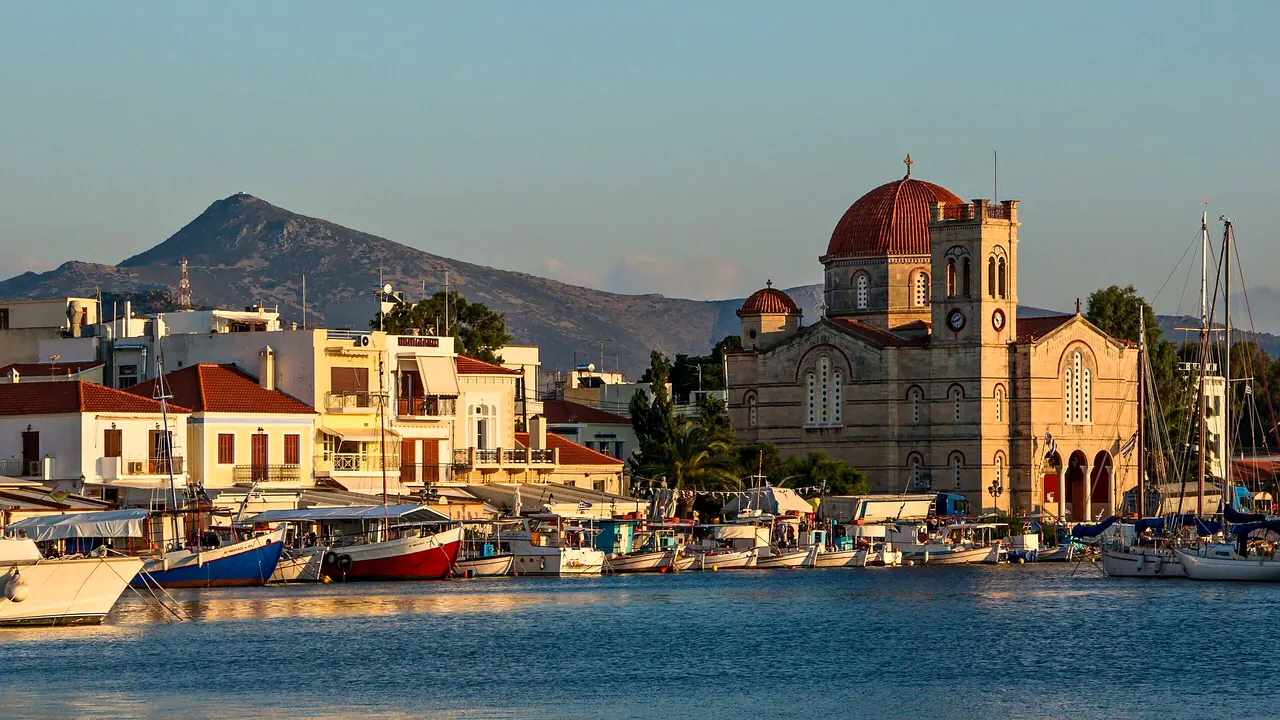
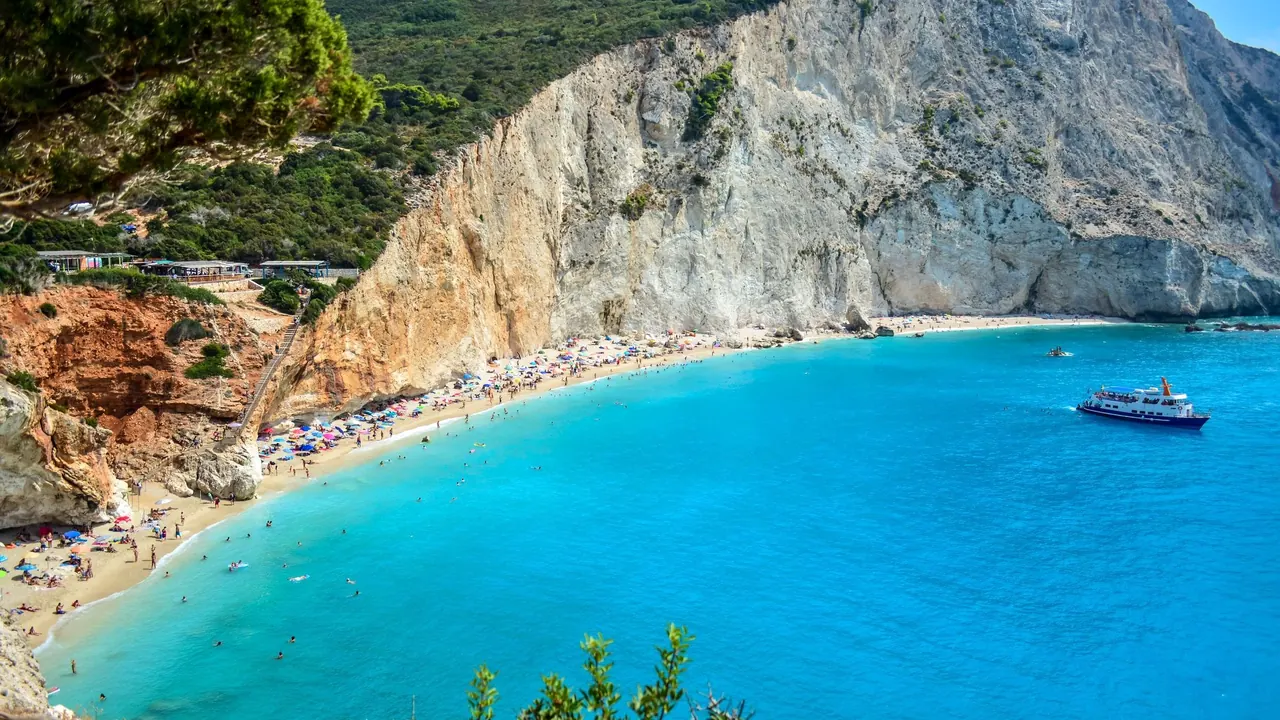
Photos: Aegina by Jebulon, CC0; Lefkada by Antone Adi, Pexels License.
Aegina or Lefkada?
Our verdict in twelve categories, each scored against the same fixed benchmark cities, and the climate month by month, so you can choose for your trip.
Choose Aegina for
- culture and sights
- getting around
- prices
Aegina suits travellers who want an easy, unhurried Greek island within reach of Athens. The fast boat from Piraeus takes well under an hour, the island is small enough to cross in half an hour, and it has a real ancient monument in the Temple of Aphaia, plus the chapels of Paleochora. It works best as a few slow days of swimming off rocks, harbour-side meze and a little history, or as a quiet add-on to a stay in the capital.
Choose Lefkada for
- beaches
- nature and the outdoors
- shopping
Lefkada is the choice when the beach is the whole point. Its west coast of white cliffs and turquoise water is in a different league from Aegina's coves, and the island is also greener, more mountainous and built for life on the water, with windsurfing at Vasiliki and sailing among the islets off Nidri. You give up easy transport and serious sights, but for a week of swimming, wind and boats it is the stronger island.
Scoreboard
Twelve categories on one fixed scale from 0 to 100. The shaded stretch is the gap between the two.
Your match
Pick a travel style or drag the sliders, and both match scores follow your weighting.
Wins on culture and sights and getting around with your weighting.
Wins on beaches and nature and the outdoors with your weighting.
What matters to you?
Category by category
What the scores mean for a trip.
Beaches & swimming
This is the widest gap between the two. Aegina swims on a small scale: coves at Marathonas and Aiginitissa, rocks near Perdika for diving into clear water, the sandy resort strip at Agia Marina, and the pine-backed pebble cove on Moni as the high point. It is calm, clean and local, but there are no long white beaches.
Lefkada's west coast is the kind of beach people cross Europe for, with Porto Katsiki, Egremni and Kathisma under tall limestone cliffs in vivid turquoise water. Those beaches face the open Ionian, so expect afternoon waves, steep shelving and midsummer crowds, while the east-coast bays around Nidri and Ligia are where you go for the calm swimming Aegina offers everywhere.
Food & drink
The two islands eat equally well, in the same honest Greek taverna style, so the difference is in the setting and the local produce. Aegina has its pistachios in every form and the ouzeries behind Aegina town's fish market, and because so many diners are Athenians the tavernas stay largely untouristy.
Lefkada's best cooking is up in the mountain villages around Karya and Englouvi, with the Eglouvi lentils and a local salami, while its resort strips lean more on tourist menus. Neither has much beyond Greek food.
Culture & sights
Aegina has the stronger sights, led by the Temple of Aphaia, a nearly complete Doric temple on a pine-clad hill looking towards Athens. Add the column and ruins at Kolona, the Byzantine chapels of Paleochora and the neoclassical buildings from its brief time as the first capital of modern Greece, and you have a short but genuinely rewarding list.
Lefkada's sights work as breaks from the beach: the Santa Maura fortress at the causeway, the painted church ceilings and earthquake-proof timber houses of Lefkada town, and the cliff at Cape Lefkatas linked with Sappho. Nothing there compares with Aphaia.
Nightlife
Neither island is for clubbing, but Lefkada has a little more going on after dark. In July and August the lanes of Lefkada town fill with young Greek visitors, Nidri's harbour draws sailing crews and resort guests, and Vasiliki has its windsurfers' bars.
Aegina's evenings are mostly long dinners and harbour cocktails, busiest when Athenians come over for the weekend, and Athens itself is the island's nightlife, a ferry ride away.
Nature & outdoors
Lefkada is the more dramatic and more active island. Its interior climbs above 1,100m, its west coast is a wall of white cliffs, and walks reach the Dimosari waterfall and the old paths between hill villages. On the water it really pulls ahead, with the steady winds at Vasiliki, kitesurfing in the north and sheltered sailing channels among the satellite islands.
Aegina's landscape is softer: pistachio orchards, olive groves and pine on low volcanic hills. Its one real walk is the climb of Mount Oros, about 530m, and the rest is orchard roads by bike or scooter and a stroll round Moni.
Day trips
Both make good bases for outings, but in different directions. Aegina's great card is Athens: the Acropolis and the city's museums are a short fast-boat ride away, with Agistri, Poros and car-free Hydra along the Saronic Gulf.
Lefkada trades the capital for a spread of islands and mainland: boat tours from Nidri to Meganisi, ferries from Vasiliki to Fiskardo and Ithaca, and Roman Nikopolis and Parga by car. On both islands, plan around the ferry timetables.
Good for families
Both islands suit a simple beach vacation with young children and offer little built for them, so the choice comes down to the shape of the days. Aegina is compact and quick to reach, with shallow sand at Agia Marina and Marathonas and the peacocks and deer of Moni as an outing.
Lefkada has calm bays around Nikiana, Ligia and Agiofili, but its famous west-coast beaches, with surf, steep shelving and cliff staircases, are hard going with small children. Families do best basing themselves on the east side.
Getting around
Aegina is simpler to get to and around. Boats leave Piraeus all day, Aegina town is flat and walkable, and nowhere on the island is much over half an hour's drive, though the buses are too sparse to rely on alone.
Lefkada has the advantage of a causeway and an airport nearby, so no ferry is needed to arrive. Once there, though, you really need a car or scooter, the winding west-coast and mountain roads are slow, and in high summer Nidri and the Porto Katsiki car park get congested.
Shopping & style
Neither island is a reason to pack an empty suitcase, and on both the best things to take home are edible. Aegina's shopping comes down to one product, the pistachios from its interior groves, which turn up in many forms in the harbour-front shops. Around them you find a little pottery and the usual souvenirs, and an hour covers the lot.
Lefkada has a little more range. Lefkada town's pedestrian main street makes a proper evening browse, with clothes and jewellery alongside the island's oil, honey and lentils, so there is more to look at than on Aegina's short harbour strip. Karya adds a craft Aegina has no equivalent for: embroidery still worked by hand in a mountain village, worth the drive if you want something made on the island rather than grown there.
Affordability
Costs are much the same, both sitting mid-range for Greek islands. Aegina's tavernas and guesthouses charge ordinary mainland prices because most visitors are Greek, and the short ferry and scooter hire are cheap, though summer weekends push room prices up.
On Lefkada the extras add up differently: car hire and boat excursions are close to essential, and rooms near the west-coast beaches are dearest in August. On both islands, June and September are noticeably easier on the wallet.
Live music & performing arts
Formal performance is thin on both, though Lefkada has slightly more to attend thanks to its long-running international folklore festival each August, with dance groups on open-air stages, plus village festivals with Greek music and dancing.
Aegina offers open-air cinema, summer concerts and live music in some tavernas. For serious theatre or the ancient-theatre festivals, you head for Athens or Epidaurus, which Aegina at least puts within easy reach.
Wellness & relaxation
Neither island has a spa or bathing tradition, so rest here means pace rather than treatments. Aegina's calm comes from weekday quiet, long lunches in Perdika and the stillness of Paleochora's chapels, with Athens close by.
Lefkada adds a handful of yoga and retreat stays in the hills and the peace of its interior villages and east-coast harbours, but its busiest resorts in August are far from restful.
When should you go?
Pick your month. The climate figures are measured averages, not a forecast.
Aegina in July
Lefkada in July
Daytime high, °C
Rainfall in the month, mm
Where the figures come from
Aegina's temperatures are measured 32 km from the centre, at Athinai Airport.
Aegina has no rain gauge within 25 km of the centre, so its rainfall comes from a gridded climate dataset read at the destination rather than from a gauge further away.
Lefkada has no rain gauge within 25 km of the centre, so its rainfall comes from a gridded climate dataset read at the destination rather than from a gauge further away.
Temperature and rainfall are climate normals, averaged over the years shown. Aegina: 1991-2020 normals, Athinai Airport (31.8 km from centre). Lefkada: 1998-2020 (rainfall 1991-2020) normals, Aktion Airport (24.3 km from centre).
Both islands are made for summer swimming from June to early October, with the sea at about 26°C in August on each. Aegina, close to Athens, runs hotter and drier: July and August reach 33°C with almost no rain and long hours of sunshine, which makes midday walks to the temple or up Mount Oros hard work. May, June and September are the most comfortable months there for combining the beach with sightseeing.
Lefkada stays a few degrees cooler in high summer, but its year is much wetter. The rain comes back in September and is heavy from October, and November brings about 150mm, roughly twice Aegina's wettest month. So Aegina is the better bet for late autumn and early spring, while on Lefkada the reliable window is June to mid-September, with spring the best time for walking its hills.
Which traveller are you?
On a beach and sun trip, Lefkada wins clearly. Porto Katsiki, Egremni and Kathisma give long strands under white cliffs, and the calm east-coast bays cover the windy days. Aegina offers pleasant coves and rocks, nothing comparable.
For a culture and arts trip, Aegina is the better island. The Temple of Aphaia is one of the best-preserved in Greece, Paleochora's frescoed chapels and the neoclassical town add depth, and the Acropolis is only a short boat ride away.
On an outdoors trip, Lefkada has much more to offer: a mountainous green interior, the Dimosari waterfall walk, renowned windsurfing at Vasiliki and classic sailing waters. Aegina's gentle hills and the climb up Mount Oros are pleasant but quickly done.
Before you go
| Measure | Aegina | Lefkada |
|---|---|---|
| Official language | Greek | Greek |
| Currency | Euro (EUR) | Euro (EUR) |
| Sockets | CF230 V, 50 Hz | CF230 V, 50 Hz |
| Driving side | Right | Right |
| Time zone | UTC+2, UTC+3 in summer | UTC+2, UTC+3 in summer |
| Emergency number | 112 | 112 |
| Main airport | Athens Eleftherios Venizelos International Airport (ATH)176 non-stop destinations | Aktion National Airport (PVK)47 non-stop destinations |
| Public holidays this year | 15 days | 15 days |
By the numbers
| Measure | Aegina | Lefkada |
|---|---|---|
| Population | 13,056 | 22,652 |
| People per km² | 149 | 64 |
| Swim season, months above 21 °C | 5 months | 5 months |
Where else could you go?
Every comparison below shares a destination with this one, so you can follow Aegina or Lefkada somewhere new.
- Hydravs Aegina
- Peloponnesevs Aegina
- Paxosvs Lefkada
- Kefaloniavs Lefkada
- Corfuvs Lefkada
- Zakynthosvs Lefkada