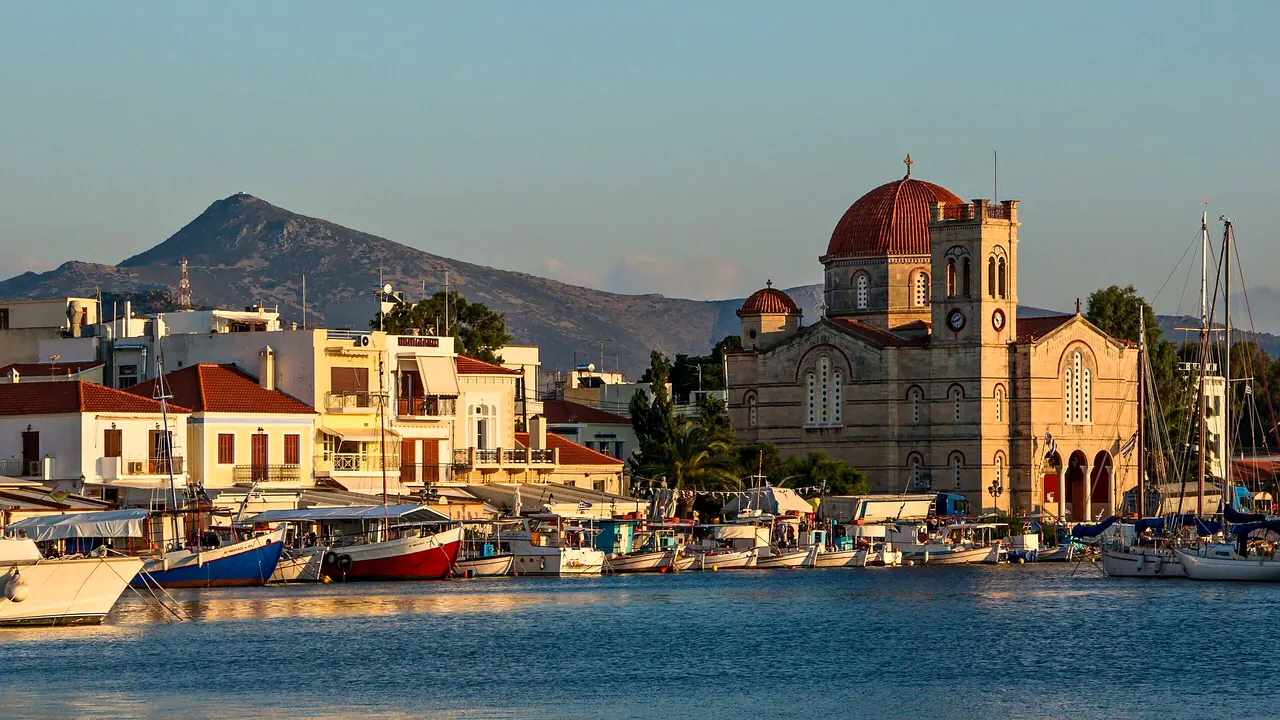
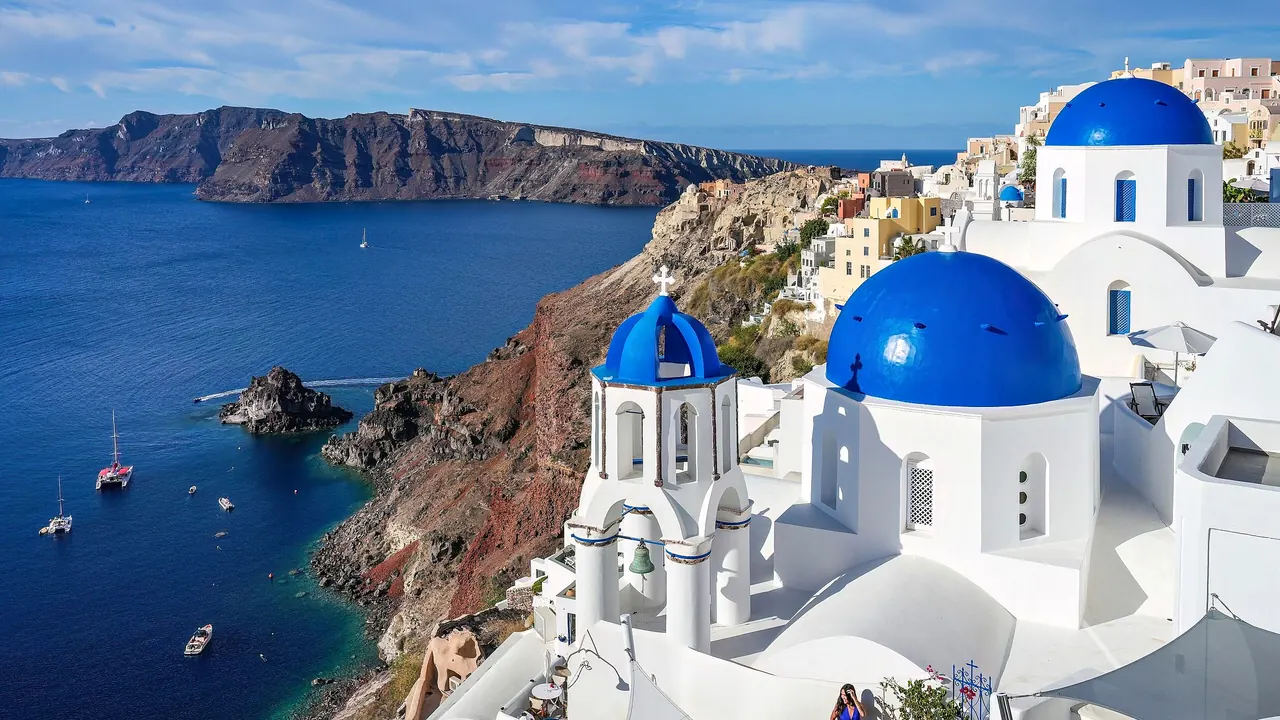
Photos: Aegina by Jebulon, CC0; Santorini by Giles Laurent, CC BY-SA 4.0, cropped.
Aegina or Santorini?
Our verdict in twelve categories, each scored against the same fixed benchmark cities, and the climate month by month, so you can choose for your trip.
Choose Aegina for
- prices
- families
- getting around
Aegina suits a relaxed, reasonably priced island stay close to Athens. Families, people who want the Acropolis as an easy day out, and travellers who like eating where Greeks eat will do well here. The island is small and simple to get around, and its weekend crowd of Athenians keeps the tavernas honest. In return you get fewer sights, gentler scenery and very quiet evenings.
Choose Santorini for
- nature and the outdoors
- food and drink
- shopping
Choose Santorini when the scenery is the point of the trip: the cliffs of the drowned caldera, the buried Bronze Age town at Akrotiri, wine tastings among the inland vineyards and dinner above the sea at sunset. It is far more expensive, and its cliff villages are hard going with small children, so it rewards couples, walkers and anyone with a generous budget more than families counting their spending.
Scoreboard
Twelve categories on one fixed scale from 0 to 100. The shaded stretch is the gap between the two.
Your match
Pick a travel style or drag the sliders, and both match scores follow your weighting.
Wins on prices and families with your weighting.
Wins on nature and the outdoors and food and drink with your weighting.
What matters to you?
Category by category
What the scores mean for a trip.
Beaches & swimming
For swimming the two islands are level, but the beaches are not alike. Aegina has small coves around Marathonas and Aiginitissa, rocks to dive from near Perdika, and the pine-fringed pebbly cove on Moni, with Agia Marina as its one longer sandy resort beach. The sea is calm and slightly warmer in late summer.
Santorini's beaches are volcanic: black sand and fine pebble under coloured cliffs at Kamari, Perissa and Perivolos, Vlychada and the small Red Beach. The sand gets very hot by midday, and the meltemi can churn the water. If you stay in a caldera village you also have to travel down to the coast to swim.
Food & drink
Santorini has the more distinctive table. Its volcanic soil gives fava, tomato fritters, white aubergines, capers and chloro cheese, and its Assyrtiko and Vinsanto wines can be tasted at wineries around Pyrgos, Megalochori and Exo Gonia. The best meals are inland or at Ammoudi Bay, since many places on the rim charge mainly for the sunset.
Aegina eats more simply and more consistently. You get pistachios in every form, and meze with ouzo in the lanes behind the old fish market or at the fish tavernas on Perdika's quay. Beyond Greek cooking and seafood there is little choice.
Culture & sights
Santorini has more to see. Akrotiri is a whole Bronze Age town preserved under volcanic ash, its wall paintings can be seen at the Museum of Prehistoric Thera in Fira, and Ancient Thera stands on its ridge above the sea. Add the cave houses and blue domes of the caldera villages and the medieval kastelli of Pyrgos and Emporio, and you have two or three full days.
Aegina's list is shorter but has one outstanding piece. The Temple of Aphaia is one of the most complete Doric temples in Greece. Around it are the lone column at Kolona, the frescoed chapels of ruined Paleochora, and the neoclassical houses left from the island's brief time as the first capital of modern Greece.
Nightlife
Neither island is a party destination, but Santorini has more going on after dark. A few lanes in Fira hold cocktail bars and a handful of clubs that stay busy into the early hours in July and August, and Kamari and Perissa add beach bars with music.
Aegina's evenings are long dinners and harbour-front drinks among weekending Athenians, with no clubbing to speak of. For a real night out, you take the boat back to Athens.
Nature & outdoors
Santorini's landscape is far more dramatic. You walk about 10km along the rim of a drowned volcano, with cliffs of ash and lava dropping 300m into the caldera, and boats take you to the black cone of Nea Kameni. Sailing and diving along the submerged crater walls round out the outdoor options.
Aegina is soft, green Mediterranean country by comparison, with pistachio orchards, olive groves and pine woods. Its best walk climbs Mount Oros past the ancient sanctuary of Zeus, and its quiet back roads suit cycling more than they suit any adventure.
Day trips
Aegina is the better base for outings, because Athens is about forty minutes away by fast boat and the Acropolis and the big museums make an easy day out. Agistri is a short hop away, Poros and car-free Hydra are further along the Saronic Gulf, and Epidaurus can be reached through the mainland ports.
Santorini's options are more ambitious and less reliable. You can take a boat to quiet Thirasia, or ferries to Ios, Folegandros, Naxos and even Crete for Knossos. Most boats leave from Athinios, services thin out outside summer, and the meltemi can cancel a crossing.
Good for families
Aegina is the more comfortable island with children. The crossing is short, drives are brief and tavernas welcome children late into the evening. The water at Agia Marina and Marathonas shelves gently, and the peacocks and deer on Moni make a good half day.
On Santorini a family has to choose its base carefully. The stepped, unfenced caldera villages are impossible with a pushchair, and many cliff hotels refuse young children. Kamari and Perissa work much better, with flat promenades and a small water park. Akrotiri and the volcano boat appeal to older children.
Getting around
Aegina is easier to move around. Aegina town is flat and walkable, and no drive on the island takes much more than half an hour. The buses are too infrequent to rely on alone, so a hired scooter or bicycle fills the gaps without fuss.
Santorini's distances are also short, but every bus runs through Fira, so crossing the island usually means a change there, on buses that are packed in high season. Parking in Oia and Fira is very scarce, the roads clog with tour coaches, and inside the villages every errand means climbing steps.
Shopping & style
Santorini gives you more reason to browse. The cliff-top lanes of Oia and Fira have jewellers, galleries of island painters and photographers, linen and resort-wear boutiques, and the wineries sell Assyrtiko and Vinsanto to take home.
On Aegina, shopping means a few streets of pistachio shops, ceramics and souvenirs around the harbour. A bag of the island's nuts is about the whole of it.
Affordability
Aegina is much the cheaper island. Its visitors are mostly Greek, so meze, harbour-side fish and guesthouse rooms cost what they would on the mainland, and the ferry and scooter hire are cheap. Rooms only get tight and dear on summer weekends and in August.
Santorini's prices follow the view. Cave suites and sunset dinners on the caldera rim are among the most expensive in Greece, and boat trips and wine tastings add up. Staying in Kamari or Perissa and walking up to the rim for the sunset brings the cost down a long way.
Live music & performing arts
Both islands offer very little in the way of performance, and neither has a theatre or a regular season. Santorini has a long-running classical music festival in Fira at the end of summer and occasional concerts in mansions and wineries. Aegina has open-air cinema and Greek music in its tavernas, but it has one practical advantage: the stages of Athens and the ancient theatre at Epidaurus are within easy reach.
Wellness & relaxation
Santorini has more to offer for a pampered rest. Its cliff-cut cave hotels at Imerovigli and Oia come with heated plunge pools and spa treatments, and boats stop off Palea Kameni so you can swim into warm, rust-coloured spring water. Choose Imerovigli or the wine villages over the crowded rim at Oia and Fira.
Aegina has only a few small hotel spas. What it offers instead is slowness: a long lunch in Perdika, a quiet weekday evening in town, and the stillness among the chapels of Paleochora.
When should you go?
Pick your month. The climate figures are measured averages, not a forecast.
Aegina in July
Santorini in July
Daytime high, °C
Rainfall in the month, mm
Where the figures come from
Aegina's temperatures are measured 32 km from the centre, at Athinai Airport.
Aegina has no rain gauge within 25 km of the centre, so its rainfall comes from a gridded climate dataset read at the destination rather than from a gauge further away.
Santorini's station stands 182 m below the place it is measured for, so that place is likely a little cooler than the figures say.
Santorini has no rain gauge within 25 km of the centre, so its rainfall comes from a gridded climate dataset read at the destination rather than from a gauge further away.
Temperature and rainfall are climate normals, averaged over the years shown. Aegina: 1991-2020 normals, Athinai Airport (31.8 km from centre). Santorini: 2000-2025, 12 years observed (rainfall 1991-2020) normals, Santorini Island / Monólithos (5 km from centre).
Both islands are warm enough for swimming from June to October, but the summers feel different. Aegina gets hotter, with daytime highs around 33°C in July and August and very long, sunny days, and its sheltered sea warms to about 26°C by late summer. Santorini peaks nearer 30°C and its sea stays a little cooler, while the meltemi wind takes the edge off the heat but can roughen the open coast. On both islands the middle of a summer day is too hot for serious walking, so May, late September and October are the best months for sightseeing on foot.
Neither island gets much rain between May and September, and Santorini is almost completely dry from June to August. Winter is the wetter season on both. Rain on Aegina builds from November, and Santorini has the wetter winter of the two, with close to 98mm in January. Neither works as a beach trip from November to April, though both stay mild enough for a quiet off-season visit.
Which traveller are you?
On a trip on a tight budget, Aegina makes the money go further, because the island is priced for Greek weekenders rather than foreign visitors. Santorini can be done cheaply, but only by sleeping well away from the caldera that most people come to see.
For an outdoors trip, Aegina gives you one good hill climb and quiet orchard roads, and little more. Santorini is the clear choice, because the volcano gives it walking on the crater rim, sailing and diving. Spring and autumn are best, before the heat sets in.
On a family trip with young children, Aegina is the easier island. It is small and safe throughout, and the days are spent swimming and eating ice cream on the harbour. Santorini only works from an east-coast beach base, and its cliff villages are best left to couples.
Before you go
| Measure | Aegina | Santorini |
|---|---|---|
| Official language | Greek | Greek |
| Currency | Euro (EUR) | Euro (EUR) |
| Sockets | CF230 V, 50 Hz | CF230 V, 50 Hz |
| Driving side | Right | Right |
| Time zone | UTC+2, UTC+3 in summer | UTC+2, UTC+3 in summer |
| Emergency number | 112 | 112 |
| Main airport | Athens Eleftherios Venizelos International Airport (ATH)176 non-stop destinations | Santorini International Airport (JTR)60 non-stop destinations |
| Public holidays this year | 15 days | 15 days |
By the numbers
| Measure | Aegina | Santorini |
|---|---|---|
| Population | 13,056 | 17,430 |
| People per km² | 149 | 220 |
| Swim season, months above 21 °C | 5 months | 5 months |
Where else could you go?
Every comparison below shares a destination with this one, so you can follow Aegina or Santorini somewhere new.
- Iosvs Santorini
- Hydravs Aegina
- Folegandrosvs Santorini
- Peloponnesevs Aegina
- Naxosvs Santorini
- Parosvs Santorini