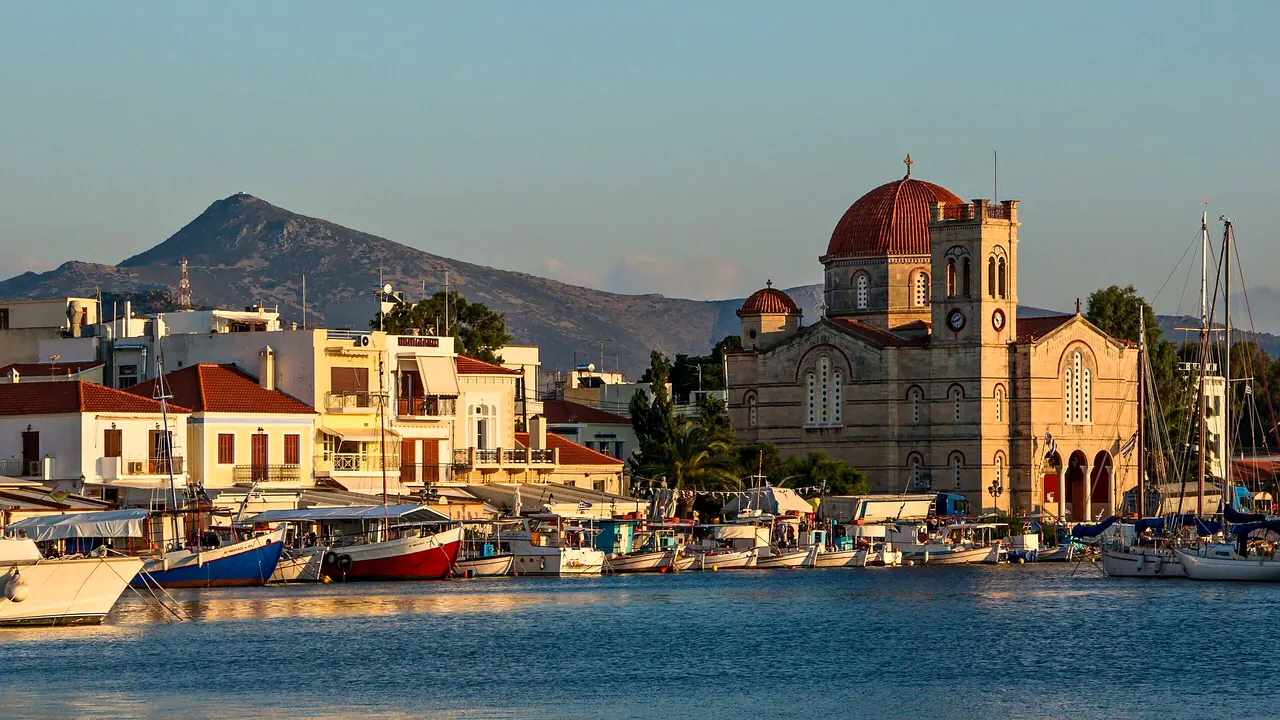
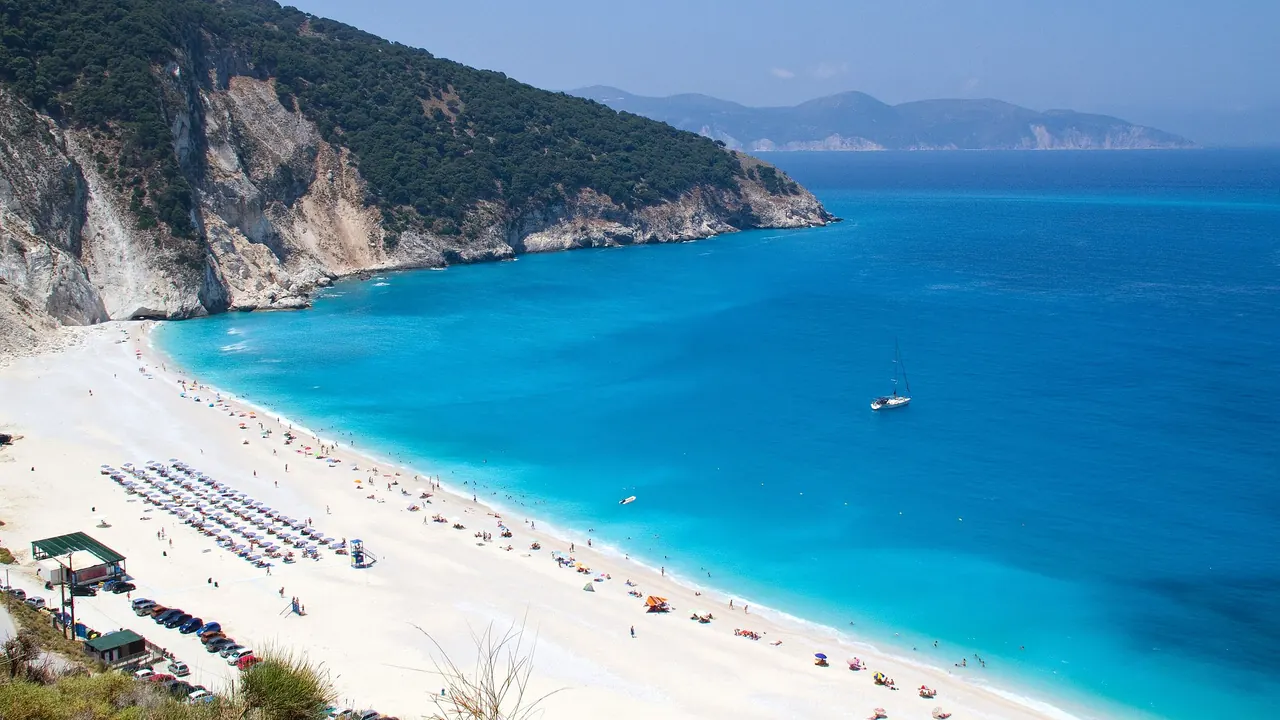
Photos: Aegina by Jebulon, CC0; Kefalonia by Tony Hisgett from Birmingham, UK, CC BY 2.0, cropped.
Aegina or Kefalonia?
Our verdict in twelve categories, each scored against the same fixed benchmark cities, and the climate month by month, so you can choose for your trip.
Choose Aegina for
- getting around
- culture and sights
- day trips
Aegina suits a shorter, easier trip, ideally one tied to Athens. The ferry from Piraeus is short, the island is small enough to cross in half an hour, and the Temple of Aphaia, the chapels of Paleochora and the Acropolis itself are all within an easy day. Choose it for good ancient sights, low-key swimming and Greek tavernas without having to hire a car or plan long drives.
Choose Kefalonia for
- beaches
- nature and the outdoors
- food and drink
Kefalonia is the island for a proper beach and landscape vacation of a week or more. Myrtos, Petani and Antisamos are on another level from Aegina's coves, and Mount Ainos, the white western cliffs and the Melissani cave give it real wild country. The cost is distance: you need a car, the drives are long and winding, and the island has far fewer historic sights to fill the days between beaches.
Scoreboard
Twelve categories on one fixed scale from 0 to 100. The shaded stretch is the gap between the two.
Your match
Pick a travel style or drag the sliders, and both match scores follow your weighting.
Too close to call, 1 point apart
Wins on getting around and culture and sights with your weighting.
Wins on beaches and nature and the outdoors with your weighting.
What matters to you?
Category by category
What the scores mean for a trip.
Beaches & swimming
This is Kefalonia's strongest card and the biggest gap between the two islands. Its beaches are spread across several coasts: the white pebble crescent of Myrtos under its cliffs, quieter Petani and red-sanded Xi on the Paliki peninsula, green Antisamos near Sami, and long sand at Skala and Lourdas in the south.
Aegina's swimming is pleasant but modest: coves around Marathonas and Aiginitissa, diving off rocks near Perdika, and the sunbed stretch at Agia Marina. Its best water is on the islet of Moni. It suits a few swims a day close to your base, not a beach-hopping vacation.
Food & drink
Kefalonia eats somewhat better and more distinctively. It has its own meat pie, bourbourelia soup and aliada with salt cod, thyme honey and mandoles, and the Robola wineries of the Omala valley make a good afternoon of tasting.
Aegina's table is narrower but honest: meze and ouzo in the lanes behind Aegina town's old fish market, fish tavernas on the quay at Perdika, and pistachios in almost everything. On both islands, cooking from beyond Greece and fine dining are rare.
Culture & sights
Aegina is the better island for sights. The Doric Temple of Aphaia on its pine-covered hill is worth the trip in its own right, and the Apollo column at Kolona, the frescoed chapels of Paleochora and the neoclassical houses from the town's brief time as Greece's first capital round it out.
Kefalonia lost most of its old buildings in the 1953 earthquake, so apart from Fiskardo's Venetian-era harbour, its sights are scattered outings: the fortress at Assos, the Castle of Agios Georgios, the tholos tomb at Tzanata and the Argostoli museum.
Nightlife
Neither island is for clubbing, but Aegina has a little more going on in summer, when weekending Athenians keep the harbour-front bars of Aegina town busy past midnight. Kefalonia's evenings are spread more thinly, between Argostoli's square and Lithostroto, the bar strip at Lassi and harbour bars in Skala and Fiskardo. Both go quiet outside July and August, but only from Aegina is a night out in Athens a ferry ride away.
Nature & outdoors
Kefalonia is in a different league outdoors. Mount Ainos rises to about 1,628m and is a national park with its own fir forest and semi-wild horses. Below it there are tall white cliffs on the west coast, the Melissani and Drogarati caves, turtles in Argostoli harbour, and kayaking and sailing towards Ithaca.
Aegina's landscape is gentler and smaller: pistachio and olive groves on low volcanic hills, the climb up Mount Oros past a sanctuary of Zeus, and quiet roads for cycling. It makes a pleasant morning or two rather than the centre of a trip.
Day trips
Aegina's position in the Saronic Gulf gives it the wider choice of outings. Athens and the Acropolis are about forty minutes away by fast boat, Agistri is a short hop, and Poros and car-free Hydra make full days by ferry, with Epidaurus reachable from the mainland.
Kefalonia's best outing is Ithaca from Sami, with Zakynthos and Lefkada reachable by summer boats. Beyond those, its day trips are mostly its own far corners, Fiskardo, Assos and Paliki, and many crossings stop outside the warmer months.
Good for families
The two are about even for families, but in different ways. Aegina is the easier logistics: a short crossing, short distances, shallow sand at Agia Marina and Marathonas, and the peacocks and deer on Moni.
Kefalonia has better beaches for children at Skala, Lourdas and Xi, plus the boat ride through Melissani and turtle spotting, but long, winding drives in the heat. Neither has theme parks or aquariums, so both suit younger children more than teenagers.
Getting around
Aegina is far simpler. Ferries run from Piraeus through the day, Aegina town is flat and walkable, and no drive takes much over half an hour, so a scooter or bicycle covers the island, with buses to Agia Marina and Perdika as a backup.
Kefalonia is large and mountainous, and a hire car is close to essential. Argostoli to Fiskardo takes about an hour and a half on ridge and cliff roads, buses are sparse, and parking at Myrtos, Assos and Fiskardo gets tight in summer.
Shopping & style
Neither island is a shopping destination, and what you take home from both is mostly edible. On Aegina it is pistachios in every form from the harbour shops. Kefalonia offers a little more variety, with clothes and jewellery on Argostoli's Lithostroto, small boutiques in Fiskardo, and Robola wine, thyme honey and mandoles to carry back.
Affordability
Aegina is the somewhat cheaper island. Its visitors are mostly Greeks, so tavernas and guesthouses charge mainland prices, and because the island is small you need no more than a cheap ferry, a bus or a rented scooter.
Kefalonia's meals and southern apartments around Skala and Lassi are fair value, but almost everyone pays for a hire car, and Fiskardo and Assos are noticeably expensive. On both islands, June and September cost less than high summer.
Live music & performing arts
Neither island has much staged performance, and the difference between them is one of kind. Aegina has little of its own beyond summer nights at the open-air cinema, the odd concert and Greek music in some tavernas. Its advantage is that Athens and the ancient theatre at Epidaurus are close enough for an evening of theatre or opera.
Kefalonia has its own music. The kantades are old serenades with Italian roots, sung by several voices together, and Argostoli's town band dates back to the nineteenth century. You hear both at summer festivals outdoors rather than in a concert hall, and the island has no big stage within easy reach when you want more.
Wellness & relaxation
Kefalonia is the more restful island. Its resort hotels around Lassi, Skala and Fiskardo have proper spas, and the quiet Paliki peninsula and north-east coast make it easy to get away from people. Aegina offers a slow weekday pace, long lunches in Perdika and the stillness of Paleochora's chapels, but very little to book, and summer weekends bring the Athens crowds over.
When should you go?
Pick your month. The climate figures are measured averages, not a forecast.
Aegina in July
Kefalonia in July
Daytime high, °C
Rainfall in the month, mm
Where the figures come from
Aegina's temperatures are measured 32 km from the centre, at Athinai Airport.
Aegina has no rain gauge within 25 km of the centre, so its rainfall comes from a gridded climate dataset read at the destination rather than from a gauge further away.
Kefalonia's temperatures are measured 59 km from the centre, at Zakinthos / Agrilia.
Kefalonia has no rain gauge within 25 km of the centre, so its rainfall comes from a gridded climate dataset read at the destination rather than from a gauge further away.
Temperature and rainfall are climate normals, averaged over the years shown. Aegina: 1991-2020 normals, Athinai Airport (31.8 km from centre). Kefalonia: 1991-2020 normals, Zakinthos / Agrilia (58.6 km from centre).
The two islands have almost the same summer. On both, afternoons reach about 33°C in July and August, which is too hot for walking the streets or the hills in the middle of the day, and the sea warms to about 26°C by August. Swimming is comfortable from June to October on either island. May is the mild month, at around 25°C and already sunny, so it suits sightseeing on Aegina or walks on Mount Ainos on Kefalonia. By June the heat has arrived on both.
Rain is where they part. Aegina stays mostly dry through September and October, and its wet season comes in November and December. Kefalonia is wetter on the Ionian side. Rain comes back in September, October turns properly showery, and November brings around 159mm, so its good season ends sooner. For an autumn or early-spring trip, Aegina is the safer choice.
Which traveller are you?
On a beach and sun trip, Kefalonia is the clear choice. Myrtos, Petani, Antisamos and the sands of Skala and Xi give real variety and unusually clear water, where Aegina offers small coves, rocks and one resort beach.
For a culture and arts trip, Aegina wins. The Temple of Aphaia is one of the best-preserved temples in Greece, Paleochora and Kolona add depth, and Athens's museums are a short boat ride away. Kefalonia's earthquake-rebuilt towns hold much less.
On an outdoors trip, Kefalonia has far more to offer: the fir forests and summit trails of Mount Ainos, sea kayaking along the north-east coast, cliff roads and caves. Aegina has one good climb up Mount Oros and gentle orchard lanes for cycling.
Before you go
| Measure | Aegina | Kefalonia |
|---|---|---|
| Official language | Greek | Greek |
| Currency | Euro (EUR) | Euro (EUR) |
| Sockets | CF230 V, 50 Hz | CF230 V, 50 Hz |
| Driving side | Right | Right |
| Time zone | UTC+2, UTC+3 in summer | UTC+2, UTC+3 in summer |
| Emergency number | 112 | 112 |
| Main airport | Athens Eleftherios Venizelos International Airport (ATH)176 non-stop destinations | Kefalonia International Airport "Anna Pollatou" (EFL)41 non-stop destinations |
| Public holidays this year | 15 days | 15 days |
By the numbers
| Measure | Aegina | Kefalonia |
|---|---|---|
| Population | 13,056 | 36,064 |
| People per km² | 149 | 49 |
| Swim season, months above 21 °C | 5 months | 5 months |
Where else could you go?
Every comparison below shares a destination with this one, so you can follow Aegina or Kefalonia somewhere new.
- Hydravs Aegina
- Zakynthosvs Kefalonia
- Peloponnesevs Aegina
- Lefkadavs Kefalonia
- Paxosvs Kefalonia
- Sifnosvs Aegina