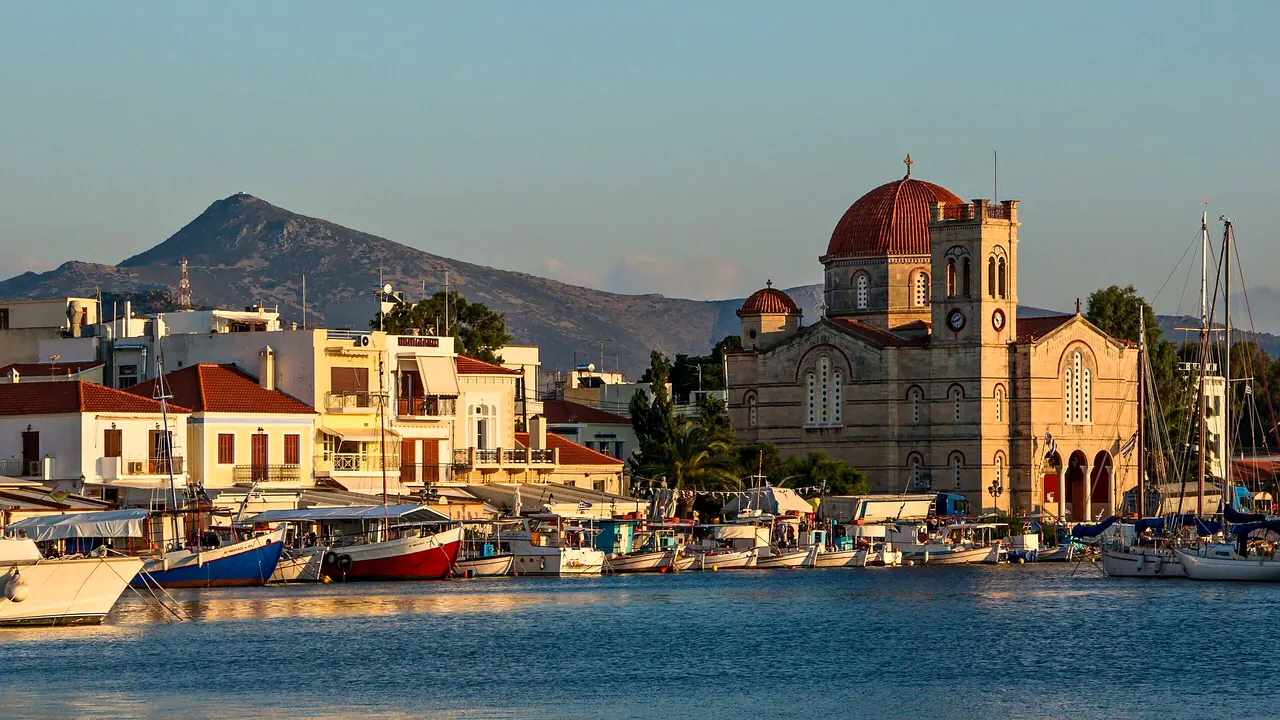
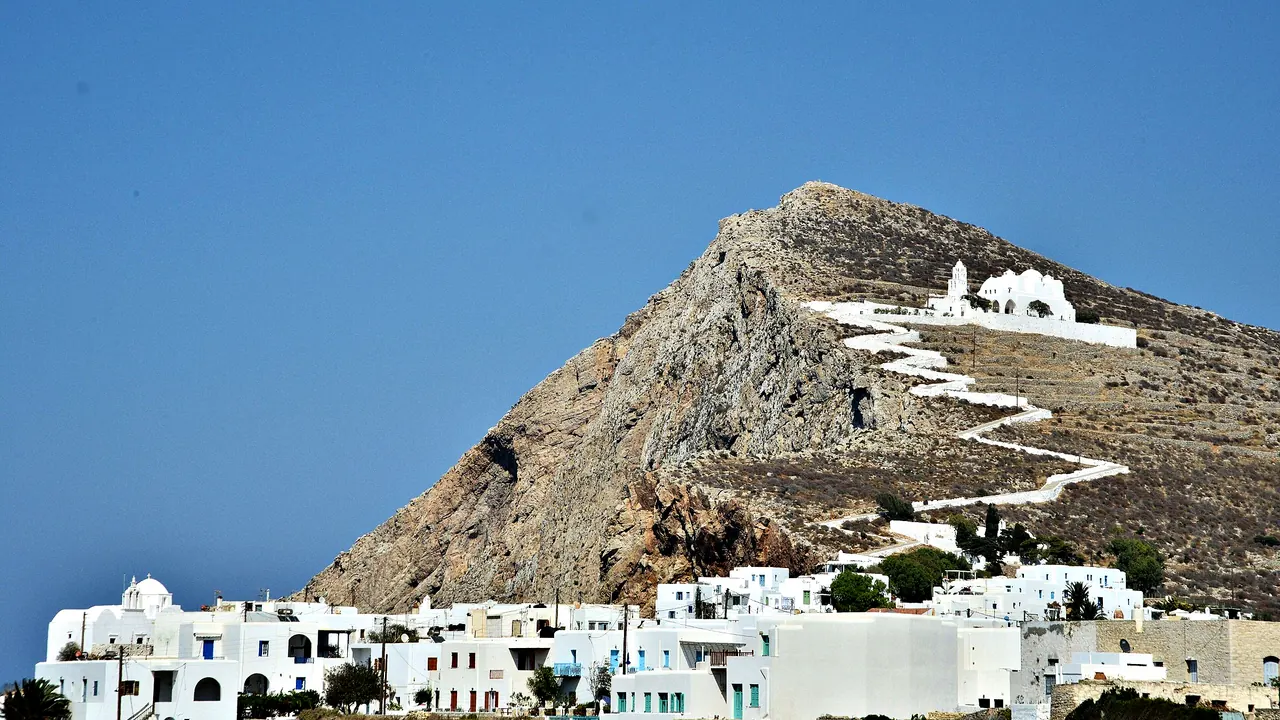
Photos: Aegina by Jebulon, CC0; Folegandros by Chris Kar, CC BY-SA 4.0, cropped.
Aegina or Folegandros?
Our verdict in twelve categories, each scored against the same fixed benchmark cities, and the climate month by month, so you can choose for your trip.
Choose Aegina for
- day trips
- culture and sights
- families
Aegina suits travellers who want an island with plenty to fill the days. The Temple of Aphaia, the chapels of Paleochora and the neoclassical streets of the old capital give it real sightseeing. Athens is close enough for a day at the Acropolis, and the gently shelving sandy beaches at Agia Marina and Marathonas make it the easier pick for families. Because so many of the visitors are Athenians, the tavernas are honest and prices stay closer to the mainland.
Choose Folegandros for
- nature and the outdoors
- beaches
- wellness
Folegandros is for people who want to get away and stay put. The cliff-top village of Chora, the waymarked paths across a bare, terraced ridge and clear coves such as Katergo that you reach on foot or by boat make it a walker's and swimmer's island. Its calm is the main reason to go. In exchange it has fewer sights, fewer outings and higher summer room prices, and you have to rely on ferries that the north wind can cancel.
Scoreboard
Twelve categories on one fixed scale from 0 to 100. The shaded stretch is the gap between the two.
Your match
Pick a travel style or drag the sliders, and both match scores follow your weighting.
Wins on day trips and culture and sights with your weighting.
Wins on nature and the outdoors and beaches with your weighting.
What matters to you?
Category by category
What the scores mean for a trip.
Beaches & swimming
Folegandros has the better swimming, though you have to work for it. Its shingle and sand coves sit under bare cliffs in very clear water. Agali and the beaches near Karavostasis are easy to reach, while Katergo and Livadaki take a boat or a rough path, often with no shade. The north wind decides which side of the island is sheltered on a given day.
Aegina's beaches are smaller and closer to hand. You get the sunbed-lined sand of Agia Marina, little coves at Marathonas and swimming off the rocks near Perdika. Its best swimming is the pine-shaded cove on Moni. It is more convenient and more sheltered, but less dramatic.
Food & drink
Aegina eats a little better and has more choice. Ouzeries along Aegina town's waterfront and behind the old fish market serve octopus and sardines with tsipouro, Perdika's quay is lined with fish tavernas, and the island's pistachios turn up in everything. The weekend crowd from Athens keeps standards honest.
Folegandros has fewer places, most of them in Chora's shaded squares, but its dishes are more its own: matsata pasta with rooster or rabbit, soft souroto cheese and watermelon pie. Most kitchens there close once summer ends.
Culture & sights
Aegina has far more to see. The Temple of Aphaia stands on its pine-covered hill looking towards Athens, and you can add the column at Kolona, the frescoed chapels of Paleochora, the large church of Agios Nektarios and the neoclassical buildings left from Aegina town's spell as Greece's first capital.
On Folegandros the village is the sight. Chora's Kastro quarter, with houses forming its defensive wall, the zigzag path up to the Panagia and a small folklore museum in Ano Meria fill an afternoon.
Nightlife
Neither island is for clubbing, but Aegina's evenings go on a little longer. On summer weekends Athenians fill the cafés and cocktail bars along the harbour past midnight, and Agia Marina has beach bars. On Folegandros you sit in Chora's squares and then go to a few small bars on the cliff edge, which is exactly the quiet many visitors come for.
Nature & outdoors
Folegandros has the more striking landscape. It is a narrow ridge of bare rock with stone-walled terraces and very high cliffs below Chora, and waymarked paths cross it from end to end. Boat trips to sea caves such as Chrysospilia add a different view.
Aegina is softer and greener, with pistachio orchards, olive groves and pine woods on low volcanic hills. Its best outing is the climb up the cone of Mount Oros past the sanctuary of Zeus, and the quiet interior roads are good for cycling.
Day trips
Aegina is a far better base for outings. Fast boats reach Piraeus in about forty minutes, which puts the Acropolis within an easy day. Agistri is a short hop away, and Poros, Hydra and, with a car, Epidaurus are further options.
Folegandros is an island to stay on. Sikinos is close and Milos or Santorini can be reached on faster boats, but routes do not run every day and the wind can stop them, so most people who want another island move on rather than come back the same day.
Good for families
Aegina is the more relaxed choice with young children. Agia Marina and Marathonas have gently shelving sand, the boat to Moni with its peacocks and deer makes an easy half-day out, and the crossing from Piraeus is short. There is still nothing built specifically for children.
Folegandros works better for older children who enjoy walking and swimming. Livadi and Agali are manageable, but many coves mean a steep descent without shade, and Chora's cliffs and the summer wind mean you have to keep an eye on little ones.
Getting around
Aegina is easier to reach and to get around. Boats come from Piraeus all day, the town is flat and walkable, and no drive takes much more than half an hour, though the buses to Perdika and Agia Marina are too infrequent to rely on.
Folegandros has a single bus line between the port, Chora and Ano Meria. Many beaches are reached only on rough paths or by seasonal caique, and with no airport every arrival depends on a ferry that the north wind can slow or cancel.
Shopping & style
Neither island is worth visiting for shopping. Aegina's harbour lanes are mostly about pistachios in every form, with some ceramics and everyday Greek shops. Chora on Folegandros has a few small boutiques selling jewellery, linen and summer clothes alongside capers and thyme honey, which makes for a nicer after-dinner browse.
Affordability
Aegina is the easier island on the budget. Its visitors are mostly Greek, so tavernas and family guesthouses charge mainland prices, and the ferry, buses and scooter hire are all inexpensive. Rooms get dearer mainly on summer weekends and in August.
Folegandros costs more in high season. Chora is full of boutique hotels with cliff views that book out early in July and August. Meals are fair, but cutting the cost usually means a simpler room near Karavostasis or in Ano Meria, or going in June or September.
Live music & performing arts
Neither island has a theatre or a concert programme. Aegina has summer open-air cinema, occasional concerts and live Greek music in some tavernas, and Athens and Epidaurus are close enough for an evening at a festival. Folegandros's music is the panigyria, saints'-day festivals where island violin and lute play late into the night, plus the Easter procession of the Panagia icon.
Wellness & relaxation
Folegandros is the more restful of the two, mainly because there is so little else to do. There are no big resorts, Chora is car-free, and days divide easily between a cove and a long evening in the squares, especially in June and September.
Aegina can be slow too, on weekdays in Perdika or among the chapels of Paleochora, but its closeness to Athens brings busy summer weekends. Neither island has a spa tradition beyond a few hotel spas.
When should you go?
Pick your month. The climate figures are measured averages, not a forecast.
Aegina in July
Folegandros in July
Daytime high, °C
Rainfall in the month, mm
Where the figures come from
Aegina's temperatures are measured 32 km from the centre, at Athinai Airport.
Aegina has no rain gauge within 25 km of the centre, so its rainfall comes from a gridded climate dataset read at the destination rather than from a gauge further away.
Folegandros has no weather station within reach, so its figures come from a gridded climate model rather than a measured record, and read a broad area rather than one spot.
Temperature and rainfall are climate normals, averaged over the years shown. Aegina: 1991-2020 normals, Athinai Airport (31.8 km from centre). Folegandros: 2001-2020 normals, NASA POWER reanalysis grid, no weather station within 90 km.
Both islands are good for swimming from June to October, but their summers feel very different. Aegina gets properly hot, with highs around 33°C in July and August and the sea at about 26°C, so you need to plan sightseeing and walks for the morning and evening. Folegandros stays cooler at around 27°C in August, helped by the north wind, but its sea only reaches about 24°C. Both are almost completely dry from June to August, and Aegina has some of the longest sunshine hours of the year then.
For walking, spring and autumn are better on both islands. April and May are mild and mostly dry, and on Folegandros that is wild-flower season. October is still warm on both. Winter rain comes to both, heaviest around December on Aegina and in January on Folegandros, which reaches about 97mm. Folegandros is also slightly milder in the coldest months.
Which traveller are you?
For a culture and arts trip, Aegina is the clear pick. The Temple of Aphaia is one of the best-preserved Doric temples in Greece, Paleochora's Byzantine chapels lie inland, and the museums of Athens are a short boat ride away. Folegandros has its Kastro and little else.
On a family trip with young children, Aegina's simple routine works best: a morning swim, ice cream on the harbour and tavernas happy to feed children late. It suits toddlers more than teenagers, while Folegandros rewards older children who enjoy walking to remote coves.
On an outdoors trip, Folegandros has more to offer. Waymarked paths follow a bare, terraced ridge above some of the highest sea cliffs in the Cyclades, and boats go out to sea caves. On Aegina the climb up Mount Oros is the main walk.
Before you go
| Measure | Aegina | Folegandros |
|---|---|---|
| Official language | Greek | Greek |
| Currency | Euro (EUR) | Euro (EUR) |
| Sockets | CF230 V, 50 Hz | CF230 V, 50 Hz |
| Driving side | Right | Right |
| Time zone | UTC+2, UTC+3 in summer | UTC+2, UTC+3 in summer |
| Emergency number | 112 | 112 |
| Main airport | Athens Eleftherios Venizelos International Airport (ATH)176 non-stop destinations | Santorini International Airport (JTR)60 non-stop destinations |
| Public holidays this year | 15 days | 15 days |
By the numbers
| Measure | Aegina | Folegandros |
|---|---|---|
| Population | 13,056 | - |
| People per km² | 149 | - |
| Swim season, months above 21 °C | 5 months | 5 months |
Where else could you go?
Every comparison below shares a destination with this one, so you can follow Aegina or Folegandros somewhere new.
- Iosvs Folegandros
- Milosvs Folegandros
- Hydravs Aegina
- Sifnosvs Folegandros
- Santorinivs Folegandros
- Parosvs Folegandros