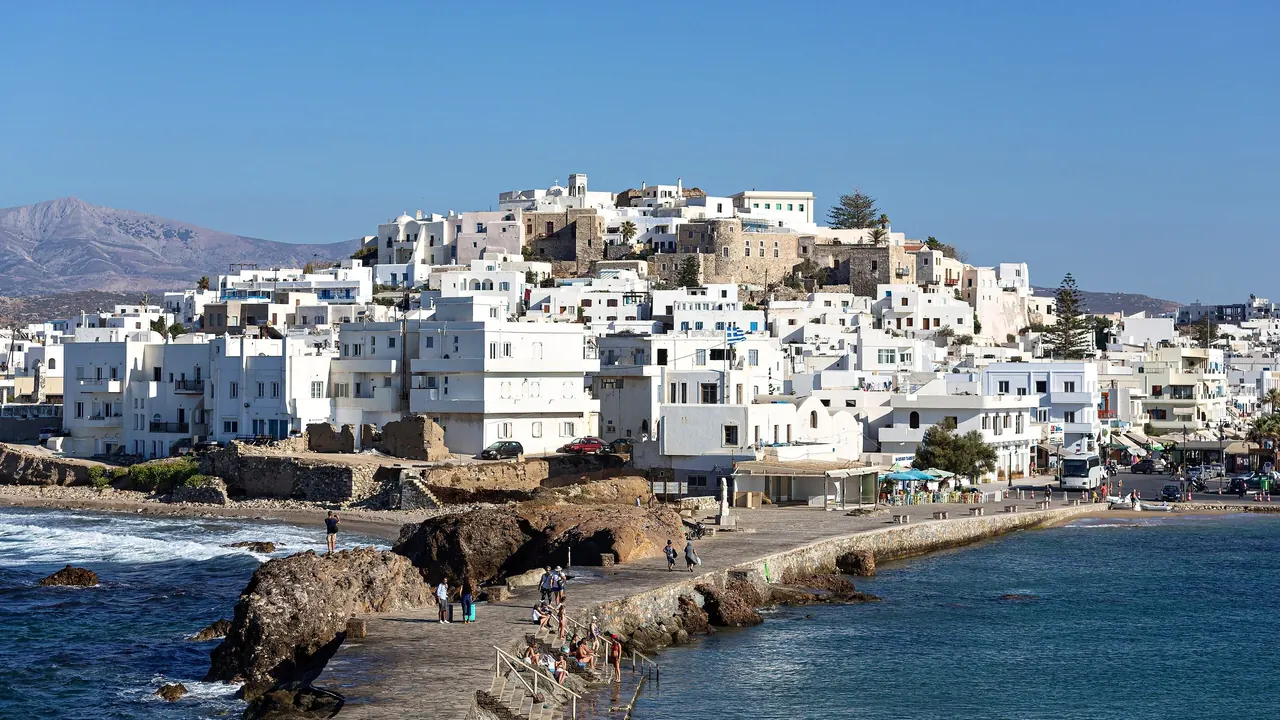
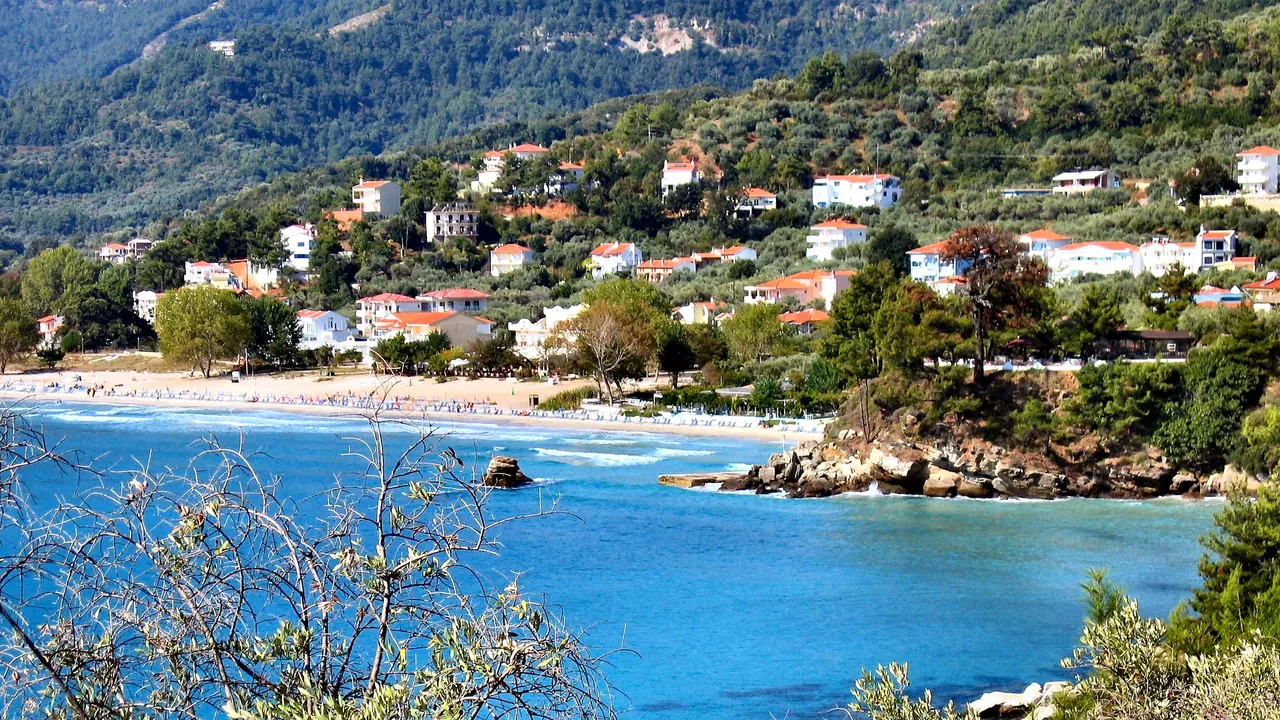
Photos: Naxos by Manfred Werner (Tsui), CC BY-SA 4.0, cropped; Thassos by Ronald Saunders from Warrington, UK, CC BY-SA 2.0, cropped.
Naxos or Thassos?
Our verdict in twelve categories, each scored against the same fixed benchmark cities, and the climate month by month, so you can choose for your trip.
Choose Naxos for
- day trips
- food and drink
- culture and sights
Naxos is the island for travellers who want more than the beach. Its west coast of sand runs almost unbroken south of Chora, and beyond that you get a Venetian kastro, marble villages and Byzantine chapels to drive between, the better taverna food and ferries to Paros, Mykonos and the Small Cyclades. Choose it if you want to mix swimming with sightseeing and a few days of hopping between islands, and you don't mind paying a little more.
Choose Thassos for
- prices
- getting around
Thassos makes more sense for a simple, good-value beach vacation in the north Aegean. Pine forest runs down to coves with very clear water, one ring road links every resort, and rooms and taverna meals cost noticeably less. It suits people who want to settle into a sandy bay, drive to a different beach each day and spend their evenings at a waterside table, with few sights pulling them away.
Scoreboard
Twelve categories on one fixed scale from 0 to 100. The shaded stretch is the gap between the two.
Your match
Pick a travel style or drag the sliders, and both match scores follow your weighting.
Wins on day trips and food and drink with your weighting.
Wins on prices and getting around with your weighting.
What matters to you?
Category by category
What the scores mean for a trip.
Beaches & swimming
These are two of the strongest beach islands in Greece, and they are different in shape. Naxos has one long chain of pale sand down its west coast, from Agios Georgios through Agios Prokopios and Plaka to the dune-backed beaches at Mikri Vigla and Alyko, with shallow water far out. The catch is the meltemi, which can make the open beaches choppy for days at a time.
Thassos spreads its beaches around the whole coast instead. You get the long sand of Golden Beach, pine-backed coves at Paradise Beach and Aliki, the white marble pebbles of Saliara and the Giola rock pool. Its sea is a little warmer in high summer, and a car finds you a quiet cove more easily than walking along a single strip does.
Food & drink
Naxos eats noticeably better, because it grows so much of its own food. It has its famous potatoes, graviera and arseniko cheeses and kitron liqueur from Halki, and the village tavernas at Filoti, Apiranthos and Koronos grill local meat and cook slow stews. The harbourfront in Chora adds fish.
Thassos offers honest island cooking with fewer standouts: grilled octopus at Limenaria and Potos, roast goat under the plane trees in Theologos, pine honey and spoon sweets. Neither island has much range or fine dining. On Thassos, more kitchens close once the summer is over.
Culture & sights
Naxos has the richer heritage, in layers. The marble Portara frames Chora's harbour, the Venetian kastro above it has mansions, churches and a museum of Cycladic figurines, and inland are the Temple of Demeter, the abandoned kouroi at Flerio and Apollonas, and the Byzantine chapels of the Tragaea valley. It's worth several days of driving.
Thassos has its sights mostly in one place, the ancient city around Limenas. There you'll find the agora, a theatre in the pines, the acropolis and the old walls, plus the sanctuary and quarries at Aliki and the cliff-top monastery of Archangel Michael. It's a good morning or two off the beach, not a cultural trip in itself.
Nightlife
Evenings are much the same on both islands, a long dinner followed by a drink near the water. Naxos gathers its nightlife in Chora's harbourfront and kastro lanes, with a couple of clubs that stay open late and sunset beach bars at Agios Prokopios and Plaka. Thassos splits it between the harbour bars of Limenas and Potos, where younger visitors go in high summer, and it has no club to speak of. Both go quiet once the season ends.
Nature & outdoors
Both islands are greener than most in the Aegean, and the landscapes differ. Naxos is marble mountain and olive grove. The classic walk is the climb up Mount Zas from Filoti, mule paths link the Tragaea villages, and the wild north and east coasts are empty. The meltemi also makes its west coast a kitesurfing centre.
Thassos is wooded from shore to summit, with pine, plane and chestnut forest climbing to Mount Ypsario and views across to Mount Athos. It also has streams and small waterfalls near Kallirachi and Maries. Its indented, sheltered coves suit kayaking, snorkelling and diving more than wind sports.
Day trips
Naxos is the better base for outings, because it sits in the middle of the Cyclades. Paros is under an hour away, the Small Cyclades such as Koufonisia make quiet days out, and Mykonos leads on to Delos, with Santorini possible on a long day. The island's own hill villages fill another day's drive. Boats run fully only in summer and can be cancelled when the wind is strong.
Thassos looks to the mainland rather than to other islands. Kavala, with its castle and Ottoman quarter, and the ruins of Philippi make one good day, and Xanthi is a longer drive. After that, most outings simply go round the island, so few visitors take more than one or two trips off it.
Good for families
Both islands suit a relaxed beach vacation with children, and neither has water parks or attractions built for children. Naxos has the edge for toddlers, with long, shallow stretches of soft sand and the sheltered beach at Agios Georgios within walking distance of Chora, though the meltemi can roughen the open beaches. Thassos has calm bays such as Golden Beach, Skala Prinou and Pefkari, and small, easy resorts. Its drawbacks are the steep paths down to some coves and the winding inland roads.
Getting around
The two islands ask different things of you. Naxos can be done without a car if you stay in Chora or Agios Prokopios. Chora is compact enough to walk, and summer buses run from its harbour down the west-coast beaches to Plaka and up to the main mountain villages. The interior chapels and the empty north and east coasts are another matter. For those you need a hired car or scooter and some long, winding drives, such as the one over the mountains to Apollonas, which takes well over an hour.
Thassos works the other way round. Its buses are too infrequent for beach-hopping, so most visitors hire a car, but driving is easy. A single coastal road circles the island, and every resort and beach is on it or a short climb above it, so no trip is long. Every arrival involves the ferry from Keramoti or Kavala, and the queues can be long on summer weekends.
Shopping & style
Neither island is a shopping destination, but Naxos gives you a little more to browse. The old market lanes below the kastro have jewellery, ceramic and linen shops, and Apiranthos and Halki sell weaving and marble work. On Thassos you mostly shop for food, pine honey, olives and spoon sweets from village stalls, plus a short street of beachwear in Limenas. On both islands the best things to take home are edible.
Affordability
Thassos is clearly the cheaper island. Its family-run studios and tavernas are priced for visitors who drive down from the Balkans rather than for luxury travellers, so even the busy resorts stay modest. The ferry and a hire car are the main extras.
Naxos is moderately priced rather than cheap. Village rooms and tavernas keep costs reasonable, but the boutique hotels around Chora and Plaka are more expensive, and August pushes up the price of beachfront rooms and car hire. On both islands, June and September give you the warm sea for less.
Live music & performing arts
You won't come to either island for performances. The best music on both is at the summer village feast days, where people dance in the squares late into the night. Naxos adds concerts and theatre at a restored Venetian tower inland and small recitals in the kastro. Thassos has its ancient theatre above Limenas, which hosts some plays and concerts during a regional festival.
Wellness & relaxation
Neither island has a bathing tradition, and spas are limited to a few resort hotels, so on both relaxation comes from the slow pace. On Naxos that means the mountain hamlets around Halki and the emptier southern beaches, plus some small yoga retreats on the southwest coast. On Thassos it means long lunches in Theologos or Panagia and the quiet bays of the south-east.
When should you go?
Pick your month. The climate figures are measured averages, not a forecast.
Naxos in July
Thassos in July
Daytime high, °C
Rainfall in the month, mm
Where the figures come from
Naxos's temperatures are measured 79 km from the centre, at Santorini Island / Monólithos.
Naxos has no rain gauge within 25 km of the centre, so its rainfall comes from a gridded climate dataset read at the destination rather than from a gauge further away.
Thassos has no rain gauge within 25 km of the centre, so its rainfall comes from a gridded climate dataset read at the destination rather than from a gauge further away.
Temperature and rainfall are climate normals, averaged over the years shown. Naxos: 2000-2025, 12 years observed (rainfall 1991-2020) normals, Santorini Island / Monólithos (78.8 km from centre). Thassos: 1997-2020 (rainfall 1991-2020) normals, Chrysoupoli Airport (24.5 km from centre).
Both islands are summer destinations, and from June to September each is hot, sunny and warm enough to swim. Naxos is the drier of the two. Around Chora and the west coast it hardly rains from May to September, while Thassos still gets the odd summer shower, with about 37mm in June. Thassos has slightly warmer sea at the height of summer, about 26°C in August against 24°C on Naxos. In both places July and August are too hot for long walks in the middle of the day.
The real difference comes in the cooler months. Naxos keeps its warmth longer into autumn and has milder winters, with January highs around 15°C against about 10°C on Thassos. That makes spring and October on Naxos better for walking the villages. On Thassos the swimming season closes more sharply after September, and late autumn and winter are wet and chilly on both islands.
Which traveller are you?
On a culture and arts trip, Naxos is the better choice. The Portara, the Venetian kastro of Chora, the unfinished kouroi in the quarries and the frescoed chapels of the Tragaea valley give you several days of history. The ancient remains at Limenas on Thassos fill an afternoon.
On a trip with a tight budget, Thassos is the island to pick. Family-run studios and modestly priced tavernas are the norm even in the busy resorts, because prices are set for visitors who drive down from the Balkans. Your main extra costs are the ferry and a hire car.
For kitesurfers and windsurfers, Naxos has something Thassos doesn't. The summer meltemi blows steadily onto the west coast, and Mikri Vigla is one of the best wind-sports spots in the Aegean. Thassos is more sheltered and better suited to calm-water kayaking and snorkelling.
Before you go
| Measure | Naxos | Thassos |
|---|---|---|
| Official language | Greek | Greek |
| Currency | Euro (EUR) | Euro (EUR) |
| Sockets | CF230 V, 50 Hz | CF230 V, 50 Hz |
| Driving side | Right | Right |
| Time zone | UTC+2, UTC+3 in summer | UTC+2, UTC+3 in summer |
| Emergency number | 112 | 112 |
| Main airport | Naxos Island National Airport (JNX)3 non-stop destinations | Kavala Alexander the Great International Airport (KVA)15 non-stop destinations |
| Public holidays this year | 15 days | 15 days |
By the numbers
| Measure | Naxos | Thassos |
|---|---|---|
| Population | 17,930 | 13,100 |
| People per km² | 42 | 35 |
| Swim season, months above 21 °C | 5 months | 4 months |
Where else could you go?
Every comparison below shares a destination with this one, so you can follow Naxos or Thassos somewhere new.