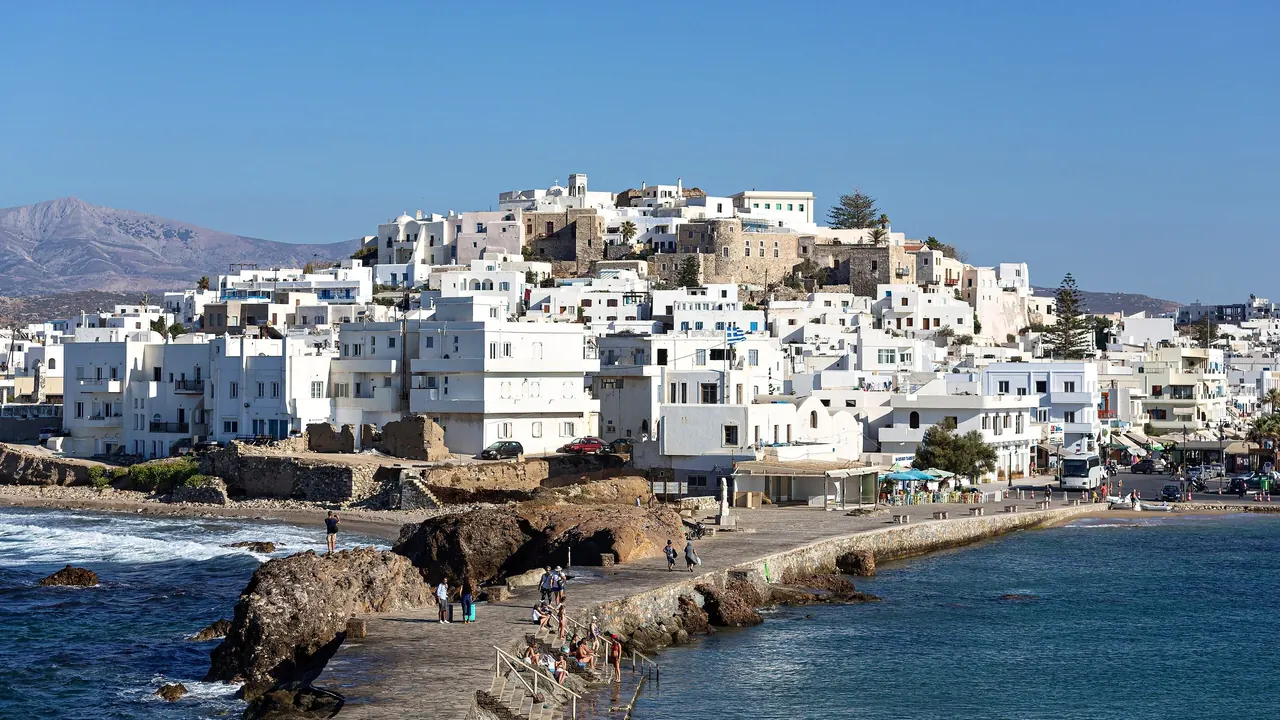
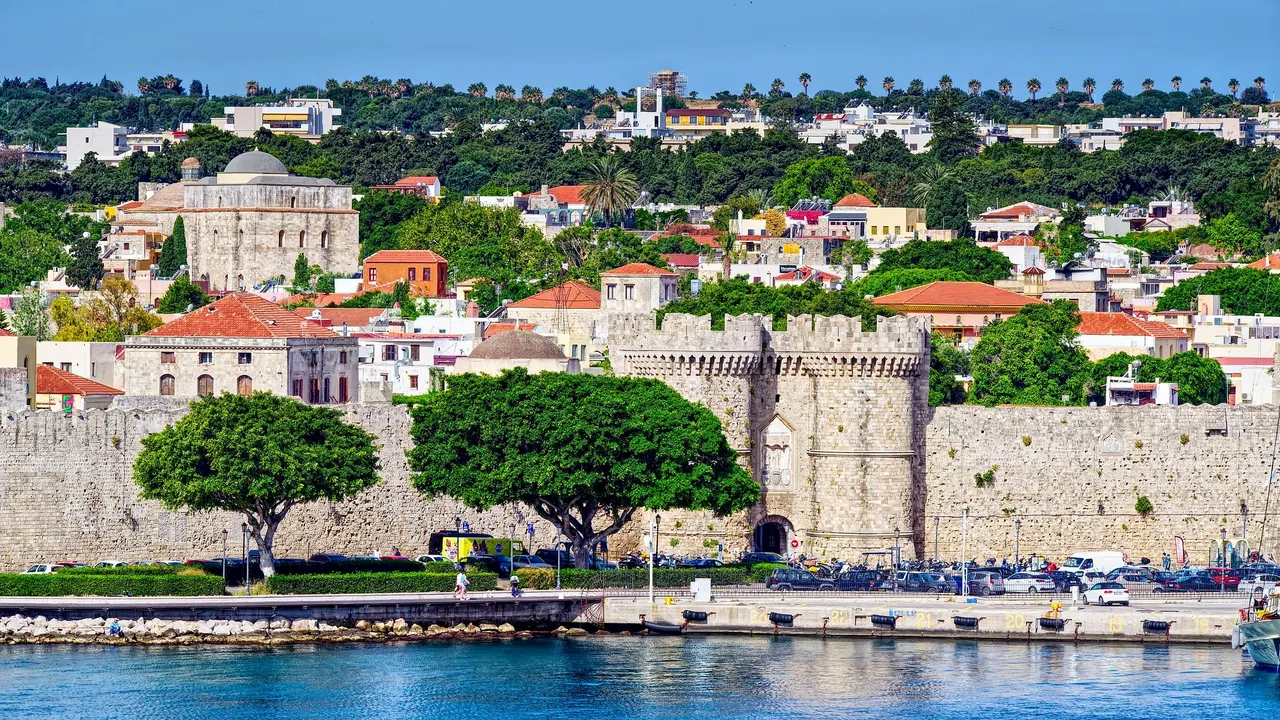
Photos: Naxos by Manfred Werner (Tsui), CC BY-SA 4.0, cropped; Rhodes by Mark Thomas, Pexels License.
Naxos or Rhodes?
Our verdict in twelve categories, each scored against the same fixed benchmark cities, and the climate month by month, so you can choose for your trip.
Choose Naxos for
- beaches
- live music and the arts
- food and drink
Naxos is the island for travellers who want sand above all else and a quieter, more rural Greece around it. Its west coast runs almost unbroken from Chora to Alyko in pale, shallow beaches. Behind them rise green mountains and marble villages where the island's own cheese and meat fill the taverna tables. Evenings are slow, and the ferries make it an easy base for hopping around the Cyclades.
Choose Rhodes for
- nightlife
- culture and sights
- families
Rhodes gives more to do between swims. The walled Old Town of the Knights and the acropolis at Lindos are history on a scale Naxos cannot match. Faliraki and Rhodes Town have a proper summer party scene, and families get resort pools, a water park and sheltered east-coast bays. The trade-off is busier beaches and a hotel belt that you need to escape to eat well.
Scoreboard
Twelve categories on one fixed scale from 0 to 100. The shaded stretch is the gap between the two.
Your match
Pick a travel style or drag the sliders, and both match scores follow your weighting.
Wins on beaches and live music and the arts with your weighting.
Wins on nightlife and culture and sights with your weighting.
What matters to you?
Category by category
What the scores mean for a trip.
Beaches & swimming
Both islands are built around their beaches, but the sand differs. Naxos has fine, pale sand stretching from Agios Prokopios and Plaka down to Kastraki, with clear water that stays shallow far out. The northerly meltemi can roughen the west coast for days, so Agios Georgios and the sheltered coves become the fallback.
Rhodes faces the problem from the other side. Its east coast between Faliraki and Lindos is sheltered, with bays and rocky inlets such as Anthony Quinn Bay that are better for snorkelling. The sand there is often mixed with shingle, though, and the busiest beaches fill with sunbeds in high summer.
Food & drink
The food is about equal in quality, but it comes from different places. Naxos grows much of what it eats. Graviera and arseniko cheeses, its well-known potatoes and kitron liqueur from Halki fill the tables in the mountain villages of Filoti, Apiranthos and Koronos.
On Rhodes the good food is a matter of escaping the buffets of the hotel belt. Try the meze places in the newer parts of Rhodes Town and the village tavernas serving pitaroudia, matsi pasta and goat. Rhodes has a little more upmarket choice around Lindos, but neither island is a fine-dining destination.
Culture & sights
Here Rhodes is in another league. Its walled Old Town is one of the most complete medieval fortified towns in Europe, with the Street of the Knights, the Grand Master's palace, mosques and a synagogue inside the walls. Add the clifftop acropolis at Lindos and ancient Kamiros, and there is enough heritage for several full days.
Naxos has fine pieces rather than a centrepiece. The Portara frames Chora harbour, the Venetian kastro is a maze to wander, and abandoned kouroi lie in the quarries. Its Byzantine chapels in the Tragaea valley reward a slow drive.
Nightlife
Rhodes has a genuine party scene and Naxos does not. Faliraki's strip of bars and clubs runs until dawn in high summer. The Old Town and Mandraki add late bars, and Lindos offers rooftop drinks for an older crowd.
On Naxos, a night out means cocktails along Chora's harbourfront, sunset sessions at the Plaka beach bars and perhaps one of a couple of clubs. Most visitors are content with a long dinner instead, and anyone set on dancing takes the ferry elsewhere.
Nature & outdoors
Naxos has the greener and more rugged interior. You can climb Mount Zas from Filoti, follow old mule paths through olive groves between the marble villages of the Tragaea, and find wild, empty coastline in the north and east. For a walking trip it has more character.
Rhodes is low, pine-covered hill country. Its beauty spots are shaded ones, the Valley of the Butterflies and the wooded stream at Seven Springs, and Mount Attavyros above the wine villages is the only real climb. Both are serious wind-sports islands, with Naxos centred on Mikri Vigla and Rhodes on the sandbar at Prasonisi.
Day trips
Both islands are fair bases for boat trips, and what decides it is where you want to sail. From Naxos, at the heart of the Cyclades, you can reach Paros, the quiet Small Cyclades, Delos by way of Mykonos and, on a long day, Santorini.
Rhodes looks east instead. It has Symi's pastel harbour, little Halki, and a ferry to Marmaris that lets you set foot in Turkey. Both lists rely on summer sailings and calm seas.
Good for families
Rhodes is the easier island with children. Large resort hotels on the east coast come with pools and kids' clubs. A water park above Faliraki and the aquarium in Rhodes Town fill the days off the beach. The bays at Tsambika and Kolymbia are calm and shallow.
Naxos has wonderfully gentle sand for toddlers and a relaxed pace, but nothing made for children beyond beach and boat. The open west coast can also be too rough for small swimmers on windy days.
Getting around
On both islands the main town is easy on foot and a car is the key to the interior. Rhodes has the more useful bus line, with a good service along the east coast to Faliraki and Lindos, and better main roads. Naxos buses cover the west-coast beaches to Plaka and the main mountain villages in summer, but its roads are narrow and winding. The drive to Apollonas takes well over an hour.
Shopping & style
Neither is a shopping destination, though Rhodes offers a bit more. Sokratous Street in the Old Town is one long souvenir lane, and the new town has high-street fashion and a few boutiques. On Naxos the best buys are things to eat: graviera, kitron, honey and thyme, plus weaving and marble work from Apiranthos and Halki.
Affordability
Overall the two islands cost much the same, and the real difference is in the kind of stay that keeps the bill down. On Naxos it is the family-run studios and simple rooms in the villages. Rhodes relies on its large stock of package hotels and all-inclusive resorts along the north and east coasts, which suits travellers who would rather book everything in one go.
The costly side is different too. On Naxos it comes down to timing: in August, beachfront rooms and car hire both go up, so June and September are the better buys. On Rhodes it comes down to place. Lindos is the most expensive spot on the island to sleep and eat, and the boutique hotels inside the Old Town walls are also pricey.
Live music & performing arts
Neither island has a theatre or concert season. Naxos offers the livelier tradition in its village panigyria, the saints' day festivals where violin and lute play late into the night and everyone dances. Rhodes has staged folk dance in an Old Town theatre and summer concerts in the medieval moat and the ancient stadium.
Wellness & relaxation
On Naxos, treatments are limited to a handful of resort hotels and small yoga retreats on the southwest coast. Rhodes has proper spas in its big resort hotels along the east coast and around Lindos, well run if lacking local character. Rest on Naxos comes from the pace of life: swim, siesta and a long dinner in the hills around Halki or on the emptier southern beaches.
Rhodes has its own version of this in the south. Villages such as Lahania, Asklipio and Gennadi have quiet church squares and kafeneia, far from the noise of the northern resort strip.
When should you go?
Pick your month. The climate figures are measured averages, not a forecast.
Naxos in July
Rhodes in July
Daytime high, °C
Rainfall in the month, mm
Where the figures come from
Naxos's temperatures are measured 79 km from the centre, at Santorini Island / Monólithos.
Naxos has no rain gauge within 25 km of the centre, so its rainfall comes from a gridded climate dataset read at the destination rather than from a gauge further away.
Rhodes has no rain gauge within 25 km of the centre, so its rainfall comes from a gridded climate dataset read at the destination rather than from a gauge further away.
Temperature and rainfall are climate normals, averaged over the years shown. Naxos: 2000-2025, 12 years observed (rainfall 1991-2020) normals, Santorini Island / Monólithos (78.8 km from centre). Rhodes: 1991-2020 normals, Rhodes Airport (12.6 km from centre).
Both islands are at their best from June to September, when there is almost no rain and highs sit around 28-30°C. That is beach weather, but in the middle of the day it is too hot for walking hills or old lanes. May and October are the gentler months for sightseeing on either. Rhodes has the warmer sea throughout the year, reaching 27°C in August against 24°C off Naxos, so the swimming season there starts in late May and lasts comfortably through October.
The two part ways in winter. Rhodes is far wetter, with around 171mm of rain in January against 83mm on Naxos, and from October its rain builds quickly. Naxos stays drier into autumn and dries out sooner in spring, which suits walking in April. Temperatures through the cool months are much the same on both.
Which traveller are you?
On a beach and sun trip, both islands deliver, and the choice comes down to the kind of shore. Naxos has fine, pale sand and long shallows from Agios Prokopios to Alyko. Rhodes has sheltered east-coast coves, better snorkelling and warmer water, but more shingle.
For a culture and arts trip, Rhodes is the clear pick. A base in Rhodes Town puts the Knights' walls, the Archaeological Museum and Monte Smith within walking distance, with Lindos and Kamiros a drive away. On Naxos, the Portara and the kastro fill a day or two.
On a family trip with young children, Rhodes is easier. Stay at an east-coast resort near Afandou or Kolymbia rather than in steep, stepped Lindos, and avoid the July heat. Naxos better suits older children who are happy with beach, boat and village days.
Before you go
| Measure | Naxos | Rhodes |
|---|---|---|
| Official language | Greek | Greek |
| Currency | Euro (EUR) | Euro (EUR) |
| Sockets | CF230 V, 50 Hz | CF230 V, 50 Hz |
| Driving side | Right | Right |
| Time zone | UTC+2, UTC+3 in summer | UTC+2, UTC+3 in summer |
| Emergency number | 112 | 112 |
| Main airport | Naxos Island National Airport (JNX)3 non-stop destinations | Rhodes International Airport "Diagoras" (RHO)136 non-stop destinations |
| Public holidays this year | 15 days | 15 days |
By the numbers
| Measure | Naxos | Rhodes |
|---|---|---|
| Population | 17,930 | 127,613 |
| People per km² | 42 | 91 |
| Swim season, months above 21 °C | 5 months | 6 months |
Where else could you go?
Every comparison below shares a destination with this one, so you can follow Naxos or Rhodes somewhere new.