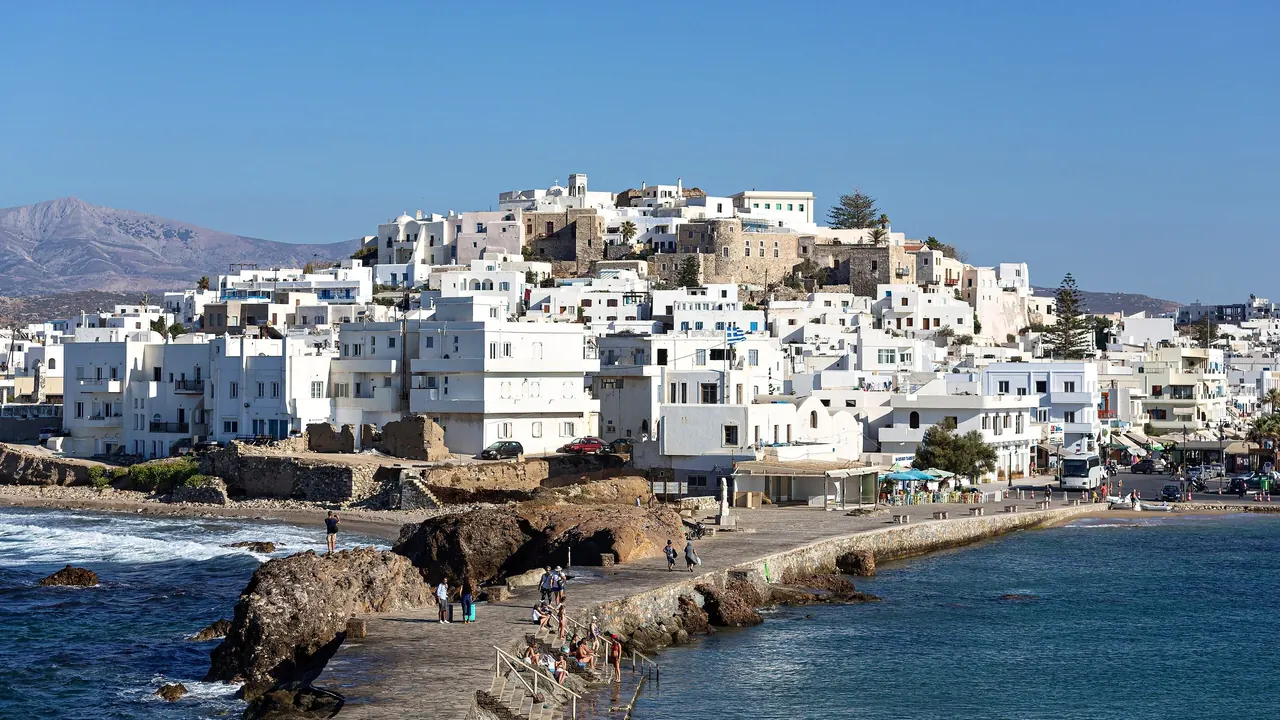
Photos: Naxos by Manfred Werner (Tsui), CC BY-SA 4.0, cropped.
Kefalonia or Naxos?
Our verdict in twelve categories, each scored against the same fixed benchmark cities, and the climate month by month, so you can choose for your trip.
Choose Kefalonia for
- nature and the outdoors
- wellness
- beaches
Kefalonia is the island for travellers who want big scenery and don't mind driving to reach it. It has the fir forest and summit road of Mount Ainos, white cliffs above Myrtos and Assos, and boat rides through the Melissani cave. The pace is slow, with long lunches in the hill villages. In return you give up history and nightlife, and you need a car for almost everything.
Choose Naxos for
- culture and sights
- getting around
- nightlife
Naxos makes more sense if you want sand on your doorstep and a trip that is easy to manage. The beaches along its west coast run almost one into the next, the kastro and Portara in Chora give you real history to walk through, and buses or ferries cover much of what you would want to see. It also works better with young children, and it is a good base for hopping to Paros and the Small Cyclades.
Scoreboard
Twelve categories on one fixed scale from 0 to 100. The shaded stretch is the gap between the two.
Your match
Pick a travel style or drag the sliders, and both match scores follow your weighting.
Wins on nature and the outdoors and wellness with your weighting.
Wins on culture and sights and getting around with your weighting.
What matters to you?
Category by category
What the scores mean for a trip.
Beaches & swimming
These are two equally strong beach islands with very different beaches. Kefalonia's best spots are dramatic and spread out: white pebble at Myrtos under the cliffs, Petani on the Paliki peninsula and red sand at Xi. Getting from one to the next means driving between coasts, though the south has sand at Skala and Lourdas.
Naxos is a single run of fine, pale sand down the west coast from Chora to Alyko, with shallow water and dunes, so you can walk from your room to the beach. The catch is the meltemi, which can make the open beaches choppy for days at a time. The sheltered coves and Agios Georgios are the places to go when it blows.
Food & drink
The two islands eat about equally well, and both are best in the taverna rather than at anything formal. Kefalonia has its own dishes, such as meat pie with rice, aliada garlic sauce with salt cod and mandoles almonds, and you can taste Robola wine at the wineries of the Omala valley. Naxos stands out for what it grows and makes itself: potatoes, graviera and arseniko cheeses, and kitron liqueur distilled in Halki. Its best meals come from the grills of mountain villages such as Filoti and Koronos. On neither island will you find much variety beyond Greek cooking.
Culture & sights
Naxos has much more to see. The marble Portara frames the harbour of Chora, and the Venetian kastro above it has coats of arms and Cycladic figurines. Inland you'll find the Temple of Demeter, the abandoned kouroi at Flerio and Apollonas, and the early frescoes of Panagia Drosiani, which together fill several days of touring.
Kefalonia's heritage mostly fell in the 1953 earthquake. What remains is Fiskardo's pastel harbour, the fortress ruins at Assos, the castle of Agios Georgios and the deserted village of Old Vlachata. These make pleasant half-days rather than a theme for the whole trip.
Nightlife
Neither island is for partying, but Naxos keeps going later. In summer, cocktail and music bars fill the harbour and the lanes below the kastro in Chora, a couple of clubs stay open into the small hours, and the beach bars at Agios Prokopios and Plaka hold sunset sessions. On Kefalonia, the evening means a drink on Argostoli's Lithostroto, the bar strip at Lassi or the harbour in Skala or Fiskardo, and most places close well before midnight outside July and August.
Nature & outdoors
Kefalonia has the grander landscape. Mount Ainos rises to about 1,628m and is a national park of dark fir forest, and the west coast falls away in tall white cliffs. Underground there are the lake cave of Melissani and the chamber at Drogarati, and loggerhead turtles feed in Argostoli harbour.
Naxos is green for the Cyclades, but on a smaller scale. Mount Zas is the classic summit walk, and old mule paths link the marble villages of the Tragaea valley. What Naxos has that Kefalonia lacks is wind: the meltemi makes Mikri Vigla one of the best kitesurfing and windsurfing spots in the Aegean.
Day trips
Naxos sits in the middle of the Cyclades, so there are far more islands within easy reach. Paros is under an hour away, the quiet Small Cyclades make easy days out, Mykonos leads on to Delos, and even Santorini is possible in a long day, as long as the wind lets the boats run.
From Kefalonia the obvious trip is Ithaca, with Vathy, Kioni and the sites linked to Odysseus. Summer boats also cross to northern Zakynthos and Lefkada, and after that the list is mostly the island's own far corners.
Good for families
Naxos is the more relaxed choice with small children. Its gently shelving sand starts right outside the beach villages, Agios Georgios is sheltered and walkable from Chora, and there is room to spread out even in August. Windy days can make the open beaches too rough for small swimmers, though.
Kefalonia works for families who stay near the sandy beaches of Skala, Lourdas or Xi. The pebble beaches in the north-west drop off steeply, and getting to the sights means long, winding drives. The boat through Melissani and spotting turtles in the harbour are highlights. Neither island has anything built for children.
Getting around
On Kefalonia almost every outing starts with the car keys. The beaches, caves and villages you came for sit on different coasts of a big, mountainous island, and going from Argostoli up to Fiskardo means about an hour and a half of winding road. Argostoli is pleasant on foot and the summer boat to Lixouri saves going round the bay, but the island buses are too infrequent to rely on.
Naxos asks much less of you. If you stay in Chora or one of the west-coast beach villages, you can walk the town and take the summer buses along the sand and up to the mountain villages, so many visitors never hire a car at all. You only need a car or scooter if you want to tour the inland villages and chapels or reach the empty north and east coasts, and the mountain road to Apollonas alone takes well over an hour.
Shopping & style
Shopping is a minor pleasure on both islands, though Naxos has a little more character. The old market lanes below the kastro have jewellery, ceramics and linen, and Apiranthos and Halki sell local weaving and marble work. Kefalonia offers everyday shops along Argostoli's Lithostroto and a few boutiques around Fiskardo's harbour. The best souvenirs on both islands are food: Robola and mandoles from Kefalonia, graviera and kitron from Naxos.
Affordability
Overall costs are much the same, and on both islands June and September give the best balance of price and warm sea. The difference is in where the money goes. On Kefalonia a hire car is an unavoidable extra, and Fiskardo and Assos are expensive, while the south around Skala and Lourdas is good value. On Naxos you can skip the car if you stay in Chora or on the west coast and use the buses, but the boutique hotels around Chora and Plaka are mid to upper range.
Live music & performing arts
Neither island has a theatre or concert season, so the music you hear will be traditional and seasonal. Kefalonia's sound is the kantades, harmonised serenades with guitar and mandolin, along with Argostoli's long-standing philharmonic band, both heard at summer concerts in the town squares. On Naxos the memorable nights are the village panigyria, saints' day festivals where violin and lute play late into the night and everyone dances. There is also a summer festival held in a Venetian tower inland.
Wellness & relaxation
Kefalonia is a little better for slowing down. The resort hotels around Lassi, Skala and Fiskardo have more spa choice, and the green, quiet Paliki peninsula and north-east coast are calm places to stay, with harbour evenings in Assos to round off the day. Naxos has only a few resort spas and small yoga retreats on the southwest coast. Its calm is drier and more rural: hamlets in the hills around Halki and empty southern beaches outside August.
When should you go?
Pick your month. The climate figures are measured averages, not a forecast.
Kefalonia in July
Naxos in July
Daytime high, °C
Rainfall in the month, mm
Where the figures come from
Kefalonia's temperatures are measured 59 km from the centre, at Zakinthos / Agrilia.
Kefalonia has no rain gauge within 25 km of the centre, so its rainfall comes from a gridded climate dataset read at the destination rather than from a gauge further away.
Naxos's temperatures are measured 79 km from the centre, at Santorini Island / Monólithos.
Naxos has no rain gauge within 25 km of the centre, so its rainfall comes from a gridded climate dataset read at the destination rather than from a gauge further away.
Temperature and rainfall are climate normals, averaged over the years shown. Kefalonia: 1991-2020 normals, Zakinthos / Agrilia (58.6 km from centre). Naxos: 2000-2025, 12 years observed (rainfall 1991-2020) normals, Santorini Island / Monólithos (78.8 km from centre).
Both islands are warm enough to swim from June to October. The difference is that Kefalonia gets hotter and wetter. Its midsummer highs climb to 33°C, which makes town walks and hikes hard after mid-morning, and the sea there is slightly warmer at around 26°C in August. Naxos peaks closer to 30°C, and the summer meltemi wind takes the edge off the heat.
The rain separates them most. Naxos stays almost completely dry from May to September and gets only light showers in October. On Kefalonia the rain returns in September, and by November it is heavy, at around 159mm, so late autumn is a gamble there. For walking, April, May and October suit both islands, but October on Naxos is noticeably drier.
Which traveller are you?
For an outdoors trip, Kefalonia gives you more. A higher, forested mountain has both trails and a summit road, and the sea adds kayaking along the north-east coast and sailing across to Ithaca. Naxos offers one classic summit walk and wind for kitesurfers.
On a family trip with young children, Naxos is less work. You can stay right on the sand, a summer bus covers the beach villages, and the days need little planning. On Kefalonia the best family outings mean long, winding drives with children in the back.
On a culture and arts trip, choose Naxos. Its history spans ancient, Byzantine and Venetian times and is spread across the whole island, so it can shape several days of touring. On Kefalonia, history makes pleasant outings but rarely a reason for the trip.
Before you go
| Measure | Kefalonia | Naxos |
|---|---|---|
| Official language | Greek | Greek |
| Currency | Euro (EUR) | Euro (EUR) |
| Sockets | CF230 V, 50 Hz | CF230 V, 50 Hz |
| Driving side | Right | Right |
| Time zone | UTC+2, UTC+3 in summer | UTC+2, UTC+3 in summer |
| Emergency number | 112 | 112 |
| Main airport | Kefalonia International Airport "Anna Pollatou" (EFL)41 non-stop destinations | Naxos Island National Airport (JNX)3 non-stop destinations |
| Public holidays this year | 15 days | 15 days |
By the numbers
| Measure | Kefalonia | Naxos |
|---|---|---|
| Population | 36,064 | 17,930 |
| People per km² | 49 | 42 |
| Swim season, months above 21 °C | 5 months | 5 months |
Where else could you go?
Every comparison below shares a destination with this one, so you can follow Kefalonia or Naxos somewhere new.