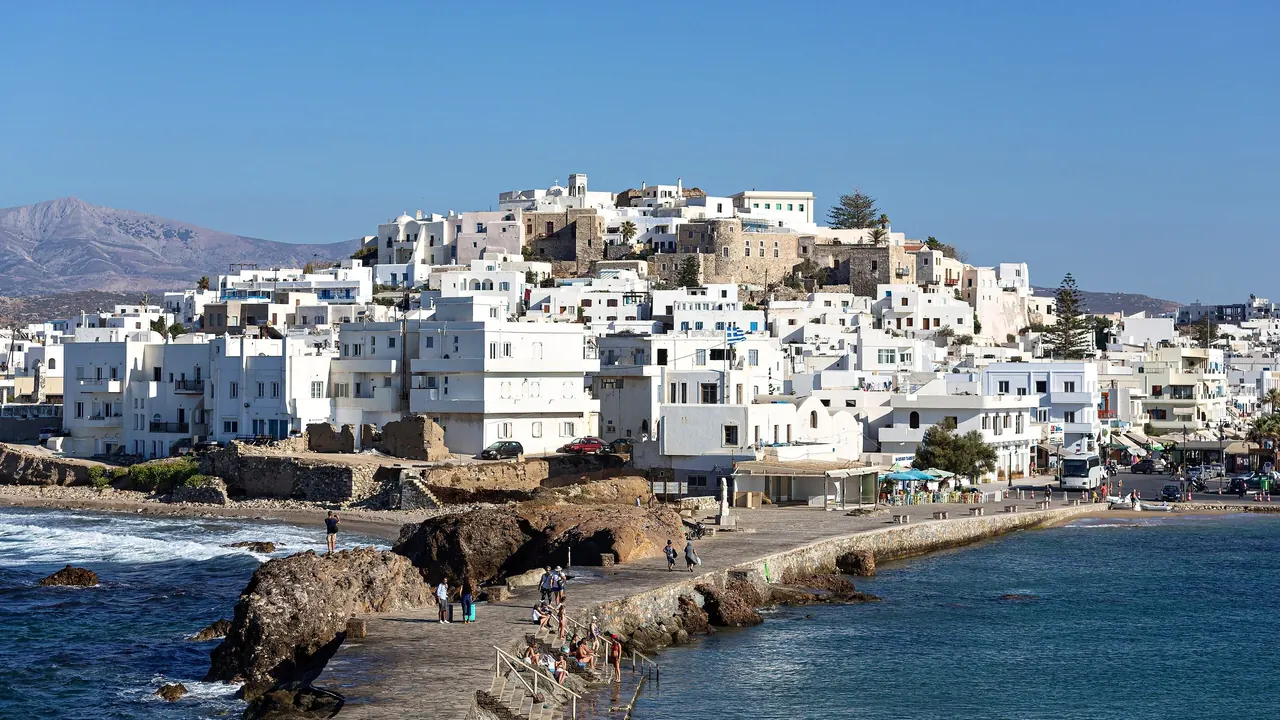
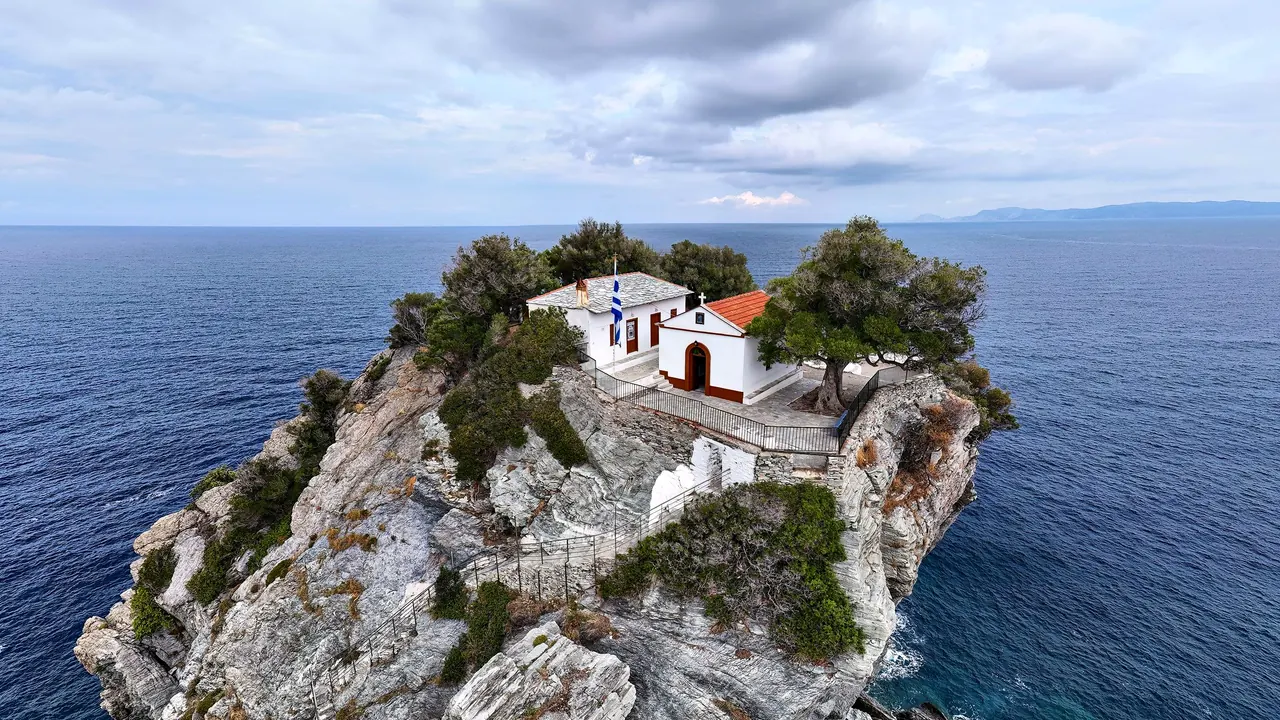
Photos: Naxos by Manfred Werner (Tsui), CC BY-SA 4.0, cropped; Skopelos by Giles Laurent, CC BY-SA 4.0, cropped.
Naxos or Skopelos?
Our verdict in twelve categories, each scored against the same fixed benchmark cities, and the climate month by month, so you can choose for your trip.
Choose Naxos for
- day trips
- culture and sights
- families
Naxos is the island to choose if you want a bit of everything from one base. Its west coast is a long run of soft, shallow sand that suits young children. Inland are marble villages, Venetian towers and ancient quarries worth several days of driving, and the tavernas cook with the island's own cheese, meat and potatoes. It is also the better hub for hopping by ferry to Paros, the Small Cyclades or Delos, and a summer bus line along the beaches means you can get by without a car.
Choose Skopelos for
- nature and the outdoors
Skopelos is smaller and slower, and it suits travellers who want exactly that. Pine forest runs down to the water in cove after sheltered cove, and boats head out into a marine park where monk seals and dolphins live. Evenings end over a drink on the harbour of a slate-roofed town. Getting there takes more effort, and there is less to see and do once you arrive, but couples who want walking, swimming and quiet will not miss much.
Scoreboard
Twelve categories on one fixed scale from 0 to 100. The shaded stretch is the gap between the two.
Your match
Pick a travel style or drag the sliders, and both match scores follow your weighting.
Wins on day trips and culture and sights with your weighting.
Wins on nature and the outdoors with your weighting.
What matters to you?
Category by category
What the scores mean for a trip.
Beaches & swimming
The two are close for swimming, but the beaches differ in kind. Naxos has fine pale sand, in an almost unbroken chain from Agios Georgios down through Agios Prokopios, Plaka and Mikri Vigla, with shallow water and room to spread out. The catch is the meltemi. On windy days the open west coast turns choppy, so you head for sheltered Agios Georgios or a cove tucked behind a headland.
Skopelos is mostly fine pebble or sand mixed with pebble, in smaller coves backed by pine trees, from Stafylos and Velanio near town to Panormos, Limnonari and Kastani further west. Its swimming coast faces south and west, away from the wind, so it is calmer and shadier. If you want long sandy beaches, choose Naxos. If you would rather swim at a different green cove each day, choose Skopelos.
Food & drink
Naxos eats better because it grows so much of its own food. Its valleys produce the potatoes Greeks know it for and the milk for graviera and arseniko cheese, and Halki distils kitron liqueur. The tavernas in the hill villages of Filoti, Apiranthos and Koronos grill local meat and cook slow stews.
Skopelos has a few signature foods: its fried, coiled cheese pie, dishes made with plums from the old orchards, and almond sweets. Beyond those, it serves good but standard taverna cooking, such as grilled octopus at Agnontas or goat in the villages. Neither island offers much variety, but Naxos gives you more to seek out, and more of it stays open outside summer.
Culture & sights
Naxos has the deeper history. The marble doorway of the Portara, built for a temple to Apollo in the sixth century BC, stands at the harbour of Chora. Above it are the coats of arms and Catholic churches of the Venetian kastro. Inland you find the Temple of Demeter near Sangri, giant unfinished kouroi at Flerio and Apollonas, and early frescoes in Panagia Drosiani. That fills several days of driving.
On Skopelos, the main sight is the town itself, tiers of whitewashed houses under grey slate roofs, plus a small folk museum and the monasteries on Mount Palouki. The Mamma Mia chapel of Agios Ioannis makes a fine photograph, but it is not much of a historic site.
Nightlife
Neither island is built for partying, but Naxos has more going on after dark. In summer, the cocktail and music bars below the kastro in Chora fill up, the beach bars at Agios Prokopios and Plaka hold sunset sessions, and a couple of clubs stay open into the small hours.
Skopelos has no real clubs. A night out means dinner and then a drink on the harbour or in a lane bar in town, where some places play Greek music late in July and August. If you want to dance until dawn, you will need a ferry to another island from either.
Nature & outdoors
Both islands are green by Aegean standards, but in different ways. Naxos is the more mountainous. The climb up Mount Zas from Filoti gives views across the Cyclades, mule paths thread through the olive groves of the Tragaea valley, and the summer wind makes Mikri Vigla a serious place for kitesurfing and windsurfing.
Skopelos is gentler and more wooded, with pine forest from the shore up to Mount Delfi and old plum orchards around the villages. Its distinctive asset is the sea next door: the Northern Sporades marine park, where boat trips go looking for dolphins and the rare monk seal, and where kayaking along the indented coast is a pleasure.
Day trips
Naxos is the far better base for exploring. It sits at the centre of the Cyclades. Paros is less than an hour away, the quiet Small Cyclades of Koufonisia and Schinoussa make easy days out, and fast boats reach Mykonos and the ancient sanctuary of Delos. Santorini is possible as a long day.
From Skopelos, the choice stops at the neighbouring Sporades: livelier Skiathos one way, quiet Alonissos and its hilltop old village the other, often combined with swimming stops in the marine park. The mainland is too far for a day out, and the boats thin out sharply once summer ends.
Good for families
Naxos is the easier island with small children. The soft sand on the west coast shelves so gently that toddlers can paddle a long way out, and buses and short distances make beach days simple. Skopelos also has sheltered, gently shelving bays such as Limnonari and Panormos, with tavernas close by and a warm welcome for children at dinner.
On Skopelos, though, the stepped lanes of the town are hard work with a pushchair, and the journey there involves a flight and a ferry. Neither island has anything built for children. On Skopelos, kayaking and boat trips are the highlights for older children.
Getting around
Naxos is simpler to reach and to get around. It has its own small airport as well as frequent ferries, Chora is compact enough to walk, and summer buses run from the harbour along the beaches to Plaka and up to the mountain villages. You only need a car for the interior and the empty north and east coasts.
Skopelos has no airport, so everyone arrives by boat, usually via Skiathos or from Volos on the mainland. One main road and its summer buses link the town to the best-known beaches and Glossa. For the coves and monasteries you will want a car or scooter, on narrow roads that are sometimes unpaved.
Shopping & style
Naxos gives you a little more to browse. The old market lanes below the kastro have jewellery, ceramic and linen shops, Apiranthos and Halki sell local weaving and marble work, and village co-operatives sell graviera cheese, kitron and thyme honey. On Skopelos, shopping amounts to an evening hour in the lanes behind the harbour, picking up prunes, herbal teas and almond sweets. Neither island has any fashion to speak of.
Affordability
The two cost about the same. Both are moderately priced, with family-run studios and taverna meals, and both are easiest on the wallet in June and September. The extra costs come from different places. On Naxos, August pushes up beachfront rooms and car hire. On Skopelos, the ferry, the near-necessity of a hire car and paid boat excursions add up, and there are fewer cheap rooms to fall back on.
Live music & performing arts
Neither island has a theatre or concert season. What you will find is summer music of a folk kind. Naxos adds a little formal programming, with a summer festival in a restored Venetian tower inland and small recitals in the kastro, but its village panigyria with violin and lute are the more memorable nights. Skopelos offers rebetiko and island songs in town tavernas on summer evenings and dancing at the saints' day festivals in August.
Wellness & relaxation
Both islands relax you through their pace rather than any spa culture. Neither has springs or bathhouses, and treatments come down to a few hotel spas. Naxos adds a handful of small yoga retreats on its southwest coast, and its quietest corners are the hills around Halki and the emptier southern beaches. On Skopelos, the calm comes from shaded pine coves, little traffic and villages that go quiet straight after dinner.
When should you go?
Pick your month. The climate figures are measured averages, not a forecast.
Naxos in July
Skopelos in July
Daytime high, °C
Rainfall in the month, mm
Where the figures come from
Naxos's temperatures are measured 79 km from the centre, at Santorini Island / Monólithos.
Naxos has no rain gauge within 25 km of the centre, so its rainfall comes from a gridded climate dataset read at the destination rather than from a gauge further away.
Skopelos's temperatures are measured 68 km from the centre, at Skyros Airport.
Skopelos has no rain gauge within 25 km of the centre, so its rainfall comes from a gridded climate dataset read at the destination rather than from a gauge further away.
Temperature and rainfall are climate normals, averaged over the years shown. Naxos: 2000-2025, 12 years observed (rainfall 1991-2020) normals, Santorini Island / Monólithos (78.8 km from centre). Skopelos: 1998-2025, 11 years observed (rainfall 1991-2020) normals, Skyros Airport (67.7 km from centre).
Both islands are summer places. The sea is warm enough to swim from June into early October, and July and August are hot, with afternoon highs around 30°C on Naxos and a degree cooler on Skopelos. Around Chora, Naxos is almost completely dry from June to August, while Skopelos gets the odd summer shower. Skopelos's sea warms a little more in high summer, reaching about 26°C in August against roughly 24°C off Naxos.
The rain comes back a month earlier on Skopelos. It returns there in September and is heavier by October. Naxos keeps a dry September, then the rain returns in October and builds through November. Spring follows the same pattern. April and May are pleasant for walking on both islands, but late spring is noticeably drier on Naxos. Winter is mild but wet and cool on both, and Skopelos is the chillier of the two.
Which traveller are you?
On a family trip with young children, Naxos is the easier choice. Its west-coast sand shelves gently for a long way out, Agios Georgios is a short walk from Chora, and buses link the beaches. On Skopelos, the stepped lanes and the ferry arrival are harder going.
For a culture and arts trip, Naxos has much more to offer. There is the Portara above the harbour, the Venetian kastro, unfinished kouroi lying in their quarries and frescoed Byzantine chapels in the Tragaea valley. Skopelos has its handsome town and monasteries, which take a day or two.
On an outdoors trip, Skopelos edges ahead. Pine-covered hills are crossed by waymarked mule tracks, kayaking around the coast is good, and boat trips go into the marine park for dolphins and monk seals. Naxos is the better pick only for its mountain summit walk or for windsurfing.
Before you go
| Measure | Naxos | Skopelos |
|---|---|---|
| Official language | Greek | Greek |
| Currency | Euro (EUR) | Euro (EUR) |
| Sockets | CF230 V, 50 Hz | CF230 V, 50 Hz |
| Driving side | Right | Right |
| Time zone | UTC+2, UTC+3 in summer | UTC+2, UTC+3 in summer |
| Emergency number | 112 | 112 |
| Main airport | Naxos Island National Airport (JNX)3 non-stop destinations | Skiathos Island National Airport (JSI)37 non-stop destinations |
| Public holidays this year | 15 days | 15 days |
By the numbers
| Measure | Naxos | Skopelos |
|---|---|---|
| Population | 17,930 | - |
| People per km² | 42 | - |
| Swim season, months above 21 °C | 5 months | 5 months |
Where else could you go?
Every comparison below shares a destination with this one, so you can follow Naxos or Skopelos somewhere new.