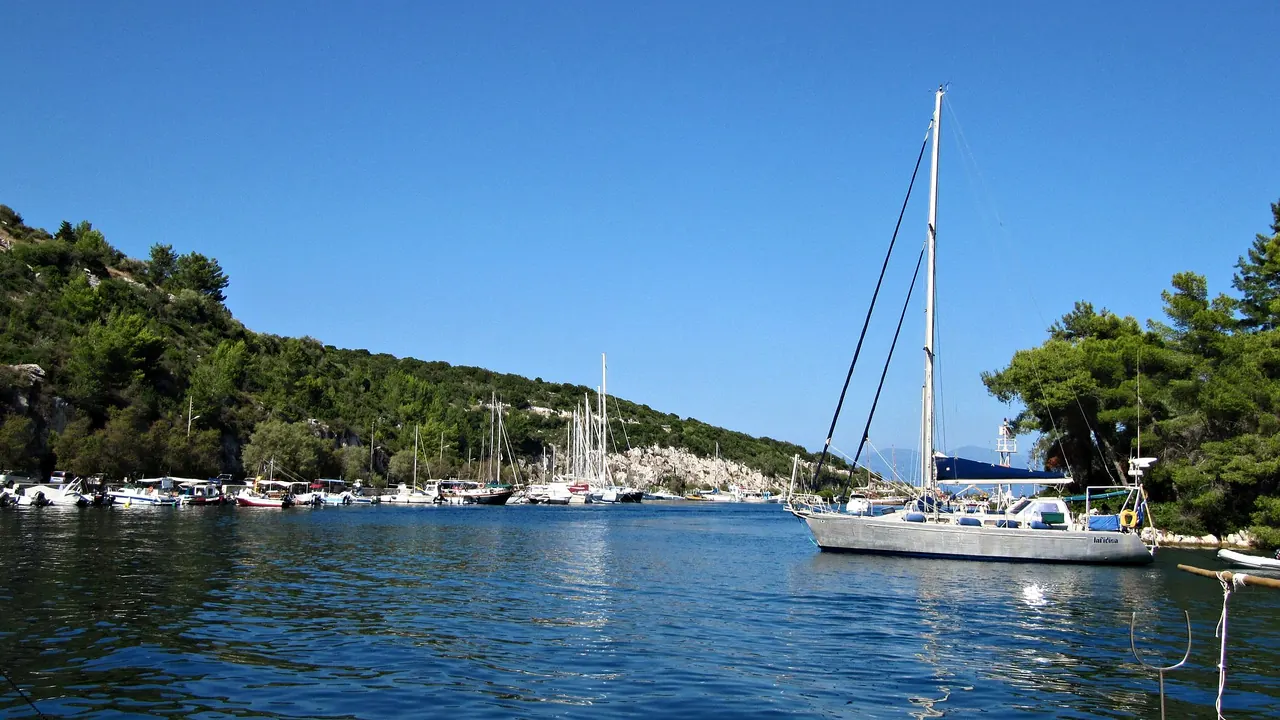
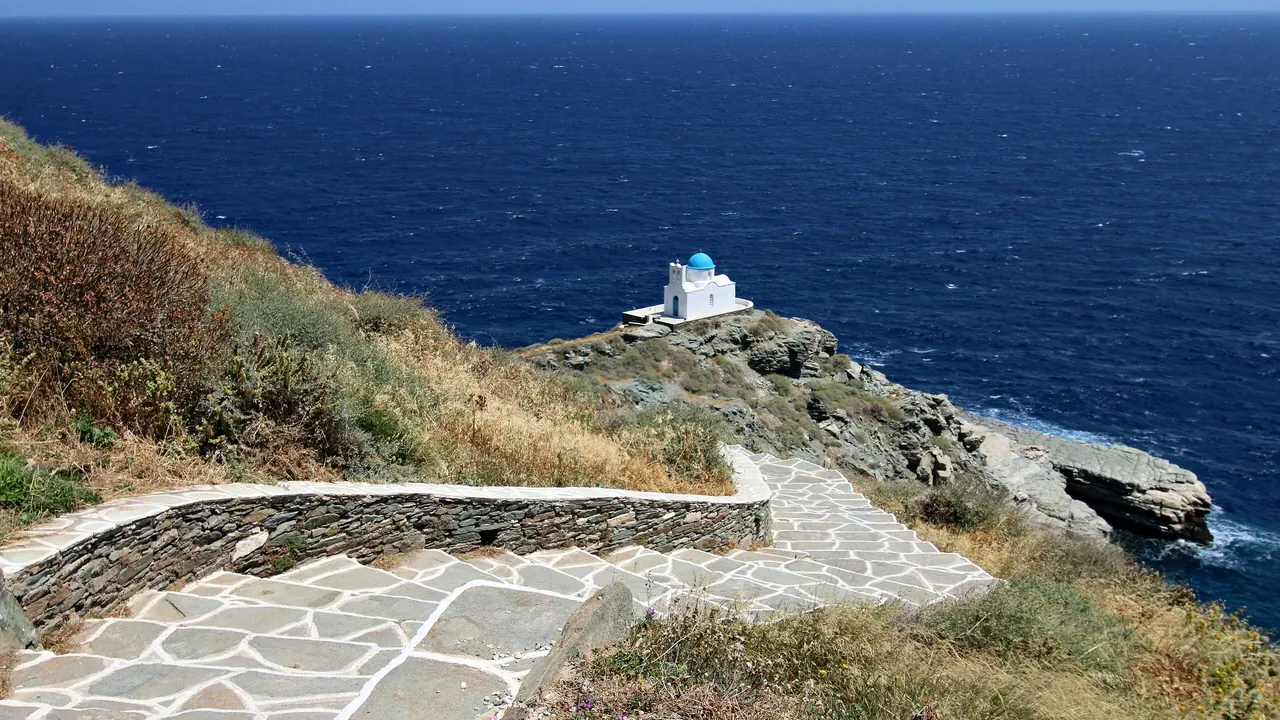
Photos: Paxos by Poiesia, CC BY-SA 4.0, cropped; Sifnos by Zde, CC BY-SA 4.0, cropped.
Paxos or Sifnos?
Our verdict in twelve categories, each scored against the same fixed benchmark cities, and the climate month by month, so you can choose for your trip.
Choose Paxos for
- beaches
- wellness
Paxos suits travellers whose days revolve around the water: a small hired motorboat, the pale sand of Antipaxos a short hop south, the sea caves and cliffs of the west coast, then a long evening on the harbour at Gaios or Lakka. It is the hotter and greener of the two, with olive groves on every hillside. In return you accept a short, repetitive menu and very little to see or do away from the sea.
Choose Sifnos for
- food and drink
- culture and sights
- shopping
Choose Sifnos if you want the beach and something to fill the rest of the day as well. Its clay-pot cooking is a reason to travel in itself, the villages of Kastro, Apollonia and Artemonas reward slow wandering, and the old mule tracks make it the better island for walking. Sandy bays such as Platis Gialos and Vathi are on the island itself rather than a boat ride away, and Apollonia's lane of bars gives it a little more life after dinner.
Scoreboard
Twelve categories on one fixed scale from 0 to 100. The shaded stretch is the gap between the two.
Your match
Pick a travel style or drag the sliders, and both match scores follow your weighting.
Wins on beaches and wellness with your weighting.
Wins on food and drink and culture and sights with your weighting.
What matters to you?
Category by category
What the scores mean for a trip.
Beaches & swimming
Both are true swimming islands with very clear water, but the beaches differ in kind. On Paxos itself you mostly get small pebble coves along the sheltered east coast, with the round sandy bay at Lakka the exception. The postcard sand is on Antipaxos at Voutoumi and Vrika, reached by boat and crowded at midday in high summer.
Sifnos has its sand at home: the long curve of Platis Gialos, the easy port beach at Kamares, and Vathi's enclosed bay, which stays calm when the meltemi churns up exposed shores in July and August. On Paxos the day is spent moving between coves by boat. On Sifnos you pick the sheltered bay and stay put.
Food & drink
Sifnos is the island to eat on. Its slow clay-pot cooking, revithia baked overnight in wood ovens and mastelo braised with wine and dill, has a reputation across Greece, and fishing hamlets such as Cheronissos and the old bakeries of Artemonas add to it.
Paxos eats well enough in its harbour tavernas, with bourdeto, sofrito, grilled fish and its own olive oil, and the villa crowd keeps standards up. But the menus repeat from Gaios to Loggos, and nobody chooses Paxos for its kitchens the way people choose Sifnos.
Culture & sights
Sifnos has more to look at. The cliff-top village of Kastro, whose outer houses form its wall, the white villages of Apollonia and Artemonas, the chapel of Chrysopigi on its rock, and Mycenaean and Hellenistic remains on the hills make several days of unhurried sightseeing.
Paxos offers the view from Gaios harbour to the Venetian fort and Panagia monastery on their islets, a small schoolhouse museum, and old olive presses passed on walks. For real history its visitors take the boat to Corfu Town.
Nightlife
Neither island has clubs, and both go quiet after dinner outside the peak weeks. Sifnos has more of a late scene, though: in July and August the narrow pedestrian lane of Apollonia fills with small cocktail and music bars that run into the early hours.
On Paxos the evening is a drink at a waterfront bar in Gaios or Lakka beside the moored yachts, with dancing in only one or two places in midsummer.
Nature & outdoors
Sifnos is the better island on foot. Paved mule tracks link villages, monasteries and watchtowers across terraced hillsides, and the climb to Profitis Ilias at about 680m gives views over the western Cyclades.
Paxos is low and gentle, with an end-to-end trail through ancient olive groves. Its finest landscape is the white limestone of the west coast, the Erimitis cliffs, the Tripitos arch and sea caves, which is best seen from a boat or kayak rather than a path.
Day trips
The outings are about equal in number but quite different in character. From Paxos, the fast ferry to Corfu Town brings a sizeable UNESCO-listed old town with Venetian fortresses, and excursion boats reach the mainland at Parga and the coves of Sivota.
From Sifnos, day trips mean island-hopping: Milos for its Plaka and painted boathouses, the dramatic hilltop chora of Serifos close by, and quiet Kimolos. On both islands wind and schedules decide what is possible.
Good for families
Sifnos makes the easier family base. Several beaches have sand and shallow water, distances are short and summer buses connect them, though the stepped villages are hard going with a pushchair.
Paxos has one ideal bay for small children at Lakka, but most beaches are pebble with steep paths down, villas in the groves usually need a car, and rainy days have nothing to fill them. It suits older children who like snorkelling and boat days.
Getting around
Both islands depend on ferries that the wind can disrupt. Paxos is reached from Corfu or the mainland, and Sifnos is a few hours from Piraeus. Once you arrive, Sifnos is the simpler of the two: summer buses run from Apollonia to Kamares, Kastro, Platis Gialos, Faros and Vathi, and footpaths join the villages.
On Paxos buses are infrequent, so most visitors rent a car or scooter for the winding lanes. A small hired boat often proves the most useful vehicle of all, because the best coves face the sea, not the road.
Shopping & style
Sifnos has a craft worth buying: its potters' workshops around Kamares, Vathi and Platis Gialos still make the clay casseroles used in island kitchens, and Apollonia adds a few boutiques and stalls of capers, cheese and almond sweets. Paxos has only summer linen and jewellery shops behind the harbours, and its best souvenir is a bottle of olive oil.
Affordability
What drives the cost differs. On Paxos it is the extras: villas and guesthouses that fill early for July and August, harbourside restaurants that charge for the view and the clientele, and then a car, boat hire and ferry crossings on top. On Sifnos the expense lies mainly in the rooms, boutique hotels and stylish rented houses that book out in high summer, while taverna meals stay fair for the quality and the buses and footpaths cost little.
The final bill comes out much the same, a little lighter on Sifnos if you manage without a car. On either island, travelling in June or September eases it noticeably.
Live music & performing arts
Paxos keeps its music to a handful of fixed dates: saints' days led by the August feast of the Panagia in Gaios, when traditional music and dancing run late, and a small chamber music festival at the end of summer in churches and village squares. Sifnos gives you more chances to join in, because its panigyria, the feasts held at a chapel or monastery on its saint's day, run right through the summer, with a shared meal followed by violin, lute and circle dancing until dawn. Beyond these, neither island has theatre or a regular stage.
Wellness & relaxation
Paxos offers calm through seclusion: villas among the olive trees with sea views, few cars, no high-rise building, harbours that wake slowly, and yoga and retreat weeks on some estates. Sifnos gets its calm from village life instead, with car-free lanes, long lunches and evening strolls between Apollonia and Artemonas, though its villages and main beaches fill up in August. Spa treatments are limited to a few hotels on each island, and on both the most peaceful weeks fall in June and September.
When should you go?
Pick your month. The climate figures are measured averages, not a forecast.
Paxos in July
Sifnos in July
Daytime high, °C
Rainfall in the month, mm
Where the figures come from
Paxos's temperatures are measured 52 km from the centre, at Kerkyra Airport.
Paxos has no rain gauge within 25 km of the centre, so its rainfall comes from a gridded climate dataset read at the destination rather than from a gauge further away.
Sifnos has no weather station within reach, so its figures come from a gridded climate model rather than a measured record, and read a broad area rather than one spot.
Temperature and rainfall are climate normals, averaged over the years shown. Paxos: 1991-2020 normals, Kerkyra Airport (52.1 km from centre). Sifnos: 2001-2020 normals, NASA POWER reanalysis grid, no weather station within 90 km.
Paxos runs hotter and wetter. July and August reach about 32°C, too hot for walking the olive lanes at midday, while the sea peaks at 26°C in August and summer brings long, cloudless days. Swimming is good from June to September. The rain returns in September and builds to 163mm in November, so Paxos's best walking weather is in April and May, when the groves are mild and the paths dry.
Sifnos is milder and drier: highs top out around 27°C in July and August, the sea holds near 24°C from July through September, and almost no rain falls from May to September. That makes September a particularly good month there, warm enough to swim and cool enough to hike, just as Paxos turns showery. In winter both islands are cool and wet, and neither is a beach destination.
Which traveller are you?
On a beach and sun trip, Paxos edges ahead. It is hotter, its sea is a touch warmer in late summer, and a hired boat opens up the turquoise sand of Antipaxos and coves along the east coast that the roads never reach.
For a food and nightlife trip, Sifnos is the clear choice. Overnight chickpeas, wine-braised mastelo and manoura cheese give it a real cuisine, and afterwards the bars along Apollonia's lane stay busy late, where Paxos offers mostly harbour tavernas and a quiet drink.
On a family trip with young children, Sifnos works better. Platis Gialos, Kamares and Vathi all have sand and shallow water, and summer buses reach them. On Paxos, Lakka is the one easy bay, and most other beaches are pebble with steep paths down.
Before you go
| Measure | Paxos | Sifnos |
|---|---|---|
| Official language | Greek | Greek |
| Currency | Euro (EUR) | Euro (EUR) |
| Sockets | CF230 V, 50 Hz | CF230 V, 50 Hz |
| Driving side | Right | Right |
| Time zone | UTC+2, UTC+3 in summer | UTC+2, UTC+3 in summer |
| Emergency number | 112 | 112 |
| Main airport | Corfu Ioannis Kapodistrias International Airport (CFU)88 non-stop destinations | Milos Airport (MLO)2 non-stop destinations |
| Public holidays this year | 15 days | 15 days |
By the numbers
| Measure | Paxos | Sifnos |
|---|---|---|
| Population | 2,300 | - |
| People per km² | 91 | - |
| Swim season, months above 21 °C | 5 months | 5 months |
Where else could you go?
Every comparison below shares a destination with this one, so you can follow Paxos or Sifnos somewhere new.