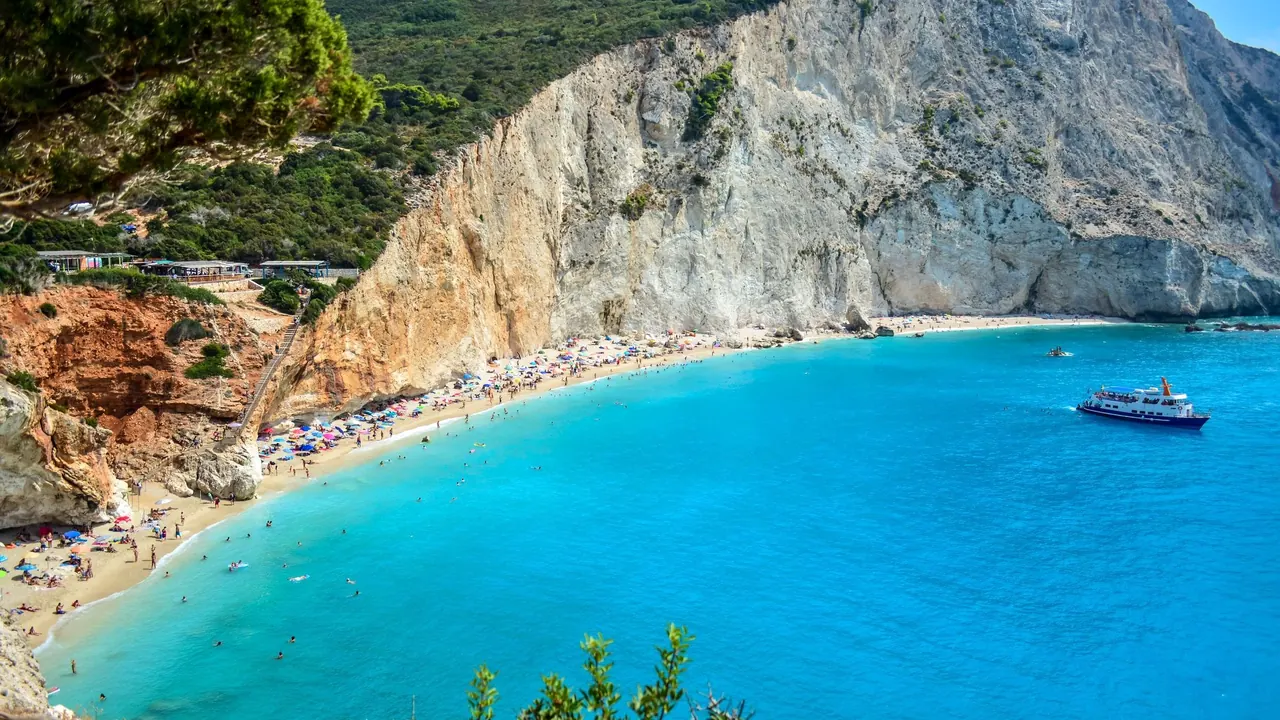
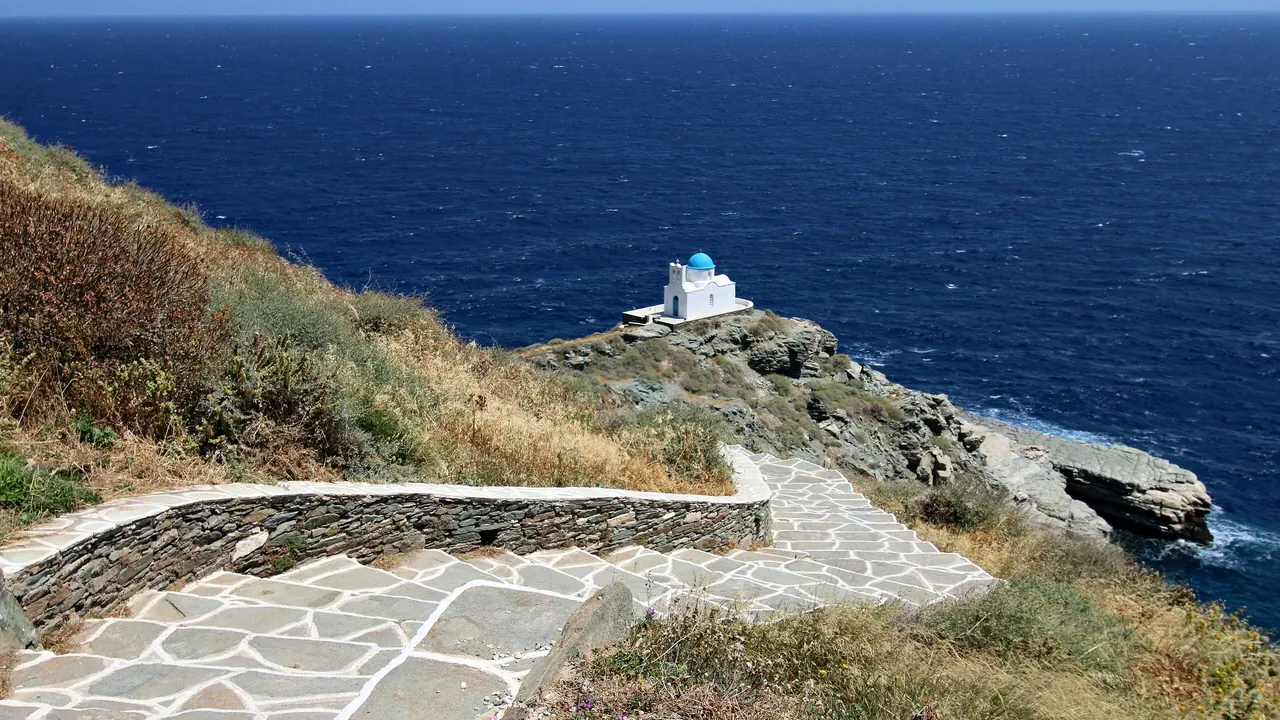
Photos: Lefkada by Antone Adi, Pexels License; Sifnos by Zde, CC BY-SA 4.0, cropped.
Lefkada or Sifnos?
Our verdict in twelve categories, each scored against the same fixed benchmark cities, and the climate month by month, so you can choose for your trip.
Choose Lefkada for
- prices
- day trips
- nature and the outdoors
Lefkada is the choice if the beach is what you're travelling for and you want more to do around it. Its west coast of white cliffs and turquoise water is the more dramatic shoreline. Vasiliki's winds and the sailing channels off the east coast make it a real water-sports island, and the causeway, a nearby airport and boats to Kefalonia, Ithaca and the mainland open up a wider week. It also costs less, especially for a family renting an apartment.
Choose Sifnos for
- food and drink
- culture and sights
- getting around
Sifnos suits travellers who come for the table and the villages. Its clay-pot cooking is a reason to visit in itself, and Kastro, Apollonia and the old mule tracks between them reward slow days on foot. The trade-off is a ferry crossing, higher summer prices and fewer outings off the island. What you get back is a quieter, more self-contained stay where everything is close.
Scoreboard
Twelve categories on one fixed scale from 0 to 100. The shaded stretch is the gap between the two.
Your match
Pick a travel style or drag the sliders, and both match scores follow your weighting.
Too close to call, 1 point apart
Wins on prices and day trips with your weighting.
Wins on food and drink and culture and sights with your weighting.
What matters to you?
Category by category
What the scores mean for a trip.
Beaches & swimming
Lefkada has the more spectacular beaches. Porto Katsiki, Egremni and Kathisma lie under tall limestone cliffs on the open Ionian, with startling colour. The catch is steep shelving, afternoon waves and heavy crowds in midsummer, and the calm swimming is on the east and south coasts around Nidri, Ligia and Agiofili.
Sifnos is gentler and more consistent. Platis Gialos is a long arc of fine sand over shallow water, and Vathi stays calm in an almost enclosed bay. When the meltemi blows, you simply choose a sheltered beach. It lacks Lefkada's sense of drama, but it has no big resort strips either.
Food & drink
On Sifnos, food is a reason to go. The island has a real cooking tradition: chickpeas and lamb slow-cooked in clay pots, cheese aged in wine lees, capers and almond sweets. It is served in tavernas from Artemonas to the fishing hamlet of Cheronissos, plus a few more ambitious kitchens.
On Lefkada you eat well but plainly. The good things are harbour fish in Nidri and Lefkada town, Eglouvi lentils and the old mountain dishes around Karya, but the resort strips fall back on standard tourist menus.
Culture & sights
Neither island has a major sight, but Sifnos gives more to explore. Kastro, a medieval village whose outer houses form its wall, the white villages of Apollonia and Artemonas, Chrysopigi on its rock and the Hellenistic watchtowers from the island's mining days fill several slow mornings.
Lefkada's sights are better treated as breaks from the beach. You get the fortress of Santa Maura at the causeway, the painted church ceilings and earthquake-proof timber houses of the main town, the Faneromeni monastery and the cliff at Cape Lefkatas linked to Sappho.
Nightlife
The two are broadly level, and both go quiet early outside July and August. The difference is in how the evening spreads out. On Lefkada it is split across three places: the waterfront and lanes of Lefkada town fill with cocktail bars and young Greek visitors, Nidri's harbour strip draws resort guests and sailing crews, and Vasiliki has its windsurfers' bars. It is a place for drinking and strolling rather than clubbing.
Sifnos keeps its nights in one lane. Dinner is the long part of the evening. After that comes a drink in the small cocktail and music bars along Apollonia's pedestrian street, which stay busy into the early hours in peak summer, or a sunset drink on the seafront at Kamares. There are no real clubs on the island.
Nature & outdoors
Lefkada has more on offer outdoors, mostly because of the water. Vasiliki bay is one of the Mediterranean's best-known windsurfing spots, Agios Ioannis has kitesurfing and the big marina is a natural start for a week of sailing. Behind the coast, green slopes rise to mountains above 1,100m, with a path to the Dimosari waterfall.
Sifnos is a walking island rather than a water-sports one. Stone-paved mule tracks cross dry, terraced hills of thyme to Profitis Ilias at about 680m. It is very pleasant in spring and autumn, but the water offers little beyond snorkelling and boat trips to coves you can't reach by road.
Day trips
Lefkada gives you more choice. Excursion boats from Nidri go to Meganisi, Kalamos and Kastos, and ferries from Vasiliki reach Fiskardo and Ithaca. Because the island is joined to the mainland, you can also drive to Roman Nikopolis, Parga and the Acheron oracle.
From Sifnos, an outing means a ferry, and the list is short. Milos is the best day out, Serifos is close by and Kimolos can be added. When the wind is up or the season thins, most visitors just stay put.
Good for families
Both work for a simple beach vacation and neither has anything built for children. The difference is where the easy water is. On Lefkada, families do best on the calm east coast and treat the cliff beaches of the west as an occasional outing. On Sifnos, the sandy shallows at Platis Gialos and Kamares are only a short drive away, but the stepped village lanes are hard with a pushchair and the ferry crossing can be rough.
Getting around
Lefkada is easier to reach but harder to tour. The causeway and the airport half an hour away mean no ferry at all. Once you're there, though, you need a car for winding west-coast roads, summer jams through Nidri and full car parks at Porto Katsiki.
Sifnos is the reverse. The hours on a ferry from Piraeus, sometimes disrupted by wind, are the hard part. After that, distances are tiny, summer buses link the villages and beaches from Apollonia, and footpaths let you skip the car entirely.
Shopping & style
Neither is a shopping destination, but Sifnos has the better thing to take home: its centuries-old pottery, thrown in workshops around Kamares, Vathi and Platis Gialos. On Lefkada, the evening stroll down the main street of the town brings small boutiques and stalls of olive oil and lentils, with the embroidery of Karya the one local craft worth seeking out.
Affordability
Lefkada is clearly the cheaper island. It sits mid-range for Greece, with plenty of family-run apartments, although car hire and boat trips add up. Sifnos is upmarket in summer, with boutique stays that book out early and taverna bills above mainland levels. On both islands, June and September ease the cost.
Live music & performing arts
There is very little staged performance on either island, and what exists happens in summer. Lefkada's draw is its long-running August folklore festival, with dance groups from abroad on open-air stages. On Sifnos it is the panigyri, the saint's-day feasts at chapels where a shared meal turns into violin, lute and circle dancing late into the night.
Wellness & relaxation
Sifnos is the more restful of the two. Its villages are car-free, the walk between Apollonia and Artemonas fills the early evening and everything is close enough to leave the day unplanned. Neither island has a bathing tradition. Lefkada's calm is found in pockets, in the hill villages and the small harbours of the east coast, while its busiest resorts are anything but peaceful in August.
When should you go?
Pick your month. The climate figures are measured averages, not a forecast.
Lefkada in July
Sifnos in July
Daytime high, °C
Rainfall in the month, mm
Where the figures come from
Lefkada has no rain gauge within 25 km of the centre, so its rainfall comes from a gridded climate dataset read at the destination rather than from a gauge further away.
Sifnos has no weather station within reach, so its figures come from a gridded climate model rather than a measured record, and read a broad area rather than one spot.
Temperature and rainfall are climate normals, averaged over the years shown. Lefkada: 1998-2020 (rainfall 1991-2020) normals, Aktion Airport (24.3 km from centre). Sifnos: 2001-2020 normals, NASA POWER reanalysis grid, no weather station within 90 km.
Both islands have a swimming season from June to early October, but Lefkada runs hotter. Its afternoons reach about 31°C in August and the sea warms to around 26°C. On Sifnos the summer highs stay nearer 27°C and the sea is a little cooler. The Cyclades are also drier: Sifnos sees almost no rain from June to August, and real rain doesn't return until October. On Lefkada the showers come back in September and build steadily, to about 150mm in November, so the wet season starts earlier and is heavier there.
For walking, Sifnos is at its best in April, May and October, when the hillsides are mild and the midday heat has gone. Lefkada's interior paths suit May and late September to October. July and August are too hot there for anything strenuous in the middle of the day. In winter both islands are cool and wet, with Lefkada the rainier of the two.
Which traveller are you?
On a trip on a tight budget, Lefkada makes more sense. Family-run studios are easy to find, there are few entry fees, and you can drive there from the mainland. On Sifnos the stock leans towards boutique hotels and stylish rented houses that fill early in summer.
For a food and nightlife trip, Sifnos wins on the eating. Revithia baked overnight, mastelo and manoura cheese make dinner the main event, followed by a drink in Apollonia's lane. Lefkada's town bars are livelier, but its tavernas are simpler and more touristy.
On an outdoors trip, Lefkada offers more. The afternoon wind at Vasiliki draws windsurfers from across the Mediterranean, the sheltered channels are classic yacht waters, and the mountains rise above 1,100m. Sifnos has good walking paths but little on the water beyond snorkelling.
Before you go
| Measure | Lefkada | Sifnos |
|---|---|---|
| Official language | Greek | Greek |
| Currency | Euro (EUR) | Euro (EUR) |
| Sockets | CF230 V, 50 Hz | CF230 V, 50 Hz |
| Driving side | Right | Right |
| Time zone | UTC+2, UTC+3 in summer | UTC+2, UTC+3 in summer |
| Emergency number | 112 | 112 |
| Main airport | Aktion National Airport (PVK)47 non-stop destinations | Milos Airport (MLO)2 non-stop destinations |
| Public holidays this year | 15 days | 15 days |
By the numbers
| Measure | Lefkada | Sifnos |
|---|---|---|
| Population | 22,652 | - |
| People per km² | 64 | - |
| Swim season, months above 21 °C | 5 months | 5 months |
Where else could you go?
Every comparison below shares a destination with this one, so you can follow Lefkada or Sifnos somewhere new.