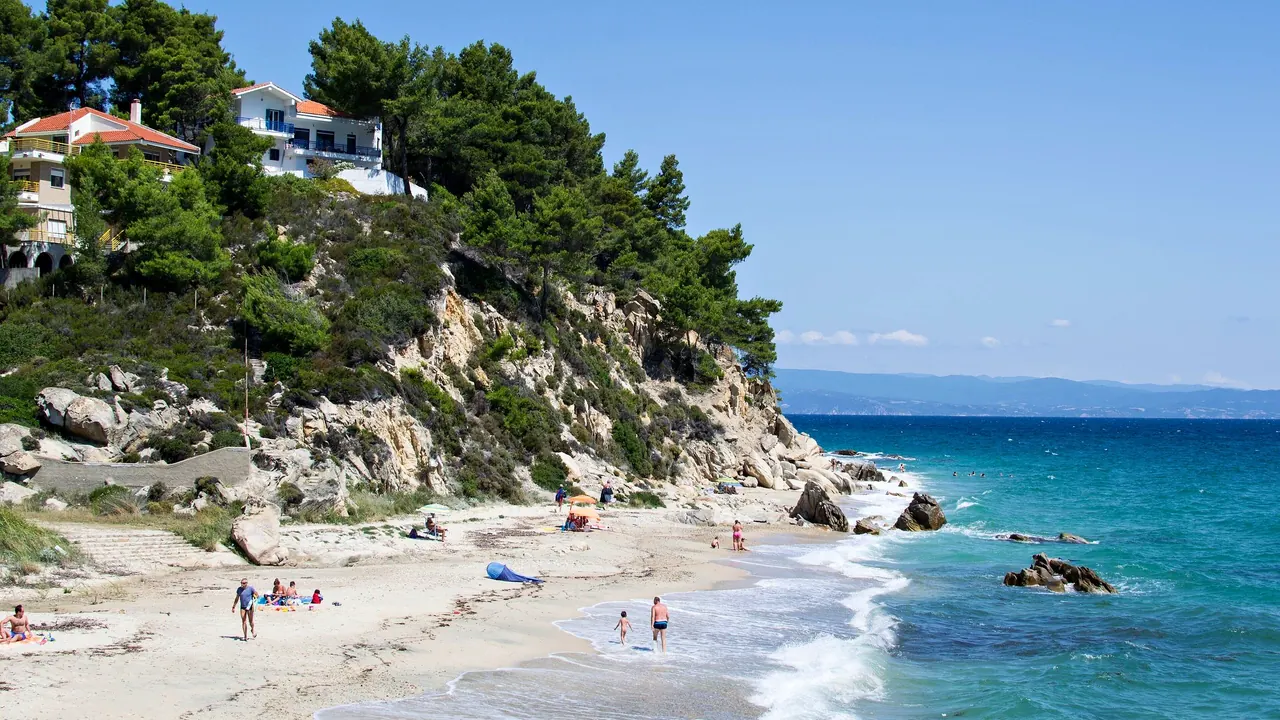
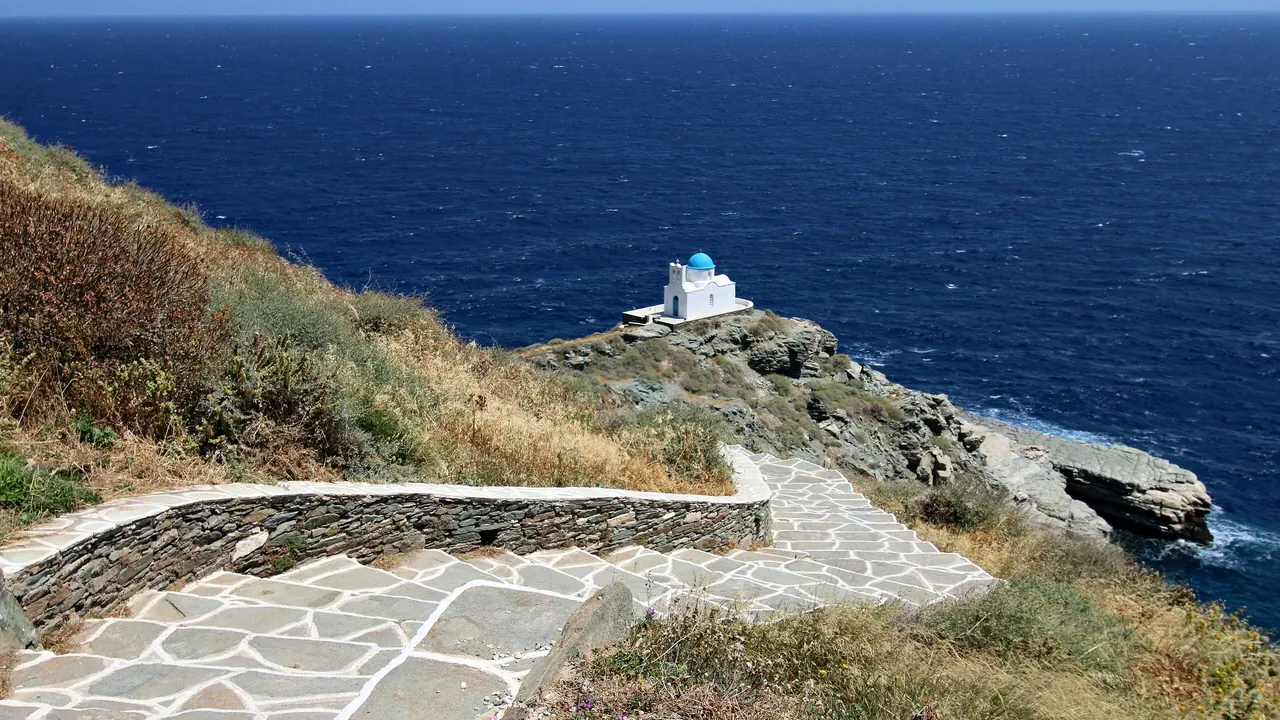
Photos: Halkidiki by Sprint28, CC BY-SA 3.0, cropped; Sifnos by Zde, CC BY-SA 4.0, cropped.
Halkidiki or Sifnos?
Our verdict in twelve categories, each scored against the same fixed benchmark cities, and the climate month by month, so you can choose for your trip.
Choose Halkidiki for
- prices
- nightlife
- families
Halkidiki suits a beach vacation with a car, especially with children or on a budget. Its three peninsulas offer far more shoreline, from the organised sand of Kassandra to the granite coves of Sithonia, as well as summer clubs, family resorts with pools and a cheaper stock of apartments and village rooms. Thessaloniki is close enough for a day of churches, shops and serious eating. The price of all that choice is driving, and the peninsulas make every crossing slow.
Choose Sifnos for
- shopping
- getting around
- food and drink
Sifnos is for the traveller who wants a small, slow island where dinner is the main event. Its clay-pot cooking is the best reason to come, the villages are joined by old stone paths, and buses or a short drive get you to the beach without long journeys. It costs more in summer, it is quiet at night and you can only reach it by ferry. For a couple happy to stay put, eat well and walk between white villages, it is the more distinctive of the two.
Scoreboard
Twelve categories on one fixed scale from 0 to 100. The shaded stretch is the gap between the two.
Your match
Pick a travel style or drag the sliders, and both match scores follow your weighting.
Wins on prices and nightlife with your weighting.
Wins on shopping and getting around with your weighting.
What matters to you?
Category by category
What the scores mean for a trip.
Beaches & swimming
Halkidiki is ahead because of its sheer scale and variety. Kassandra has long organised beaches with sunbeds and bars, and Sithonia has wilder granite coves at Kavourotrypes and Karydi. With pine forest running down to turquoise water on three peninsulas, you can always find another beach. The catch is the crowds that come out from Thessaloniki at weekends in high summer.
Sifnos has fewer beaches, and they are calmer. Platis Gialos is a broad curve of fine sand, and Vathi's almost enclosed bay stays flat when the meltemi blows. The island has no resort strips, but on a windy day you have to pick a sheltered bay.
Food & drink
Sifnos is the stronger place to eat, and food is a reason to choose it. Its slow clay-pot cooking, with chickpeas baked overnight on Sunday and lamb or goat stewed with wine and dill, is a tradition of its own. Eating at Cheronissos, where the fishing boats come in beside the tables, is part of the pleasure.
Halkidiki serves good standard seaside taverna food: grilled octopus, mussels and its own big green olives. It is at its best in fishing villages such as Nikiti and Toroni. Menus in the Kassandra resorts get repetitive, so the serious food lover drives into Thessaloniki.
Culture & sights
Neither is a sightseeing destination, and the two offer different kinds of heritage. Halkidiki's big sight is Mount Athos, which most visitors see from a cruise boat out of Ouranoupoli because only men with a permit may enter. Beyond that it has scattered half-days at Olynthos, ancient Stagira and the Petralona cave.
The culture on Sifnos is the island itself. The cliff-top fortified village of Kastro, the white lanes and dovecotes of Apollonia and Artemonas and the chapel of Chrysopigi on its rock are all close together, so you can take them in slowly over a few days on foot.
Nightlife
Halkidiki has a real summer nightlife, all of it on Kassandra. Kallithea has open-air clubs, and Pefkohori and Hanioti have bar strips that fill after midnight, kept lively by young Greeks driving in from Thessaloniki at weekends. Sithonia and the Athos side are as quiet as any island.
On Sifnos, the late night is a cocktail in Apollonia's narrow pedestrian lane after a long dinner. It gets lively in July and August, but there are no clubs, and outside peak season the island goes to bed early.
Nature & outdoors
Both have plenty of outdoors, but of a different kind. In Halkidiki most of it happens on the water: kayaking along the Sithonian coves, sailing out to Diaporos and its lagoon, and snorkelling over rocky seabeds. On land the best of it is the forested coast drives beneath Mount Itamos.
On Sifnos you go on foot. Waymarked mule tracks cross the terraced hillsides between villages, monasteries and bays, and a climb to Profitis Ilias at about 680m looks out over the western Cyclades. For walkers who are not men with an Athos permit, the island is the better choice.
Day trips
Being on the mainland gives Halkidiki the wider range of outings. Thessaloniki's Byzantine churches and waterfront are an easy day away, and with a longer drive you can reach the royal tombs at Vergina, Pella, Kavala or ancient Amphipolis. Closer to base there are the weaving village of Arnea and the short ferry to Ammouliani.
On Sifnos, day trips mean other islands and depend on the summer ferries. Milos is the best of them, with Serifos close by and Kimolos easy to add. When the wind rises or the season ends, the options shrink to the island itself.
Good for families
Halkidiki is better set up for children. Beaches like Psakoudia shelve so gently that toddlers can paddle far out, the sea is usually calm, and the Kassandra resorts are built around families, with pools and kids' clubs. You won't find theme parks in either place, but here the boat trips and the Petralona cave fill a spare day.
Sifnos is fine for a simple beach week, with sandy shallows at Platis Gialos and Kamares and short distances everywhere. Stepped village lanes are hard work with a pushchair, and there is very little laid on to entertain older children.
Getting around
Sifnos is easier once you have arrived. Apollonia is the obvious base, summer buses reach most beaches and villages, and footpaths join the rest. Getting there is the hard part: there is no airport, it takes a few hours on the ferry from Piraeus, and wind can cancel sailings.
In Halkidiki you will need a car. The airport is close, but each peninsula is a long finger, so crossing from Kassandra to the Athos side means driving back up one and down the next, and the Kassandra road is slow at summer weekends.
Shopping & style
Neither is a place to go shopping, though Sifnos gives you more to browse. In Halkidiki the resort strips of Kassandra and Neos Marmaras sell mostly beachwear, souvenirs and jewellery. The things worth packing are things to eat and drink: olive oil, pine and thyme honey and local wine. Ouranoupoli adds icons and incense from the Athos trade, and for anything more you drive to Thessaloniki.
On Sifnos, pottery is the best of a short list. The island has worked clay for centuries, and workshops near Kamares and Vathi still make the casseroles its kitchens cook in, so a pot to take home goes with the meals you ate. With a few boutiques in Apollonia and jars of capers and almond sweets, it fills a pleasant hour rather than a day.
Affordability
Halkidiki is the cheaper of the two, and the difference shows most in the cost of a room. Its prices only start to match Sifnos at the large Kassandra resort hotels in high summer, when a beachfront room and sunbeds on an organised beach add up. Away from those, an ordinary stay and a taverna dinner are fair value. The extra cost to plan for is the car, which you will need for every outing between peninsulas.
On Sifnos the room takes up most of the budget, because the island's accommodation in July and August is aimed at the top of the market. After that, the days cost little: a bus to the beach, a walk between villages, and taverna meals that cost more than on the mainland but are good enough to justify it. If you go early or late in the summer, the room costs less and the swimming is just as good.
Live music & performing arts
Neither has much of a stage life, and what each has is different. Halkidiki's is organised: the Kassandra Festival puts on concerts and theatre in the open-air amphitheatre at Siviri, and the Sani Festival brings jazz and classical evenings, both in July and August.
Sifnos has the panigyri, a saint's-day feast at a chapel or monastery, where violin and lute music and circle dancing can go on until morning. It is less a show than something you join in.
Wellness & relaxation
Both are places to slow down, and Halkidiki has a little more in the way of treatments. There are warm mineral pools above the sea at the thermal springs of Agia Paraskevi, and the large resorts run proper spas, though Kassandra gets noisy in high summer.
On Sifnos, the rest comes from the island's rhythm rather than a spa. You get car-free lanes, long lunches and an evening stroll from Apollonia to Artemonas, and the island is at its most peaceful in June and September.
When should you go?
Pick your month. The climate figures are measured averages, not a forecast.
Halkidiki in July
Sifnos in July
Daytime high, °C
Rainfall in the month, mm
Where the figures come from
Halkidiki's temperatures are measured 64 km from the centre, at Thessaloniki Airport.
Halkidiki has no rain gauge within 25 km of the centre, so its rainfall comes from a gridded climate dataset read at the destination rather than from a gauge further away.
Sifnos has no weather station within reach, so its figures come from a gridded climate model rather than a measured record, and read a broad area rather than one spot.
Temperature and rainfall are climate normals, averaged over the years shown. Halkidiki: 1991-2020 normals, Thessaloniki Airport (63.7 km from centre). Sifnos: 2001-2020 normals, NASA POWER reanalysis grid, no weather station within 90 km.
Both are summer places, but Halkidiki runs hotter and has the warmer sea. On its peninsulas, afternoons reach 32°C in July and August and the sea climbs to around 26°C, so swimming is at its best from late June to September. Those midsummer afternoons are too hot for long walks or village sightseeing, and May and early October are more comfortable for that. Rain comes back in October and stays all winter, when the resorts close and it turns cold.
Sifnos stays milder through the summer, peaking around 27°C. It is almost completely dry from June to August, but the meltemi makes some beaches choppy. Its sea is a touch cooler, but it stays at swimming temperature into October, which makes September a very good month there. Winter on Sifnos is mild but wet, with over 100mm of rain in December, so the island really belongs to May through October.
Which traveller are you?
On a family trip with young children, Halkidiki is the easier choice. Its sandy beaches on Kassandra and around Gerakini stay shallow a long way out, and the big resorts have pools and children's clubs. You also avoid Sifnos's steep stepped lanes and the ferry crossing.
For a trip on a tight budget, Halkidiki stretches money further. Greek and Balkan families driving in keep plenty of simple apartments and village tavernas in business. Sifnos leans towards boutique hotels and rented houses that fill up early and cost more in high summer.
For a food and nightlife trip, the answer depends on which half matters more. If you want to eat well, Sifnos wins with its revithia, mastelo and manoura cheese. If you want to dance until late, go to Halkidiki for the open-air clubs at Kallithea and the bar strips of Kassandra.
Before you go
| Measure | Halkidiki | Sifnos |
|---|---|---|
| Official language | Greek | Greek |
| Currency | Euro (EUR) | Euro (EUR) |
| Sockets | CF230 V, 50 Hz | CF230 V, 50 Hz |
| Driving side | Right | Right |
| Time zone | UTC+2, UTC+3 in summer | UTC+2, UTC+3 in summer |
| Emergency number | 112 | 112 |
| Main airport | Thessaloniki Macedonia International Airport (SKG)93 non-stop destinations | Milos Airport (MLO)2 non-stop destinations |
| Public holidays this year | 15 days | 15 days |
By the numbers
| Measure | Halkidiki | Sifnos |
|---|---|---|
| Population | 110,587 | - |
| People per km² | 38 | - |
| Swim season, months above 21 °C | 5 months | 5 months |
Where else could you go?
Every comparison below shares a destination with this one, so you can follow Halkidiki or Sifnos somewhere new.