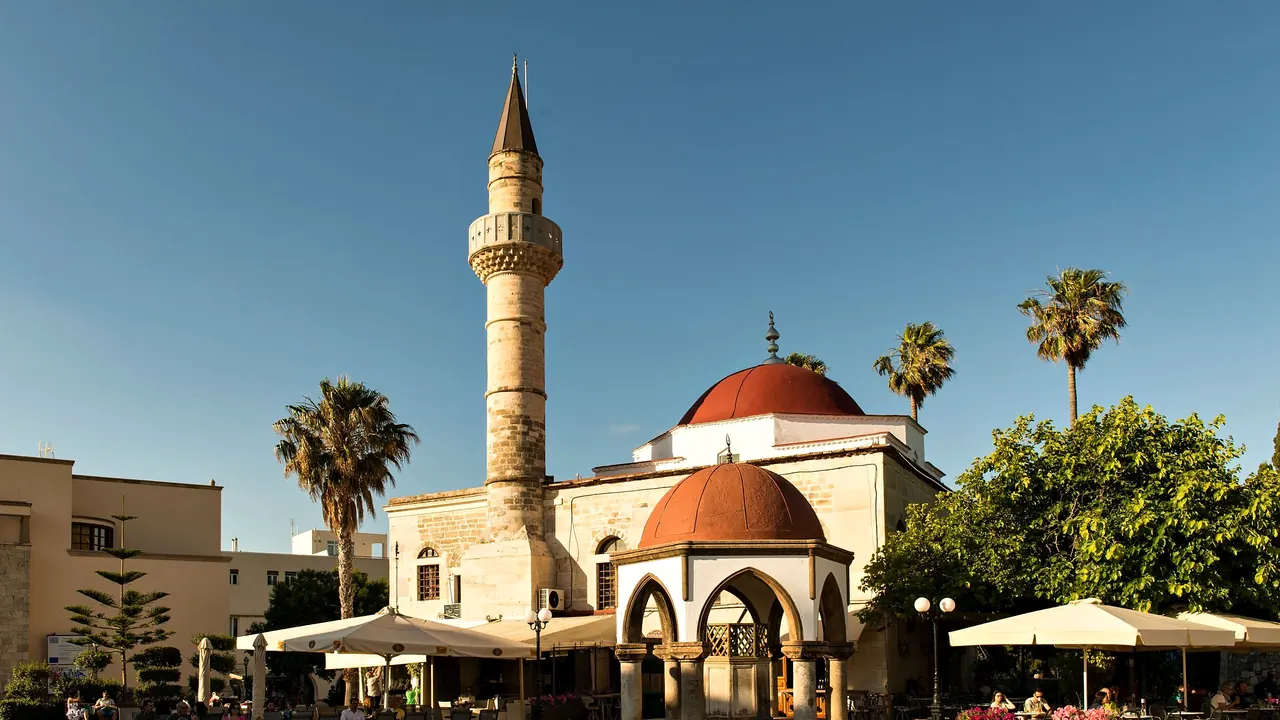
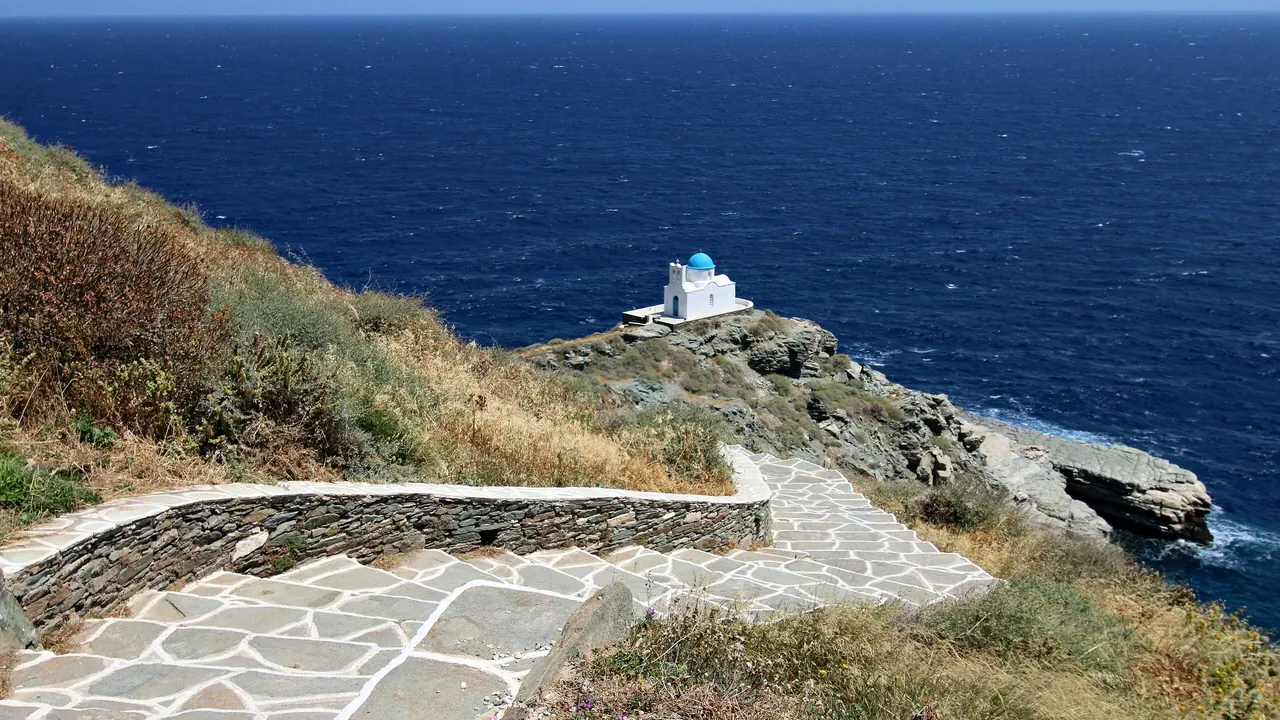
Photos: Kos by Wolfgang Weiser, Pexels License; Sifnos by Zde, CC BY-SA 4.0, cropped.
Kos or Sifnos?
Our verdict in twelve categories, each scored against the same fixed benchmark cities, and the climate month by month, so you can choose for your trip.
Choose Kos for
- nightlife
- prices
- families
Kos suits a sun-and-sand vacation with plenty laid on. It has long sandy beaches, resort pools and kids' clubs, a water park, Roman ruins in Kos Town and the Asklepieion on the hill above it, and an easy boat across to Bodrum. Nights can be as loud as you like in the old-quarter lanes or Kardamena. It costs less than Sifnos, and the airport makes it simple to reach. It is the better pick for families, groups of friends and anyone watching the budget.
Choose Sifnos for
- food and drink
- nature and the outdoors
- shopping
Sifnos is quieter and more expensive, and its charm is in small things done well. You eat chickpeas slow-baked in clay pots, walk old mule tracks between white villages and chapels, and swim in calm bays like Vathi. There is no airport, the nightlife stops at cocktail bars and there is little laid on for children. Couples and walkers who care more about a long lunch than a late night will find it repays the ferry crossing.
Scoreboard
Twelve categories on one fixed scale from 0 to 100. The shaded stretch is the gap between the two.
Your match
Pick a travel style or drag the sliders, and both match scores follow your weighting.
Wins on nightlife and prices with your weighting.
Wins on food and drink and nature and the outdoors with your weighting.
What matters to you?
Category by category
What the scores mean for a trip.
Beaches & swimming
Both are sandy summer islands with clear water from June to October, and the beaches are a close match. What differs is their shape. Kos has long, open strands along the north coast from Tigaki to Mastichari, with room to spread out but exposed to the meltemi. Its prettiest bays are far off on the Kefalos peninsula.
Sifnos is a string of bays rather than strands: the broad sweep of Platis Gialos, almost-enclosed Vathi, which stays calm when the wind is up, and small coves around Faros and Chrysopigi. It has no large resort strips, so the beaches feel lower-key than the organised stretches on Kos.
Food & drink
Sifnos is the island to choose for food. Eating is a reason to go in itself: revithia baked overnight in clay pots, mastelo lamb with dill and wine, manoura cheese, and fish landed beside the tables at Cheronissos. Artemonas adds old bakeries and almond sweets.
Kos feeds you well enough on grilled octopus, pitaroudia and wine-aged krasotyri, but you have to look for it in Zia, Pyli or the back streets of Kos Town. In the big resorts much of the food is multilingual menus and all-inclusive buffets.
Culture & sights
Kos has more to show. Kos Town is threaded with Roman and Hellenistic ruins, from the Agora and the Odeon to the mosaics of the western excavations. Add the Knights' castle at the harbour and the terraced Asklepieion above town, and you have a few full days of serious sightseeing.
Sifnos offers atmosphere rather than monuments. The cliff-top medieval village of Kastro, the dovecotes and windmills of Apollonia and Artemonas, a Mycenaean acropolis and scattered watchtowers reward slow wandering, but there is no site to match the Asklepieion.
Nightlife
Kos is clearly the island for going out. The old-quarter lanes of Kos Town stay loud until the small hours, Lambi has beach clubs, and Kardamena is a full-blown party resort with late clubs and a young crowd.
On Sifnos the evening is mostly dinner. Afterwards there are small cocktail and music bars along Apollonia's pedestrian lane in July and August, plus sunset drinks at Kamares. There are no clubs, and outside high summer the island is quiet soon after dinner.
Nature & outdoors
Sifnos is the better island to explore on foot. Old stone-paved mule tracks cross almost the whole island, linking terraced hillsides of thyme and olive groves to monasteries and bays, and Profitis Ilias gives wide views of the western Cyclades. Snorkelling in the rocky coves adds to it.
Kos is flatter and drier. Its outdoor appeal is more varied but scattered: pine-wood trails up the Dikeos range to Mount Christos, peacocks in the Plaka forest, flamingos on the Alikes salt lake in the cooler months, and steady wind for windsurfing at Marmari and Tigaki.
Day trips
Kos has more choice of outings. The short ferry to Bodrum adds a crusader castle and a Turkish bazaar (bring a passport), and the boat to Nisyros lets you walk down into a volcanic crater. Kalymnos and little Pserimos are easy hops too.
From Sifnos the trips are island-hopping on the summer ferries. Milos is the best of them, and Serifos is close by, but beyond those the list runs out quickly, and wind can cancel crossings.
Good for families
Kos is far better set up for children. Gently shelving beaches at Tigaki and Marmari, resorts with pools and kids' clubs, a large water park and flat paths for family cycling make the days easy to fill. You only need to avoid Kardamena at night.
Sifnos suits families who want nothing more than sand and a taverna. Platis Gialos and Vathi are shallow and safe, but there are no attractions for children, and the stepped village lanes are hard work with a pushchair.
Getting around
Kos is simpler at both ends of the trip. It has its own airport, the flat main town is easy on foot or by bike, and buses run along the main road to the big resorts. A hired car covers the hill villages and Paradise Beach.
On Sifnos, the hard part is arriving: a ferry of a few hours from Piraeus that strong winds can delay. Once you are there, everything is close to Apollonia. Summer buses and footpaths link the villages, though roads are narrow and parking tight.
Shopping & style
Neither island is a shopping destination, but Sifnos has the more distinctive buys. Its potters' workshops around Kamares and Vathi still make the clay casseroles used in local kitchens, and Apollonia has a few boutiques and shops selling capers and honey.
On Kos, the old-quarter lanes are mostly souvenirs, leather and sandals. The Italian-era market hall on Eleftherias Square, with its herbs and spices, is the best stop.
Affordability
Kos is the cheaper island by a clear margin. Package and all-inclusive travel means plenty of mid-range rooms in Kardamena, Tigaki and Marmari, and buses, bike hire and site entry cost little.
Sifnos is upmarket in summer, with boutique hotels and stylish rented houses that book out early for July and August. Tavernas are dearer than on the mainland, though fair for the quality. June and September bring lower room prices without giving up the sea.
Live music & performing arts
Neither island has any year-round stage life, and both rely on summer. On Kos the highlight is the Hippokrateia festival, which puts concerts, theatre and dance on stages like the Asklepieion, the Roman Odeon and the castle. Greek-night shows in the resorts fill the gaps.
Sifnos has the panigyri instead: a saint's-day feast at a chapel or monastery, where a shared meal turns into violin and lute music and circle dancing that can go on all night, with visitors welcome to join.
Wellness & relaxation
The two are evenly matched, but the way you unwind differs. Kos has Therma, where a hot sulphur spring runs onto a pebble beach and bathers build stone pools that mix it with the sea. It also has plenty of resort spas at the larger beach hotels.
Sifnos has no springs and only a few spa rooms in boutique hotels. Its calm comes from car-free lanes, long lunches and evening walks between Apollonia and Artemonas, and the island is at its most peaceful in June and September.
When should you go?
Pick your month. The climate figures are measured averages, not a forecast.
Kos in July
Sifnos in July
Daytime high, °C
Rainfall in the month, mm
Where the figures come from
Kos has no rain gauge within 25 km of the centre, so its rainfall comes from a gridded climate dataset read at the destination rather than from a gauge further away.
Sifnos has no weather station within reach, so its figures come from a gridded climate model rather than a measured record, and read a broad area rather than one spot.
Temperature and rainfall are climate normals, averaged over the years shown. Kos: 1993-2020 (rainfall 1991-2020) normals, Kos Airport (23.2 km from centre). Sifnos: 2001-2020 normals, NASA POWER reanalysis grid, no weather station within 90 km.
The two share the same swimming season, June to October, with the sea at its warmest in August and only a degree apart. The difference is the heat on land. Kos reaches about 31°C in July and August, hot enough that the middle of the day is best spent at the beach or by the pool. Sifnos stays near 27°C, which makes village walks easier in high summer. Both are almost dry from June to August.
In spring and autumn Sifnos is cooler, so April, May and October are its walking months. On Kos those same months are warmer, which makes late May and late September pleasant for ruins and cycling. Winter is much wetter on Kos, with around 170mm in January against roughly 106mm on Sifnos. Neither island is a winter beach destination.
Which traveller are you?
On a family trip with young children, Kos is the easier choice. The north-coast beaches are shallow, resorts come with pools and kids' clubs, and there is a water park near Marmari. The flat cycle paths are a bonus. Sifnos has calm sand too, but steep stepped villages and nothing built for children.
For a trip on a tight budget, Kos goes further. It is built for package travel, so there are plenty of mid-range apartments in Tigaki and Marmari, and buses and bike hire are cheap. Sifnos is boutique-priced in summer, and rooms in July and August are expensive and book out early.
On an outdoors trip built around walking, Sifnos is the island. Waymarked stone mule tracks link villages, monasteries and bays, and Profitis Ilias looks out over the western Cyclades. Kos has fine trails up Mount Christos and good windsurfing at Marmari, but its landscape is mostly low farmland and scrub.
Before you go
| Measure | Kos | Sifnos |
|---|---|---|
| Official language | Greek | Greek |
| Currency | Euro (EUR) | Euro (EUR) |
| Sockets | CF230 V, 50 Hz | CF230 V, 50 Hz |
| Driving side | Right | Right |
| Time zone | UTC+2, UTC+3 in summer | UTC+2, UTC+3 in summer |
| Emergency number | 112 | 112 |
| Main airport | Kos International Airport "Ippokratis" (KGS)75 non-stop destinations | Milos Airport (MLO)2 non-stop destinations |
| Public holidays this year | 15 days | 15 days |
By the numbers
| Measure | Kos | Sifnos |
|---|---|---|
| Population | 33,387 | - |
| People per km² | 115 | - |
| Swim season, months above 21 °C | 5 months | 5 months |
Where else could you go?
Every comparison below shares a destination with this one, so you can follow Kos or Sifnos somewhere new.