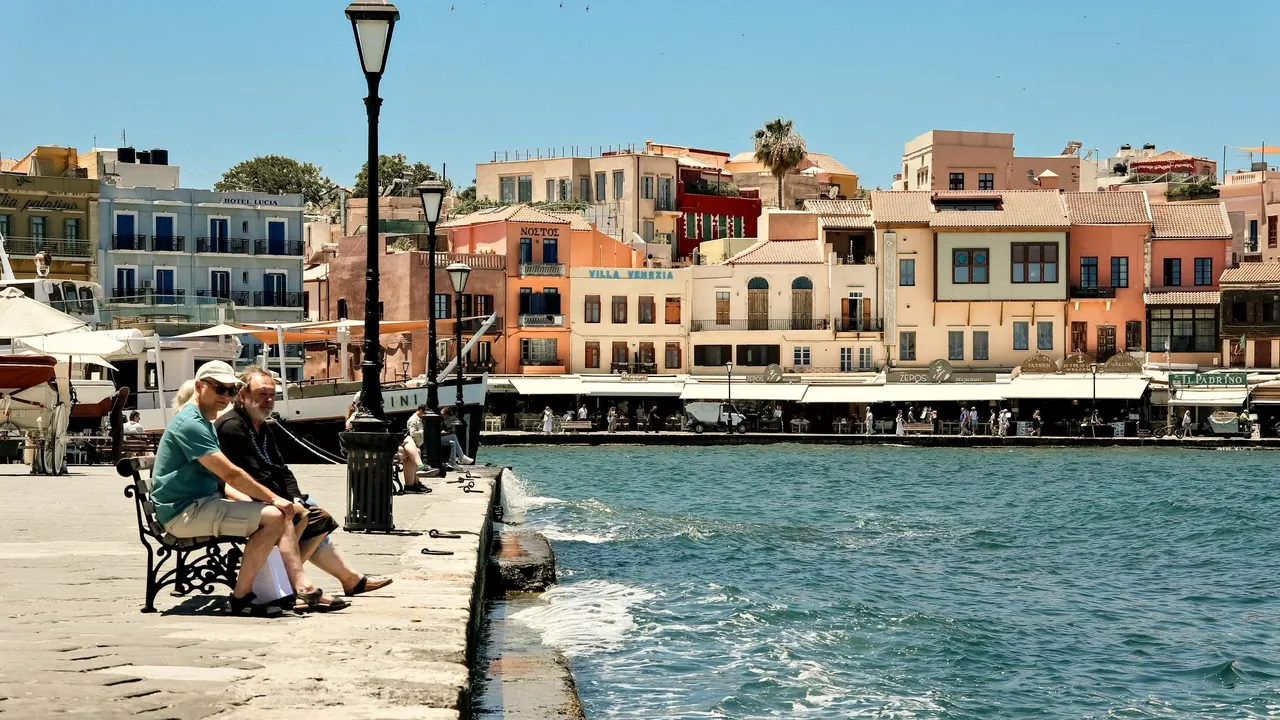
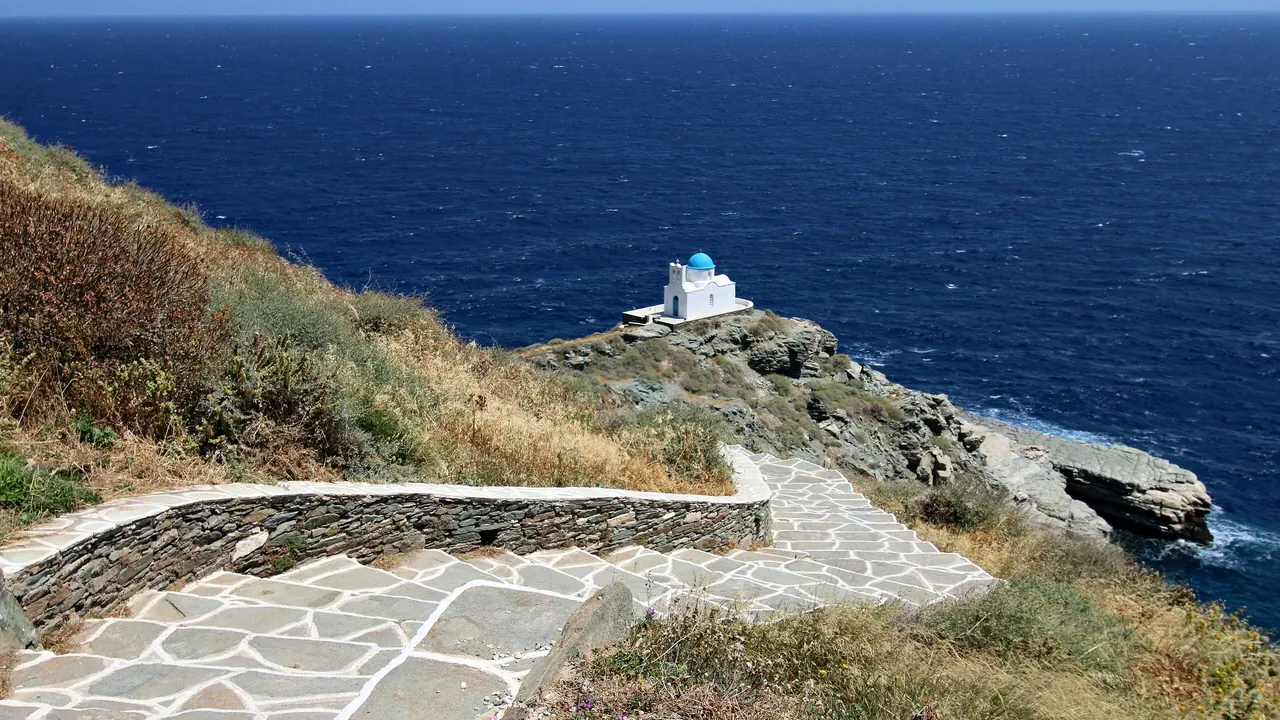
Photos: Crete by Piotr Baranowski, Pexels License; Sifnos by Zde, CC BY-SA 4.0, cropped.
Crete or Sifnos?
Our verdict in twelve categories, each scored against the same fixed benchmark cities, and the climate month by month, so you can choose for your trip.
Choose Crete for
- culture and sights
- nightlife
- nature and the outdoors
Crete suits the traveller who wants a whole country's worth of variety in one trip. It has Minoan palaces and the Heraklion museum, Venetian harbour towns, high mountains cut by gorges, and beaches from Elafonissi's lagoons to the long resort sands of the north coast. It also costs less than Sifnos, has more for children and more to do after dark. The price is distance: you will need a car and some long drives on mountain roads.
Choose Sifnos for
- getting around
Sifnos is for the visitor who would rather settle in one small place and slow down. The beaches are fewer but calm and low-key, the clay-pot cooking is worth the trip on its own, and old mule tracks link white villages that are a short hop apart. It is pricier in summer and has no airport, so you arrive by ferry. In return you get an island you can know well within a week, with none of the resort strips Crete has.
Scoreboard
Twelve categories on one fixed scale from 0 to 100. The shaded stretch is the gap between the two.
Your match
Pick a travel style or drag the sliders, and both match scores follow your weighting.
Wins on culture and sights and nightlife with your weighting.
Wins on getting around with your weighting.
What matters to you?
Category by category
What the scores mean for a trip.
Beaches & swimming
Crete has more beaches and a wider range of them. In the west there are the pink sands of Elafonissi, the turquoise bay at Balos and the open stretch of Falassarna, in the east the palm-fringed bay at Vai, and on the south coast pebble coves on the Libyan Sea reached by boat. The north coast adds long, easy resort beaches. The well-known western beaches do get crowded at midday in summer.
Sifnos has a shorter list, all close together: the fine-sand curve of Platis Gialos, the sheltered bay at Vathi and the sandy port beach at Kamares. The beaches stay low-key, and when the meltemi wind blows there is usually a calm bay within a few minutes' drive.
Food & drink
Crete's cooking covers more ground. It includes mountain cheeses, wild greens, snails, slow-cooked lamb, dakos and a real wine country south of Heraklion. The best meals are in village tavernas and the old-town backstreets of Chania and Rethymno, and the main weak spot is the menus on the north-coast resort strips.
Sifnos is smaller, but food is a real reason to go. The island is known for its clay-pot cooking, with chickpeas baked overnight in a wood oven and mastelo lamb with wine and dill, as well as manoura cheese aged in wine lees. Fish comes straight off the boats at Cheronissos. You get a narrower range, cooked with great care.
Culture & sights
On culture the two are far apart. Crete has Knossos, the frescoes and the Phaistos Disc in the Heraklion museum, the palaces at Phaistos and Malia, and Roman Gortyn. On top of that come the Venetian harbour at Chania, the Ottoman balconies of Rethymno, Spinalonga and Arkadi. You could fill a long trip with history alone, though seeing it all means driving across the island.
Sifnos is about villages rather than monuments. There is the cliff-top Kastro, with houses that double as its walls, the white lanes and dovecotes of Apollonia and Artemonas, the monastery of Chrysopigi, and old watchtowers from the island's mining past. It rewards slow wandering more than a list of sights.
Nightlife
Crete has nightlife in two forms. Malia and Hersonissos are loud party resorts for young groups, while the harbour bars of Chania, the Rethymno waterfront and Heraklion's café-bar quarter offer later, more grown-up evenings among Greek students and locals.
Sifnos has one lane of small bars in Apollonia, which stays busy into the early hours only in July and August, and a few sunset bars at Kamares. It has no clubs at all, and outside the peak weeks the island goes quiet soon after dinner.
Nature & outdoors
Crete's interior is serious mountain country. Two ranges rise above 2,400m and keep snow into spring, and gorges such as Samaria, Imbros and Aradena cut down towards the Libyan Sea. Griffon vultures circle the cliffs, the wild kri-kri goat survives in the western mountains, and the coast path between Loutro and Agia Roumeli is one of the best walks on the island.
Sifnos offers gentler walking, and that is part of its appeal. Waymarked stone mule tracks cross terraced hills of thyme, stone walls and olive groves, and Profitis Ilias, the highest point, rises only to about 680m. You can cross much of the island on foot, but it has no high peaks or deep gorges like Crete's.
Day trips
From Crete the day trips are mostly on the island itself. You can visit the other old towns, the wine villages around Peza and Archanes, the pottery village of Margarites or Anogia in the mountains, and take boats to Chrissi and Gramvousa. A fast ferry from Heraklion makes Santorini a long but possible day out.
From Sifnos every outing means a boat to another island. Milos is the best of them, and Serifos and Kimolos are close. These trips depend on summer ferries and calm weather, so many visitors simply stay put.
Good for families
Crete is better set up for children. It has gently shelving sandy beaches on the north coast and around Chania, resort hotels with kids' clubs, waterparks, and the big aquarium at Gournes for a hot afternoon. Elafonissi's shallow lagoon is ideal for toddlers. The downsides are midsummer heat and long drives on winding roads.
Sifnos keeps family days simple. The shallow sandy beaches at Platis Gialos, Kamares and Vathi are a short drive away, but there are no attractions built for children. The villages are steep and stepped, which makes a pushchair hard work.
Getting around
Sifnos is easier to get around once you have arrived. It is small, Apollonia makes a central base, summer buses reach the main beaches and villages, and footpaths link the rest. The hard part is getting there: there is no airport, and the ferry from Piraeus takes a few hours and can be held up by wind.
Crete is easier to reach but harder to cover. A car is close to essential, the roads to the south coast are steep and slow, and the main north-coast highway is fast but demanding to drive. Buses serve the line of northern towns well, but not much beyond it.
Shopping & style
Neither island is a place for fashion shopping, and both are about crafts. Crete has more of them: Chania's leather-makers' lane, knife-makers and covered market, Heraklion's market street for cheese, herbs and raki, and ceramics from Margarites. Sifnos has a narrower but long-established pottery trade, with workshops around Kamares and Vathi still making the clay casseroles used in the island's kitchens.
Affordability
Crete is noticeably cheaper. Village tavernas and family-run rooms are good value, and prices only climb around the famous western beaches, Chania's old town and the luxury resorts of Elounda. Car hire is the cost most visitors can't avoid.
Sifnos is upmarket in summer. Most rooms are in boutique hotels and stylish rented houses that book up early, and taverna meals cost more than on the mainland. Going in June or September brings room prices down while the sea stays the same.
Live music & performing arts
On both islands the live music is traditional rather than staged. Crete has more of it: lyra players in the music tavernas of Rethymno and Chania, famous musicians from Anogia, village festivals, and summer festival programmes in the fortresses of Heraklion and Chania.
Sifnos has the panigyri, a saint's-day feast at a chapel with violin, lute and circle dancing into the night, which visitors are welcome to join. Apart from that and the odd village concert, there is almost nothing in the way of theatre or concerts.
Wellness & relaxation
Neither island has a bathing tradition, and on both the restful part is the pace of life. Crete offers serious resort spas around Elounda and the Gulf of Mirabello, plus quiet corners such as boat-only Loutro. Sifnos has only a few hotel spas, but the whole island moves slowly, with car-free lanes, the evening walk from Apollonia to Artemonas, and bays where the day needs no plan.
When should you go?
Pick your month. The climate figures are measured averages, not a forecast.
Crete in July
Sifnos in July
Daytime high, °C
Rainfall in the month, mm
Where the figures come from
Sifnos has no weather station within reach, so its figures come from a gridded climate model rather than a measured record, and read a broad area rather than one spot.
Temperature and rainfall are climate normals, averaged over the years shown. Crete: 1991-2020 normals, Heraklion Airport (3.6 km from centre). Sifnos: 2001-2020 normals, NASA POWER reanalysis grid, no weather station within 90 km.
Both islands follow the same Aegean pattern: a dry, sunny summer, then rain from October that peaks in December and January. Crete runs a little warmer through the year. Its summer highs reach about 29°C, which makes midday sightseeing at Knossos or a gorge walk hard work in July and August, and the sea there warms to about 25°C. Sifnos stays a couple of degrees cooler and often windier at the peak, with the sea a degree or so lower. On both, the water is warm enough for swimming from June to October.
Spring comes earlier on Crete. April is already pleasant for walking there, while Sifnos is still cool, and Crete's long sunny days stretch from May well into September. For walking and sightseeing, May, early June, late September and October are the best months on either island. From November to February rain is frequent, with Sifnos the wetter of the two at around 107mm in December, so neither makes a good winter beach destination.
Which traveller are you?
On a culture and arts trip, Crete is the clear choice. Knossos, Phaistos and the Heraklion Archaeological Museum hold Europe's oldest great civilisation, and Chania and Rethymno add Venetian and Ottoman townscapes. Sifnos offers chapels and a fortified village, and little else.
For an outdoors trip, Crete has real mountains. The White Mountains and Psiloritis rise above 2,400m, and the Samaria gorge, the E4 path and the climbing at Agiofarago go far beyond Sifnos's gentle, terraced mule tracks, which are pleasant but modest by comparison.
On a relaxing trip, Sifnos has the edge. It is small, nothing is more than a short drive away, the village lanes are car-free and there are no resort strips. On Crete the same calm is found only in remote corners such as Loutro.
Before you go
| Measure | Crete | Sifnos |
|---|---|---|
| Official language | Greek | Greek |
| Currency | Euro (EUR) | Euro (EUR) |
| Sockets | CF230 V, 50 Hz | CF230 V, 50 Hz |
| Driving side | Right | Right |
| Time zone | UTC+2, UTC+3 in summer | UTC+2, UTC+3 in summer |
| Emergency number | 112 | 112 |
| Main airport | Heraklion International Nikos Kazantzakis Airport (HER)129 non-stop destinations | Milos Airport (MLO)2 non-stop destinations |
| Public holidays this year | 15 days | 15 days |
By the numbers
| Measure | Crete | Sifnos |
|---|---|---|
| Population | 623,065 | - |
| People per km² | 75 | - |
| Swim season, months above 21 °C | 5 months | 5 months |
Where else could you go?
Every comparison below shares a destination with this one, so you can follow Crete or Sifnos somewhere new.