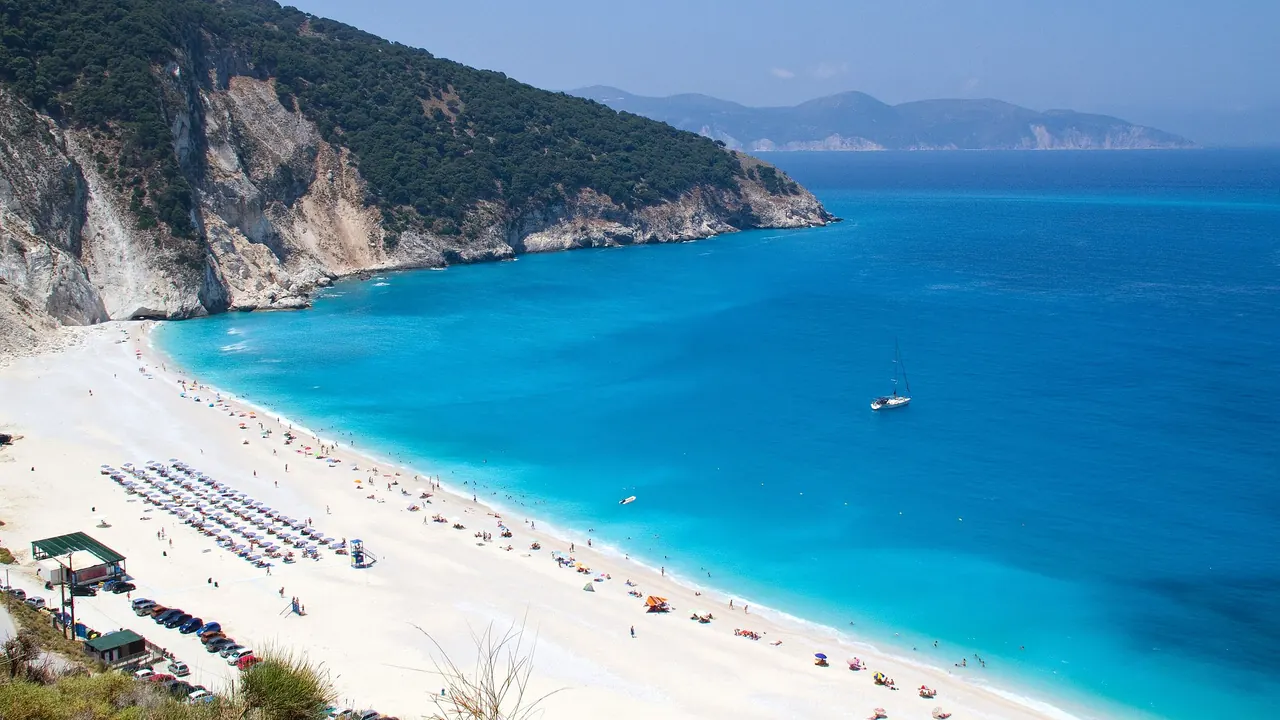
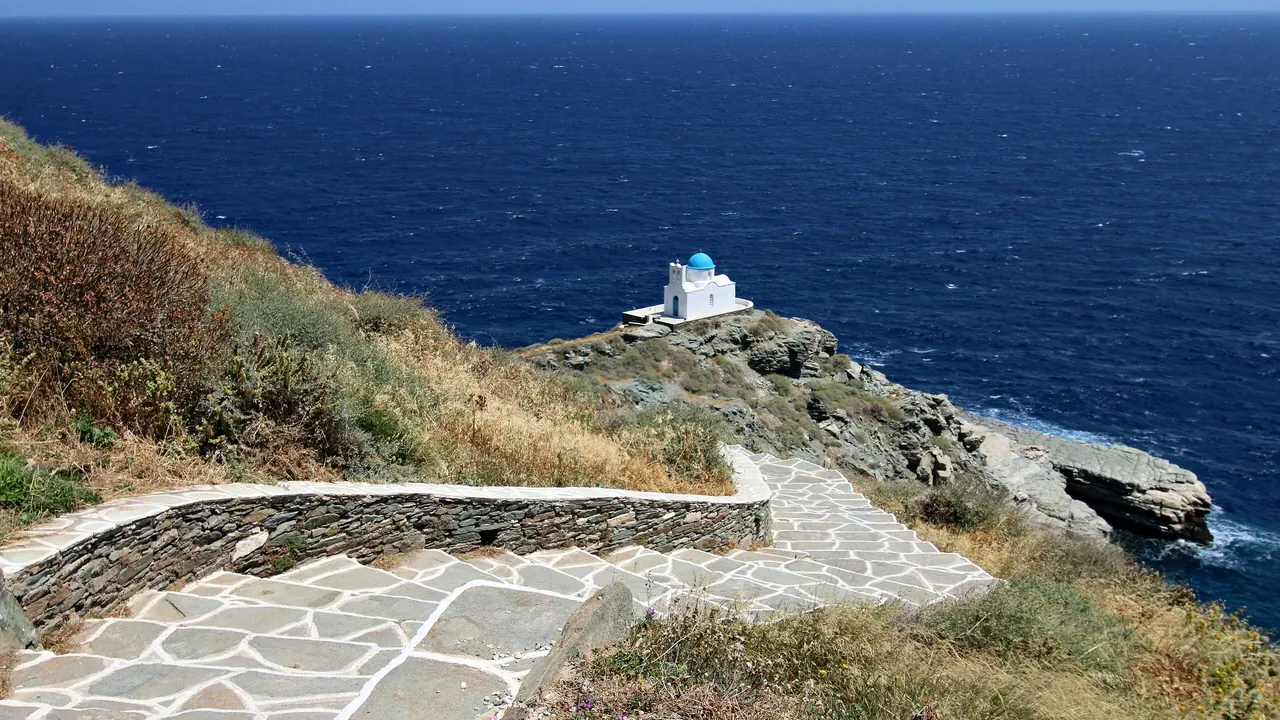
Photos: Kefalonia by Tony Hisgett from Birmingham, UK, CC BY 2.0, cropped; Sifnos by Zde, CC BY-SA 4.0, cropped.
Kefalonia or Sifnos?
Our verdict in twelve categories, each scored against the same fixed benchmark cities, and the climate month by month, so you can choose for your trip.
Choose Kefalonia for
- nature and the outdoors
- prices
- beaches
Kefalonia suits travellers who want a large, green island to explore by car. Its beaches are the more varied and dramatic, from the cliff-backed pebbles of Myrtos to the long sands of the south. Mount Ainos, the Melissani cave and the turtles of Argostoli harbour give it more outdoors than Sifnos has. Rooms and meals cost less too. In return you get plain postwar towns and a lot of winding driving.
Choose Sifnos for
- getting around
- shopping
- culture and sights
Sifnos is the better pick if you would rather stay put, eat very well and walk. It is small enough that beaches, villages and footpaths are all close by, and it has kept its white Cycladic villages and the clifftop Kastro, which Kefalonia lost in the earthquake. The clay-pot cooking is a reason to come in itself. Expect higher prices and a ferry crossing that the wind can disrupt.
Scoreboard
Twelve categories on one fixed scale from 0 to 100. The shaded stretch is the gap between the two.
Your match
Pick a travel style or drag the sliders, and both match scores follow your weighting.
Too close to call, 1 point apart
Wins on nature and the outdoors and prices with your weighting.
Wins on getting around and shopping with your weighting.
What matters to you?
Category by category
What the scores mean for a trip.
Beaches & swimming
Both islands are built around swimming, but Kefalonia has the wider range and the bigger scenery. There is the white pebble crescent of Myrtos under its cliffs, turquoise Petani on the Paliki peninsula, the reddish sand of Xi and long sandy stretches at Skala and Lourdas. The catch is that the best beaches lie on different coasts, so beach days often start with a drive.
Sifnos has fewer and gentler beaches, all close together: fine sand at Platis Gialos, the almost enclosed bay of Vathi and the easy port beach at Kamares. In July and August the meltemi can roughen the exposed bays, so on Sifnos you often pick the day's beach by the wind.
Food & drink
Sifnos has the edge, and food is a real reason to choose it. The island has a tradition of clay-pot cooking, with chickpeas baked overnight in a wood oven and lamb or goat slow-cooked with wine and dill. Add wine-aged manoura cheese and fish landed at Cheronissos next to the tables.
Kefalonia has its own dishes too, including the spiced meat pie and aliada garlic sauce with salt cod. It also has one thing Sifnos lacks, the Robola wineries of the Omala valley, which welcome visitors for tastings. Away from Argostoli, though, its menus tend to repeat from one place to the next.
Culture & sights
Sifnos has the more rewarding sights because its villages survived intact. Kastro is a fortified medieval village on a cliff, and Apollonia and Artemonas are classic white villages with dovecotes and windmills. Chrysopigi monastery sits on its rocky islet.
The 1953 earthquake left Kefalonia with mostly rebuilt postwar towns. The exceptions are the Venetian-era harbour at Fiskardo and the castle ruins at Assos and Agios Georgios. Both islands go back to Mycenaean times, with the tholos tomb at Tzanata on one and the acropolis of Agios Andreas on the other, but on Kefalonia sightseeing fills an occasional afternoon rather than the trip.
Nightlife
Neither island has proper clubs, and on both the evening is mostly a long dinner. Sifnos keeps going later in high summer, when the small music and cocktail bars along Apollonia's narrow pedestrian lane stay busy into the early hours.
Kefalonia's evenings are more spread out. There is the late crowd on Argostoli's main square and Lithostroto, a strip of beach bars at Lassi, and harbour bars at Skala and Fiskardo. Most of it goes quiet early outside July and August.
Nature & outdoors
Kefalonia is much greener and higher. Mount Ainos is a national park of dark Greek fir with semi-wild horses and views to Ithaca and Zakynthos. Below ground are the lake cave of Melissani and the stalactites of Drogarati, and loggerhead turtles feed in Argostoli harbour. Kayaking and sailing to Ithaca add time on the water.
Sifnos is dry, terraced hillside of thyme and stone walls, and its strength is walking. Waymarked mule tracks link villages, monasteries and bays, so you can cross much of the island on foot, which Kefalonia's size and roads don't allow.
Day trips
The two are about even, and on both the outings are by boat and mostly seasonal. From Kefalonia, Ithaca is the obvious crossing, a short ferry from Sami. Summer boats also reach northern Zakynthos and Lefkada, and the island is big enough that Fiskardo, Assos and Paliki make day trips in their own right.
From Sifnos, Milos is the best day out, with Serifos close by and quiet Kimolos within reach. Because Sifnos itself is so small, all its day trips mean a ferry, and strong wind can cancel them.
Good for families
Neither island has anything built for children, and both suit a simple beach vacation. Kefalonia has a little more to do, with the boat ride through Melissani and turtle spotting, plus shallow sand at Skala, Lourdas and Xi. Those outings mean long, winding drives in the heat.
On Sifnos the shallow beaches at Platis Gialos, Kamares and Vathi are all a short ride away. The steep, stepped villages are hard with a pushchair, and the ferry over can be rough.
Getting around
Sifnos is far easier once you are there. It is compact, with Apollonia as a central base, summer buses to the main villages and beaches, and footpaths between them. The hard part is arriving: there is no airport, only a ferry of a few hours from Piraeus that the wind can delay.
Kefalonia is the other way round. It has its own airport near Argostoli, but the island is large and mountainous, and a hired car is close to essential. The drive to Fiskardo alone takes about an hour and a half, and buses are too rare to plan a day around.
Shopping & style
Sifnos has a real craft to shop for: its potters still make the clay casseroles and jugs used in local kitchens, in workshops around Kamares, Vathi and Platis Gialos. Kefalonia offers everyday shops along Argostoli's Lithostroto and a few boutiques at Fiskardo. On both islands the best things to take home are edible: Robola, thyme honey and mandoles from Kefalonia, and capers and almond sweets from Sifnos.
Affordability
Kefalonia is clearly kinder on the wallet. Apartments and small hotels in the south and around Lassi are fair value, though Fiskardo and Assos cost more and nearly everyone pays for a hire car.
Sifnos is an upmarket island, with rooms mostly in boutique hotels and rented houses that are expensive and book out early in July and August. You save a little on transport by using the buses and walking. On both, June and September bring prices down with the sea still warm.
Live music & performing arts
Neither island has regular theatre or concerts, but each has its own music. On Kefalonia it is the kantades, Venetian-style serenades for guitar and mandolin, and Argostoli's long-standing philharmonic band, heard at festivals and open-air concerts in town squares. On Sifnos it is the panigyri, an all-night saint's day feast at a chapel or monastery with violin, lute and circle dancing that visitors can join.
Wellness & relaxation
The two are much alike: neither has a bathing tradition, and on both the restful part is the pace rather than treatments. Kefalonia has more resort-hotel spas, around Lassi, Skala and Fiskardo, and room to get away on the quiet Paliki peninsula. Sifnos offers car-free village lanes and evening walks between Apollonia and Artemonas, though its villages and main beaches fill up in August.
When should you go?
Pick your month. The climate figures are measured averages, not a forecast.
Kefalonia in July
Sifnos in July
Daytime high, °C
Rainfall in the month, mm
Where the figures come from
Kefalonia's temperatures are measured 59 km from the centre, at Zakinthos / Agrilia.
Kefalonia has no rain gauge within 25 km of the centre, so its rainfall comes from a gridded climate dataset read at the destination rather than from a gauge further away.
Sifnos has no weather station within reach, so its figures come from a gridded climate model rather than a measured record, and read a broad area rather than one spot.
Temperature and rainfall are climate normals, averaged over the years shown. Kefalonia: 1991-2020 normals, Zakinthos / Agrilia (58.6 km from centre). Sifnos: 2001-2020 normals, NASA POWER reanalysis grid, no weather station within 90 km.
Both islands have a sea warm enough for swimming from June to October, but the peak of summer feels very different. Kefalonia gets much hotter, reaching about 33°C in August, which makes walking hard after mid-morning, though its sea is the warmer at about 26°C. Sifnos tops out nearer 27°C, so midsummer is easier on foot there. On both islands, June and September are the best months, warm enough to swim without the hardest heat.
The rain also arrives at different times. Kefalonia starts to turn wet in late September, gets properly rainy through October and has a wet late autumn and winter, with the most rain in November at about 159mm. Its summers make up for it by being long and very sunny. Sifnos stays drier through September, and its rain builds in October. Its winter is wet too, but less so. Spring is good for walking on both islands from April, although the sea is still cool then.
Which traveller are you?
For an outdoors trip, Kefalonia is the stronger choice. It has the fir forest and summit trails of Mount Ainos, the Melissani and Drogarati caves, sea kayaking along the north-east coast and turtles in the harbour. Sifnos offers pleasant walking on old mule tracks, but nothing on that scale.
On a food and nightlife trip, Sifnos wins. Its slow-cooked revithia and mastelo, manoura cheese and seaside tavernas at Cheronissos make eating the point of the stay. Afterwards, the bar lane through Apollonia stays lively later than anything Kefalonia offers outside Argostoli.
On a tight budget, Kefalonia goes further. The apartments and small hotels around Skala, Lourdas and Lassi are fair value, and taverna meals are reasonable. Sifnos is mostly boutique hotels and stylish rented houses that book out early, though its buses and footpaths cost little.
Before you go
| Measure | Kefalonia | Sifnos |
|---|---|---|
| Official language | Greek | Greek |
| Currency | Euro (EUR) | Euro (EUR) |
| Sockets | CF230 V, 50 Hz | CF230 V, 50 Hz |
| Driving side | Right | Right |
| Time zone | UTC+2, UTC+3 in summer | UTC+2, UTC+3 in summer |
| Emergency number | 112 | 112 |
| Main airport | Kefalonia International Airport "Anna Pollatou" (EFL)41 non-stop destinations | Milos Airport (MLO)2 non-stop destinations |
| Public holidays this year | 15 days | 15 days |
By the numbers
| Measure | Kefalonia | Sifnos |
|---|---|---|
| Population | 36,064 | - |
| People per km² | 49 | - |
| Swim season, months above 21 °C | 5 months | 5 months |
Where else could you go?
Every comparison below shares a destination with this one, so you can follow Kefalonia or Sifnos somewhere new.