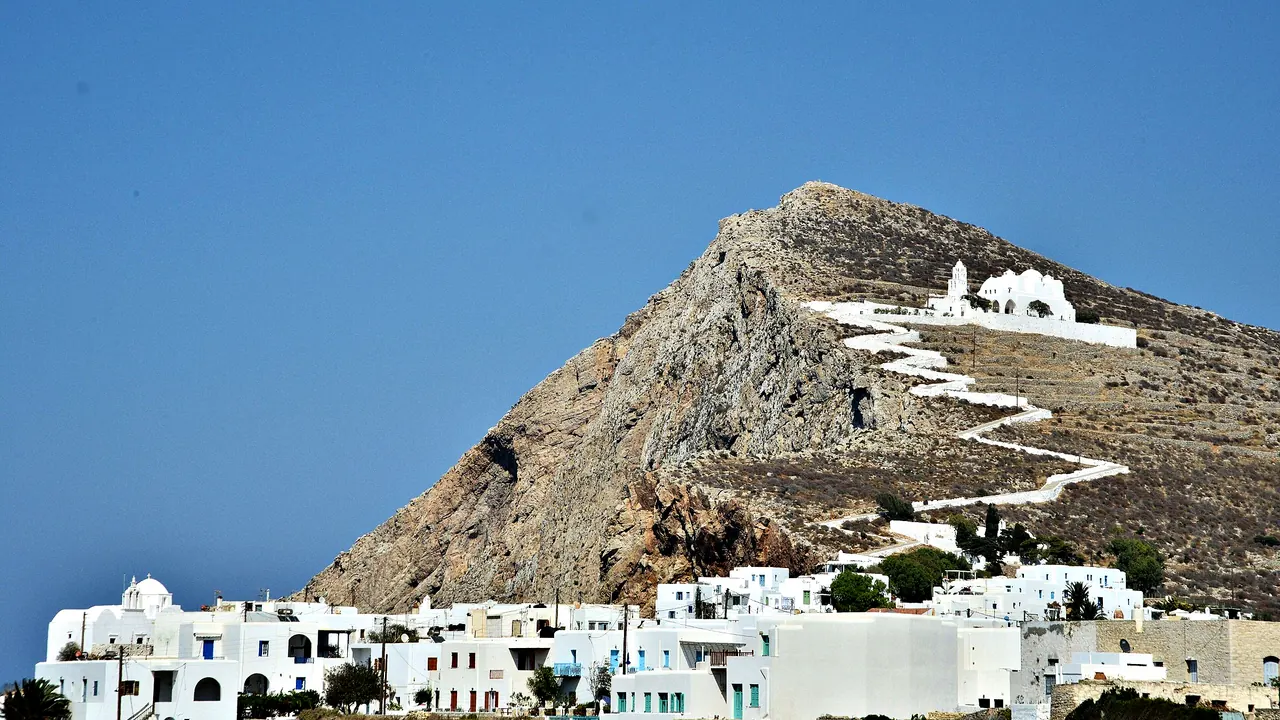
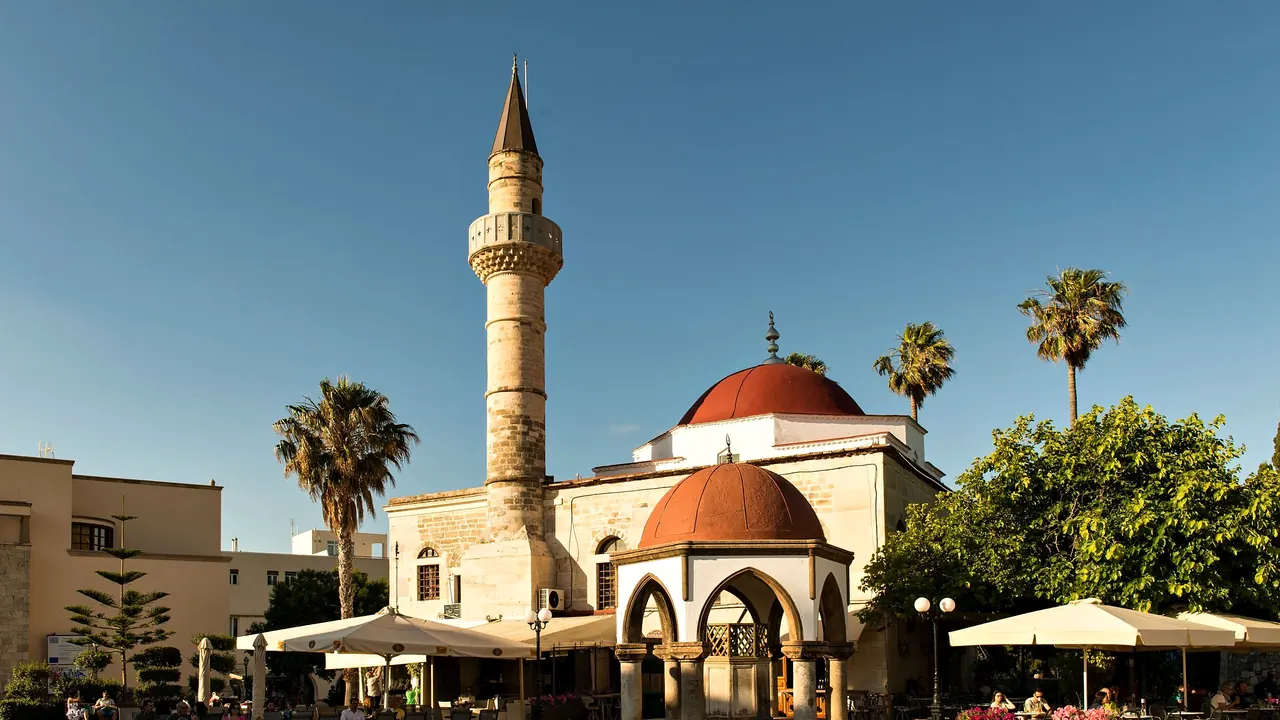
Photos: Folegandros by Chris Kar, CC BY-SA 4.0, cropped; Kos by Wolfgang Weiser, Pexels License.
Folegandros or Kos?
Our verdict in twelve categories, each scored against the same fixed benchmark cities, and the climate month by month, so you can choose for your trip.
Choose Folegandros for
- nature and the outdoors
Folegandros suits travellers who want a small island where nothing much is meant to happen. You get a cliff-top village with no cars, waymarked paths across a bare rocky ridge, clear coves you reach on foot or by caique, and long dinners in Chora's squares. It works best for couples and walkers who are happy to stay in one place. You give up most entertainment, any choice of beaches for small children, and the ease of flying in.
Choose Kos for
- nightlife
- families
- day trips
Kos is the easier and broader island. Long sandy beaches, resorts built around pools and kids' clubs, Roman ruins in the main town and an airport make it a natural choice for families and for anyone who wants a beach vacation with things to do in the evening. Boat trips to Bodrum, Nisyros and Kalymnos add variety, and package-style rooms keep the cost down. The price is a busier, more commercial island with less character in its resorts.
Scoreboard
Twelve categories on one fixed scale from 0 to 100. The shaded stretch is the gap between the two.
Your match
Pick a travel style or drag the sliders, and both match scores follow your weighting.
Wins on nature and the outdoors with your weighting.
Wins on nightlife and families with your weighting.
What matters to you?
Category by category
What the scores mean for a trip.
Beaches & swimming
Folegandros swims in small shingle-and-sand coves under bare cliffs, with remarkably clear water. Livadi, Vardia and Agali are easy to reach, but the most memorable spots, such as Katergo facing its rock islet, mean a rough walk or a boat, and many have no shade.
Kos has far more beach and far easier access. Long sandy strands run from Tigaki to Mastichari with room to spread out, and the south coast is more sheltered. The bays of the Kefalos peninsula, Paradise Beach and Agios Stefanos with its islet chapel, are the best of them. Both islands catch the summer meltemi, so on either one the calm side changes with the wind.
Food & drink
Folegandros eats well for its size, mostly in Chora's tree-shaded squares. Its own dishes are worth seeking out: matsata pasta with rooster or rabbit, soft souroto cheese and karpouzopita, the watermelon pie. The choice is narrow, though, and kitchens close once summer ends.
Kos gives you more places to eat and more variety. The best meals are in Zia and Pyli, at the fishing harbours of Mastichari and Kamari, and in the back streets of Kos Town, with pitaroudia, wine-matured krasotyri cheese and a few wineries near Kefalos. The catch is that the big resorts serve a lot of food made for package tourists, so you have to choose where you eat.
Culture & sights
On Folegandros the main sight is Chora itself: the Kastro quarter, whose outer houses form a defensive wall, and the zigzag climb to the Panagia church above the sea. Add the small folklore museum at Ano Meria and an afternoon covers it.
Kos has real archaeology. Ruins from Hellenistic and Roman times lie among the streets of Kos Town, including the Ancient Agora, the Odeon and the Casa Romana, with the Knights' Neratzia Castle on the harbour. The terraced healing sanctuary of the Asklepieion sits just outside town. Old Pyli and the castle at Antimachia take you further afield, and together they fill two or three days.
Nightlife
Kos is the island for going out. In summer the lanes of Kos Town's old quarter are packed with bars until the small hours, there are beach clubs at Lambi, and Kardamena is a party resort with late clubs and a young crowd. Elsewhere on the island, evenings end with a quiet seafront drink.
On Folegandros, nights mean staying on in Chora's squares after dinner and perhaps moving to a small bar on the cliff edge. There are no clubs at all, which for many visitors is exactly why they come.
Nature & outdoors
Folegandros has the more dramatic landscape: a narrow ridge of bare rock with sheer sea cliffs below Chora, stone-walled terraces, juniper and scattered chapels. Footpaths link the village to the western coves and run along the ridge at Ano Meria. Coastal boats pass sea caves such as Chrysospilia, and walking here is the point of a visit.
Kos is mostly low farmland and scrub, but it has more variety. Pine woods climb the Dikeos range to Mount Christos, peacocks roam the Plaka forest, and flamingos winter on the Alikes salt lake. The meltemi makes Marmari and Tigaki good for windsurfing and kitesurfing, and the flat coast is easy cycling country.
Day trips
Kos is the better base for day trips. A short ferry takes you to Bodrum on the Turkish coast (bring a passport), boats run to Nisyros for its volcanic crater, and from Mastichari it is a short hop to Kalymnos, the sponge-diving island. Pserimos and Plati are good for a lazy taverna lunch.
From Folegandros, quiet Sikinos is close, and faster boats reach Milos or Santorini in summer. Routes do not run every day and the north wind can cancel them, so visitors usually move on to the next island rather than come back the same evening.
Good for families
Kos is built for families with small children. The north-coast beaches at Tigaki, Marmari and Mastichari are shallow, many resorts have pools, kids' clubs and all-inclusive dining, there is a water park near Marmari, and the flat coast is easy for family bike rides. Beyond the beach there is little made for children, but the castles and ruins of Kos Town can fill a day for older ones.
Folegandros is safe and calm but harder work with toddlers. Livadi, the coves near Karavostasis and Agali are manageable, while most other beaches mean steep paths and no shade, and the cliffs and wind call for care. Teenagers who like swimming and walking get more out of it.
Getting around
Kos has an airport and is easy once you land. Buses run along the main road between Kos Town and resorts such as Tigaki, Kardamena and Kefalos, cycle lanes lead to the beaches near town, and good roads make a hire car simple for the hill villages and the south-west.
Folegandros can only be reached by ferry, from Piraeus or a neighbouring island, and the north wind can slow or cancel crossings. On the island, a local bus connects the port, Chora, Ano Meria and the road to Agali. Chora itself is car-free and takes minutes to walk, but many coves need a hike, a seasonal caique or a scooter.
Shopping & style
Neither island is a reason to go shopping, though Kos has a little more. The lanes of Kos Town's old quarter sell leather, sandals, sponges and jewellery, and the Italian-era market hall on Eleftherias Square is good for herbs, spices and local produce. On Folegandros a few shops in Chora's lanes sell ceramics, linen, honey and capers, which makes for a pleasant browse after dinner.
Affordability
Kos is the cheaper island because so much of it is set up for package and all-inclusive travel. There are plenty of mid-range rooms and apartments in Kardamena, Tigaki and Marmari, and back-street tavernas, buses and bike hire are fairly priced. Harbour-front restaurants and sunbeds are where costs add up.
Folegandros leans towards boutique hotels with cliff views in Chora, and these fill early in July and August. Simpler rooms near Karavostasis or in Ano Meria help, and June or September costs noticeably less than the peak.
Live music & performing arts
Neither island has a year-round theatre or concert scene, but Kos has its summer Hippokrateia festival. It puts concerts, theatre and dance on at the Asklepieion, the Roman Odeon and the castle, an unusual setting for an evening out. Folegandros has only its panigyria, saints'-day festivals where violin and lute play late into the night, and the Easter procession of the Panagia icon through its villages.
Wellness & relaxation
Both islands are good for winding down, in different ways. Folegandros relaxes you through its pace: no big resorts, a car-free village and days split between a cove and a nap, with only a few hotels offering treatments.
Kos has something Folegandros lacks: the hot sulphur spring at Therma, which runs onto a pebble beach where bathers build stone pools in the sea. It also has the spas of its larger beach resorts, and the quieter corners around Kefalos and the hill villages are slow enough for an unhurried stay.
When should you go?
Pick your month. The climate figures are measured averages, not a forecast.
Folegandros in July
Kos in July
Daytime high, °C
Rainfall in the month, mm
Where the figures come from
Folegandros has no weather station within reach, so its figures come from a gridded climate model rather than a measured record, and read a broad area rather than one spot.
Kos has no rain gauge within 25 km of the centre, so its rainfall comes from a gridded climate dataset read at the destination rather than from a gauge further away.
Temperature and rainfall are climate normals, averaged over the years shown. Folegandros: 2001-2020 normals, NASA POWER reanalysis grid, no weather station within 90 km. Kos: 1993-2020 (rainfall 1991-2020) normals, Kos Airport (23.2 km from centre).
The two islands follow the same pattern: dry, settled summers and wet winters. The sea warms enough for swimming from June to October on both, reaching about 24°C in late summer. The difference is heat. Folegandros stays milder, with August highs around 27°C, so walking Chora's lanes or the footpaths is still pleasant in the early morning and evening even in midsummer. Kos climbs to about 31°C in July and August, warm enough that the middle of the day is for the beach or the shade rather than ruins and hill villages.
In spring Kos warms up sooner and is comfortable for sightseeing by May. Folegandros is still cool then, which suits walkers among the wild flowers. June and September are the best balance on both. Winter is wetter on Kos, where January brings around 170mm of rain, against roughly half that on Folegandros, though neither island is a winter beach destination.
Which traveller are you?
On a family trip with young children, Kos is the clear pick. The north-coast beaches shelve gently into shallow water, resorts have pools and kids' clubs, and there is a water park. On Folegandros many coves need a steep walk down, and the cliffs need watching.
For an outdoors trip, Folegandros has the stronger landscape. Waymarked paths cross a bare ridge of terraces and chapels above some of the highest sea cliffs in the Cyclades, and boats run to sea caves. Kos has gentler hills and suits windsurfers and cyclists better.
For a food and nightlife trip, Kos gives you much more to work with. The bars in Kos Town's old quarter stay loud late, Kardamena has proper clubs, and there are tavernas in the hill villages and harbours. Folegandros has lovely dinners in its squares and little afterwards.
Before you go
| Measure | Folegandros | Kos |
|---|---|---|
| Official language | Greek | Greek |
| Currency | Euro (EUR) | Euro (EUR) |
| Sockets | CF230 V, 50 Hz | CF230 V, 50 Hz |
| Driving side | Right | Right |
| Time zone | UTC+2, UTC+3 in summer | UTC+2, UTC+3 in summer |
| Emergency number | 112 | 112 |
| Main airport | Santorini International Airport (JTR)60 non-stop destinations | Kos International Airport "Ippokratis" (KGS)75 non-stop destinations |
| Public holidays this year | 15 days | 15 days |
By the numbers
| Measure | Folegandros | Kos |
|---|---|---|
| Population | - | 33,387 |
| People per km² | - | 115 |
| Swim season, months above 21 °C | 5 months | 5 months |
Where else could you go?
Every comparison below shares a destination with this one, so you can follow Folegandros or Kos somewhere new.
- Iosvs Folegandros
- Milosvs Folegandros
- Sifnosvs Folegandros
- Santorinivs Folegandros
- Parosvs Folegandros
- Naxosvs Folegandros