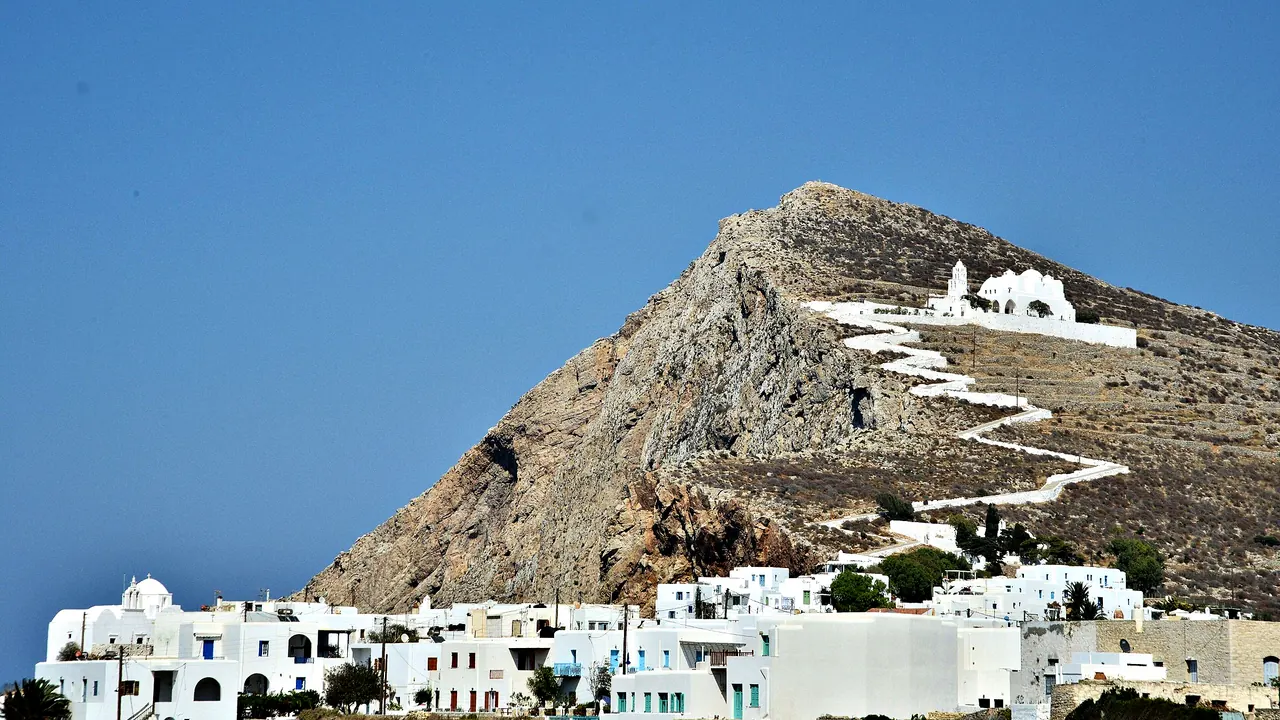
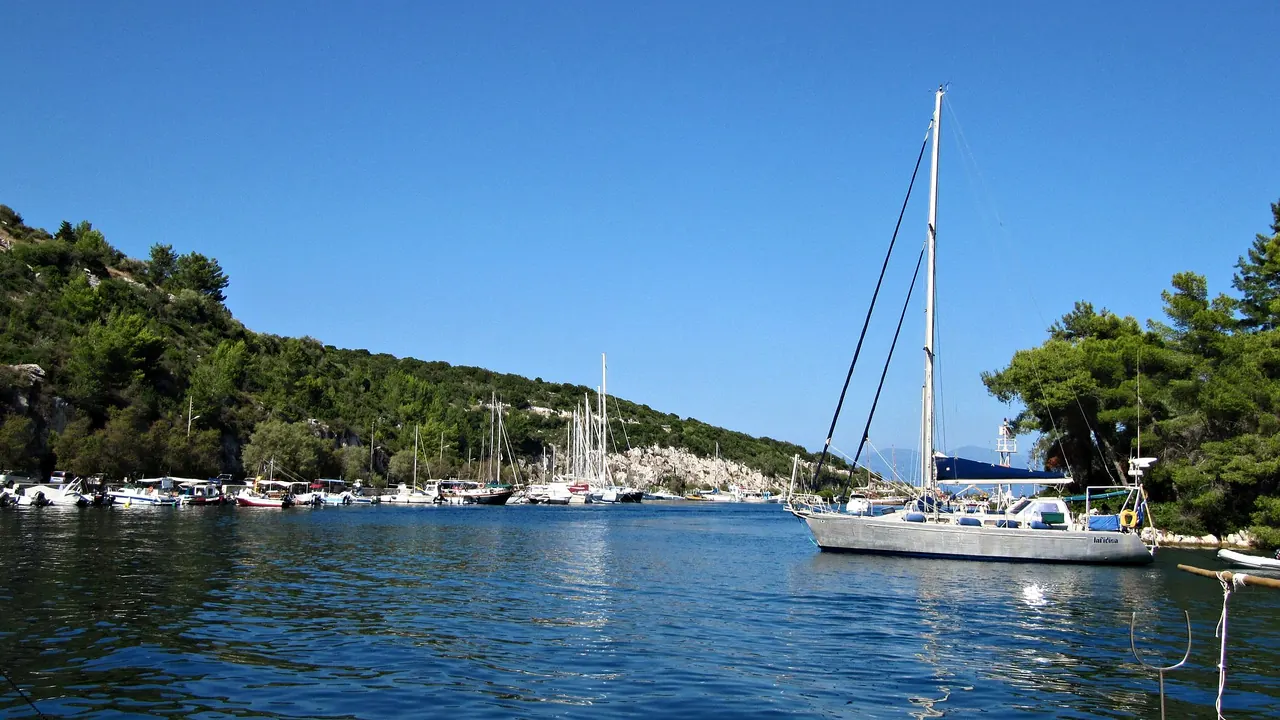
Photos: Folegandros by Chris Kar, CC BY-SA 4.0, cropped; Paxos by Poiesia, CC BY-SA 4.0, cropped.
Folegandros or Paxos?
Our verdict in twelve categories, each scored against the same fixed benchmark cities, and the climate month by month, so you can choose for your trip.
Choose Folegandros for
- culture and sights
- prices
- nature and the outdoors
Folegandros suits travellers who want an island with a strong sense of place and a bit of effort in it. Chora, strung along a clifftop with its walled Kastro quarter, is the finest village on either island. The waymarked paths over the bare ridge and down to remote coves give it the better walking, and a stay usually costs less. You give up some ease. The coves are harder to reach, the north wind decides where you swim, and there is little to do off the island.
Choose Paxos for
- beaches
- day trips
- families
Paxos is the choice when the sea comes first. Calm coves on the east coast, the sheltered bay at Lakka and the pale sand of Antipaxos give it the better swimming, and spending your days moving between coves in a small hired boat is the classic Paxos vacation. Families with young children will find it easier, and Corfu Town and Parga are within reach for a change of scene. In return you get very few sights and a higher bill.
Scoreboard
Twelve categories on one fixed scale from 0 to 100. The shaded stretch is the gap between the two.
Your match
Pick a travel style or drag the sliders, and both match scores follow your weighting.
Too close to call, level with your weighting
Wins on culture and sights and prices with your weighting.
Wins on beaches and day trips with your weighting.
What matters to you?
Category by category
What the scores mean for a trip.
Beaches & swimming
Both islands offer very clear water over shingle and pebble rather than long sandy strands, but Paxos is the stronger swimming destination. On Folegandros the coves sit under bare cliffs. Livadi, Vardia and Agali are the easy ones, while Katergo, a pale shingle bay facing a rock islet, takes a boat or a rough walk. Shade is scarce, and the July and August wind decides which side of the island is sheltered.
Paxos has a dependable lee coast, with pebble coves such as Kipiadi and Monodendri, and calm sandy shallows around the round bay at Lakka. Antipaxos is the real prize: Voutoumi and Vrika have pale sand and turquoise water. Hiring a motorboat to reach coves the roads cannot is a style of beach day Folegandros only partly offers, though Antipaxos does fill up at midday in high summer.
Food & drink
The two are evenly matched: good cooking for small islands, a narrow choice and many kitchens shut out of season. The difference is in what is on the plate. Folegandros has dishes of its own, such as matsata pasta with rooster or rabbit, soft souroto cheese and watermelon pie, eaten in Chora's tree-shaded squares.
Paxos cooks in the Ionian manner, with bourdeto, sofrito and grilled fish dressed in the island's olive oil, served at harbourside tables in Gaios, Lakka and Loggos. Because of its villa guests, a few kitchens on Paxos take a more modern line with local produce.
Culture & sights
Neither island is for sightseeing, but Folegandros has more to show. Chora on its clifftop is a sight in itself, and inside the Kastro the outer houses form a medieval defensive wall around narrow lanes and wooden balconies. Add the zigzag climb to the Panagia church and the folklore museum in an old Ano Meria farmhouse, and you have an afternoon well spent.
On Paxos the sights are mostly viewed from the water: the Venetian fort of Agios Nikolaos and the Panagia monastery on the islets off Gaios harbour, plus a small museum of island life. Anyone who wants real history takes the boat to Corfu Town.
Nightlife
Both are quiet islands where the evening means dinner and a drink, not clubs. On Folegandros you linger in Chora's squares, then move on to small bars in the lanes and along the cliff edge, some of which play music late in high summer. On Paxos the evening plays out by the water, with drinks on the waterfront in Gaios or Lakka beside moored yachts and one or two places to dance in July and August. Choose village squares on a clifftop or a harbour full of boats.
Nature & outdoors
Folegandros has the more dramatic landscape. It is a narrow ridge of bare rock with some of the highest sea cliffs in the Cyclades, stone-walled terraces and almost no trees. Waymarked paths cross it from Chora to the western coves and along the ridge at Ano Meria, and boat trips pass sea caves such as Chrysospilia.
Paxos is gentler and greener, low hills under ancient olive groves crossed by mule tracks and an end-to-end trail. Its scenery peaks on the west coast, where the white Erimitis cliffs, the Tripitos arch and the sea caves are best seen by kayak or boat, and the snorkelling is good. It has no high or wild ground to match Folegandros.
Day trips
Paxos gives you more reasons to leave the island for a day. Corfu Town, with its Venetian fortresses and UNESCO-listed old town, is about an hour away by fast ferry. Excursion boats also run to Parga on the mainland and the coves near Sivota, and Antipaxos makes an easy beach day.
From Folegandros, quiet Sikinos is close, and Milos or Santorini are an hour or two away on faster boats in summer. Routes do not run every day and the wind can disrupt crossings, so most visitors treat other islands as the next stop of a trip, not a day out.
Good for families
Folegandros works best for families whose children are old enough to walk and swim, and its best hours are the evenings. Chora has no cars, so the lanes make an easy stroll after dinner in the squares, though the cliff edge and the summer wind mean keeping small children close. Days take more planning. Most coves have no shade or facilities, so you carry your own, and with toddlers you will stick to the few beaches by the port at Karavostasis and Livadi, or Agali, where the tavernas give you lunch and some cover.
Paxos is the more forgiving island, with younger children too, because calm water is easier to find on its sheltered side, above all in the shallow bay at Lakka. You pay for that in driving. Family villas are usually scattered through the olive groves, so a hired car is part of most stays, and every evening out starts with a drive down to a harbour. Neither island offers much made for children, and on Paxos a day of bad weather leaves almost nothing to do.
Getting around
Both are reached only by ferry, and rough seas can delay or cancel crossings on either. Folegandros boats come from Piraeus or nearby islands, while Paxos is a crossing from Corfu, which has an airport, or from the mainland. On the island, Folegandros is easier without a car: a local bus links the port, Chora, Ano Meria and the road to Agali, and Chora is car-free.
On Paxos the buses are infrequent and most visitors rent a car or scooter for the narrow, winding roads, though footpaths through the olive groves link the villages. The best coves on both islands are reached by sea, but on Paxos a small hired boat is close to essential.
Shopping & style
Shopping on either island amounts to an after-dinner browse, not a reason to go. On Folegandros the small shops in Chora's lanes sell jewellery, ceramics and linen, plus capers, herbs and thyme honey. On Paxos the summer boutiques behind the harbours in Gaios and Lakka sell much the same, but the souvenir worth taking home is the island's own olive oil.
Affordability
Folegandros is the cheaper of two islands that are both pricey in summer. Its clifftop boutique hotels in Chora are expensive, but the simpler rooms near Karavostasis or in Ano Meria are a real alternative. The bus is cheap and most coves can be reached on foot.
Paxos is one of the dearer Greek islands. Villas and guesthouses book up early, harbourside restaurants charge for the view, and the boat or car you will likely hire, plus the ferries, adds a good deal to the cost. On both islands, self-catering, simple tavernas and the shoulder months bring the cost down.
Live music & performing arts
There is no theatre or concert hall on either island, and live music mostly means summer saints' day festivals that run late into the night. On Folegandros that means the panigyria with island violin and lute, and the Easter procession carrying the Panagia icon through the settlements. Paxos adds one thing Folegandros lacks: a small chamber music festival at the end of summer, held in churches and village squares, alongside the big August feast of the Panagia in Gaios.
Wellness & relaxation
Folegandros is the plainer place to rest. There are no resorts, the village has no cars, treatments are limited to a handful of hotels, and the day runs from a cove to an afternoon sleep to a late table in Chora. You don't book anything, and that is the appeal.
Paxos gives rest a little more shape. Some estates run yoga and retreat weeks, the larger hotels and villas have massage rooms, and a villa among the olive trees looking out to sea is a retreat in itself. The shared calm is quietest in June and September on both islands, and on Paxos in May as well.
When should you go?
Pick your month. The climate figures are measured averages, not a forecast.
Folegandros in July
Paxos in July
Daytime high, °C
Rainfall in the month, mm
Where the figures come from
Folegandros has no weather station within reach, so its figures come from a gridded climate model rather than a measured record, and read a broad area rather than one spot.
Paxos's temperatures are measured 52 km from the centre, at Kerkyra Airport.
Paxos has no rain gauge within 25 km of the centre, so its rainfall comes from a gridded climate dataset read at the destination rather than from a gauge further away.
Temperature and rainfall are climate normals, averaged over the years shown. Folegandros: 2001-2020 normals, NASA POWER reanalysis grid, no weather station within 90 km. Paxos: 1991-2020 normals, Kerkyra Airport (52.1 km from centre).
Both islands are summer places, but they get there differently. Folegandros stays relatively mild, with daytime highs peaking around 27°C in August, so a morning walk to a cove or an evening stroll around Chora stays comfortable through the summer. It is almost rainless from May to September, the sea is warm enough to swim from June to October, and the rain only really returns in late autumn and winter.
Paxos gets much hotter, reaching 32°C in July and August, so midday is for the water and the shade, not the olive-grove trails. Its sea warms slightly more, to about 26°C in August, and the summer months are long and very sunny. Autumn turns wet sooner and harder than on Folegandros, though. September already brings around 91mm and November about 163mm. For swimming plus walking, aim for June or September on Folegandros, and May, June or early September on Paxos.
Which traveller are you?
For a beach and sun trip, Paxos is the better pick. The east-coast coves are sheltered, Lakka has calm sandy shallows, and Antipaxos, a short boat ride away, has turquoise water over pale sand. Folegandros has clear water too, but its coves are rougher and more exposed to the wind.
On a family trip with children, Paxos is easier. The shallow bay at Lakka suits small children, and a day spent by boat between coves keeps older ones happy. On Folegandros many coves need a steep walk down, and the cliffs and summer wind call for care.
On a trip on a tight budget, Folegandros goes further. Simple rooms near Karavostasis or in Ano Meria, a cheap local bus and footpaths to the coves keep costs down. Paxos runs to villas, harbourside dining and boat or car hire, which add up quickly.
Before you go
| Measure | Folegandros | Paxos |
|---|---|---|
| Official language | Greek | Greek |
| Currency | Euro (EUR) | Euro (EUR) |
| Sockets | CF230 V, 50 Hz | CF230 V, 50 Hz |
| Driving side | Right | Right |
| Time zone | UTC+2, UTC+3 in summer | UTC+2, UTC+3 in summer |
| Emergency number | 112 | 112 |
| Main airport | Santorini International Airport (JTR)60 non-stop destinations | Corfu Ioannis Kapodistrias International Airport (CFU)88 non-stop destinations |
| Public holidays this year | 15 days | 15 days |
By the numbers
| Measure | Folegandros | Paxos |
|---|---|---|
| Population | - | 2,300 |
| People per km² | - | 91 |
| Swim season, months above 21 °C | 5 months | 5 months |
Where else could you go?
Every comparison below shares a destination with this one, so you can follow Folegandros or Paxos somewhere new.
- Iosvs Folegandros
- Milosvs Folegandros
- Sifnosvs Folegandros
- Santorinivs Folegandros
- Corfuvs Paxos
- Parosvs Folegandros