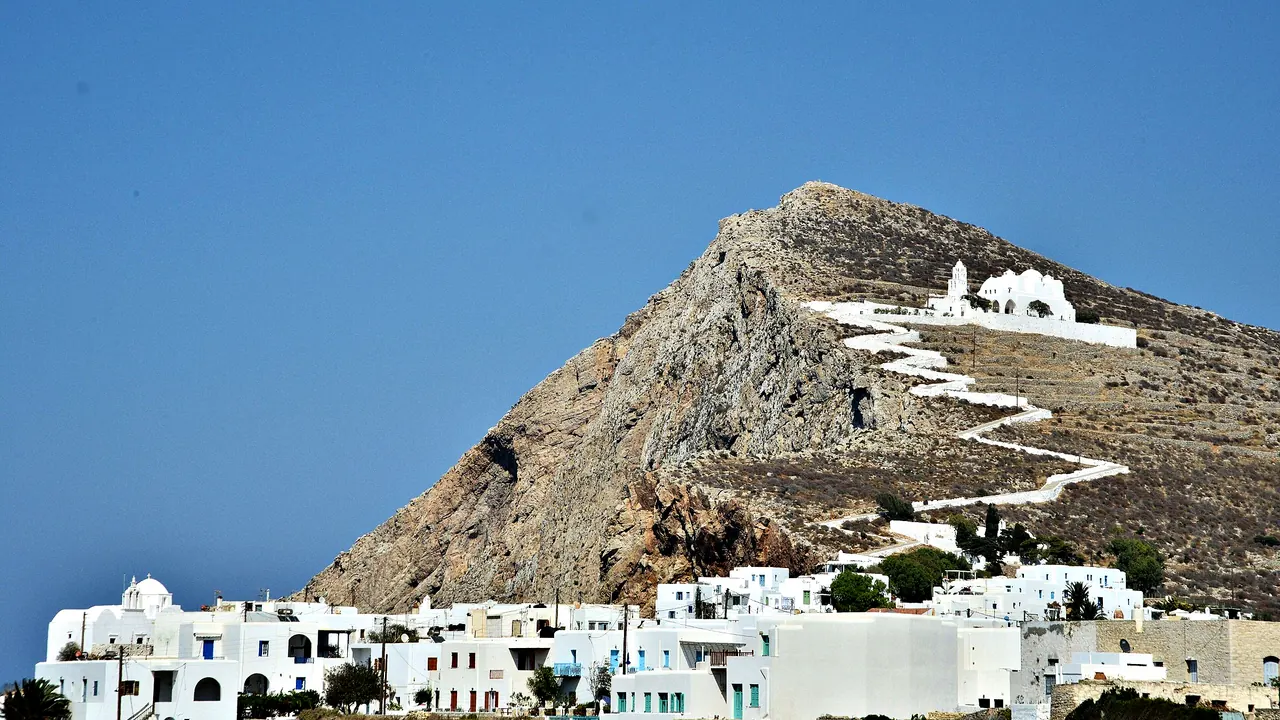
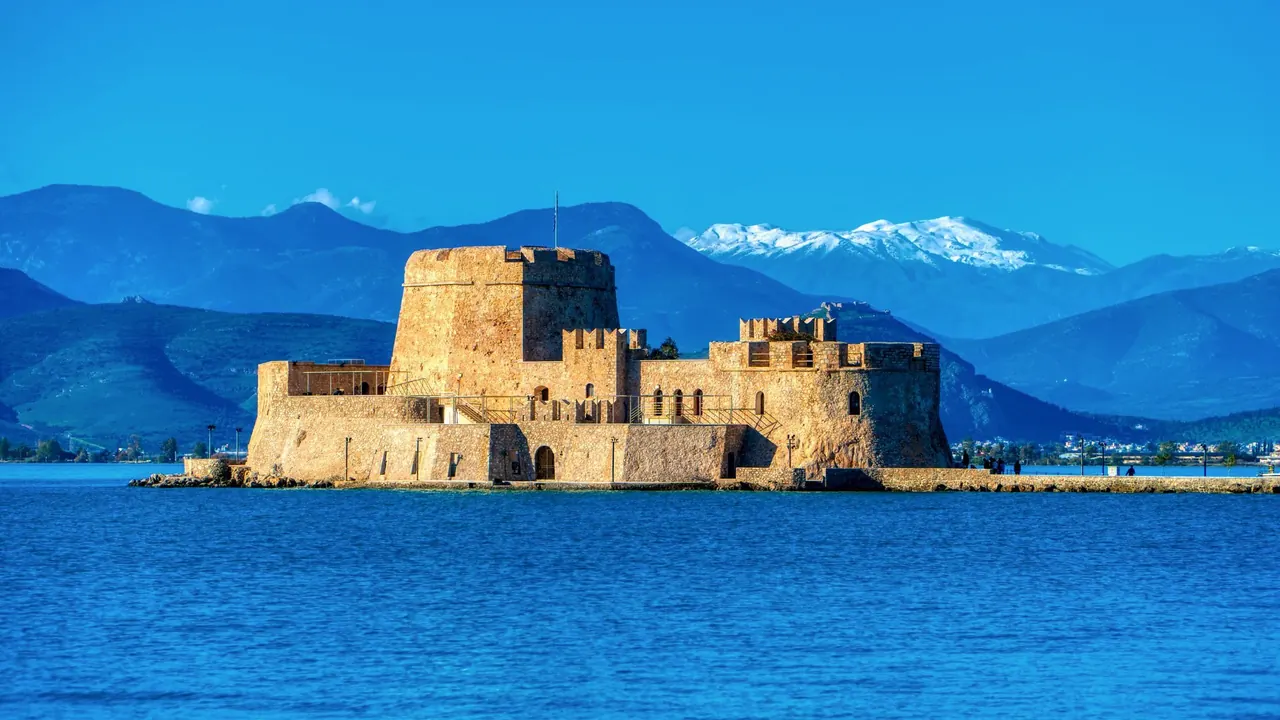
Photos: Folegandros by Chris Kar, CC BY-SA 4.0, cropped; Peloponnese by Alex Ravvas, Pexels License.
Folegandros or Peloponnese?
Our verdict in twelve categories, each scored against the same fixed benchmark cities, and the climate month by month, so you can choose for your trip.
Choose Folegandros for
Folegandros does not lead in any category we score.
Folegandros suits the traveller who wants one small island and no programme: a cliff-top village without cars, long evenings at tables in Chora's squares, and days spent walking down to a shingle cove of very clear water. You give up ancient sites, variety and cheap rooms in high summer. What you get is quiet, and a place you cover on foot or by local bus rather than by car.
Choose Peloponnese for
- culture and sights
- day trips
- food and drink
For range, the Peloponnese is the stronger pick on almost every count. Mycenae, Epidaurus, Olympia and Mystras, the sandy bays of Messinia and Elafonisos, the gorges of Arcadia and country tavernas pouring Nemea wine all fit into one road trip, and it costs less than the famous islands. The trade-off is a hire car, long drives on winding roads and usually more than one base.
Scoreboard
Twelve categories on one fixed scale from 0 to 100. The shaded stretch is the gap between the two.
Your match
Pick a travel style or drag the sliders, and both match scores follow your weighting.
Has no clear advantage with the weighting you have chosen.
Wins on culture and sights and day trips with your weighting.
What matters to you?
Category by category
What the scores mean for a trip.
Beaches & swimming
Folegandros swims in small coves of shingle and sand under bare cliffs. Livadi and Agali are easy, but Katergo and the western bays mean a rough path or a boat, often with no shade. Which side is sheltered changes with the north wind.
The Peloponnese has far more coastline and more kinds of beach. There is the horseshoe of Voidokilia and the long sands towards Kyparissia, the white sand of Elafonisos, rock swimming below Mani villages, and sheltered Tolo near Nafplio. On both, the sea is swimmable from June to October.
Food & drink
Folegandros eats well for its size. Matsata pasta with rooster, soft souroto cheese and watermelon pie are served in Chora's shaded squares, but the choice is narrow and most kitchens close once summer ends.
The Peloponnese gives you a whole country larder: Kalamata olives and oil, Mani cured pork, slow-cooked goat and harbour-grilled fish. It also has real wine country in Nemea's Agiorgitiko reds and the Moschofilero whites of the Tripoli plateau. Kalamata and Nafplio add a covered market and a much wider spread of places to eat.
Culture & sights
On Folegandros the sight is Chora itself, with its walled medieval Kastro on the cliff edge and the path up to the Panagia church. Add the folklore museum at Ano Meria and you have seen it all.
The Peloponnese is one of the richest regions in Greece for history. Bronze Age Mycenae and Tiryns, the theatre at Epidaurus, Olympia, Messene and lonely Bassae cover the ancient world. Byzantine Mystras, Monemvasia's fortified rock, the Venetian castles at Methoni and Koroni and the elegant streets of Nafplio cover the centuries after. Seeing it properly takes days and several bases.
Nightlife
Neither is a party destination, and Folegandros is the quieter of the two by choice. Nights there mean lingering in Chora's squares and a few small bars, with no clubs at all. The Peloponnese offers more: late café-bars on Nafplio's waterfront, a local bar crowd in Kalamata, and in Patras a proper student scene of bars and clubs at its height during carnival.
Nature & outdoors
Folegandros is one dry, treeless ridge with tall sea cliffs, stone terraces and chapels, crossed by waymarked footpaths. Boat trips go to sea caves such as Chrysospilia, and spring is the time for walking.
The Peloponnese has a wider range of landscapes and is often greener. Taygetos rises to about 2,400m, the Lousios gorge has monasteries built into its cliffs, and the long Menalon Trail crosses Arcadia. You can also ride the Vouraikos rack railway, ski on Chelmos in winter, walk the stark Mani down to Cape Tainaron, and watch migrating birds at the Gialova lagoon.
Day trips
Folegandros is a place to stay put. Ferries reach Sikinos, Milos and Santorini in summer, but timetables are patchy and the wind can cancel crossings, so most visitors move on rather than return the same day.
The Peloponnese is built for outings. Hydra and Spetses are a short ferry ride from the southern Argolid, and Nemea, Arcadian villages, Pylos, Methoni, Monemvasia and Elafonisos all make full days out. Athens is about two hours away, though nearly every trip needs a car.
Good for families
With children, the Peloponnese is the more practical choice. It has shallow sandy bays at Tolo, along the Messinian coast and on Elafonisos, resort hotels with kids' clubs and pools, and Nafplio for a pushchair stroll. Older children can be won over by Mycenae and Olympia early in the morning.
Folegandros is calm and safe, but Livadi and Agali are about the only easy beaches. Elsewhere there are steep descents, cliffs and summer wind, so it suits swimmers and walkers more than toddlers. Neither has theme parks or zoos.
Getting around
Both take some effort, but of different kinds. On Folegandros, a local bus links the port, Chora and Ano Meria, the village is car-free, and a scooter or caique reaches the rest. The catch is that there is no airport, and ferries can be held up by the wind.
The Peloponnese means driving. Motorways make the main towns quick to reach, but mountain and Mani roads are slow, and buses hardly reach sites, beaches or villages.
Shopping & style
Neither is worth the trip for shopping, but the Peloponnese gives you more to take home. Nafplio's lanes mix jewellery, worry beads and ceramics, Nemea wineries sell direct, Kalamata and Tripoli have weekly street markets, and Patras has an ordinary high street. On Folegandros it comes down to a few shops in Chora with jewellery, linen, capers and honey, which makes a short browse after dinner.
Affordability
Folegandros is the dearer stay. Chora's boutique hotels with cliff views set the tone and book out in July and August, though simpler rooms near Karavostasis or in Ano Meria help, and buses and walking cost little.
The mainland Peloponnese is noticeably cheaper than the islands, with family-run village rooms in the Mani and Arcadia, good local wine and inexpensive tavernas. The extra costs are a hire car, fuel and entry fees at the big ancient sites.
Live music & performing arts
The Peloponnese has one of the great summer experiences of Greece: ancient drama on weekend nights in the theatre of Epidaurus, where the acoustics need no amplification. There are also concerts at the Little Theatre nearby and Kalamata's dance festival in July. Folegandros has no stage at all, just saints' day panigyria with violin and lute playing late and the Easter procession of the Panagia icon.
Wellness & relaxation
On both, rest comes mostly from the slow pace rather than from spas, but the Peloponnese has more on offer. There are old thermal towns at Loutraki and Methana, sulphur-fed Lake Kaiafas, and full spas in the Messinian resorts. Folegandros has no springs and only a few hotel treatments. What it does offer is a car-free village and days split between a cove and a nap, at their calmest in June and September.
When should you go?
Pick your month. The climate figures are measured averages, not a forecast.
Folegandros in July
Peloponnese in July
Daytime high, °C
Rainfall in the month, mm
Where the figures come from
Folegandros has no weather station within reach, so its figures come from a gridded climate model rather than a measured record, and read a broad area rather than one spot.
Peloponnese's temperatures are measured 89 km from the centre, at Kalamata Airport.
Peloponnese has no rain gauge within 25 km of the centre, so its rainfall comes from a gridded climate dataset read at the destination rather than from a gauge further away.
Temperature and rainfall are climate normals, averaged over the years shown. Folegandros: 2001-2020 normals, NASA POWER reanalysis grid, no weather station within 90 km. Peloponnese: 1991-2020 normals, Kalamata Airport (89 km from centre).
Folegandros stays fairly mild through summer, peaking around 27°C in August, and the north wind takes the edge off the heat. The sea holds at 24°C from July to September and is warm enough for swimming from June into October. Rain almost disappears from May to September, then returns in autumn, and the winter months are cool and wet.
On the Peloponnese, measured where most visitors stay, summer runs much hotter, at 32°C in July and August. That is too hot for long walks around ruins or in the lowlands at midday, though the sea warms to 26°C and the days are long and very sunny. May, June, September and October are the best months for combining sights, hiking and swimming. November and December are the wettest months.
Which traveller are you?
On a culture and arts trip, the Peloponnese wins outright. Mycenae, Olympia, Mystras and Monemvasia are all within one region, with ancient drama at Epidaurus on summer nights. Folegandros has its cliff-top Kastro and a small folklore museum, which take an afternoon.
On a family trip with children, the Peloponnese is easier. It has shallow sandy bays at Tolo and on Elafonisos, plus resort pools and kids' clubs in Messinia. Folegandros has a few gentle beaches near the port, but its steep paths, cliffs and wind suit older children better.
For a trip on a tight budget, the Peloponnese makes money go further, with family-run rooms in Mani and Arcadian villages and inexpensive taverna meals, although a hire car is hard to avoid. In summer, Folegandros fills with boutique hotels in Chora that book out early.
Before you go
| Measure | Folegandros | Peloponnese |
|---|---|---|
| Official language | Greek | Greek |
| Currency | Euro (EUR) | Euro (EUR) |
| Sockets | CF230 V, 50 Hz | CF230 V, 50 Hz |
| Driving side | Right | Right |
| Time zone | UTC+2, UTC+3 in summer | UTC+2, UTC+3 in summer |
| Emergency number | 112 | 112 |
| Main airport | Santorini International Airport (JTR)60 non-stop destinations | Athens Eleftherios Venizelos International Airport (ATH)176 non-stop destinations |
| Public holidays this year | 15 days | 15 days |
By the numbers
| Measure | Folegandros | Peloponnese |
|---|---|---|
| Swim season, months above 21 °C | 5 months | 5 months |
Where else could you go?
Every comparison below shares a destination with this one, so you can follow Folegandros or Peloponnese somewhere new.
- Iosvs Folegandros
- Milosvs Folegandros
- Sifnosvs Folegandros
- Santorinivs Folegandros
- Parosvs Folegandros
- Aeginavs Peloponnese