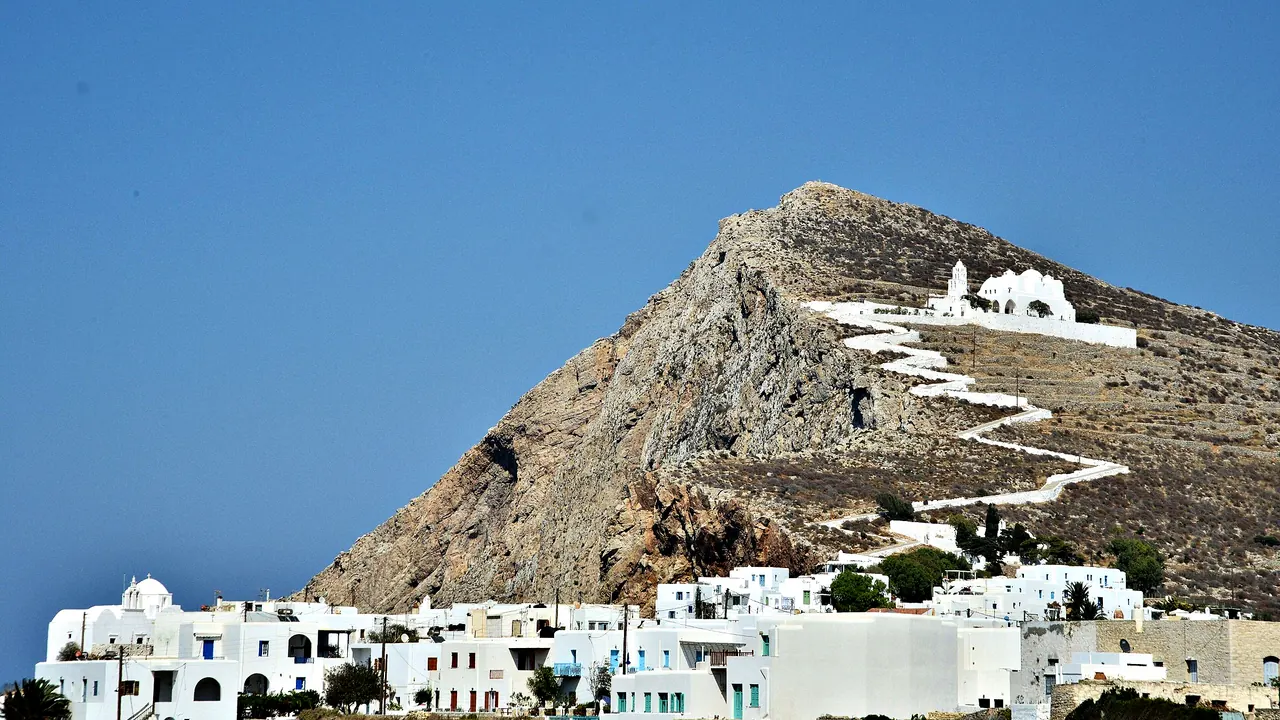
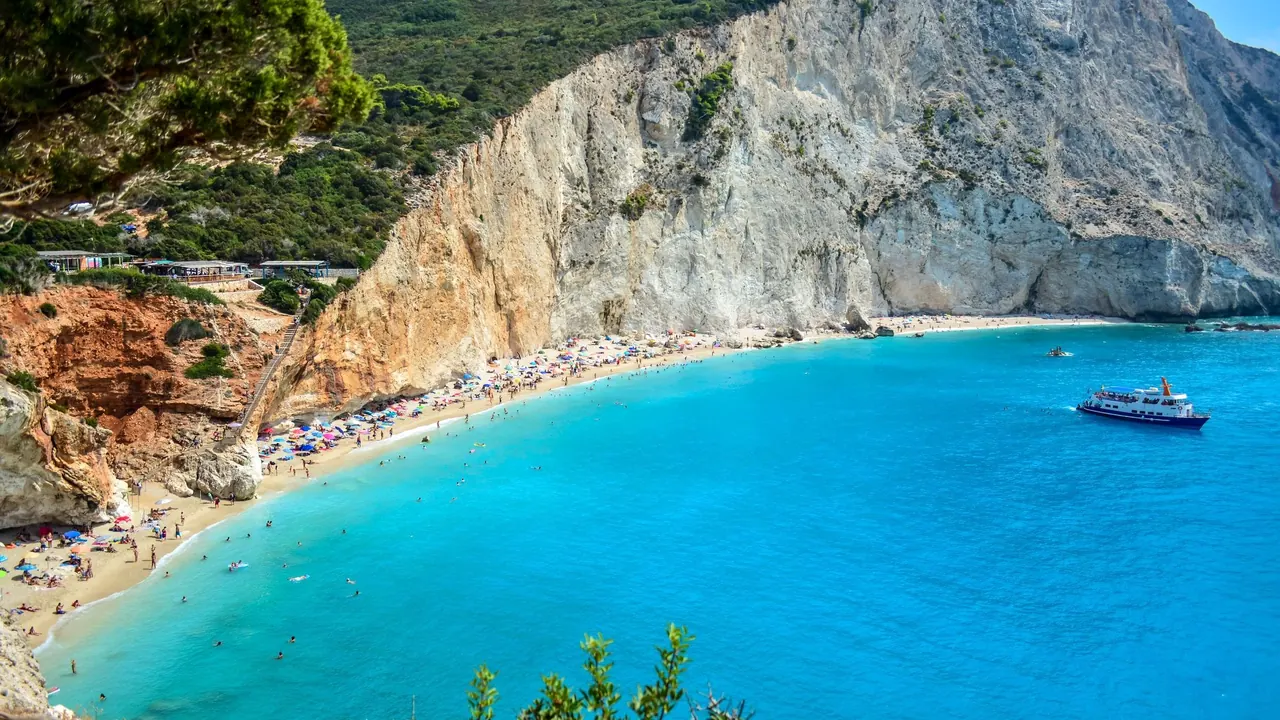
Photos: Folegandros by Chris Kar, CC BY-SA 4.0, cropped; Lefkada by Antone Adi, Pexels License.
Folegandros or Lefkada?
Our verdict in twelve categories, each scored against the same fixed benchmark cities, and the climate month by month, so you can choose for your trip.
Choose Folegandros for
- getting around
- wellness
- culture and sights
Folegandros is for travellers who want very little to happen. It is one small cliff-top village, a handful of shingle coves and footpaths across a bare ridge, with no clubs, no resorts and no airport. You pay for that seclusion in the choice of beaches, how easy it is to get there and how much there is to fill a week. Couples and walkers who want to slow right down, and who don't mind a ferry, will find it easier to rest here.
Choose Lefkada for
- day trips
- families
- beaches
Lefkada gives a broader and easier island vacation. Its west coast has some of the most striking beaches in Greece, and the east side has calm bays where children can paddle. There are also boats to Meganisi, Kefalonia and Ithaca, windsurfing at Vasiliki and yacht charters from the marina. It suits families, groups and anyone who wants plenty of variety from one base, and the causeway and nearby airport make arriving simple. In return it is busier and more built up in high summer.
Scoreboard
Twelve categories on one fixed scale from 0 to 100. The shaded stretch is the gap between the two.
Your match
Pick a travel style or drag the sliders, and both match scores follow your weighting.
Wins on getting around and wellness with your weighting.
Wins on day trips and families with your weighting.
What matters to you?
Category by category
What the scores mean for a trip.
Beaches & swimming
Lefkada has the bigger and better-known beaches. Porto Katsiki, Egremni and the long sweep of Kathisma lie under white cliffs on the west coast, with turquoise water. Those west-coast beaches face open sea with afternoon waves, so the east-coast bays give you calm water as an alternative. The trade-off is crowds at the famous coves in midsummer.
Folegandros has small coves of shingle and sand instead. The water is very clear, but there is little shade, and many coves need a walk or a caique to reach. Katergo is the stand-out, while Agali and the bays near Karavostasis are the easy ones. The north wind decides each day which side of the island is sheltered.
Food & drink
Neither island is a food destination, but Lefkada gives you more range and more settings. You can eat fish on the harbours of Lefkada town and Nidri, slow-cooked meat in mountain villages such as Karya, and Eglouvi lentils grown on the plateau. Away from the resort strips, the traditional cooking is easy to find.
Folegandros has fewer places to eat, mostly in Chora's shaded squares. It does have a distinct island kitchen of its own: matsata pasta with rooster or rabbit, soft souroto cheese and watermelon pie. Dinner in Chora is a real pleasure, but most kitchens close once the summer ends.
Culture & sights
Both islands are equally light on sights, but the kind of culture differs. On Folegandros it is the village of Chora itself, with its walled Kastro quarter on a cliff rim and the climb to the Panagia church, and you can see it all in an afternoon. Lefkada spreads a few modest sights around the island: the fortress of Santa Maura at the causeway, painted Ionian churches in the town, the Faneromeni monastery and Karya's embroidery.
Nightlife
Lefkada has more going on after dark. In July and August, Lefkada town's lanes and waterfront fill with cocktail bars and young Greek visitors, and Nidri's harbour draws sailing crews. It is still drinks and strolling rather than clubs.
Folegandros is deliberately quiet. Evenings end in Chora's squares or at a few small bars on the cliff edge, and many visitors choose the island for exactly that.
Nature & outdoors
Lefkada has more variety outdoors. It is greener, with olive and cypress slopes rising to mountains over 1,100m, and you can walk to the Dimosari waterfall or drive the cliff road to Cape Lefkatas. Out on the water there is windsurfing at Vasiliki, kitesurfing at Agios Ioannis and sailing between the islands.
Folegandros is a starker landscape. It is a treeless ridge of stone terraces and chapels, with some of the highest cliffs in the Cyclades. Walking its waymarked paths is the main activity, along with a boat trip past the Chrysospilia sea cave.
Day trips
Folegandros offers few days out. In summer, ferries reach quiet Sikinos nearby, and fast boats get to Milos or Santorini in an hour or two. But timetables are thin and the north wind can cancel a crossing, so another island usually becomes the next stop on the trip rather than an outing with a return the same evening.
Lefkada gives far more choice from one base, by boat or by car. Excursion boats from Nidri tour Meganisi, Kalamos and Kastos, and ferries from Vasiliki cross to Fiskardo on Kefalonia and to Ithaca. Across the strait lie Preveza and the ruins of Roman Nikopolis, and further north is Parga under its Venetian castle.
Good for families
Folegandros asks more of families. Livadi, Agali and the beaches near Karavostasis are manageable with small children, but the cliffs and strong summer wind call for care. The island works best for older children who enjoy swimming and walking.
Lefkada is the easier island with children. On the east coast and at Vasiliki and Agiofili the water is calm enough for toddlers to paddle safely, and tavernas welcome children late into the evening. Its west-coast beaches, with steep shelving and long staircases, are better kept for the occasional day out.
Getting around
Getting around is about as easy on both, but in different ways. Folegandros is compact: a local bus links the port, Chora, Ano Meria and Agali, and Chora is car-free. Getting there is the hard part, with no airport and ferries that can be slowed or cancelled by the wind.
Lefkada is the reverse. A causeway and Aktion airport make arriving simple, but on the island you really need a car or scooter. Its winding roads and the summer traffic around Nidri and Porto Katsiki take patience.
Shopping & style
Neither island is worth a trip for shopping, though Lefkada has a little more. Lefkada town's pedestrian main street has clothing shops, jewellers and local lentils and oil, and Karya sells hand embroidery. On Folegandros, a few lanes in Chora sell ceramics, linen, capers and honey for an after-dinner browse.
Affordability
Lefkada is the cheaper of the two. Family-run studios and apartments are easy to find, and the costs that add up are car hire, boat trips and August rooms near the west coast. On Folegandros, Chora's cliff-view boutique hotels push prices up and book out early in summer. Simpler rooms at Karavostasis or Ano Meria help, and on both islands June and September cost noticeably less.
Live music & performing arts
Neither island has a theatre, but Lefkada offers more to attend. Its international folklore festival brings dance groups to open-air stages every August, alongside summer concerts and village fêtes. On Folegandros, live music means the panigyria, saints'-day festivals with violin and lute that run late into the night, and the Easter procession of the Panagia icon.
Wellness & relaxation
Both islands offer rest through their pace rather than spas, and Folegandros keeps that pace more consistently. With no big resorts and a car-free village, its days are a cove and a nap even in high summer. On Lefkada you have to look for the calm, in the interior villages, the east-coast harbours or a hillside yoga retreat, because August in the main resorts is far from restful.
When should you go?
Pick your month. The climate figures are measured averages, not a forecast.
Folegandros in July
Lefkada in July
Daytime high, °C
Rainfall in the month, mm
Where the figures come from
Folegandros has no weather station within reach, so its figures come from a gridded climate model rather than a measured record, and read a broad area rather than one spot.
Lefkada has no rain gauge within 25 km of the centre, so its rainfall comes from a gridded climate dataset read at the destination rather than from a gauge further away.
Temperature and rainfall are climate normals, averaged over the years shown. Folegandros: 2001-2020 normals, NASA POWER reanalysis grid, no weather station within 90 km. Lefkada: 1998-2020 (rainfall 1991-2020) normals, Aktion Airport (24.3 km from centre).
Both islands have almost rainless summers, and on both the sea is warm enough to swim from June to October. They differ in heat and in how early autumn turns. Folegandros is the milder, peaking around 27°C in August, though the strong north wind and the bare, shadeless ridge still make longer walks a job for early morning and evening. Lefkada is noticeably hotter, around 31°C in July and August, with a sea a degree or two warmer, so the middle of the day there is better spent in the water than on the cliff roads.
On Folegandros the dry spell lasts through September, then rain picks up in October to about 49mm and keeps building into winter. Lefkada turns earlier and harder: September is already showery and November brings around 150mm. Spring is the best walking season on both. Lefkada warms faster from April, while Folegandros stays cooler into May.
Which traveller are you?
On a family trip with young children, Lefkada is the clear choice. Its east-coast bays at Nikiana, Ligia and Agiofili have calm, shallow water, and boat outings to the islets are easy. On Folegandros many coves need a steep walk down or a boat, and few have shade.
For a relaxing and wellness trip, Folegandros has the edge. There are no big resorts, and the car-free village gives you long, quiet evenings in the squares. Lefkada can be peaceful in its hill villages, but its busiest resorts are anything but restful in August.
For windsurfers and sailors, Lefkada has something Folegandros cannot offer. The bay at Vasiliki has steady afternoon winds, and the sheltered channels around its satellite islands are classic yachting waters. The large marina makes it a natural place to start a week afloat.
Before you go
| Measure | Folegandros | Lefkada |
|---|---|---|
| Official language | Greek | Greek |
| Currency | Euro (EUR) | Euro (EUR) |
| Sockets | CF230 V, 50 Hz | CF230 V, 50 Hz |
| Driving side | Right | Right |
| Time zone | UTC+2, UTC+3 in summer | UTC+2, UTC+3 in summer |
| Emergency number | 112 | 112 |
| Main airport | Santorini International Airport (JTR)60 non-stop destinations | Aktion National Airport (PVK)47 non-stop destinations |
| Public holidays this year | 15 days | 15 days |
By the numbers
| Measure | Folegandros | Lefkada |
|---|---|---|
| Population | - | 22,652 |
| People per km² | - | 64 |
| Swim season, months above 21 °C | 5 months | 5 months |
Where else could you go?
Every comparison below shares a destination with this one, so you can follow Folegandros or Lefkada somewhere new.
- Iosvs Folegandros
- Milosvs Folegandros
- Sifnosvs Folegandros
- Santorinivs Folegandros
- Parosvs Folegandros
- Paxosvs Lefkada