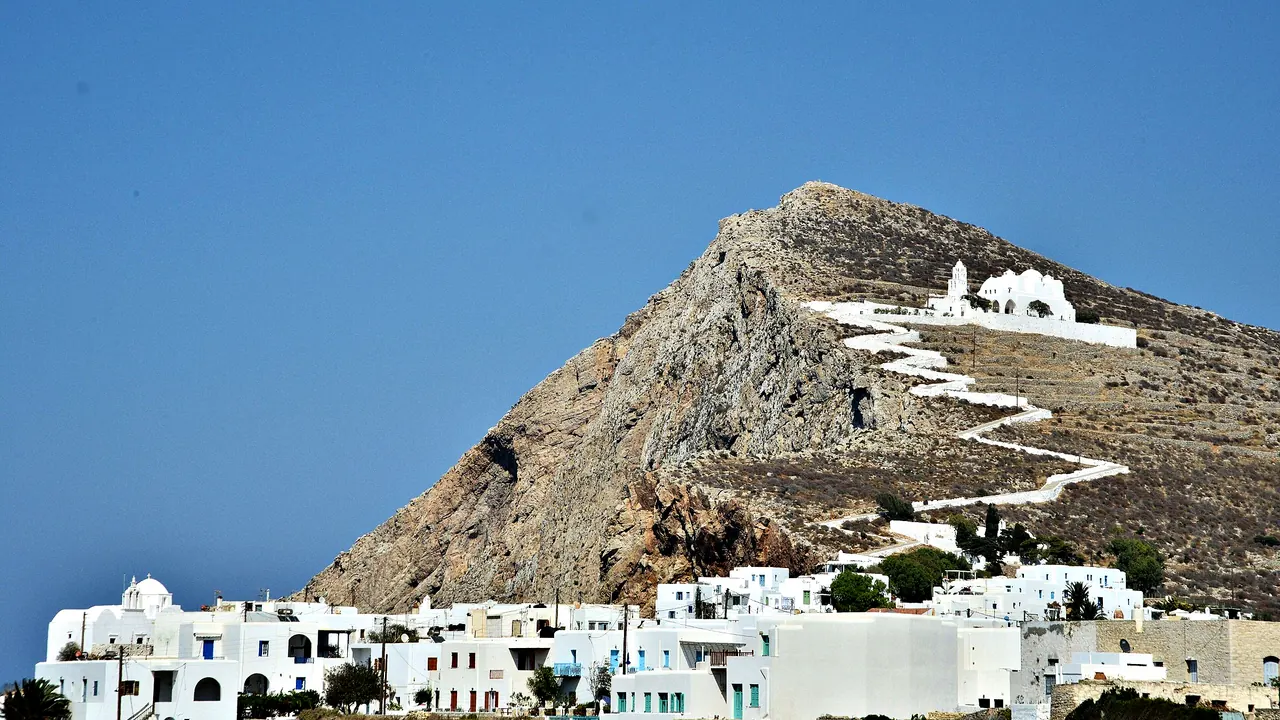
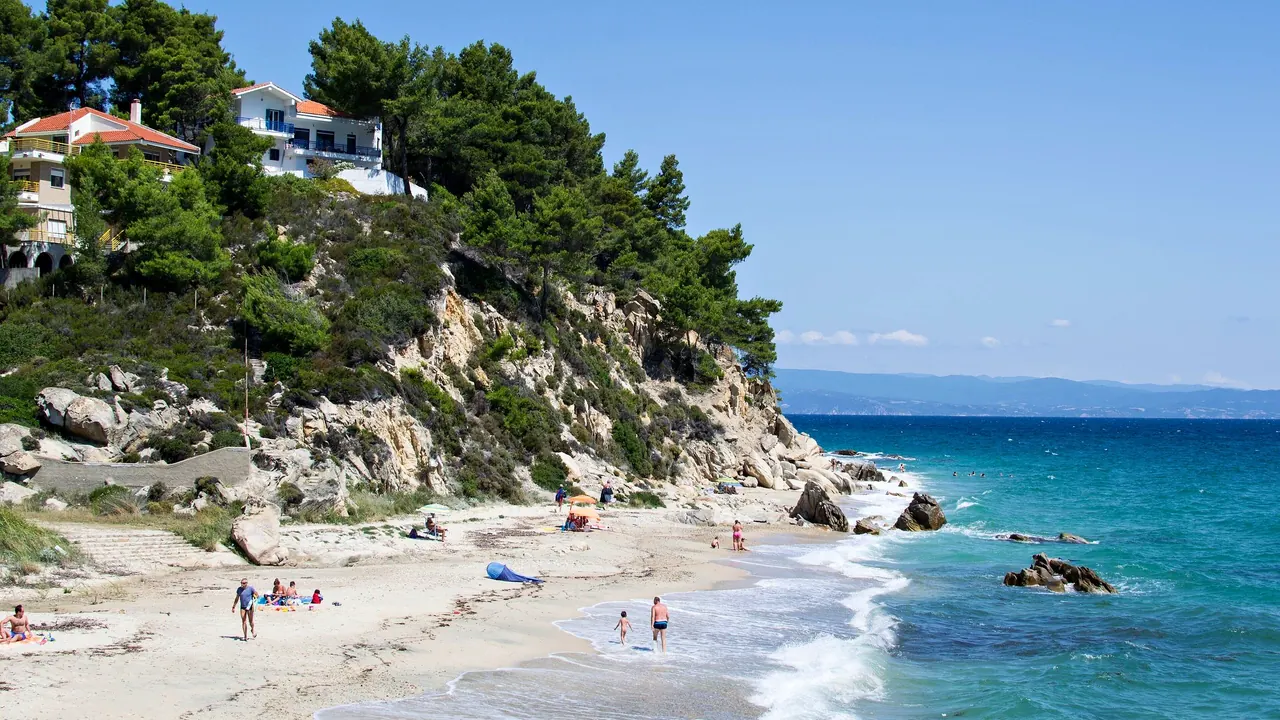
Photos: Folegandros by Chris Kar, CC BY-SA 4.0, cropped; Halkidiki by Sprint28, CC BY-SA 3.0, cropped.
Folegandros or Halkidiki?
Our verdict in twelve categories, each scored against the same fixed benchmark cities, and the climate month by month, so you can choose for your trip.
Choose Folegandros for
- getting around
Folegandros suits travellers who want one small island and nothing much to do on it. You stay in Chora, a car-free whitewashed village on a cliff edge. Your days are a walk down to a shingle cove, and your evenings are dinner under the trees in its squares. Couples and people who want to rest, walk and read will like it best. You give up sandy beaches, any real nightlife, easy day trips and low prices.
Choose Halkidiki for
- families
- day trips
- nightlife
Halkidiki is the better choice for a classic beach vacation, especially with children or as a group. It has long sandy shores with shallow water and pine forest behind them, and family resorts on Kassandra. It also has clubs at Kallithea, the coves of Sithonia, a boat trip along Mount Athos and Thessaloniki within a day's drive. It costs less too. The catch is that you need a car, and the peninsulas make every drive between them long.
Scoreboard
Twelve categories on one fixed scale from 0 to 100. The shaded stretch is the gap between the two.
Your match
Pick a travel style or drag the sliders, and both match scores follow your weighting.
Wins on getting around with your weighting.
Wins on families and day trips with your weighting.
What matters to you?
Category by category
What the scores mean for a trip.
Beaches & swimming
Folegandros has small shingle and sand coves under bare cliffs, and the water is very clear. The easy ones are Livadi, Vardia and Agali, while Katergo means a boat or a rough walk. Many coves have no shade, and the north wind decides which side of the island is sheltered on a given day.
Halkidiki has far more beach of every kind. Kassandra has long organised beaches of fine pale sand that slope gently, with pine trees behind them. Sithonia has granite coves at Kavourotrypes and Karydi, plus the long sweep of Kalamitsi. The cost is weekend crowds from Thessaloniki in high summer, which Folegandros never sees.
Food & drink
Folegandros has a cuisine of its own: matsata pasta with rooster or rabbit, soft souroto cheese and watermelon pie. Dinner in Chora's squares is a highlight of a stay. But there is little choice, and kitchens close once summer ends.
Halkidiki gives you more good meals and more places to eat them. Family tavernas in Ouranoupoli and the hill villages serve grilled octopus, mussels and the region's big green olives, alongside wine from Athos and Neos Marmaras. The Kassandra resorts can get repetitive, but Thessaloniki's restaurants are close enough for a day out.
Culture & sights
On Folegandros, the village is the sight. Chora's Kastro quarter, where the outer houses form the old defensive wall, and the zigzag path up to the Panagia church fill an afternoon. Add the small folklore museum at Ano Meria and you have seen it all.
Halkidiki has a bit more, led by the Mount Athos monasteries. Most visitors see them from a boat out of Ouranoupoli, because only men with a permit may go ashore. Ancient Olynthos, Stagira and the Petralona cave add a few modest half-days.
Nightlife
On Folegandros the evening means sitting late in Chora's squares and then going to a few small bars on the cliff edge. There are no clubs, and many visitors choose the island for exactly that.
Halkidiki has a real summer scene, almost all of it on Kassandra. Kallithea's open-air clubs stay open the latest, and Hanioti and Polychrono have bar strips that fill after midnight. Sithonia is as quiet at night as Folegandros.
Nature & outdoors
The two are equally strong but very different. Folegandros is bare and stony, with some of the highest cliffs in the Cyclades, stone-walled terraces and almost no trees. You see it on foot along its footpaths, or from a boat that passes sea caves such as Chrysospilia.
Halkidiki is green, with pine forest running down to the sea and its best scenery on Sithonia, around the slopes of Mount Itamos. There the outdoors is mostly on the water: kayaking, sailing to the Diaporos lagoon and snorkelling over rocky seabeds.
Day trips
Folegandros is a place to stay put. Summer ferries reach quiet Sikinos, Milos or Santorini, but not every day, and the wind can cancel crossings. Most people who want a second island move on rather than come back the same day.
Halkidiki is on the mainland, so a car opens up a lot. You can drive to Thessaloniki's Byzantine churches and waterfront in about an hour or so, or make a longer day of the royal tombs at Vergina and old Pella. From the Athos side you can reach Ammouliani by ferry, or Kavala and Amphipolis by road.
Good for families
Folegandros feels safe and calm, but little on the island is made for children. Only the beaches near Karavostasis and Agali are easy to reach, and the cliffs and wind need watching. It works better for older children who like walking than for toddlers.
Halkidiki is built for family beach trips. Sand that stays shallow far out at Psakoudia and on Kassandra, resorts with children's clubs and tavernas that welcome children late all make it easy. It has no theme parks or zoos, so the days still revolve around the sea.
Getting around
Once you have arrived, Folegandros is easier. A local bus links the port, Chora, Ano Meria and the Agali road, and the village itself is car-free and small enough to cross in minutes. Getting there is the hard part: there is no airport, and ferries from Piraeus can be slow or cancelled when the wind is up.
Halkidiki is easy to reach, about an hour from Thessaloniki airport, but you need a car to explore. Buses are too infrequent to rely on. Moving between peninsulas means driving back up one and down the next, so crossing from Kassandra to Athos takes a good part of the day.
Shopping & style
Neither is a place to shop. Folegandros has a few shops in Chora's lanes selling jewellery, ceramics and linen, plus island capers and thyme honey. Halkidiki has beachwear on resort strips, but its best buys are olive oil, wine, and the icons and incense sold in Ouranoupoli at the gate to Mount Athos.
Affordability
Halkidiki is easier on the budget. Most of its visitors are Greek and Balkan families who drive in, so there are plenty of simple apartments and village tavernas. Costs rise mainly at the big Kassandra resorts.
Folegandros leans towards small boutique hotels in Chora with cliff views, and in July and August they book out early. Simpler rooms near Karavostasis or in Ano Meria help. In both places, June and September cost noticeably less than the peak.
Live music & performing arts
Folegandros has no venue at all. Its music comes from the summer panigyria on saints' days, with violin and lute playing late into the night, and from the Easter procession of the Panagia icon around the island.
Halkidiki at least has a summer programme. The Kassandra Festival puts on concerts and theatre in the open-air amphitheatre at Siviri, and the Sani Festival brings jazz and classical evenings. Beyond that, Thessaloniki has the real stages.
Wellness & relaxation
Halkidiki has more in the way of actual treatments. It has the warm mineral pools at Agia Paraskevi above the sea on Kassandra's tip, and proper spas in the large resorts. Sithonia and the coast towards Ouranoupoli are the calmest bases.
On Folegandros, rest simply comes from the island's pace: no big resorts, a car-free village, and a cove in the day with a nap after. Only a handful of hotels offer treatments. It is at its most peaceful in June and September.
When should you go?
Pick your month. The climate figures are measured averages, not a forecast.
Folegandros in July
Halkidiki in July
Daytime high, °C
Rainfall in the month, mm
Where the figures come from
Folegandros has no weather station within reach, so its figures come from a gridded climate model rather than a measured record, and read a broad area rather than one spot.
Halkidiki's temperatures are measured 64 km from the centre, at Thessaloniki Airport.
Halkidiki has no rain gauge within 25 km of the centre, so its rainfall comes from a gridded climate dataset read at the destination rather than from a gauge further away.
Temperature and rainfall are climate normals, averaged over the years shown. Folegandros: 2001-2020 normals, NASA POWER reanalysis grid, no weather station within 90 km. Halkidiki: 1991-2020 normals, Thessaloniki Airport (63.7 km from centre).
The two places run on different temperatures. On Folegandros the summer is fairly mild, with highs around 27°C in August and the north wind keeping it fresh. The sea is good for swimming from June to October, and spring is the best season for walking. Halkidiki gets much hotter, reaching about 32°C in July and August, so walking or sightseeing at midday is hard work. The sea there is a little warmer, about 26°C at its peak, and summer sunshine is long and steady. June and September are the most comfortable months there for a beach trip.
The winters differ as well. Folegandros stays mild but gets most of its rain from November to February, with about 97mm in January, and most places close. Halkidiki's winter is drier but colder, with highs near 10°C. Its season closes after early October, when the rain returns.
Which traveller are you?
On a family trip with young children, Halkidiki is the clear choice. Beaches on Kassandra and around Gerakini have sand and shallow, calm water, and resorts come with pools and children's clubs. On Folegandros many coves mean a steep path down and no shade.
For a food and nightlife trip, Halkidiki has more to offer. There are fish tavernas in Nikiti and Toroni, Athos wines, open-air clubs in Kallithea and bar strips in Pefkohori. Folegandros has its own good dishes, like matsata, but evenings end in quiet bars on the lanes.
On an outdoors trip on foot, Folegandros suits walkers. Waymarked paths start in Chora and lead across a bare ridge to the western coves and Ano Meria, with no car needed. Halkidiki's outdoors is more about water, with kayaking in Sithonia and boats to Diaporos.
Before you go
| Measure | Folegandros | Halkidiki |
|---|---|---|
| Official language | Greek | Greek |
| Currency | Euro (EUR) | Euro (EUR) |
| Sockets | CF230 V, 50 Hz | CF230 V, 50 Hz |
| Driving side | Right | Right |
| Time zone | UTC+2, UTC+3 in summer | UTC+2, UTC+3 in summer |
| Emergency number | 112 | 112 |
| Main airport | Santorini International Airport (JTR)60 non-stop destinations | Thessaloniki Macedonia International Airport (SKG)93 non-stop destinations |
| Public holidays this year | 15 days | 15 days |
By the numbers
| Measure | Folegandros | Halkidiki |
|---|---|---|
| Population | - | 110,587 |
| People per km² | - | 38 |
| Swim season, months above 21 °C | 5 months | 5 months |
Where else could you go?
Every comparison below shares a destination with this one, so you can follow Folegandros or Halkidiki somewhere new.
- Iosvs Folegandros
- Milosvs Folegandros
- Sifnosvs Folegandros
- Santorinivs Folegandros
- Parosvs Folegandros
- Naxosvs Folegandros