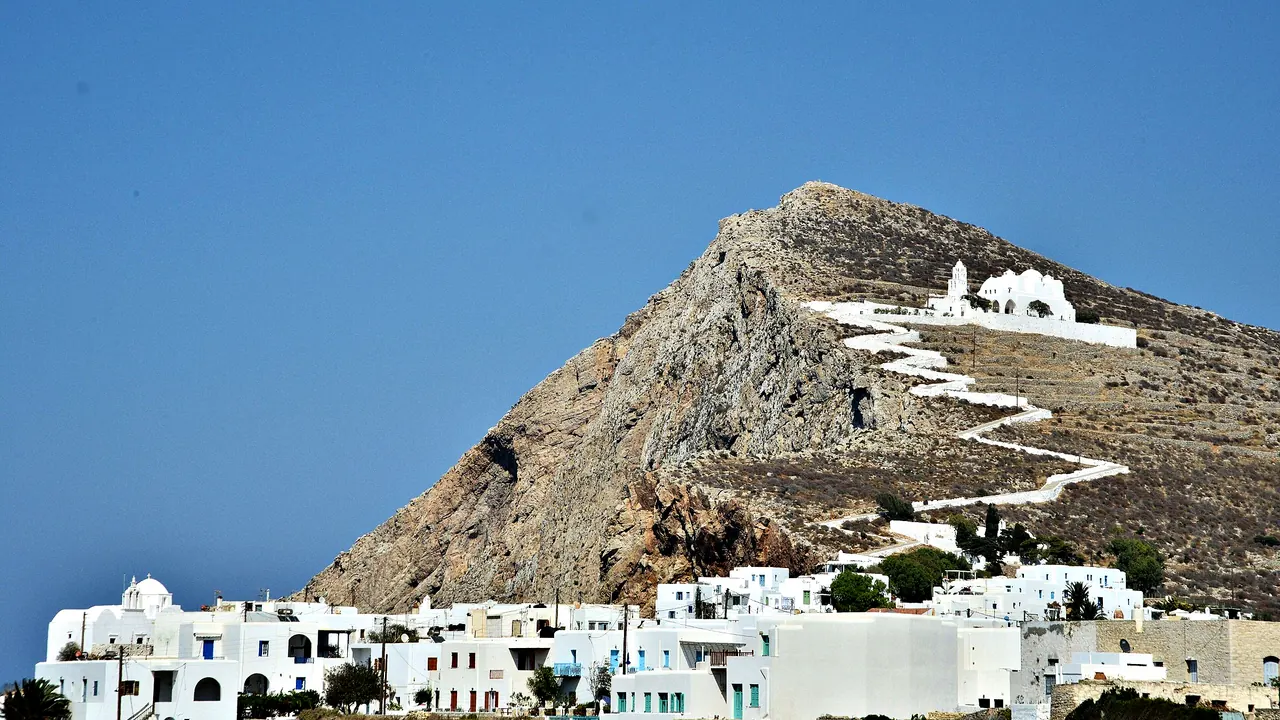
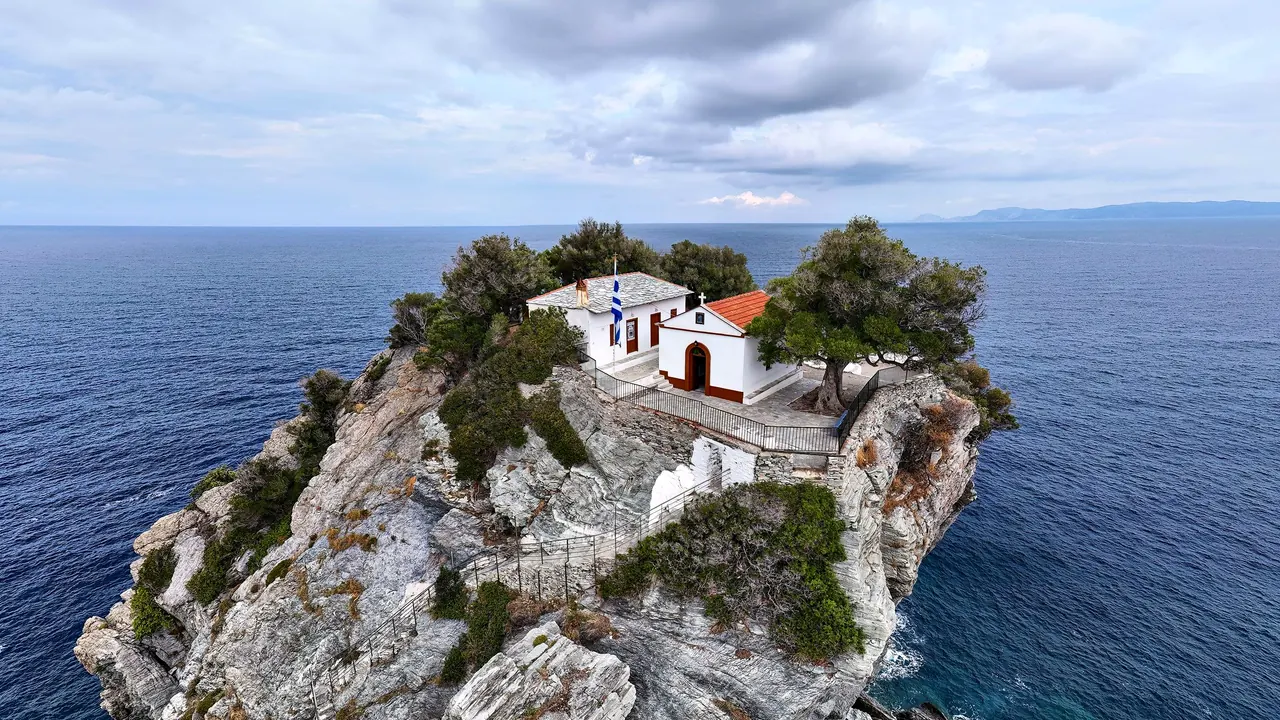
Photos: Folegandros by Chris Kar, CC BY-SA 4.0, cropped; Skopelos by Giles Laurent, CC BY-SA 4.0, cropped.
Folegandros or Skopelos?
Our verdict in twelve categories, each scored against the same fixed benchmark cities, and the climate month by month, so you can choose for your trip.
Choose Folegandros for
- getting around
- wellness
Folegandros is for travellers who want a stark, quiet Cycladic island and plan to stay put. Chora on its cliff edge, the car-free lanes of the Kastro and long evenings in the squares make it a place to slow right down, and the bare ridge and waymarked footpaths suit people who like to walk to their swim. It asks more of you: steep descents to shadeless coves, a strong summer wind and rooms that cost more than the island's simplicity suggests.
Choose Skopelos for
- families
- beaches
- prices
Skopelos suits a beach vacation with more ease and more green. Pine forest runs down to a long string of sheltered bays on the south and west coasts, many of them gentle enough for small children, and the marine park, boat trips and neighbouring Skiathos and Alonissos give a week more variety. It is the better pick for families and for anyone who wants a different cove each day without hard walking, though a hire car helps a lot.
Scoreboard
Twelve categories on one fixed scale from 0 to 100. The shaded stretch is the gap between the two.
Your match
Pick a travel style or drag the sliders, and both match scores follow your weighting.
Wins on getting around and wellness with your weighting.
Wins on families and beaches with your weighting.
What matters to you?
Category by category
What the scores mean for a trip.
Beaches & swimming
Skopelos has the better beaches, and more of them. Pine forest comes down to the shingle along the sheltered south and west coasts, from Stafylos and Velanio near town to Agnontas, Panormos, Limnonari, Milia and Kastani, so you can pick a different bay each day and usually find shade and a taverna.
Folegandros swims beautifully but asks more effort. The easy options are Livadi and Vardia near Karavostasis and Agali on the west coast, while Livadaki, Galifos and the memorable shingle bay of Katergo mean a hike or a boat, with little shade on bare cliffs. The meltemi hits both, but Skopelos has a reliably sheltered south shore to retreat to.
Food & drink
The two eat at much the same level: good, simple island cooking with a narrow range and most kitchens shut out of season. The difference is in the specialities. Folegandros has matsata, hand-rolled pasta with rooster or rabbit, souroto cheese and watermelon pie, and the setting is the tree-shaded squares of Chora at night.
Skopelos brings its coiled fried cheese pie, dishes made with plums and prunes from the old orchards, and almond sweets, with grilled fish and octopus on the harbour at Agnontas and along the Skopelos Town waterfront. One is a village-square evening, the other a harbour-side one.
Culture & sights
Neither island is a sightseeing destination, and in each the main sight is the island's town. Folegandros has the more dramatic one: Chora on a cliff rim, its medieval Kastro walled by its own houses, and the climb to the Panagia church, plus a folklore museum in Ano Meria.
Skopelos has a little more to fill the time. Its tiered harbour town of slate roofs and churches leads up to a Venetian castle, and monasteries such as Evangelistria and Prodromos sit on Mount Palouki, with Glossa and the Mamma Mia chapel of Agios Ioannis as further outings.
Nightlife
Both are quiet islands after dark, with no clubs and late music only in July and August. On Folegandros the night stays in Chora's squares and a few small bars along the cliff edge, while on Skopelos it moves between the harbour front and bars in the town's lanes, some playing Greek music late.
Nature & outdoors
The landscapes could hardly be more different. Folegandros is a bare, almost treeless ridge with some of the highest sea cliffs in the Cyclades, stone-walled terraces and juniper, and boat trips past sea caves such as Chrysospilia.
Skopelos has a slight edge for outdoor variety: it is green with Aleppo and black pine up to Mount Delfi, with olive groves and plum orchards, mule tracks between monasteries, and boat trips into the marine park where monk seals and dolphins live. Sea kayaking and sailing add to the walking, which on both is best in spring.
Day trips
On either island you mostly stay put, with outings by sea in summer. From Folegandros, Sikinos is close and Milos and Santorini are a fast boat away, though wind and patchy timetables push most people to move on rather than return the same day. Skopelos has the handier pairings: lively Skiathos a short hop away, Alonissos's old village in the other direction, and boat excursions that combine it with swims in the marine park.
Good for families
Skopelos is clearly the easier island with children, mainly because its best beaches take no effort to reach. Limnonari, Panormos and Agnontas are sheltered and shallow at the edge, pines give shade close to the shore, and the main road and summer buses run to them, so a beach day needs little planning. The weak point is Skopelos Town, whose stepped lanes are hard going with a pushchair.
On Folegandros the village is the easy part, with Chora's car-free lanes good for a stroll after dinner. The beaches are the hard part. Beyond Livadi, Agali and the bays around Karavostasis, a swim usually means a rough path or a caique to a cove with no shade, and the sheer cliffs and the meltemi keep parents watchful. Teenagers who enjoy hiking to the water will get far more out of it than toddlers.
Getting around
Neither has an airport, but Folegandros is easier once you are there. It is small, a local bus links Karavostasis, Chora, Ano Meria and the road to Agali, and Chora is a car-free village crossed on foot in minutes; the catch is the long ferry from Piraeus and crossings slowed by the north wind.
Skopelos is bigger and more spread out. Buses run the single main road from town to Glossa in summer, but for the smaller coves, the monasteries and the north coast a car or scooter on narrow, winding roads makes life much easier, and arriving usually means flying to Skiathos and taking a boat.
Shopping & style
Shopping is an after-dinner browse on both, in a few small shops selling jewellery, ceramics, linen and summer clothes. Folegandros keeps it to the lanes of Chora with honey, capers and herbs, while Skopelos has a few more shops behind the harbour and adds prunes, herbal teas and almond sweets.
Affordability
Skopelos is the easier island on the budget. Family-run studios, rooms and taverna meals are moderately priced, although the ferry, a hire car and boat excursions add up over a stay.
Folegandros costs more to sleep on, because Chora is full of small boutique hotels with cliff views that book out in July and August. Meals are fair and the bus and walking keep other costs low, and simpler rooms near Karavostasis or in Ano Meria help. On both, June and September are noticeably cheaper than the peak.
Live music & performing arts
Neither island has a theatre or concert venue, but Skopelos gives you more chances to hear live music. Rebetiko and island songs are played in tavernas and bars in Skopelos Town on summer nights, on top of the August village festivals. On Folegandros it comes down to the summer panigyria with violin and lute, the Easter procession of the Panagia icon and the odd guitar in a Chora bar.
Wellness & relaxation
Neither island has thermal springs or a bathing tradition, and on both, treatments come down to a few hotel spas. The calm comes from the pace, and Folegandros takes it a step further. There are no big resorts and only an afternoon's worth of sights, so days settle into a cove, a nap and a long evening in Chora, and switching off is the reason many people make the trip.
Skopelos is unhurried too, with late breakfasts, shaded tavernas and quiet villages, but it is a larger island that keeps tempting you out, to the monasteries on Mount Palouki, the marine park by boat, or Skiathos and Alonissos across the water. On both, June and September are the calmest months.
When should you go?
Pick your month. The climate figures are measured averages, not a forecast.
Folegandros in July
Skopelos in July
Daytime high, °C
Rainfall in the month, mm
Where the figures come from
Folegandros has no weather station within reach, so its figures come from a gridded climate model rather than a measured record, and read a broad area rather than one spot.
Skopelos's temperatures are measured 68 km from the centre, at Skyros Airport.
Skopelos has no rain gauge within 25 km of the centre, so its rainfall comes from a gridded climate dataset read at the destination rather than from a gauge further away.
Temperature and rainfall are climate normals, averaged over the years shown. Folegandros: 2001-2020 normals, NASA POWER reanalysis grid, no weather station within 90 km. Skopelos: 1998-2025, 11 years observed (rainfall 1991-2020) normals, Skyros Airport (67.7 km from centre).
Both islands have the same Aegean pattern of dry, hot summers and wet winters, and the sea is warm enough to swim from June to early October in both. Skopelos runs hotter in high summer, with afternoons around 29°C in July and August and the sea reaching about 26°C, while Folegandros stays a couple of degrees cooler, helped by the north wind that blows hard there in those months. That wind makes midsummer bearable for walking around Chora but puts hiking on Folegandros into the early morning and evening.
For walking and sightseeing, May, June and September are the sweet spot on both. Rain returns from October, and winter is wetter on Folegandros, which gets about 97mm in January, while the greener Skopelos has a little more rain in summer and in the spring and autumn shoulders. Neither is a winter destination, and Skopelos is the chillier of the two in midwinter.
Which traveller are you?
On a beach and sun trip, Skopelos is the stronger choice. Its south and west coasts hold a long run of sheltered pine-backed bays such as Panormos, Limnonari and Agnontas, while Folegandros has fewer coves, many shadeless and reached by steep paths or boat.
On a family trip with young children, Skopelos is the better base. Its sheltered bays shelve gently with tavernas a few steps from the water, Greek families welcome children at the table however late, and older ones can head out on boats, whereas Folegandros has little made for children.
For a relaxing and wellness trip, Folegandros has the edge. It is a small island with no big resorts, Chora is a car-free village made for slow evenings, and with little to see, rest is the main reason many visitors come, above all in June and September.
Before you go
| Measure | Folegandros | Skopelos |
|---|---|---|
| Official language | Greek | Greek |
| Currency | Euro (EUR) | Euro (EUR) |
| Sockets | CF230 V, 50 Hz | CF230 V, 50 Hz |
| Driving side | Right | Right |
| Time zone | UTC+2, UTC+3 in summer | UTC+2, UTC+3 in summer |
| Emergency number | 112 | 112 |
| Main airport | Santorini International Airport (JTR)60 non-stop destinations | Skiathos Island National Airport (JSI)37 non-stop destinations |
| Public holidays this year | 15 days | 15 days |
By the numbers
| Measure | Folegandros | Skopelos |
|---|---|---|
| Swim season, months above 21 °C | 5 months | 5 months |
Where else could you go?
Every comparison below shares a destination with this one, so you can follow Folegandros or Skopelos somewhere new.
- Skiathosvs Skopelos
- Iosvs Folegandros
- Milosvs Folegandros
- Sifnosvs Folegandros
- Santorinivs Folegandros
- Parosvs Folegandros