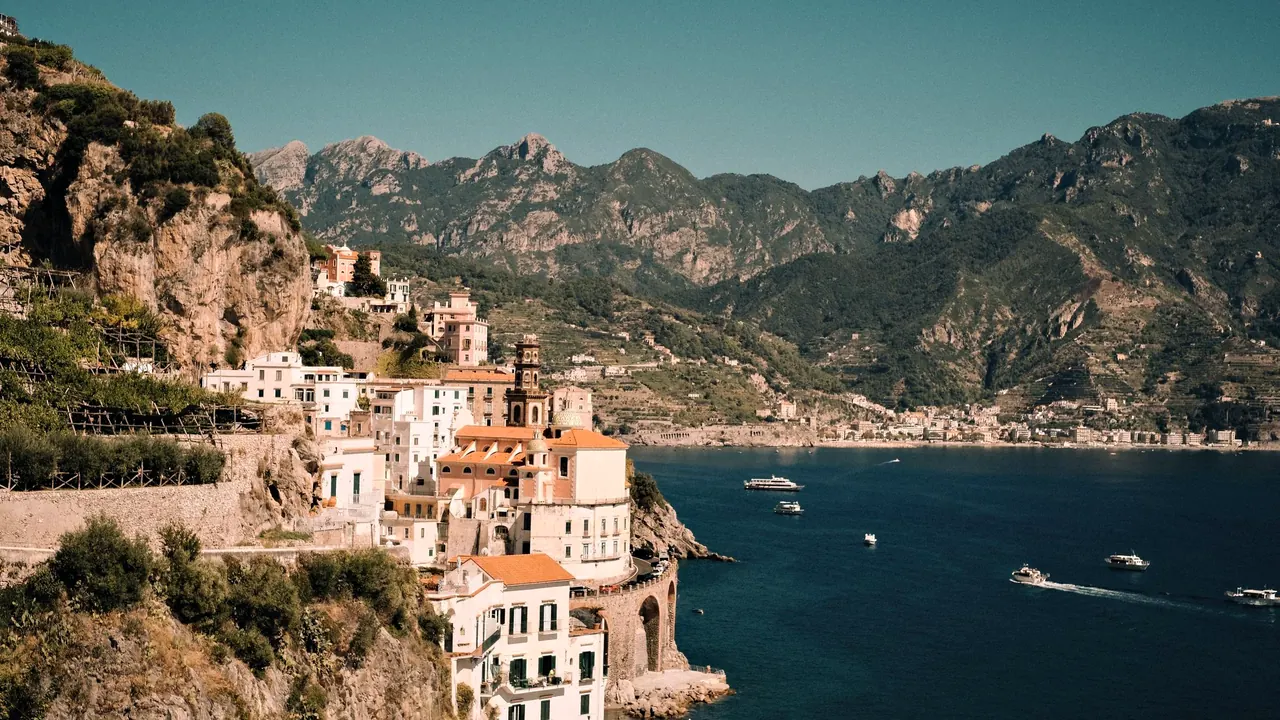
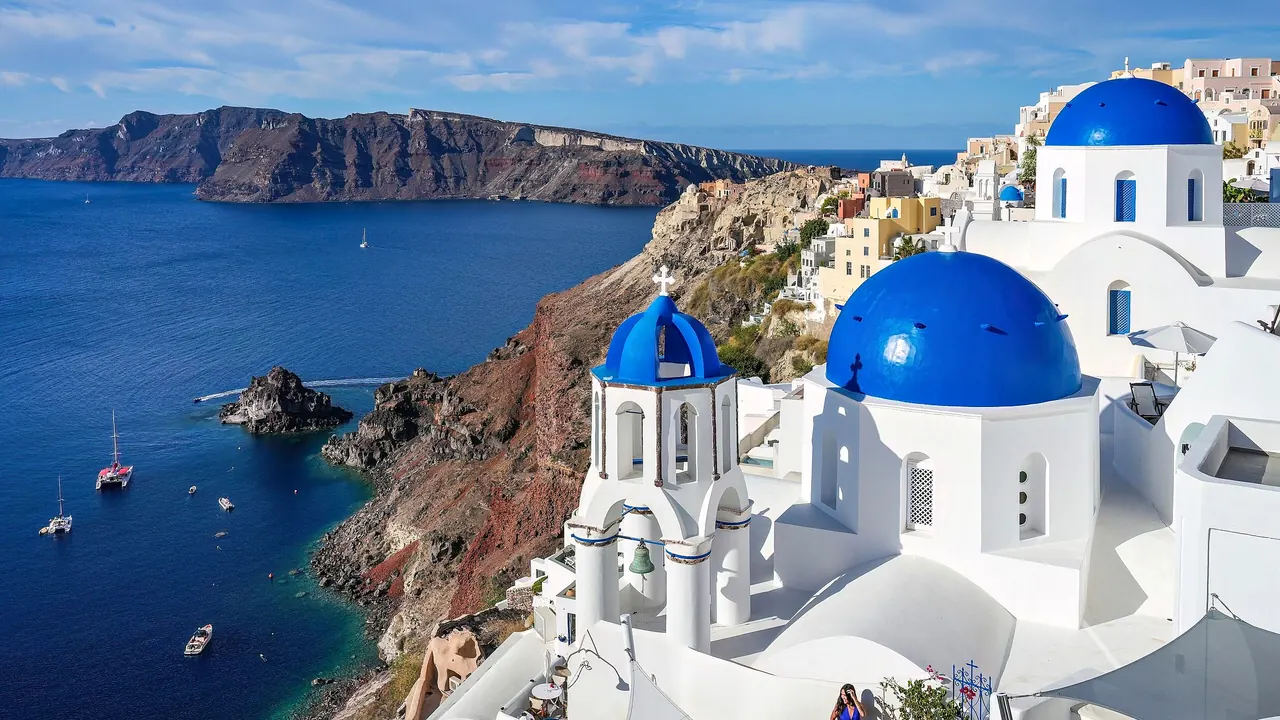
Photos: Amalfi Coast by Alina Chernii, Pexels License; Santorini by Giles Laurent, CC BY-SA 4.0, cropped.
Amalfi Coast or Santorini?
Our verdict in twelve categories, each scored against the same fixed benchmark cities, and the climate month by month, so you can choose for your trip.
Choose Amalfi Coast for
- day trips
- live music and the arts
- shopping
The Amalfi Coast suits travellers who want to be busy. You can walk the cliff paths above Positano, swim from a hired boat, spend a day at Pompeii or on Capri, and come back for a concert in the Ravello gardens. Its food, crafts and range of excursions are richer than Santorini's. In return you get a slow, crowded coast road, a lot of stairs and some of the highest prices in Europe.
Choose Santorini for
- nightlife
- getting around
- prices
Santorini is the smaller and more concentrated trip. It is a single volcanic island built around the caldera, with sunsets on the rim, wine tastings in the inland villages and the Bronze Age streets of Akrotiri. It is also the better of the two for a night out in Fira. Getting around is a little easier and a budget stay on the east coast costs a little less. Its day trips all depend on ferries, though, and after two or three days you will have seen most of the island.
Scoreboard
Twelve categories on one fixed scale from 0 to 100. The shaded stretch is the gap between the two.
Your match
Pick a travel style or drag the sliders, and both match scores follow your weighting.
Wins on day trips and live music and the arts with your weighting.
Wins on nightlife and getting around with your weighting.
What matters to you?
Category by category
What the scores mean for a trip.
Beaches & swimming
Neither destination has long sandy beaches, but the Amalfi Coast is better for swimming. Its grey-pebble coves at Positano, Atrani and the Furore fjord open onto clear, deep water under the cliffs. The best swimming is from a hired boat anchored between Positano and Amalfi, and Maiori has a proper stretch of sand.
Santorini's beaches are volcanic, with black sand and pebble that gets very hot by midday. The long strip at Perissa and Perivolos has more room and gently shelving water than most Amalfi coves. However, the meltemi wind can make the sea choppy, and anyone staying in the caldera villages has to travel down to the coast to swim.
Food & drink
The Amalfi Coast has the slightly richer table. It is built on seafood pasta, fish baked in lemon leaves, Cetara's cured anchovies and colatura, and the big Sfusato lemons that go into limoncello and granita. The sfogliatella of Conca dei Marini and mozzarella from the hills round it out.
Santorini's cooking is smaller in range: fava, tomato fritters, white aubergines and capers. Its wine is the stronger draw, with basket-trained Assyrtiko and sweet Vinsanto tasted at wineries around Pyrgos and Megalochori. On both, the meals with the best views are often not the best food. Look inland on Santorini, and uphill or one town along on the Amalfi Coast.
Culture & sights
The two are about level, but their history is very different. On the Amalfi Coast it is medieval and aristocratic. Amalfi's Arab-Norman cathedral recalls the old maritime republic, Villa Rufolo and Villa Cimbrone have gardens above the gulf, and the UNESCO-listed coastline of towns and lemon terraces is a sight in itself.
Santorini's history goes much further back. Akrotiri, the Bronze Age town buried by the eruption, is a stronger single site than anything on the Amalfi Coast, and its wall paintings can be seen in Fira. Ancient Thera and the medieval kastelli of Pyrgos and Emporio fill out a heritage that takes two or three days to see.
Nightlife
Santorini is the better choice for a late night, though only by island standards. A few lanes in Fira have cocktail bars and clubs busy into the early hours in high summer, and Kamari and Perissa have relaxed beach bars with music.
On the Amalfi Coast an evening means aperitivo with a sea view, a long dinner and café tables in Amalfi's cathedral square until about midnight. Positano has a handful of bars, but anyone looking for more has to head to Naples or Salerno.
Nature & outdoors
Mountains falling into the sea give more to do than the rim of a drowned volcano. On the Amalfi Coast the Lattari range carries the Path of the Gods, the stepped mule tracks between the villages and the shaded waterfalls of the Valle delle Ferriere. On the water there are kayaks, the Grotta dello Smeraldo and snorkelling around the Li Galli islets.
Santorini's scenery is just as striking, but there is less of it. Its main outings are the 10km rim walk from Fira to Oia and the boat to Nea Kameni's lava cone. Away from the cliffs the island is dry and treeless, and a day or two covers the main walks.
Day trips
For day trips the Amalfi Coast is far ahead. Pompeii and Herculaneum are a little over an hour away, ferries run to Capri and Salerno, and the temples of Paestum and the museums of Naples are full days within reach.
From Santorini every day out goes by sea. You can sail across to quiet Thirasia, take a fast ferry to Ios or Folegandros, or make a long day of it to Knossos on Crete. Most boats leave from Athinios, services thin out outside summer, and a windy day can cancel the plan.
Good for families
Neither is easy with young children, and for the same reasons: steep steps, crowds and hotels aimed at couples. On the Amalfi Coast the flatter towns of Maiori and Minori are the answer, with sandier beaches and a seafront promenade, and boat trips to the emerald grotto are popular with children.
Santorini's family base is the east and south coast. Kamari and Perissa have level promenades, gently shelving water and a small water park, and older children enjoy the volcano trip and Akrotiri. Many cliff hotels will not take young children, and the dark sand gets very hot.
Getting around
Santorini is easier to get around. Distances are short, buses run out from Fira to the beaches and Oia, and hiring a car or scooter is a realistic option, although parking in Oia and Fira is scarce.
The Amalfi Coast depends on one narrow cliff road that jams for hours in summer, and its buses fill quickly. Many visitors do without a car. From spring to autumn they use the ferries between Positano, Amalfi and Salerno, which double as sightseeing.
Shopping & style
Local crafts tip the balance towards the Amalfi Coast. Positano has linen boutiques and sandal makers who fit a pair while you wait, Amalfi sells handmade paper, and Vietri sul Mare has hand-painted majolica.
Santorini's shops are mostly jewellers, galleries and resort-wear in the lanes of Oia and Fira, alongside a lot of souvenirs. The best things to take home are Vinsanto, Assyrtiko and capers. There are no markets, and most shops close for the winter.
Affordability
Both are expensive, and Santorini is a little less so. Its east coast, at Kamari and Perissa, has plenty of family-run studios well below caldera-view prices. With buses and village tavernas, a careful stay there is quite manageable.
On the Amalfi Coast, a room, meal or sunbed by the sea costs more than almost anywhere else in southern Italy. Maiori, Minori, Atrani and Agerola soften the bill without changing the picture much. On both, the months outside high summer are cheaper.
Live music & performing arts
The Amalfi Coast has a real reason to plan around music. Ravello's summer festival puts orchestras on a stage built out over the cliff at Villa Rufolo, and a chamber series fills the town's churches and halls on many warm evenings.
Santorini has one late-summer classical festival in Fira and the occasional concert in an old mansion or winery. Most evenings the only live music is a guitarist in a taverna.
Wellness & relaxation
The two are roughly level, and neither has a bathing tradition of its own. The Amalfi Coast's version is quiet towns rather than spa culture: the gardens of Ravello, peaceful Atrani and Praiano, and hotel spas with seawater pools. For real thermal baths you need a long ferry day to Ischia.
Santorini's version is the cave suite with a heated plunge pool facing the caldera, in Imerovigli or Oia. It also has something the Amalfi Coast lacks, a swim into the warm, rust-coloured spring water off Palea Kameni. The inland wine villages are the calmest places to stay.
When should you go?
Pick your month. The climate figures are measured averages, not a forecast.
Amalfi Coast in July
Santorini in July
Daytime high, °C
Rainfall in the month, mm
Where the figures come from
Amalfi Coast's temperatures are measured 65 km from the centre, at Grazzanise.
Amalfi Coast has no rain gauge within 25 km of the centre, so its rainfall comes from a gridded climate dataset read at the destination rather than from a gauge further away.
Santorini's station stands 182 m below the place it is measured for, so that place is likely a little cooler than the figures say.
Santorini has no rain gauge within 25 km of the centre, so its rainfall comes from a gridded climate dataset read at the destination rather than from a gauge further away.
Temperature and rainfall are climate normals, averaged over the years shown. Amalfi Coast: 1991-2020 normals, Grazzanise (64.7 km from centre). Santorini: 2000-2025, 12 years observed (rainfall 1991-2020) normals, Santorini Island / Monólithos (5 km from centre).
On the Amalfi Coast the sea is warm enough to swim from June to early October and reaches about 26°C in August, a little warmer than around Santorini. July and August are the sunniest and driest months, but daytime highs of 31°C make the stairs and trails hard going by midday. The rain comes back in September and builds through the autumn to a wet November of around 143mm. Late May, June and September are the best balance for walking and swimming.
Santorini has the drier summer by far. From May to September it hardly rains at all, and July is completely dry. Summer highs are about the same as on the Amalfi Coast, and the sea peaks a little lower at around 24°C, but it stays at that warmth into September. Spring and autumn are better for walking the rim, because there is no shade. Winters are slightly milder and less wet than on the Amalfi Coast.
Which traveller are you?
For an outdoors trip, choose the Amalfi Coast. The Path of the Gods, the mule tracks below Ravello and the wooded gorge of the Valle delle Ferriere offer far more walking than Santorini's rim path. It also has sea caves and snorkelling around Punta Campanella.
On a trip on a tight budget, Santorini is the easier of two expensive places. Studios in Kamari or Perissa, gyros counters and the public bus can keep costs down. Cheap bases on the Amalfi Coast are fewer, and costs pile up quickly in season.
On a food and nightlife trip, Santorini comes out ahead because of its evenings. Fira has cocktail bars and clubs that stay open into the early hours, and the island's Assyrtiko wineries add something to the days. The Amalfi Coast eats slightly better but is very quiet after dinner.
Before you go
| Measure | Amalfi Coast | Santorini |
|---|---|---|
| Official language | Italian | Greek |
| Currency | Euro (EUR) | Euro (EUR) |
| Sockets | CFL230 V, 50 Hz | CF230 V, 50 Hz |
| Driving side | Right | Right |
| Time zone | UTC+1, UTC+2 in summer | UTC+2, UTC+3 in summer |
| Emergency number | 112 | 112 |
| Main airport | Naples International Airport (NAP)131 non-stop destinations | Santorini International Airport (JTR)60 non-stop destinations |
| Public holidays this year | 13 days | 15 days |
By the numbers
| Measure | Amalfi Coast | Santorini |
|---|---|---|
| Population | - | 17,430 |
| People per km² | - | 220 |
| Swim season, months above 21 °C | 5 months | 5 months |
Where else could you go?
Every comparison below shares a destination with this one, so you can follow Amalfi Coast or Santorini somewhere new.
- Caprivs Amalfi Coast
- Iosvs Santorini
- Naplesvs Amalfi Coast
- Ischiavs Amalfi Coast
- Naxosvs Santorini
- Parosvs Santorini