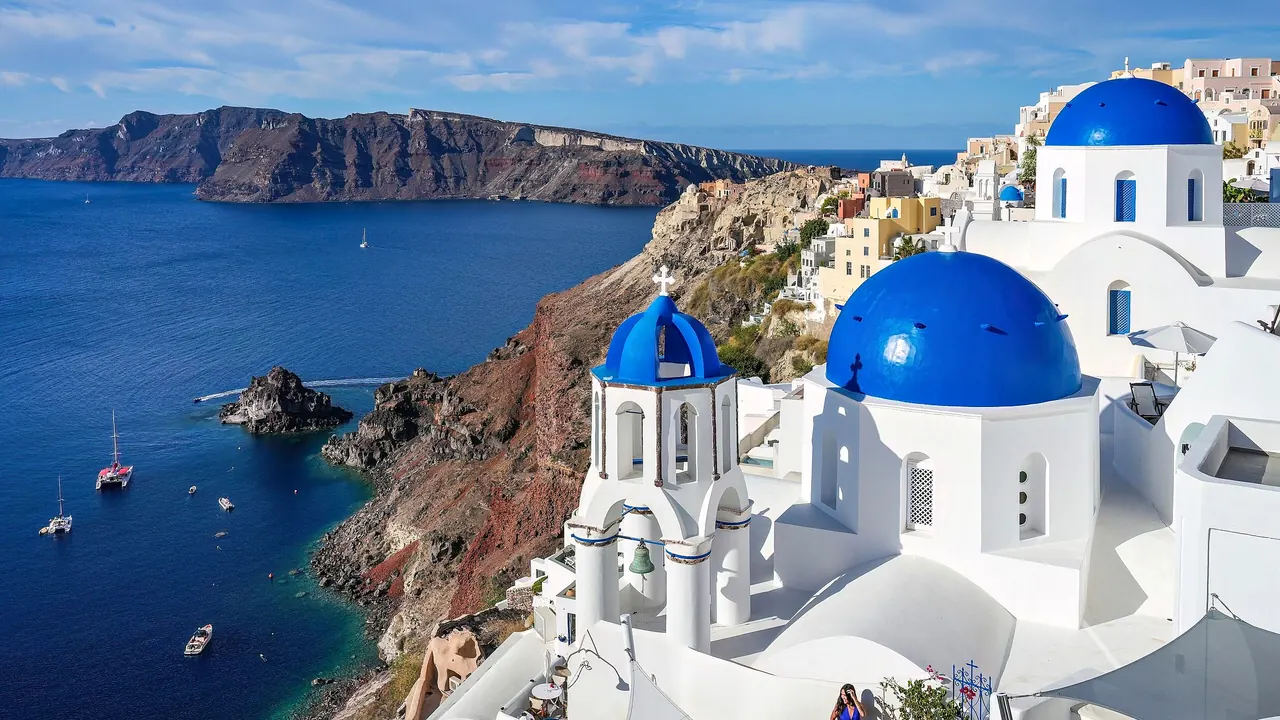
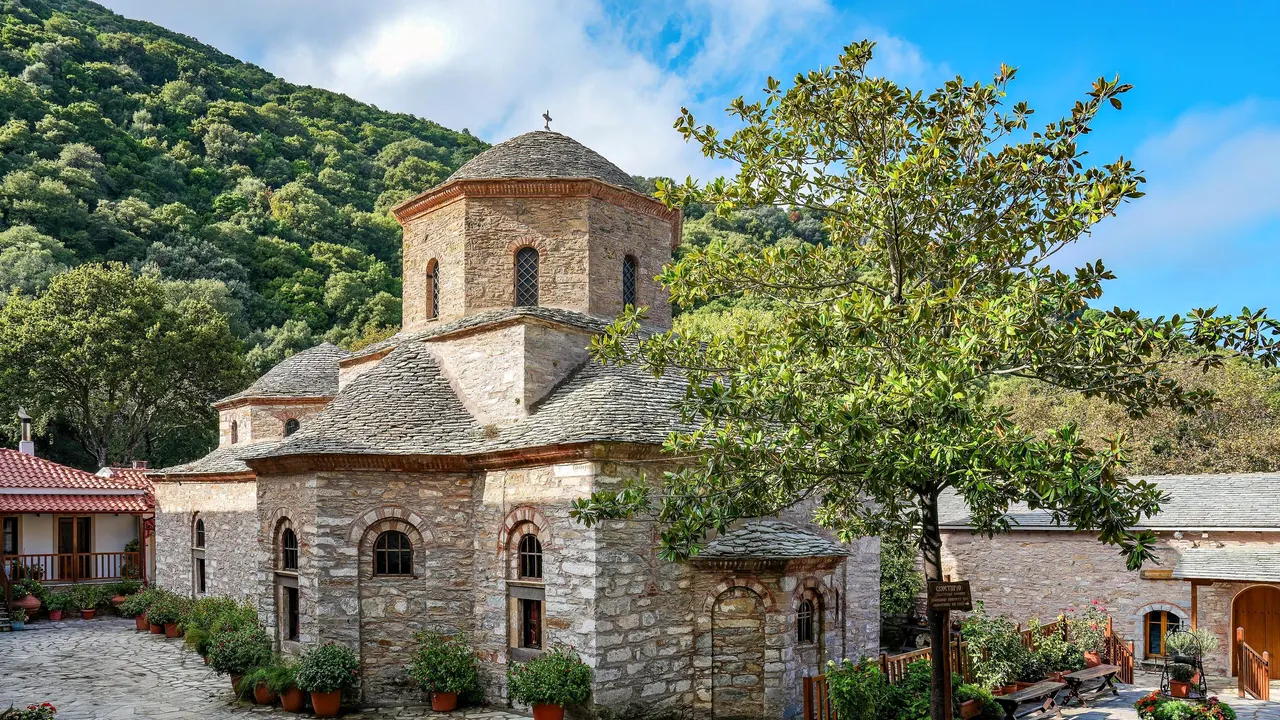
Photos: Santorini by Giles Laurent, CC BY-SA 4.0, cropped; Skiathos by Giles Laurent, CC BY-SA 4.0, cropped.
Santorini or Skiathos?
Our verdict in twelve categories, each scored against the same fixed benchmark cities, and the climate month by month, so you can choose for your trip.
Choose Santorini for
- culture and sights
- food and drink
- nature and the outdoors
Santorini suits a traveller who wants the island itself to be the spectacle. The caldera cliffs, the Bronze Age streets of Akrotiri, the whitewashed villages hanging over the drowned volcano and the Assyrtiko wineries inland make it a trip for looking, walking and tasting. It fits couples on a special-occasion trip who accept that the beach is secondary and the bill is high.
Choose Skiathos for
- beaches
- prices
- families
If the aim is long days by the water, Skiathos is the better choice. Its sandy, pine-backed coves along the south coast are the reason to go, the sea is calm for children, the town has a livelier summer night out, and staying there costs noticeably less. You give up depth: there is little to see beyond the beaches, and the food is pleasant rather than memorable.
Scoreboard
Twelve categories on one fixed scale from 0 to 100. The shaded stretch is the gap between the two.
Your match
Pick a travel style or drag the sliders, and both match scores follow your weighting.
Too close to call, 1 point apart
Wins on culture and sights and food and drink with your weighting.
Wins on beaches and prices with your weighting.
What matters to you?
Category by category
What the scores mean for a trip.
Beaches & swimming
This is Skiathos's ground. Its coves are pale sand or fine shingle with pine forest running almost to the water, and there are dozens of them: Koukounaries and Banana Beach at the western tip, quieter bays near town, wilder ones on the north coast, and Lalaria's white pebbles by boat. The southern side is usually calm, and a short ride finds a less crowded cove.
Santorini's beaches are another kind of place altogether: black sand and pebble below red and grey volcanic cliffs at Kamari, Perissa and Perivolos, with Red Beach small and dramatic. They are pleasant for a swim, but the sand burns by midday, and anyone staying on the caldera rim has to travel down to reach them.
Food & drink
Santorini eats and drinks better, mostly because of its volcanic soil. Fava, tomato fritters, white aubergines and capers are distinctly local, and the basket-trained Assyrtiko vines and old Vinsanto tradition make winery tastings around Pyrgos and Megalochori a highlight of the trip. The catch is the caldera rim, where many places charge for the sunset rather than the cooking.
Skiathos serves straightforward island food: grilled octopus, fish on the harbour, Sporades pies and shady beach-taverna lunches. It is honest if you choose carefully, but it has no wine country or local speciality to build days around.
Culture & sights
Santorini has the far deeper heritage. Akrotiri, a Bronze Age town preserved under volcanic ash, ranks among the great archaeological sites of the Aegean, and Ancient Thera, the Prehistoric Thera museum and the fortified medieval cores of Pyrgos and Emporio add to it. The cliff villages themselves, with their cave houses and captains' mansions, are part of the sightseeing.
On Skiathos culture is a pleasant extra rather than a draw. The Papadiamantis house, the woodland Evangelistria Monastery and the clifftop Kastro ruins make good outings, and all of them fit into a couple of days.
Nightlife
Skiathos goes out harder. Its bar street climbing from the harbour fills after midnight, waterfront clubs run till morning in high summer, and Banana Beach hosts afternoon parties, all with a young international crowd.
Santorini's evenings centre on sunset, dinner and a cocktail with a view, which suits couples more than night owls. A few lanes in Fira carry the late scene, and the beach bars of Kamari and Perissa stay relaxed.
Nature & outdoors
Santorini's landscape is the more extraordinary one. You walk the 10km cliff path from Fira to Oia along the rim of a flooded volcano, climb the lava cone of Nea Kameni by boat, sail the caldera or dive its submerged walls. Away from the cliffs the land is bare and dry, and summer walking is shadeless.
Skiathos is gentle and green instead, with pine and oak hills crossed by old footpaths, the Strofilia wetland behind Koukounaries, and sea caves on the north coast. Kayaking, windsurfing and dolphin-spotting trips towards the Alonissos marine park round it out, but nothing is high or wild.
Day trips
Both islands look outward by ferry, and the choice from each is about even. From Santorini the range is wider: Thirasia across the caldera, Ios, Folegandros, Naxos and Paros, even Knossos on Crete for a long day. But everything leaves from Athinios, and services thin outside summer.
Skiathos has fewer options that are easier to reach. Skopelos, with its stacked harbour town and the clifftop chapel of Agios Ioannis, is an hour away, and Alonissos makes a longer day. Pelion on the mainland is better kept for an overnight stay.
Good for families
Santorini is the harder island with children, and it works only from the east and south coast. Kamari and Perissa have flat promenades and beachfront tavernas, and Perissa adds a small water park, but the dark sand heats up fast in high summer, so children need shoes and a shaded break at midday. Older children get the most out of it, because the boat out to climb the lava cone of Nea Kameni and the excavated streets of Akrotiri are real adventures, while the stepped, crowded rim villages are best kept for a short evening visit.
Skiathos comes out ahead because the sea fills the days with little effort. Nothing is built for children, with no waterparks, zoos or museums for young visitors, but long days on the southern sand, boat trips round the island and the planes coming in very low over the road at the end of the runway keep most ages happy. The main thing to watch is the coast road, which is busy with scooters and quad bikes in summer and short of pavements, and families usually stay away from the bar streets in town.
Getting around
Skiathos is simpler. One road links the town to Koukounaries with a bus along it, water taxis serve many beaches, and the airport and ferry harbour sit at the edge of town. The north coast and the Kastro still need a scooter, jeep or boat.
On Santorini distances are short, but every bus route runs through Fira, the buses are packed in summer, and parking in Oia and Fira is very scarce. Many visitors end up hiring a car or quad, and Fira is the practical base without one.
Shopping & style
Santorini offers more to browse, though it is aimed at well-funded couples. Galleries showing island artists, jewellers near the Fira cathedral and linen boutiques line the cliff lanes, and the best buys are bottles of Assyrtiko and Vinsanto with jars of capers and fava.
Skiathos keeps to one main street of sandals, summer clothes, honey and souvenirs, fine for an evening stroll and little more.
Affordability
Skiathos is clearly the cheaper stay. Studios and family-run rooms are plentiful, taverna meals and the island bus are reasonable, and June or September brings prices down while the sea is still warm.
Santorini charges for its view. Caldera cave suites and sunset dinners are among the costliest in Greece, and boat trips and tastings add up. Staying in Kamari or Perissa and walking up to the rim for sunset is how budget travellers manage it.
Live music & performing arts
Neither island is a place to plan around performances. Santorini has the one fixture of note, an international classical music festival in Fira at the end of summer, plus occasional concerts in old wineries and mansions. Skiathos offers summer evenings at the open-air theatre on the Bourtzi and traditional music and dancing at village saints' day festivals.
Wellness & relaxation
Santorini has the edge for a pampered stay. Cliff cave hotels in Imerovigli and Oia have heated plunge pools and spa treatments facing the caldera, and boats stop at Palea Kameni for a swim in warm volcanic spring water. Imerovigli and the wine villages are calm, while the rim at Oia and Fira fills with crowds.
Skiathos's restfulness lies in its pace rather than its spas: slow mornings, cool pine shade and quiet evenings on the north coast. Resort hotel spas cover the rest, and nights in town are loud in high season.
When should you go?
Pick your month. The climate figures are measured averages, not a forecast.
Santorini in July
Skiathos in July
Daytime high, °C
Rainfall in the month, mm
Where the figures come from
Santorini's station stands 182 m below the place it is measured for, so that place is likely a little cooler than the figures say.
Santorini has no rain gauge within 25 km of the centre, so its rainfall comes from a gridded climate dataset read at the destination rather than from a gauge further away.
Skiathos's temperatures are measured 60 km from the centre, at Anchialos Airport.
Skiathos has no rain gauge within 25 km of the centre, so its rainfall comes from a gridded climate dataset read at the destination rather than from a gauge further away.
Temperature and rainfall are climate normals, averaged over the years shown. Santorini: 2000-2025, 12 years observed (rainfall 1991-2020) normals, Santorini Island / Monólithos (5 km from centre). Skiathos: 1998-2020 (rainfall 1991-2020) normals, Anchialos Airport (59.8 km from centre).
Both islands are summer places, warm enough for the beach from June to early October, with the sea at its warmest in August. Skiathos runs hotter in high summer, around 32°C in July and August, and its sea is slightly warmer at about 26°C. That suits lying in pine shade by the water but makes walking the hill paths hard work. Santorini peaks a little cooler, but its rim and villages have almost no shade, so midday walking there is tiring too. Its summers are almost completely dry, while Skiathos gets the odd shower even in July.
For walking and sightseeing, both are at their best in April, May and October, when days are comfortably warm. In winter the two part ways. Santorini turns the wetter of the two, with close to 100mm of rain in January, while Skiathos is cooler but rather less rainy. Neither is a beach destination from November to April.
Which traveller are you?
On a beach and sun trip, Skiathos wins clearly. It has dozens of sandy and shingle coves backed by pines, Koukounaries among the finest in Greece, and calm southern water, while Santorini's dark, hot volcanic beaches are a side attraction to the caldera.
For a culture and arts trip, Santorini is far richer. Akrotiri's buried Bronze Age town, its frescoes in Fira, Ancient Thera on its ridge and the medieval kastelli of Pyrgos and Emporio fill several days, where Skiathos offers a monastery, a museum house and the Kastro ruins.
On a family trip with young children, Skiathos is much easier. The airport is minutes from the beaches, the sand shelves gently into calm sea, and tavernas welcome children. Santorini's stepped cliff villages defeat pushchairs, and many of its cliff hotels turn away small children.
Before you go
| Measure | Santorini | Skiathos |
|---|---|---|
| Official language | Greek | Greek |
| Currency | Euro (EUR) | Euro (EUR) |
| Sockets | CF230 V, 50 Hz | CF230 V, 50 Hz |
| Driving side | Right | Right |
| Time zone | UTC+2, UTC+3 in summer | UTC+2, UTC+3 in summer |
| Emergency number | 112 | 112 |
| Main airport | Santorini International Airport (JTR)60 non-stop destinations | Skiathos Island National Airport (JSI)37 non-stop destinations |
| Public holidays this year | 15 days | 15 days |
By the numbers
| Measure | Santorini | Skiathos |
|---|---|---|
| Population | 17,430 | - |
| People per km² | 220 | - |
| Swim season, months above 21 °C | 5 months | 5 months |
Where else could you go?
Every comparison below shares a destination with this one, so you can follow Santorini or Skiathos somewhere new.
- Skopelosvs Skiathos
- Iosvs Santorini
- Folegandrosvs Santorini
- Naxosvs Santorini
- Parosvs Santorini
- Sifnosvs Santorini