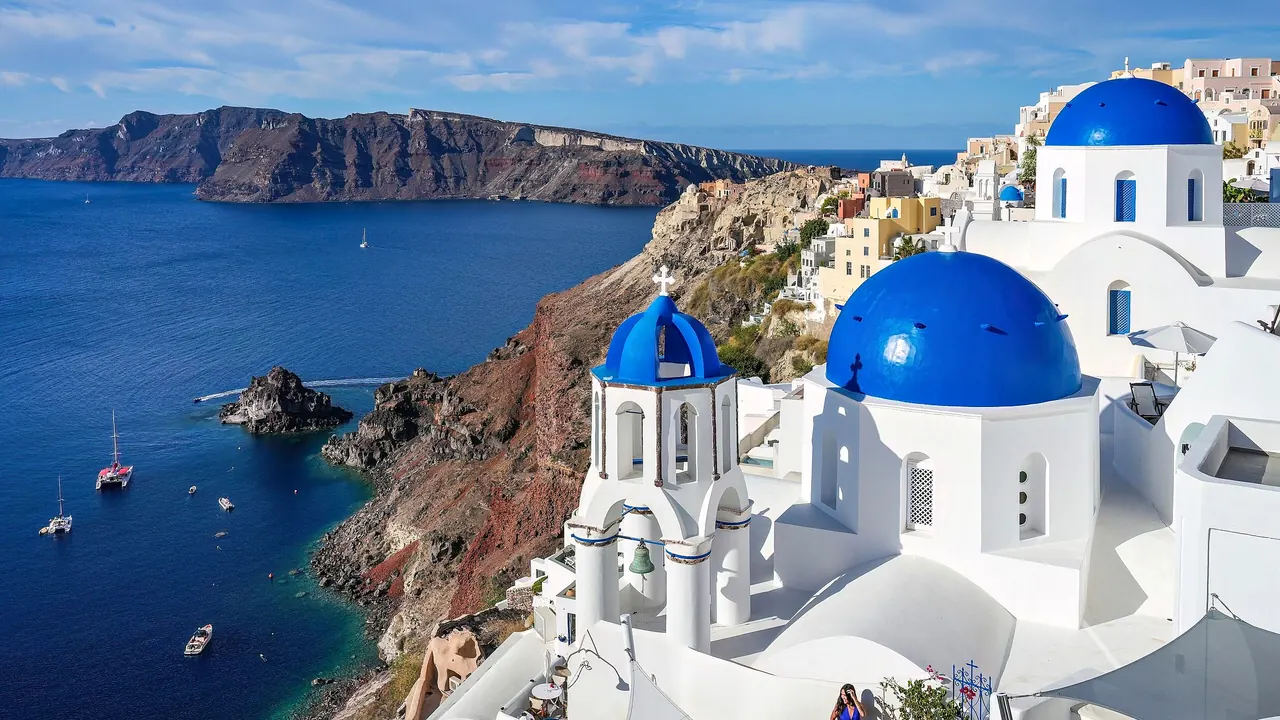
Photos: Santorini by Giles Laurent, CC BY-SA 4.0, cropped.
Kefalonia or Santorini?
Our verdict in twelve categories, each scored against the same fixed benchmark cities, and the climate month by month, so you can choose for your trip.
Choose Kefalonia for
- prices
- beaches
- families
Kefalonia suits travellers who want the beach to be the point of the trip and don't mind driving to reach it. Myrtos, Petani and the sandy south give a choice of coves in very clear water, Mount Ainos and its fir forest add green walking country, and rooms and meals cost less. Families with small children will find gentle sand at Skala and Lourdas. What you give up is history and late nights: the 1953 earthquake left little old architecture standing, and evenings end early.
Choose Santorini for
- culture and sights
- nightlife
- shopping
Pick Santorini for the sights and the setting rather than the swimming. Akrotiri's buried Bronze Age town, the cliff villages above the caldera and the volcanic wine country pack a short stay with things to see, eat and drink, and Fira offers more of a night out than anywhere on Kefalonia. It costs a good deal more, its dark beaches are a side attraction rather than the main event, and it suits couples better than young families.
Scoreboard
Twelve categories on one fixed scale from 0 to 100. The shaded stretch is the gap between the two.
Your match
Pick a travel style or drag the sliders, and both match scores follow your weighting.
Too close to call, 2 points apart
Wins on prices and beaches with your weighting.
Wins on culture and sights and nightlife with your weighting.
What matters to you?
Category by category
What the scores mean for a trip.
Beaches & swimming
Beaches are Kefalonia's strongest card, and it comes out well ahead. Its coves are spread around a large island. Myrtos and Petani have white pebble below green cliffs, Xi has reddish sand in shallow water, and Skala and Lourdas have long stretches of sand. The water is exceptionally clear, and the coves are worth driving between.
Santorini's beaches are black sand and pebble below cliffs of red, grey and ochre rock. Perissa, Perivolos and Kamari are well set up with sunbeds, but the dark sand gets very hot and the meltemi can churn the sea. Most visitors treat a beach day as a break from the caldera rather than the reason for coming.
Food & drink
Santorini eats and drinks better. Its volcanic soil gives intense small produce such as fava, cherry tomatoes and capers. The wine is the real attraction: Assyrtiko from basket-trained vines and sweet Vinsanto, tasted at wineries around Pyrgos and Megalochori. Avoid restaurants that charge mainly for the sunset.
Kefalonia's cooking is plainer and more homely: meat pie, salt cod with aliada and thyme honey in family tavernas by the harbours. Robola from the Omala valley makes a pleasant tasting outing, but outside Argostoli the menus repeat themselves.
Culture & sights
Santorini has far more to see. Akrotiri, a Bronze Age town preserved under volcanic ash, is a sight of real importance, and its wall paintings continue in the museum in Fira. Add Ancient Thera, the cliff villages with their captains' mansions and the fortified inland cores of Pyrgos and Emporio.
On Kefalonia the 1953 earthquake wiped out most old buildings, so its heritage comes in fragments: Venetian Fiskardo, the castles at Assos and Agios Georgios, a Mycenaean tomb and the ruined village of Old Vlachata. They make good outings but rarely shape a trip.
Nightlife
Neither island is a party destination, but Santorini offers more after dark. A few lanes in Fira have cocktail bars and small clubs that run into the early hours in high summer, and Kamari and Perissa add beach bars with music.
Kefalonia's evenings are a long dinner followed by a drink on the Lithostroto in Argostoli, along the bar strip at Lassi or by the harbour at Skala or Fiskardo. Outside July and August most places close before midnight.
Nature & outdoors
Both islands offer strong scenery, but of very different kinds. Kefalonia is green and mountainous. Mount Ainos has its fir forest and semi-wild horses, Melissani and Drogarati are caves to go underground in, turtles feed in Argostoli harbour, and kayaking and sailing towards Ithaca are the main activities.
Santorini is one dramatic, treeless volcano. The 10km rim path from Fira to Oia, the climb up the lava cone of Nea Kameni and sailing or diving inside the flooded caldera are unforgettable, but you can cover them in a day or two.
Day trips
Both islands rely on boats for their outings, and neither has a long list. From Kefalonia the easy choice is Ithaca, a short crossing from Sami to Vathy and the fishing villages. Summer boats also reach northern Zakynthos and Lefkada, and Fiskardo and Paliki make good drives within the island.
Santorini has a wider spread of Cycladic islands within reach, from quiet Thirasia to Ios, Folegandros, Naxos and even Knossos on Crete. However, nearly everything leaves from the one port at Athinios, and wind can cancel crossings.
Good for families
Kefalonia is the easier island with children. The gently shelving sand at Skala, Lourdas and Xi, the boat ride through Melissani and turtle spotting fill days well, though the drives between sights are long and winding.
On Santorini, the stepped, crowded caldera villages are hard work with a pushchair, and some cliff hotels turn small children away. Families do best on the flat seafronts of Kamari and Perissa, where there is a small water park, but the dark sand gets very hot in high summer.
Getting around
Santorini is the easier island to get around, mainly because it is small: no drive takes more than about an hour. Buses link everything through Fira, so staying there works without a car, though in summer the buses are packed and parking in Oia is scarce.
Kefalonia is large and mountainous. Argostoli to Fiskardo alone is about an hour and a half on winding roads, and the buses run too rarely to rely on, so a hire car is close to essential.
Shopping & style
Santorini has more to browse, all of it in the cliff-top lanes of Oia and Fira. You'll find galleries of island artists, jewellers near Fira's cathedral, linen, ceramics and plenty of souvenirs, though there are no markets or high street.
Kefalonia offers little beyond everyday shops on Argostoli's Lithostroto and a few boutiques in Fiskardo. On both islands the best things to take home are edible: Robola, thyme honey and mandoles on one, and Assyrtiko, Vinsanto and capers on the other.
Affordability
Kefalonia is clearly the cheaper choice. Apartments and small hotels around Skala, Lourdas and Lassi are good value, and taverna meals are reasonably priced. Hiring a car and staying in Fiskardo or Assos are the main extra costs.
On Santorini the view drives the price. Cave suites on the rim in Oia and Imerovigli cost more than almost anywhere in Greece. Even budget travellers end up staying in Kamari or Perissa and walking up to the rim just for the sunset.
Live music & performing arts
Neither island has a theatre, opera or regular concert season. What differs is the kind of music you might hear. Kefalonia has its own tradition: kantades serenades and an old philharmonic band, best heard at village festivals and open-air concerts in Argostoli in summer. Santorini's main event is an international classical festival held in Fira at the end of summer, plus occasional concerts in old mansions and wineries.
Wellness & relaxation
Kefalonia slows you down through its pace rather than pampering, and it has no spa or bathing tradition of its own. Long lunches in hill villages, harbour evenings in Assos and Fiskardo and quiet stays on Paliki or the north-east coast make it easy to unwind. Treatments mean the spas of the larger resort hotels around Lassi and Skala.
Santorini's idea of rest is more polished: a luxury cave hotel in Imerovigli or Oia, with a heated plunge pool facing the caldera. Boats also stop off Palea Kameni so you can swim into its warm, rust-coloured spring water. Day crowds on the rim can break the calm, so Imerovigli and the wine villages of Pyrgos and Megalochori make quieter bases.
When should you go?
Pick your month. The climate figures are measured averages, not a forecast.
Kefalonia in July
Santorini in July
Daytime high, °C
Rainfall in the month, mm
Where the figures come from
Kefalonia's temperatures are measured 59 km from the centre, at Zakinthos / Agrilia.
Kefalonia has no rain gauge within 25 km of the centre, so its rainfall comes from a gridded climate dataset read at the destination rather than from a gauge further away.
Santorini's station stands 182 m below the place it is measured for, so that place is likely a little cooler than the figures say.
Santorini has no rain gauge within 25 km of the centre, so its rainfall comes from a gridded climate dataset read at the destination rather than from a gauge further away.
Temperature and rainfall are climate normals, averaged over the years shown. Kefalonia: 1991-2020 normals, Zakinthos / Agrilia (58.6 km from centre). Santorini: 2000-2025, 12 years observed (rainfall 1991-2020) normals, Santorini Island / Monólithos (5 km from centre).
The two islands follow the same broad pattern: the sea is warm enough to swim from June to October, winters are wet, and spring and autumn are best for walking. Kefalonia, out in the Ionian, is hotter and wetter. Around Argostoli, July and August reach about 33°C, which makes midday hiking and sightseeing hard work. The sea warms to 26°C, a degree or two above Santorini's. The rain comes back sooner, with showers in September, heavy rain from October and a very wet November. May, June and September strike the best balance, with long sunny days and less heat.
Santorini is milder in summer, peaking around 30°C, and almost rainless from June through September, so early autumn there stays dry when Kefalonia has turned unsettled. Its winter rain is lighter too. The summer wind can make its sea choppy. For walking the caldera rim, April, May and October are the comfortable months.
Which traveller are you?
On a beach and sun trip, Kefalonia is the clear choice. Myrtos, Petani, Xi and the long sands at Skala give pale pebble, reddish sand and turquoise water on several coasts. Santorini's dark volcanic beaches are pleasant but usually come second to the views.
On a culture and arts trip, Santorini is far ahead. Akrotiri's preserved Bronze Age streets and wall paintings, Ancient Thera on its ridge and the medieval lanes of Pyrgos and Emporio outweigh Kefalonia's rebuilt towns, where Fiskardo and a few castles are the main survivors.
On a tight budget, Kefalonia makes money go further. Apartments around Skala, Lassi and the southern villages, and ordinary taverna meals, cost much less than on Santorini. There, even careful travellers stay on the east coast and pay heavily for anything near the caldera.
Before you go
| Measure | Kefalonia | Santorini |
|---|---|---|
| Official language | Greek | Greek |
| Currency | Euro (EUR) | Euro (EUR) |
| Sockets | CF230 V, 50 Hz | CF230 V, 50 Hz |
| Driving side | Right | Right |
| Time zone | UTC+2, UTC+3 in summer | UTC+2, UTC+3 in summer |
| Emergency number | 112 | 112 |
| Main airport | Kefalonia International Airport "Anna Pollatou" (EFL)41 non-stop destinations | Santorini International Airport (JTR)60 non-stop destinations |
| Public holidays this year | 15 days | 15 days |
By the numbers
| Measure | Kefalonia | Santorini |
|---|---|---|
| Population | 36,064 | 17,430 |
| People per km² | 49 | 220 |
| Swim season, months above 21 °C | 5 months | 5 months |
Where else could you go?
Every comparison below shares a destination with this one, so you can follow Kefalonia or Santorini somewhere new.
- Iosvs Santorini
- Zakynthosvs Kefalonia
- Lefkadavs Kefalonia
- Naxosvs Santorini
- Parosvs Santorini
- Milosvs Santorini