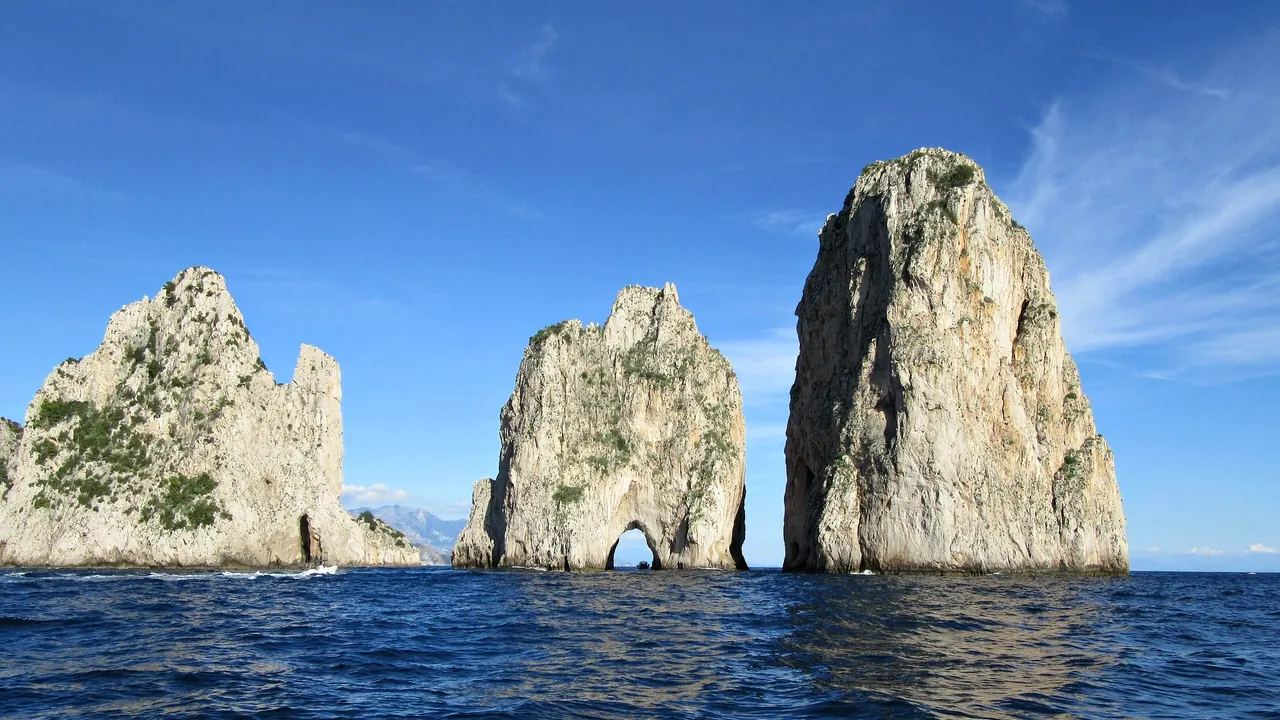
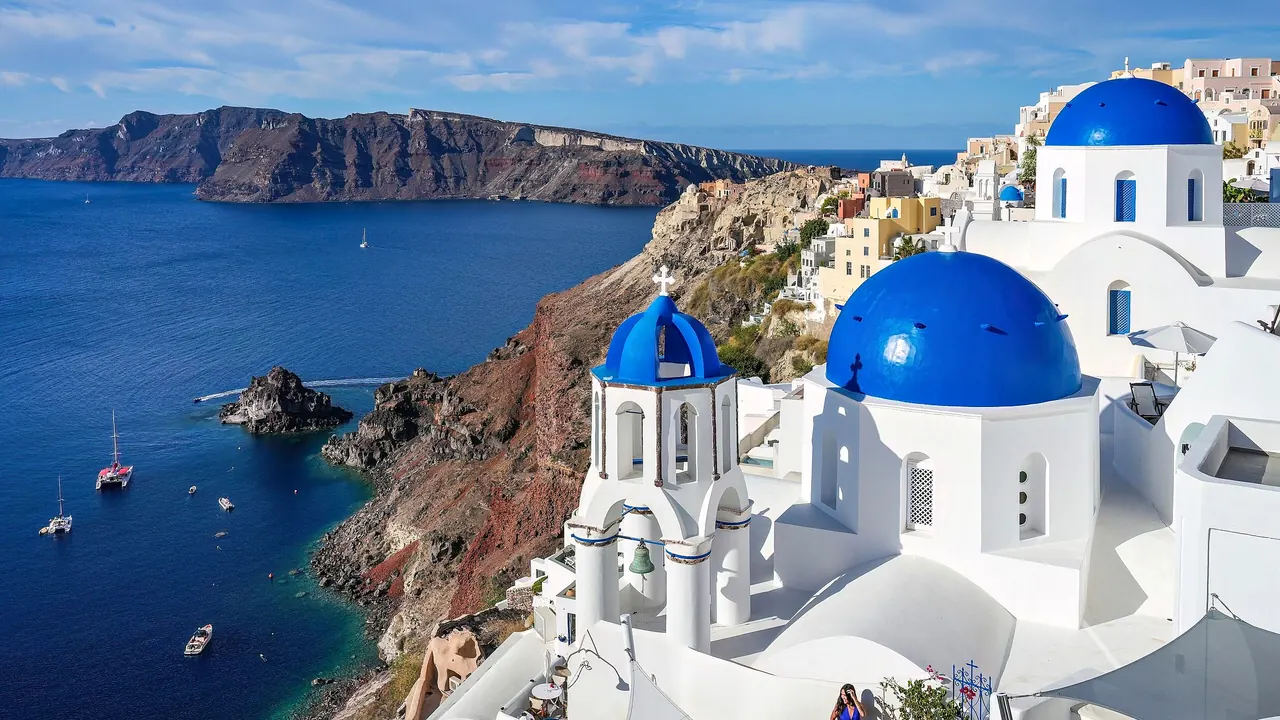
Photos: Capri by Sheeba Samuel, CC BY-SA 4.0, cropped; Santorini by Giles Laurent, CC BY-SA 4.0, cropped.
Capri or Santorini?
Our verdict in twelve categories, each scored against the same fixed benchmark cities, and the climate month by month, so you can choose for your trip.
Choose Capri for
- day trips
- shopping
- getting around
Capri suits a traveller who wants to swim in very clear, deep water, dress up for the evening and use a compact island as a base for the Bay of Naples. Sorrento, Naples, the Amalfi Coast and Pompeii are all within a boat ride, and the island is easy to get around without a car. Its own sights and food don't take long to cover, so it works best as a short, stylish stay with plenty of time spent on the water.
Choose Santorini for
- culture and sights
- food and drink
- prices
Santorini gives more to see and taste. It has a Bronze Age town preserved under volcanic ash, wineries making wines found nowhere else, and a walk along a caldera rim that has no equal in the Mediterranean. It is the better pick for curious travellers, wine lovers and families who will stay on the black-sand east coast, provided they accept that getting around needs more planning.
Scoreboard
Twelve categories on one fixed scale from 0 to 100. The shaded stretch is the gap between the two.
Your match
Pick a travel style or drag the sliders, and both match scores follow your weighting.
Too close to call, 1 point apart
Wins on day trips and shopping with your weighting.
Wins on culture and sights and food and drink with your weighting.
What matters to you?
Category by category
What the scores mean for a trip.
Beaches & swimming
This is a choice between water and sand. Capri has almost no beach to speak of, only pebble coves and rock platforms with ladders. The swimming is still the better of the two: deep, very clear water off the rocks at Punta Carena and from boats moored under the Faraglioni, a degree or two warmer by late summer.
Santorini has real beaches, black sand and fine pebble along Kamari and the long Perissa and Perivolos strip, where the water shelves gently and sunbeds line the shore. The sand burns underfoot at midday, the meltemi can chop up the open coast, and anyone staying in the caldera villages has to take a bus or car down to it.
Food & drink
Santorini eats and drinks noticeably better. Its volcanic soil gives fava, tomato fritters, white aubergines and capers, and above all wine. You can taste Assyrtiko from basket-trained vines and the sun-dried Vinsanto at wineries around Pyrgos and Megalochori, then eat fish at Ammoudi Bay below Oia.
Capri has a few dishes of its own, insalata caprese, ravioli capresi and torta caprese, along with limoncello from its lemons. Beyond the family trattorias of Anacapri there is little to explore. On both islands, the tables with the best views charge more for the view than for the food.
Culture & sights
Santorini has the deeper heritage. Akrotiri, a whole Bronze Age town with stairways and multi-storey houses kept under the ash, is a major site in its own right, and its wall paintings can be seen in Fira. Ancient Thera on its ridge and the fortified medieval cores of Pyrgos and Emporio fill out two or three days.
Capri offers a handful of fine places rather than a historic landscape. There is Tiberius's Villa Jovis above its cliff, Villa San Michele in Anacapri and the Certosa di San Giacomo. Most visitors cover them in a couple of days.
Nightlife
Neither island is built for partying, and the evenings differ more in style than in amount. Capri's night is the Piazzetta: dressed-up aperitivo once the day-trippers have gone, then piano taverns where Neapolitan songs and dancing on the tables run late. It is glamorous, and there are no clubs.
Santorini's evening starts with the sunset and dinner on the rim. After that the action moves to a few lanes in Fira, where cocktail bars and a handful of clubs stay open into the early hours in high summer. Kamari and Perissa have relaxed beach bars as well.
Nature & outdoors
Both islands are dramatic, but they are made of different rock. Capri is a green limestone block with the Faraglioni stacks and the Arco Naturale. You can take the chairlift up Monte Solaro and walk down through woods, follow the wild western coast on the Sentiero dei Fortini, and snorkel or kayak from the shore.
Santorini is a drowned volcano. Its signature outings are the 10km walk along the caldera rim from Fira to Oia, a boat to climb the black lava cone of Nea Kameni, and diving along the submerged walls. Its dry, treeless interior gives no shade in summer, unlike Capri's wooded paths.
Day trips
Capri has the far richer choice of outings. Sorrento is half an hour away by fast ferry, and Naples is under an hour by hydrofoil. Positano, Amalfi and Ischia are reachable in season, and Pompeii and Herculaneum fit into a long day via Sorrento and the local train.
From Santorini every outing is a sea crossing to another island: quiet Thirasia, Ios, Folegandros, Naxos, or Crete for Knossos on a very long day. Nearly everything leaves from the single port at Athinios. Services thin out sharply outside summer, and the meltemi can cancel them.
Good for families
Santorini is the slightly easier island with children, as long as the family stays on the east and south coast. Kamari and Perissa have flat promenades, gently shelving water and a small water park, while the caldera villages are no place for a pushchair.
Capri has no such fallback. Its swimming spots are rocks and ladders into deep water, and the town is a maze of steps. It works only for older children who swim well and will enjoy the Blue Grotto and the chairlift.
Getting around
Capri is the simpler island to move around. The funicular lifts you from the ferry to the town in minutes, small buses link the marinas with Anacapri, and nobody needs a car. The only real hurdles are steep lanes and the summer queues.
Santorini spreads further, and its buses all run through Fira, so crossing the island usually means changing there. Many visitors end up hiring a car, quad or scooter, then struggle with narrow roads, tour coaches and almost no parking in Oia.
Shopping & style
Capri is a real destination for shopping. Via Camerelle and Via Vittorio Emanuele hold an unusual number of luxury boutiques for such a small place. Island crafts add to them: sandals made to measure, linen, and perfumes distilled from local flowers.
Santorini's cliff-top lanes offer jewellery, galleries showing island artists and resort wear, mixed in with a great many souvenir shops. The things most worth taking home are edible, such as Vinsanto, Assyrtiko, capers and fava.
Affordability
Both islands are expensive, but Santorini gives a careful spender more room. The high prices are on the caldera rim. Studios on the east coast, village tavernas, gyros and the public bus keep costs down, and spring and late autumn are cheaper than high summer.
Capri has few rooms and a wealthy crowd competing for them, so even modest stays cost a lot. Buses, the funicular, the walks and Anacapri's bakeries are the savings. Staying in Sorrento saves more, but you give up the island's evenings.
Live music & performing arts
Neither island is a place for theatre or a concert season. Capri offers summer concerts in the Certosa cloisters and the gardens of Villa San Michele, plus Neapolitan song in its late-night taverns. For opera, take the boat to Naples.
Santorini's main fixture is a long-running classical music festival in Fira at the end of summer. There are occasional evenings in old mansions and wineries, and in winter almost nothing.
Wellness & relaxation
The calm on these islands comes from where you sleep, since neither has springs or a bathing culture to build a stay around. On Capri that means a hotel spa, several nights in Anacapri and the hours before and after the day-trippers, when the lanes smell of lemon and jasmine. Ischia's thermal baths are across the bay.
Santorini offers a cave suite with a heated plunge pool facing the caldera in Imerovigli, or a quiet stay among the vineyards of Pyrgos and Megalochori. It also has one natural warm-water swim, in the rust-coloured spring cove off Palea Kameni.
When should you go?
Pick your month. The climate figures are measured averages, not a forecast.
Capri in July
Santorini in July
Daytime high, °C
Rainfall in the month, mm
Where the figures come from
Capri has no rain gauge within 25 km of the centre, so its rainfall comes from a gridded climate dataset read at the destination rather than from a gauge further away.
Capri's sunshine is measured 58 km from the centre, at Grazzanise.
Santorini's station stands 182 m below the place it is measured for, so that place is likely a little cooler than the figures say.
Santorini has no rain gauge within 25 km of the centre, so its rainfall comes from a gridded climate dataset read at the destination rather than from a gauge further away.
Temperature and rainfall are climate normals, averaged over the years shown. Capri: 2005-2025 (sunshine 1991-2020, rainfall 1991-2020) normals, Capri (3.6 km from centre). Santorini: 2000-2025, 12 years observed (rainfall 1991-2020) normals, Santorini Island / Monólithos (5 km from centre).
Both islands reach about 30°C in July and August, and both are hot work on the steps of their cliff villages at midday. Summer is dry and very sunny on Capri, and the sea there is the warmer of the two, reaching 26°C in August against about 24°C off Santorini. Capri's weather turns sooner. Rain returns in September and builds to wet autumns and winters, with October already at 112mm. Santorini stays almost rainless from May to September, and only modest rain comes back in late autumn.
For swimming, both islands are at their best from June to early October. For walking, Santorini's spring and October are the more reliable, since they stay dry and mild while Capri's autumn turns showery. Santorini also keeps a couple of degrees more warmth through the winter.
Which traveller are you?
On a culture and arts trip, Santorini is the better choice. Capri's handful of sights, Villa Jovis, Villa San Michele and the Certosa, fill a couple of days. Santorini has more on the island itself, with Bronze Age Akrotiri, Ancient Thera and the medieval lanes of Pyrgos.
For a shopping trip, choose Capri. Its boutique lanes fit easily between a swim and an aperitivo, and you can take home sandals or perfume made on the island, though at island prices. Santorini's best buys come from its wineries and kitchens.
On a trip on a tight budget, Santorini is the kinder of two expensive islands. Capri's prices follow you from breakfast to the evening drink in the Piazzetta. On Santorini, a cheap studio on the east coast still gives you the sunsets, the beaches and the buses.
Before you go
| Measure | Capri | Santorini |
|---|---|---|
| Official language | Italian | Greek |
| Currency | Euro (EUR) | Euro (EUR) |
| Sockets | CFL230 V, 50 Hz | CF230 V, 50 Hz |
| Driving side | Right | Right |
| Time zone | UTC+1, UTC+2 in summer | UTC+2, UTC+3 in summer |
| Emergency number | 112 | 112 |
| Main airport | Naples International Airport (NAP)131 non-stop destinations | Santorini International Airport (JTR)60 non-stop destinations |
| Public holidays this year | 13 days | 15 days |
By the numbers
| Measure | Capri | Santorini |
|---|---|---|
| Population | 12,903 | 17,430 |
| People per km² | 1,241 | 220 |
| Swim season, months above 21 °C | 5 months | 5 months |
Where else could you go?
Every comparison below shares a destination with this one, so you can follow Capri or Santorini somewhere new.