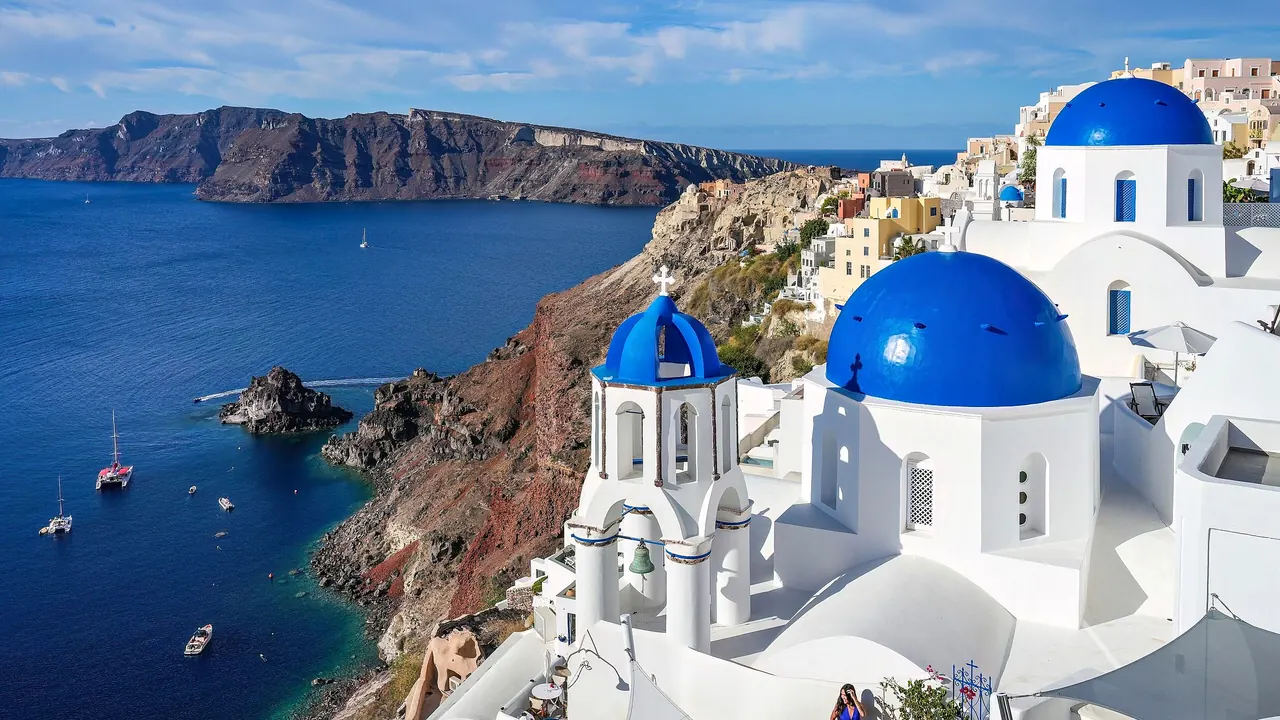
Photos: Santorini by Giles Laurent, CC BY-SA 4.0, cropped.
Lefkada or Santorini?
Our verdict in twelve categories, each scored against the same fixed benchmark cities, and the climate month by month, so you can choose for your trip.
Choose Lefkada for
- prices
- beaches
- families
Lefkada is the island for people whose days revolve around the water. Its west coast has long pale strands under white cliffs and startlingly turquoise sea, its east side has calm bays where small children can paddle, and Vasiliki is a byword for windsurfing. Add easy boat days to Meganisi, Ithaca and Kefalonia and noticeably gentler prices, and it suits families, beach lovers and anyone who wants a week of sun and sea without paying for a view.
Choose Santorini for
- culture and sights
- food and drink
- shopping
Santorini rewards travellers who come for the setting rather than the sand. The drowned volcano, the whitewashed villages on the caldera rim, the Bronze Age town at Akrotiri and the Assyrtiko wineries make it the better choice for couples, culture seekers and food and wine lovers on a shorter stay. The trade-off is cost, crowds at sunset and dark volcanic beaches that are pleasant but secondary.
Scoreboard
Twelve categories on one fixed scale from 0 to 100. The shaded stretch is the gap between the two.
Your match
Pick a travel style or drag the sliders, and both match scores follow your weighting.
Too close to call, level with your weighting
Wins on prices and beaches with your weighting.
Wins on culture and sights and food and drink with your weighting.
What matters to you?
Category by category
What the scores mean for a trip.
Beaches & swimming
Lefkada is the stronger beach island by a wide margin. The west coast from Kathisma down to Porto Katsiki and Egremni has long pale strands under white cliffs and water of an extraordinary turquoise, though it shelves steeply and catches afternoon waves. When the open Ionian is rough, the east coast bays around Nikiana and Ligia and the sheltered shore at Vasiliki take over.
Santorini's beaches are striking in a different way: black sand and fine pebble under red and ochre cliffs, at Kamari, Perissa and Perivolos, with sunbeds and gently shelving water. The sand burns underfoot by midday, Red Beach is small, and anyone staying on the caldera rim has to travel down to the coast to swim.
Food & drink
Lefkada feeds you well in the plain Greek way: grilled fish on the harbours at Lefkada town and Nidri, slow-cooked meat in mountain villages such as Karya, and the small lentils of the Eglouvi plateau. Away from the villages, resort menus are fairly standard.
Santorini has a more distinctive table and is the better island for anyone who travels to eat and drink. Its volcanic soil produces fava, tomato fritters, white aubergines and capers, and wine is the highlight, with tastings of Assyrtiko and Vinsanto at wineries around Pyrgos and Megalochori. The trick is to eat inland or at Ammoudi Bay rather than paying for the view on the rim.
Culture & sights
Lefkada's sights fill a few spare hours: the fortress of Santa Maura at the causeway, a small archaeological museum, Ionian churches with painted ceilings, the Faneromeni monastery and the embroidery tradition of Karya.
Santorini is in another league. Akrotiri, the Bronze Age town buried by the eruption, is one of the great archaeological sites of the Aegean, and its wall paintings can be seen in Fira. Ancient Thera on its ridge, the medieval kastelli of Pyrgos and Emporio and the cliff villages themselves give a culture-minded traveller two or three full days.
Nightlife
Neither island is a clubbing destination, but Santorini has more of a late night. A few lanes in Fira hold cocktail bars and a handful of clubs that run into the early hours in high summer, with beach bars at Kamari and Perissa, although most evenings there are about sunset and dinner.
Lefkada's evenings are a drink-and-stroll affair in the lanes of Lefkada town, on Nidri's harbour among sailing crews, and in Vasiliki's windsurfers' bars. Outside July and August both islands go quiet early.
Nature & outdoors
Lefkada's outdoors is green and mountainous, with olive and cypress slopes rising above 1,100m, the Dimosari waterfall above Nidri and old paths between the hill villages. Its real strength is the water: steady afternoon winds at Vasiliki, kitesurfing at Agios Ioannis, and sheltered channels that make the island a natural start for a week's sailing.
Santorini has the more dramatic landscape. You walk along the rim of a drowned volcano, about 10km from Fira through Imerovigli to Oia above cliffs of layered ash and lava, then cross the flooded caldera by boat to climb the black cone of Nea Kameni. Away from the cliffs the land is dry and treeless, and a day or two covers the main routes.
Day trips
Lefkada offers the easier and more varied days out. Excursion boats from Nidri tour Meganisi, Kalamos and Kastos, ferries from Vasiliki reach Fiskardo on Kefalonia and Ithaca, and because the island is joined to the mainland you can drive to Roman Nikopolis or Venetian Parga.
From Santorini everything goes by sea, mostly from the single port at Athinios. Thirasia, Ios and Folegandros are within easy reach, and a long day can take in Knossos on Crete, but the meltemi can cancel crossings and services thin out after the summer.
Good for families
Lefkada is the more natural family choice. The calm east coast bays at Nikiana and Ligia, Agiofili and the shore at Vasiliki have shallow, safe water for small children, and boat trips to the islets make easy outings. The west-coast beaches are better kept for an occasional day out.
Santorini's caldera villages are steep, crowded and impossible with a pushchair, and some cliff hotels do not accept young children. Families who go should base themselves in Kamari or Perissa, where the promenades are flat and the water gentle.
Getting around
On both islands a hired car or scooter makes life easier, and summer traffic tests everyone's patience. Lefkada has the simpler arrival, with a causeway from the mainland and an airport about half an hour away, but its sparse buses are no use for beach-hopping and its west-coast and mountain roads wind slowly.
Santorini has a fuller bus network, though every route runs through Fira and the buses are packed in season. Inside the caldera villages you walk everywhere, up and down steps, while Lefkada town is flat and easy on foot.
Shopping & style
Neither island is worth a trip for its shops, but Santorini gives more to browse. The cliff lanes of Oia and Fira hold jewellers, galleries of island painters and photographers, ceramics and linen boutiques, and its wineries supply the best souvenirs.
Lefkada's shopping is an evening walk along the pedestrian main street of Lefkada town for olive oil, honey and lentils, plus hand embroidery in Karya.
Affordability
Lefkada is much the cheaper island. It sits mid-range for the Greek islands, with plentiful family-run studios and few entry fees, and the main costs are August accommodation near the west-coast beaches, car hire and boat trips.
On Santorini the caldera view is the main cost: rooms on the rim at Oia, Imerovigli and Fira, sunset dinners, boat trips and tastings all come at a premium. Staying in Kamari or Perissa and riding the bus closes some of the gap, but not all of it.
Live music & performing arts
Neither island has a theatre or concert season, and in winter both are silent. Each has one summer event: Lefkada town's long-standing international folklore festival in August brings dance groups to open-air stages, while Fira hosts a classical music festival at the end of summer, alongside occasional concerts in old mansions and wineries.
Wellness & relaxation
Santorini is the better place for pampering. Its cave hotels at Imerovigli and Oia offer plunge pools, spa treatments and slow days facing the caldera, and boats stop off Palea Kameni for a swim in warm volcanic spring water. The quiet lies in Imerovigli and the wine villages rather than on the crowded rim at Oia and Fira.
Lefkada has little formal spa culture beyond a few better hotels and yoga stays in the hills. Its restfulness lies in the interior villages and the small east-coast harbours, best in June or September.
When should you go?
Pick your month. The climate figures are measured averages, not a forecast.
Lefkada in July
Santorini in July
Daytime high, °C
Rainfall in the month, mm
Where the figures come from
Lefkada has no rain gauge within 25 km of the centre, so its rainfall comes from a gridded climate dataset read at the destination rather than from a gauge further away.
Santorini's station stands 182 m below the place it is measured for, so that place is likely a little cooler than the figures say.
Santorini has no rain gauge within 25 km of the centre, so its rainfall comes from a gridded climate dataset read at the destination rather than from a gauge further away.
Temperature and rainfall are climate normals, averaged over the years shown. Lefkada: 1998-2020 (rainfall 1991-2020) normals, Aktion Airport (24.3 km from centre). Santorini: 2000-2025, 12 years observed (rainfall 1991-2020) normals, Santorini Island / Monólithos (5 km from centre).
Both islands peak at around 30°C in July and August, warm enough for the beach but hot for walking at midday, especially on Santorini's shadeless cliff paths. The sea is a touch warmer off Lefkada, reaching 26°C in August against 24°C, and swimming on both runs comfortably from June to early October. May and late September to October are the kindest months for walking on either island.
The real difference is rain. Santorini is almost completely dry from May to September and stays fairly light into October, while Lefkada's greener landscape comes from heavy autumn and winter rain that returns in September and peaks at around 150mm in November. For a late-season trip with settled weather, Santorini is the safer bet. Lefkada is at its best from late May to mid-September.
Which traveller are you?
On a beach and sun trip, Lefkada is the clear pick. Its west coast has long turquoise strands at Kathisma and Porto Katsiki, the east coast adds sheltered bays, and the sea runs warmer than Santorini's, whose black sand burns underfoot by midday.
For a culture and arts trip, Santorini wins easily. Lefkada's fortress and painted churches fill an afternoon. Santorini has the buried Bronze Age streets of Akrotiri, their frescoes in Fira, Ancient Thera and the fortified villages of Pyrgos and Emporio.
On a trip on a tight budget, Lefkada goes much further, with family-run studios, reasonable tavernas and few entry fees. On Santorini, staying in Kamari or Perissa and eating at village tavernas helps, but rooms and boat trips still cost noticeably more.
Before you go
| Measure | Lefkada | Santorini |
|---|---|---|
| Official language | Greek | Greek |
| Currency | Euro (EUR) | Euro (EUR) |
| Sockets | CF230 V, 50 Hz | CF230 V, 50 Hz |
| Driving side | Right | Right |
| Time zone | UTC+2, UTC+3 in summer | UTC+2, UTC+3 in summer |
| Emergency number | 112 | 112 |
| Main airport | Aktion National Airport (PVK)47 non-stop destinations | Santorini International Airport (JTR)60 non-stop destinations |
| Public holidays this year | 15 days | 15 days |
By the numbers
| Measure | Lefkada | Santorini |
|---|---|---|
| Population | 22,652 | 17,430 |
| People per km² | 64 | 220 |
| Swim season, months above 21 °C | 5 months | 5 months |
Where else could you go?
Every comparison below shares a destination with this one, so you can follow Lefkada or Santorini somewhere new.
- Iosvs Santorini
- Kefaloniavs Lefkada
- Naxosvs Santorini
- Parosvs Santorini
- Milosvs Santorini
- Corfuvs Lefkada